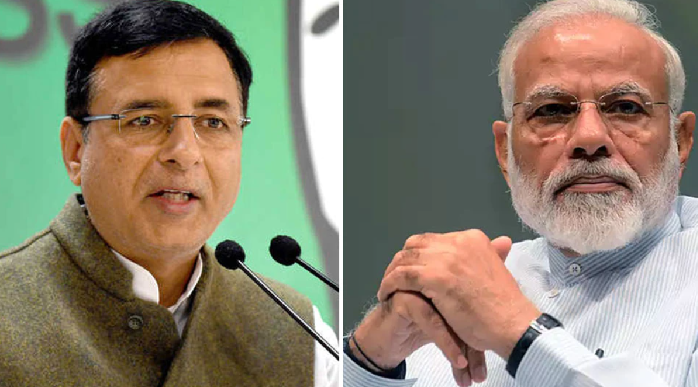
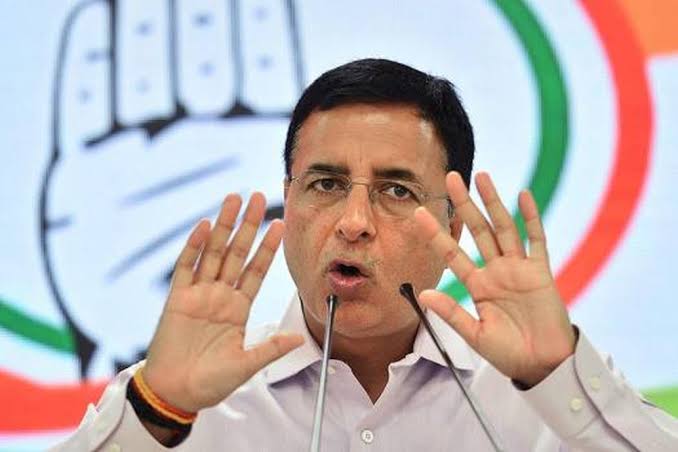
Congress leader Randeep Singh Surjewala on Monday launched another scathing attack on Prime Minister Narendra Modi calling the latter an ‘Asura’. Surjewala said that the Prime Minister was not a ruler but an ‘Asura’. This is hours after the Congress leader ‘cursed’ the voters of the BJP calling them ‘rakshas’ (demons).
As per Republic TV, instead of apologising for dehumanising and insulting the voters, the Congress leader said that PM Modi is not a ruler but an ‘Asura’. “Who is not filled with compassion, who does not love the people? He is not a ruler, he is an asura. The one who does not love the farmer, the labourer, and the youth,” he was quoted as saying. He also added that emotions and sentiments in dialogues are more important than words, which only a sensitive person can understand.
As reported earlier, the Congress leader in Kaithal, Haryana abused the Prime Minister calling him a demon. Earlier, Surjewala, while addressing the ‘Jan Akrosh’ rally, at the Uday Singh fort in the district, sparked controversy by also hitting out at those voting for the BJP.
“Demons of the BJP and JJP, you are demons. Those who vote for the Bharatiya Janata Party and those who support the Bharatiya Janata Party have demonic tendencies. I curse from the land of Mahabharat today,” Surjewala said.
Derogatory words used by Congress leaders for PM Modi
The Congress party members and leaders have time and again used abusive and derogatory words for PM Modi where some called the leader ‘pagal’ (mad) or even compared him to Ravana. On August 9, Congress MP Rahul Gandhi while speaking on the Motion of No-Confidence in the Lok Sabha during the Monsoon session of Parliament, came down heavily on the Prime Minister for not visiting Manipur and alleged that the PM does not consider the state to be part of India.
Further Gandhi compared the PM to Ravana and said that the prime minister listens to only two people, Amit Shah and Gautam Adani, “just as Ravan paid heed to only two.”
Also, on May 24 this year, Congress MP Adhir Ranjan Chowdhury used abusive words for PM Modi calling him ‘pagala Modi’. Later the leader also blatantly issued a clarification over his ‘pagala Modi’ remark and said that he was simply “echoing the sentiments of the public and was voicing what the public was reacting already over the withdrawal of Rs 2000 notes”.
“PM Modi will die dog’s death,” Congress’ Sheikh Hussain
Interestingly, in June 2022, Congress leader Sheikh Hussain used derogatory words for PM Modi. As reported, the Congress leader in Nagpur on June 13 last year said, “Jaise Kutte ki maut hoti hai vaise Narendra Modi ki maut hogi (Modi will die a dog’s death).” The Congress leader was demonstrating outside the ED office in Nagpur to protest against the interrogation of Congress MP Rahul Gandhi by the central probe agency.
Further, in June 2022, a senior Congress leader compared Prime Minister Narendra Modi to Adolf Hitler and said that the “PM will die like Hitler” if he follows the path of the German dictator. The Congress, however, had distanced itself from the statement made by the party’s leader at the ‘Satyagraha’ protest at Jantar Mantar against the Centre’s Agnipath scheme.
BJP condemns remarks against PM Modi by Congress leaders
The comments by Congress leader Randeep Singh Surjewala have strongly been condemned by the BJP leaders and members. BJP spokesperson Shehzad Poonawala slammed the Congress leader saying, “Congress has crossed all its limits. Randeep Surjewala, who calls ‘Afzal Guru’ ‘Afzal guru ji’, and his party members call ‘Osama’ ‘Osama ji’, has started abusing Indian voters. Congress party says on foreign land that democracy has died and ‘Bharat Mata’ has been murdered.”
#WATCH | BJP spokesperson Shehzad Poonawala says, "Congress has crossed all its limits. Randeep Surjewala, who calls 'Afzal Guru' as 'Afzal guru ji' and his party members calls 'Osama' as 'Osama ji', has started abusing Indian voters now. Congress party says on foreign land that… https://t.co/INpUOR3U5spic.twitter.com/swQTNesfN1
“Now Randeep Surjewala has said that voters who vote have the nature of demons. So now he’s calling at least 23 crores, who vote BJP as the demon. Citizens are a form of God in democracy, but Congress is calling them demons. This shows that Congress is living in which arrogance, they abuse the position of PM, OBC, democratic institutions, and now they have abused the citizens,” he added.
Madhya Pradesh chief minister Shivraj Singh Chouhan, too, hit out at the Congress leader for his attempt to dehumanise the BJP supporters.
"मोहब्बत की दुकान चलाने वाले जनता को राक्षस मानते हैं"
लेकिन मैं हमेशा ये कहता हूं… "मध्यप्रदेश मेरा मंदिर है, उसमें रहने वाली जनता मेरी भगवान है और उनका पुजारी शिवराज सिंह चौहान है।"
Slamming the Congress party, Madhya Pradesh Chief Minister Shivraj Singh Chouhan said, “Are the crores of people who vote for BJP rakshasa? What do Sonia Gandhi and Rahul Gandhi believe? Do you consider the public rakshasa? BJP considers the public the God. I always say that Madhya Pradesh is my temple, the people who live there are my God and we are the worshippers of that God…You consider yourself a God. Is this your Mohabbat ki dukaan?”
On 16th July 2023, Sundar Iyer, the main defendant in the Cisco Caste case, shared his experience at the Caste Con’23 on the legal battle that he fought because of a bogus case of caste discrimination filed against him and his colleague Ramana Kompella by a person identified as ‘John Doe’. The complainant claimed that Iyer and Kompella discriminated against Doe, a Dalit, at Cisco’s United Stated based office.
At the beginning of his speech, Iyer said the last few years were difficult because of the litigation. Because of legal purposes, he read from a pre-written script. Iyer, an entrepreneur in Silicon Valley for over 20 years, has a few startups under his sleeve. Most of these startups were related to the tech sector. On the job front, he works as the primary manager at Cisco, where he was sued over the claims of caste discrimination by the California Civil Rights Department, aka CRD.
Iyer pointed out that he would not be speaking on the pros and cons of SB403, the infamous anti-Hindu bill tabled in California to target Indians living in the United States. His primary focus remains on the personal experience in the Cisco caste case.
Iyer’s ordeal of the Cisco caste case
The following section is based on his readout of the script at Caste Con’23.
Iyer grew up in India, and India gave him two essential things vital for growth: opportunity and adversity. His caste privilege was that he took a loan of USD 40,000 (USD 75,000 at the current time) to study in America. CRD sued his colleague Ramana Kompella and him in June 2020.
It was claimed that Iyer and Kompella discriminated against and harassed CRD’s anonymous client John Doe because of his case. John Doe was Iyer’s classmate in his college days in India. Iyer paid Doe several million dollars in compensation to join his startup at Cisco Systems. He recruited him and other employees by sacrificing his Cisco Equity.
John Doe self-identifies as a Dalit which, according to CRD, ‘is the lowest caste in Hinduism and India’. CRD defined caste as a strict Hindu social and religious hierarchy. They submitted several articles, declarations, and book chapters that equate caste with South Asia and Hinduism.
Coming to the allegations against him in the case, Iyer said he was accused of the fact that he did not award John Doe the head of engineering position in his startup because he was a Dalit. Interestingly, according to the Court documents Cisco submitted, it was clear that Doe never requested or even wanted that position. Still, Iyer was accused of bigotry against Dalits.
Contrary to CRD’s claims, Iyer said not only did he hire Doe allegedly even if he knew his caste but also offered all of the top three leadership positions at his Cisco startup, including the position of the head of engineering that Doe claimed discrimination against to another Dalit, the same lowest caste as Doe.
Iyer said the person offered the position was the best person he could hire. Two of the positions offered to him were made before the case was filed against him. Still, CRD sued him and his colleague for Dalit discrimination. CRD also accused him of salary discrimination.
To put the matter in context, Iyer pointed out that he did not take any equity in the startup and compensated Doe with several millions of dollars. Instead of considering his position, CRD accused him of salary discrimination because he did not give Doe a few extra thousand dollars in a single salary increment cycle in October 2016.
CRD named him and his colleague Kompella in the press on the same day they filed the lawsuit before their Fair Day in court. CRD collaborated with caste activists who wrote several articles tarnishing their reputations. Even today, both continue to receive activist propaganda and unadulterated hate. Some of these activists even targeted them for their last names, calling their previous names and several other Hindu last names violent casters.
Calling themselves the best and only example of America’s caste litigation, Iyer said that despite giving top leadership positions to a Dalit, he was accused of caste discrimination. Iyer said during the trial, he provided CRD public data that showed he was not a practising religious person. Yet, CRD claimed he adhered to Hindu religious practices. Iyer said the CRD is supposed to protect civil rights, but in his case, they deliberately violated his freedom of religious rights.
Despite being aware that he does not practice caste or even wear the scared threat, he was sued for caste discrimination. Iyer pointed out that he had written several short stories against caste over the years. Still, CRD went ahead and assigned him to a Hindu Brahmin caste. Iyer said it was ironic that civil rights organisations deliberately assigned him a caste based on his last name alone.
While CRD claimed caste is a deeply private matter, they broadcasted his caste to the world. Next, they claimed that caste leads to violence. Furthermore, they colluded with the activists who made several violent stereotypes of Brahmins in upper caste Indians. On record, Equality Labs, CRD’s main activist collaborator, said that Nazis in Germany and Europe are upper-caste Indians.
He added that 30th June 2020 would be remembered as the day California civil rights sued them as the first instance of state-sponsored casteism. The CRD investigated the Cisco case for many years despite overwhelming evidence to the contrary. After a mere 15-minute interview that he was given, they sued him for caste discrimination which was a violation of his due process rights.
CRD did not stop there. They also sued Iyer for harassment, which is a serious crime. One has to call someone the n-word multiple times at a place of work to be sued for harassment. It is not based on business actions but on personal behaviour. In the eight years since Iyer hired Doe, CRD did not find a single bad statement Iyer made against Doe.
Ramana was also sued for caste-based harassment. His most grievous crime was that he asked John Doe to file weekly status reports. His directions to Doe came from the White American manager whom Iyer described as a brilliant man and a legend in Silicon Valley. “Isn’t that racist stereotyping accusing Ramana of harassment for simply following his manager’s request?” Iyer questioned.
CRD named and shamed them simply for doing their job. CRD did not stop there. They targeted not only Iyer and Ramana but also 50+ Cisco co-workers. His team was ethnically vibrant and diverse, with men and women from various races and ethnicities from all over the globe. CRD, on the other hand, painted them as “entirely upper caste Indians”. They accused 50+ co-workers of Iyer without any due process of importing bigotry and caste system from India to America. CRD stripped them of their humanity and claimed a hostile Dalit environment but did not bother to interview the senior person who was a Dalit himself in his group.
The person who had the topmost position in his group was erased of his Dalit identity as it did not fit in their narrative. “We were not humans to them. We were just pawns in their racist narrative,” Iyer said.
CRD, in association with Equality Labs, then unleashed a flood of hate against all Hindu Americans. They repeatedly racially profiled and violently stereotyped Hindu Americans. They even accused them of raping and assaulting 25 per cent of all Dalits in America without a shred of evidence. The judge rejected the insane targeting of Hindu Americans. He also rejected each and every claim that was based on the unscientific Equality Labs report that was presented as anecdotal and not evidence.
They made statements like ‘life is a living hell working under Indian managers’. They accused Indian Americans of spitting on Dalits simply because of knowledge of their caste and accused upper-caste Indians of boasting their biological superiority on purely anecdotal data. CRD even claimed that the increase in casteism in America was due to the election of Indian Prime Minister Narendra Modi. Interestingly, CRD suppressed PM Modi’s caste background. PM Modi belongs to OBC or Other Backward Class, for those who are unaware. Despite the fact, PM Modi is not an upper-caste Hindu, his election as Prime Minister was used as a reason for so-called caste discrimination in the US.
In January 2021, Hindu American Foundation sued the CRD for violating the American Consitution Multiple Times. In September 2021, the deferral equal employment opportunity commission (a federal body) accused CRD of several ethics violations. In April 2022, Governor Newsom fired CRD’s lead prosecutor, who was also the lead prosecutor in the Cisco case. In October 2022, Castegate.org, a volunteer-led organisation, documented deeply disturbing and continuing unethical actions in the Cisco case. In January 2023, Iyer and others filed a motion to Sanction the CRD prosecutors for bringing a case that had no legal or factual basis. After their motion, CRD withdrew the case against him and Ramana but continued to sue Cisco.
In April 2023, California Policy Center, a Southern California-based Think Tank, released a damning white paper accusing the CRD of a pattern of corrupt behaviour against several Californian companies, including Tesla and Ride Games. In July 2023, California for Justice, a volunteer-driven engineer organisation, accused the CRD of targeting Indian Americans and appealed to Governor Newsom to intervene urgently.
Iyer said that over the past years, he had given executive roles to people from British, Australian, Pakistani, Syrian American, Bangladeshi, Taiwanese, Indian ethnicities and, of course, fellow Americans because they were best for the jobs.
Ultimately, he metaphorically talked to Dr BR Ambedkar and said, “Dear Dr Ambedkar, I hadn’t realised that I would have to talk to you. I am deeply sorry; at Cisco, I first gave my top leadership positions to a brilliant, hard-working, developed candidate. Why? Because he was the best person that I could hire. The CRD won’t tell the judge that the activists who claimed to speak for the Dalits in America won’t tell you that the scholars were supposed to uphold academic integrity. [They] will not tell you that, and the press will not report that it does not fit the narrative. But dear Dr Ambedkar, I thought you should know the truth that we’re not expected to prove our innocence in America. It is the job of the state to prove guilt. The CRD withdrew their case against Ramana and me with prejudice. In layman’s language, they agreed never to sue Ramana and me on this matter. However, earlier this year, our local Fremont Senator [Aisha] Wahab introduced SB-403 to prevent discrimination based on someone’s perceived caste. In her speech, she invoked the Cisco case and presumed my 50-plus co-workers guilty. Many of them are her own constituents. Like the CRD, she perceived us as an oppressed upper cause before our Fair Day in court. I thank you, Senator Wahab.”
Speaking to Dev Discourse, Iyer said during Caste Con’23, “I gave away the entirety, that is, 100 per cent of my CEO equity in my Cisco startup to all of my employees, including to John Doe (the anonymous Dalit plaintiff). I hired and compensated Doe (my classmate), with several millions of dollars. Despite that, the CRD (Civil Rights Department) accused me (on behalf of Doe), of salary discrimination, for not giving Doe a raise of a few thousand dollars in October 2016.”
Who is John Doe?
The CRD had decided to keep the accuser anonymous (John Doe) till the case was over because the accuser feared for his safety. However, with the Cisco case against Iyer falling apart and the arbitration with Cisco also falling flat, OpIndia went through the documents collected and published by castegate.org. In one of the CRD (previously DEFH) documents, several details helped us narrow down the possible identification of the person. By using those documents and publically available information on professional websites like LinkedIn, IIT Bombay, ContactOut, CrunchBase, RocketReach and USPTO, we tried to establish the identity.
The first aspect of the case we noticed was that Iyer and John Doe went to IIT Bombay. John Doe also worked at Iyer’s startup in Cisco. Iyer’s startup at Cisco was called Candid Systems. We noticed several patents filed by Sunder Iyer in collaboration with other people from Cisco, probably from his startup.
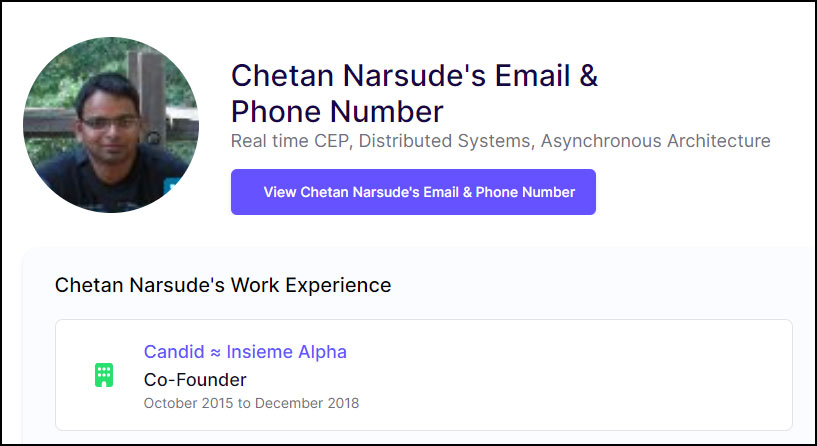
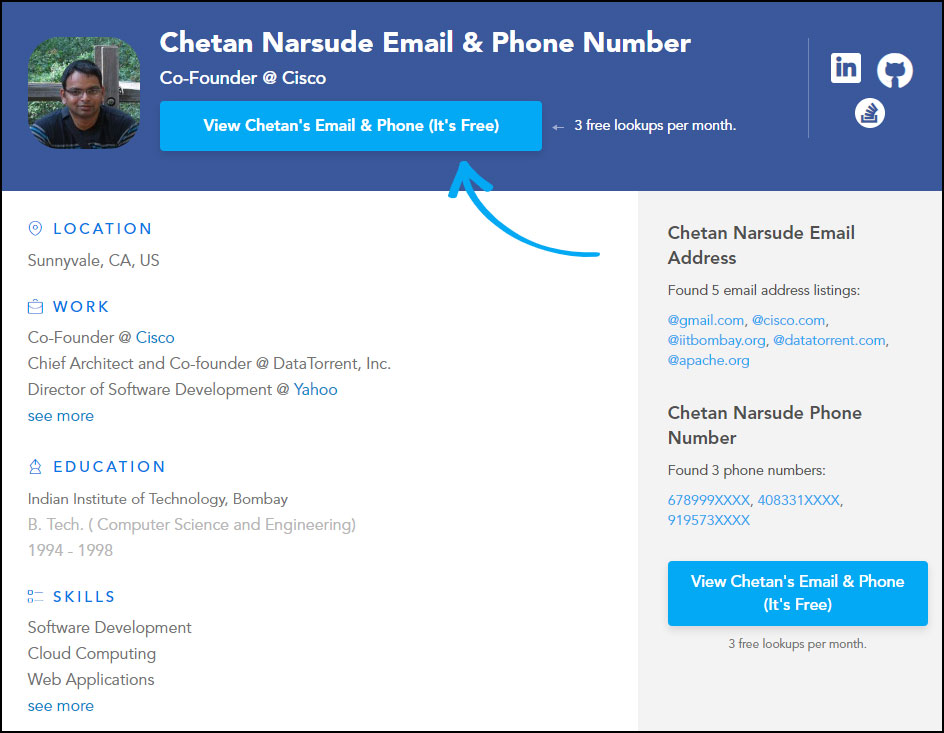
Out of these names, we checked all names to see if any of them were Indians. One name that stood out was Chetan Narsude, a Principal Engineer at Cisco Narsude’s ContactOut profile, which suggested he was co-founder of Candid, an Inseime Alpha company. Insieme was the incubator of Iyer’s startup named Candid Systems. Patents filed by Cisco that have both Iyer’s and Narsude’s names can be seen here, here, here and here.
Source: ContactOut
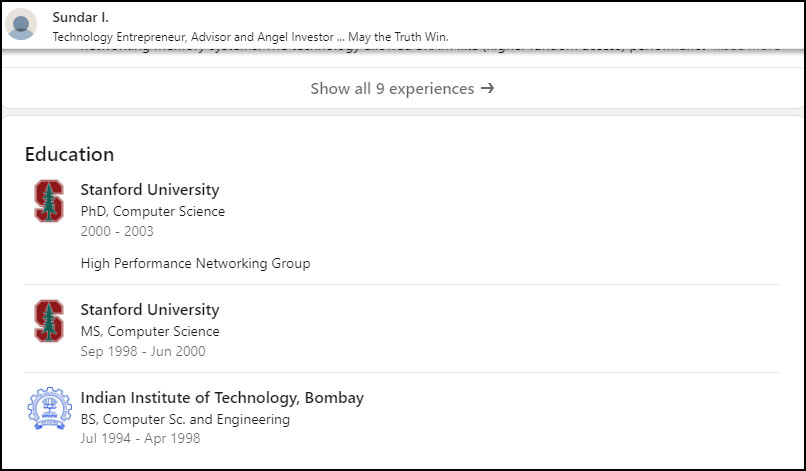
According to Sunder Iyer’s LinkedIn and ContactOut profile, he attended IIT Bombay between 1994 and 1998.
Source: LinkedIn
Chetan Narsude’s RocketReach profile suggested he also went to IIT Bombay between 1994 to 1998.
Source: RocketReach
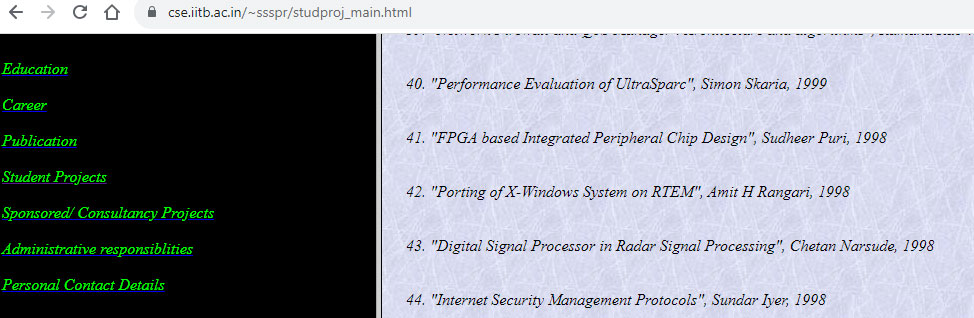
As we established they attended IIT Bombay simultaneously, we tried to establish a link between them at the college. During our research, we found a page of BTech projects guided by retired professor Srikantam Sai Surya Prakasa Rao (SSSP Rao). On that page, it was mentioned that he guided projects of Sunday Iyer (Internet Security Management Protocols) and Chetan Narsude (Digital Signal Processor in Radar Signal Processing).
Source: IIT Bombay
OpIndia has written to both Iyer and Narsude for their comments about their identity, role and the case falling flat. We have not received a response yet. When and if we do receive a response, we will update this report with it.
The case against Sundar Iyer and Ramana Kompella
On 10th April 2023, CRD voluntarily dismissed its infamous ‘caste discrimination’ case against two Indian-origin Cisco Systems Inc. engineers in the Superior Court. The case was filed against Sundar Iyer and Ramana Kompella in June 2020 for supposedly discriminating against a ‘self-identifying Dalit’. CRD, an agency of the California state government, had allegedly made false claims about Hinduism, besides depicting people of Indian origin as ‘xenophobic.’
This was despite Iyer recruiting the alleged victim at a generous package with millions in stock grants. The Indian-origin engineer had also hired at least one more ‘self-identifying Dalit’ who held a leadership position at Cisco Sytems Inc.
Notably, California Civil Rights Department was well aware of the diversity in the company and the particular Division where Sundar Iyer worked. It also came to light that the ‘self-identifying Dalit’ had been working in the American company for 8 long years at the time of filing the complaint. CRD could not find any evidence against the two Cisco Systems engineers that constituted harassment.
Anti-Hindu bill SB403
SB403 is a so-called anti-caste discrimination legislation that is making its way through the Californian state legislature. California Senator Aisha Wahab tabled the bill. The dubious organisation Equality Labs is one of the bill’s biggest supporters. The bill was completely based on the Cisco caste case. Although the case fell flat, the SB403 bill is on its way to becoming law in California state of the US.
Death of Hindu activist Milind Makwana
Milind Makwana, who belonged to a marginalised community, was a HSS sevak and APNADB co-founder. He was one of the vocal Hindus against SB403. On 19th July, he went to attend a Cupertino City Council meeting where residents requested to pass a resolution against SB403. He was a humble, earnest and kind human being who worked extensively for society. Unfortunately, soon after the council meeting, Makwana collapsed and died at 11 PM Pacific time.
Just before his death, Makwana made a 1-minute eloquent speech in favour of a resolution against SB403. He said, “My name is Milind I am a Cupertino School district taxpayer. I’m from a marginalized community and I am a proud Hindu. So whoever is claiming here to represent us but ignoring Hindus is talking about us without us. So what I would like to say is looks can be deceiving, just like having a disco ball on a Monday morning. When you look at the proposed resolution SB403 and peel off the shiny exterior, you will find a costume party of hidden racial discrimination and Hinduphobia for Asian Indians. I urge the city council to vote no on SB403 and dance our way to fairness.“
Pandit Satish K Sharma, a British Hindu leader, who also attended Caste Con’23 as the keynote speaker, expressed his concerns over the continuous attack on Hindus. He wrote a heartfelt note on Twitter after learning about the death of Makwana.
'The level of victimisation of Hindus, by those supporting this unnecessary bill at all levels has been brought home by this tragedy. Californias Hindus have been on the receiving end of outright contempt, dehumanisation and direct oppression, under the guise of…
— Pt Satish K Sharma MBCS FRSA (@thebritishhindu) July 20, 2023
He wrote, “The level of victimisation of Hindus, by those supporting this unnecessary bill at all levels has been brought home by this tragedy. California’s Hindus have been on the receiving end of outright contempt, dehumanisation and direct oppression, under the guise of anti-discrimination legislation.
Milind Makwana should have been at home with his young family, not having to defend his Constitutional rights, not having to travel around the country to protect his children’s future, not having to prove his innocence when those who hate Hindus have failed to prove any guilt.
I was invited to the valley as a Keynote speaker at the #CasteCon Conference, to provide historical evidence of Caste as a colonial tool, sculpted by an oppressive colonial occupier intent on denying Hindus freedoms and rights.
I am devastated to witness the contempt with which Hindus have been treated in today’s California, simply because they are Hindus and totally unjustifiably ‘perceived’ to be oppressors. It’s clear from the manner and circumstances of the tragic passing of Milind Makwana, just after delivering the following speech, a devout Hindu Dalit, as to who the oppressors are and who is being oppressed. May Milind’s family be given the strength and support to navigate this time of trial. Aum Namaha Shivaya.“
A 37-year-old Lucknow-based businessman allegedly killed his wife in front of his two children on Saturday morning, 12 August. According to the Lucknow police, the man killed his wife in his SUV on Purvanchal Expressway in Sultanpur out of jealousy and a deep-seated “inferiority complex” over his wife’s substantial Instagram following.
The couple had been married for nearly 15 years and had two children aged 12 years and 5 years. Their children were present when the horrific incident unfolded.
The Lucknow police took to X (formally Twitter) to inform about the crime. They said that the incident happened under the Gosiaganj police station limits. The couple had a dispute over something for long. On the day of the incident, the fight escalated, after which the husband Suraj Pal strangulated his wife Mamata Pal with her saree and hid the body in the bushes nearby. The accused was arrested.
As per a TOI report, Kurebhar SHO Praveen Kumar Yadav said, “The accused owns a tour and travel agency while his wife was a homemaker. The couple lived in the Para locality of Lucknow with their 12-year-old daughter and a five-year-old son.”
The accused allegedly killed his wife in a fit of rage after they had an argument over Instagram followers. Reportedly, the accused suspected that in his absence, some of his wife’s social media followers were visiting her and it had led to many arguments between the couple.
It is being claimed that his “insecurity” and “inferiority complex” were aggravated when his wife reportedly blocked him from her social media account and this could have eventually pushed him to commit this horrific crime, the TOI report pointed out citing police officials.
The authorities will examine the victim’s Instagram account which is currently locked and private.
The police officials stated the whole sequence of events that ultimately culminated in the victim’s death. As per the police officials, the family started off in their SUV for Rae Bareli, but at around 5 am, they took a diversion to Purvanchal Expressway where the crime occurred.
Subsequently, the accused man halted near Mujesh intersection in Sultanpur, where the couple got engaged in a heated argument. The officials stated that in a fit of rage, the accused husband strangled his wife to death while his children were present in the SUV and witnessed the crime in horror. Following the incident, the accused man locked himself inside the SUV.
In the meantime, a patrolling unit from UPEIDA observed a vehicle that was parked in a suspicious manner. Afterwards, they immediately alerted the nearest police station.
The couple’s distressed daughter, who was continuously crying in shock, narrated the entire incident to the police. Subsequently, based on the testimony of the couple’s daughter, police arrested the accused man.
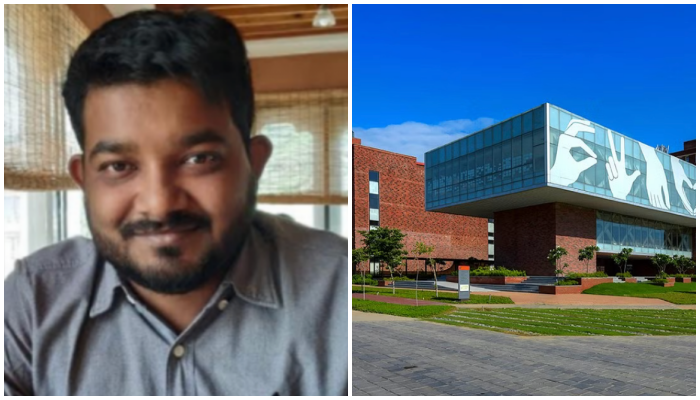
Sabyasachi Das, an economics professor at Ashoka University has reportedly resigned after the University distanced itself from his controversial ‘paper’ that made misleading, and bizarre claims alleging ‘election manipulation’ in India.
Leftist propaganda site The Wire published a report stating Das’ resignation from Ashoka University and added that the professor has refused to comment on it as he is ‘focusing on getting his paper published and not on media engagement’.
Sabyasachi Das, an assistant professor of economics at Ashoka University, has resigned from his position.
Das has been in the news for a paper he wrote alleging the possibility of electoral ‘manipulation’ in the 2019 Lok Sabha elections.#Educationhttps://t.co/ys8WUxX6dd
Wire tries to make a martyr out of Das, conveniently forgetting that his report had serious flaws
The Wire report has tried to make a martyr out of Das, asserting that he had to resign because of political pressure, and not due to the fact that the University had publicly denounced his attempts to create social media activism out of an unpublished, yet-to-be-peer-reviewed paper.
The report by The Wire states that Das’ findings were ‘attacked by BJP leaders’. It also cites unnamed faculty members of the university, playing up Das’ victimhood’ and insinuating that the resignation came due to undue political pressure on academic research, not due to the University publically denouncing a shoddy paper with glaring flaws presented as ‘research’.
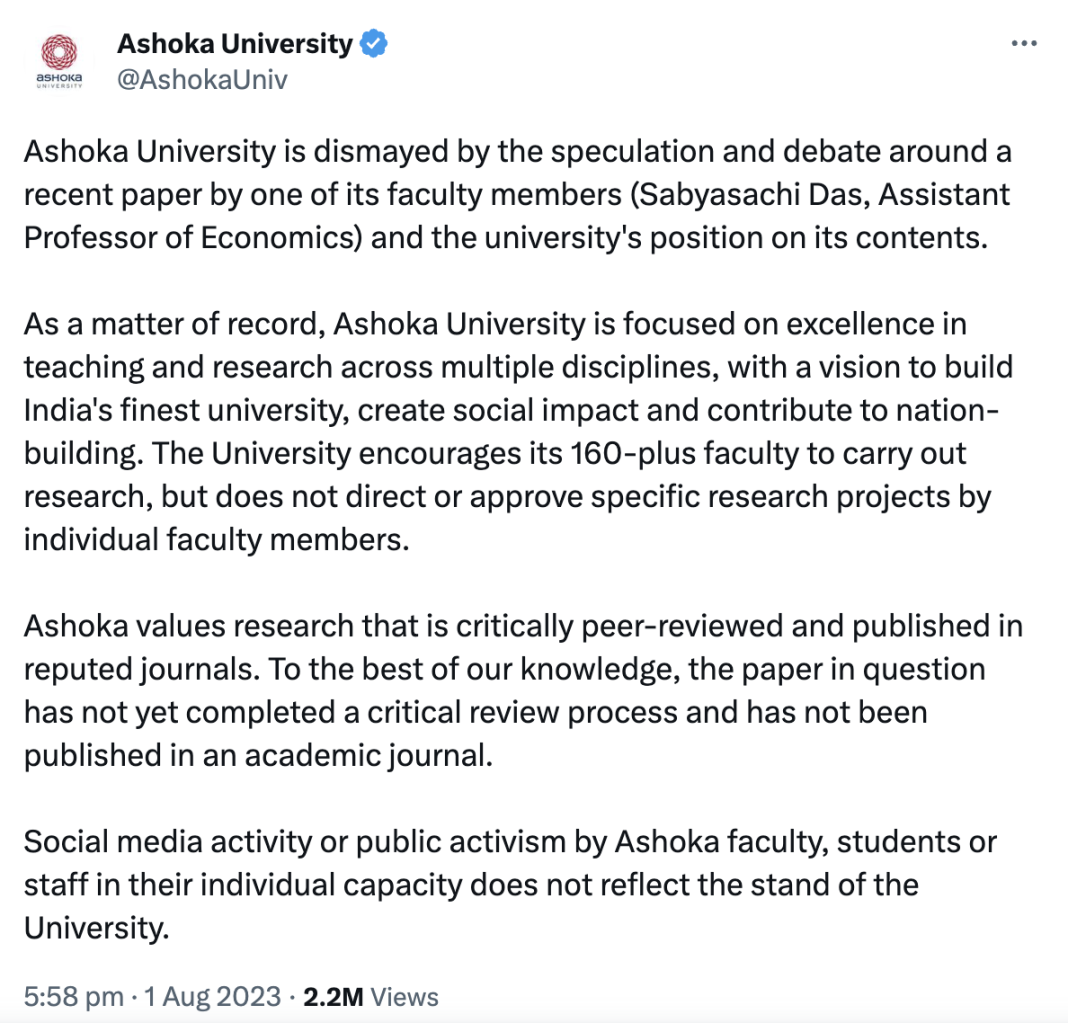
Ashoka University’s tweet on Sabyasachi Das’ controversial paper
The University said, “Social media activity or public activism by Ashoka faculty, students or staff in their individual capacity does not reflect the stand of the University.”
Das’ X (formerly Twitter’ handle still has ‘Professor of Economics at Ashoka University’ in his bio.
How the shoddy paper by Das used flawed datasets and statistical jugglery to draw misleading, bizarre conclusions
An alleged ‘research paper’, unpublished so far in any academic journal and yet to be peer-reviewed, as clarified by Ashoka University, gained attention on social media recently. By claiming they have ‘scientific evidence’, the paper boasts that they have cracked how the BJP wins elections in India. It claimed that ‘manipulation’ is achieved by targeted discrimination against India’s largest minority group, Muslims.
The paper’s wild claims of election manipulation were amplified by Congress leader Shashi Tharoor too.
The paper suggests that the BJP wins more owing to ‘electoral manipulation’, that is, somehow deleting the names of voters from lists. That too, deleting the names of Muslim voters. Doing some wild math, Das claims in the paper that the BJP has won at least 11 seats in the 2019 elections by doing “voter manipulation”.
However, the claims made in the paper were disputed and even flawed. Twitter user @Saiarav discussed the claims, pointing out how Das makes unrealistic insinuations and skips crucial facts to paint a misleading picture.
“However, for the complicated statistical jugglery exhibited throughout the paper, it gets this basic fact wrong. This pattern of outperformance is not limited to NDA-ruled states. Out of the 41 seats it won, nearly half are from non-NDA states”, @Saiarav added.
Additionally, @Sairav also pointed out that the growth rate of the electorate in BJP-won seats was at par with the national average of the growth rate of the electorate, so the claims of ‘manipulation’ do not hold up. Also, the 4 seats that the BJP lost in Bengal by a close margin of 5% or less, had an electorate growth rate of approximately 11.6%, above the national average.
He also pointed out other factual errors and mistakes made in the paper, like citing Nabrangpur, Odisha as a ‘close contest’ for BJP when the party was a distant third, behind Congress, and citing 2 union territories of Andaman & Nicobar and Dadra and Nagar Haveli as non-BJP ruled areas.
Since then, @Sairav has published a detailed rebuttal of the controversial ‘paper’.
Just look at the sense of superiority of these guys. Under the garb of academic research, misinformation is being spread. When questions are raised, we are told it is pompous of us to expect the academic to respond quickly even if it means the disinfo continues to spread. https://t.co/AfpoYtPl1S
Economist Mudit Kapoor, from the Economics and Planning Unit, Indian Statistical Institute, also pointed out the flaws in Das’ paper in a detailed statistical analysis and shared the findings in a blogpost. “While interpreting statistical outcomes it is surprisingly easy to be “fooled by randomness” depending on one’s political preference. We are tricked by randomness to see patterns where none might exist”, Kapoor wrote in a tweet.
Kapoor added that the statistical findings in Das’ paper do not support the claims he is making.
I have written a blog, Political Claims and Statistical Findings: "Fooled by Randomness", which critically assesses a recent paper on "Democratic Backsliding in World's Largest Democracy" by @sabya_economist. Comments and suggestions are welcome.https://t.co/iHDaMsoZH5
It is notable here that the author has not responded to the posts highlighting the flaws in his report. Instead, a careful media game is being weaved by the likes of The Wire to peddle false victimhood, insinuating that the professor was allegedly made to resign because of political pressure, rather than the fact that the ‘paper’ has basic flaws and was used to create a social media buzz over unsubstantiated and misleading claims.
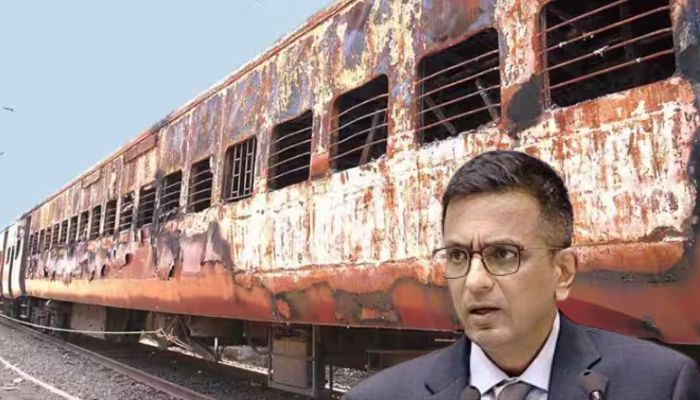
On Monday (August 14), the Supreme Court refused to grant bail to three men, who were convicted in the Godhra train burning case of 2002. The pre-planned attack led to the death of 59 pilgrims, including 27 women and 10 children.
The matter came up before a three-judge bench, comprising Chief Justice of India DY Chandrachud, Justices JB Pardiwala and Manoj Misra. While rejecting the bail applications, the CJI noted, “The incident is also a very serious incident. It’s not an isolated death of one person.”
[Bail applications of Godhra train burning convicts in the #SupremeCourt]
He added that the matter could not be kept pending indefinitely and had to be heard early. “I’ll list the appeal before an appropriate bench. Because this matter has to hear this. It can’t be kept indefinitely,” he stated.
“We are not inclined at this stage to grant bail,” the court said. Chief Justice of India informed that an appropriate bench will be constituted and that the three convicts could file their bail applications before that particular Bench.
CJI: I'll list the appeal before an appropriate bench. Because this matter has to hear this. It can't be kept indefinitely.#SupremeCourt#Godhra#SupremeCourtofIndia
On February 27, 2002, an Islamist mob set two coaches of the Sabarmati Express on fire in Godhra. 59 Hindu karsevaks, including children and women, were burnt alive in the incident. Following the train burning incident, communal riots broke out in Gujarat, leaving 1,200 persons dead and several thousand injured.
In March 2011, 11 convicts were handed death sentences in the matter, and 20 were sentenced to life imprisonment by a special court. Six years later, the death penalty for 11 convicts was commuted to life imprisonment by Gujarat High Court, while the court upheld life imprisonment for 20 others.
After a cloudburst on Monday, August 14, caused a Shiv Mandir in Shimla to collapse, at least nine persons have been reported dead and 20–25 more are suspected to be trapped under the debris. Chief Minister Sukhvinder Singh Sukhu addressed the tragedy and stated that as of now, nine bodies have been retrieved.
“Distressing news has emerged from Shimla, where the Shiv Mandir at Summer Hill collapsed as a result of the heavy rainfall. As of now, nine bodies have been retrieved. The local administration is diligently working to clear the debris in order to rescue individuals who may still be trapped. Om Shanti,” the CM tweeted.
Distressing news has emerged from Shimla, where the “Shiv Mandir” at Summer Hill collapsed as a result of the heavy rainfall.
As of now, nine bodies have been retrieved. The local administration is diligently working to clear the debris in order to rescue individuals who may…
According to the reports, the devotees had gathered to offer prayers on the occasion of Sawan at the temple. According to an official, nearly 50 people had gathered at the temple when the incident took place.
The landslip in the Fagli area also is said to have buried several homes under the mud and snow. Meanwhile, a cloudburst in Himachal Pradesh’s Solan district claimed the lives of seven family members.
Following the cloudburst on Sunday night, two homes in Solan were destroyed by flooding. Six people were saved, while seven more lost their lives in Jadon village, according to police officials. According to Superintendent of Police for Solan Gaurav Singh, the deceased have been identified as Harnam (38), Kamal Kishore (35), Hemlata (34), Rahul (14), Neha (12), Golu (8), and Raksha (12).
Aditya Negi, the deputy commissioner of Shimla, told the media that rescue efforts are in full swing and that 15 to 20 persons are suspected to be buried in the two landslides. The Chief Minister advised the public to stay away from water bodies and regions that are prone to landslides when he subsequently visited the scene of the landslide in the Summer Hill area today.
“20-25 people are trapped under debris here (Summer Hill, Shimla). 21 people dead in the last 24 hours in the state. I appeal to people to stay indoors, to not venture near rivers and landslide-prone areas. Restoration works will begin as soon as rain stops,” he said.
#WATCH | Himachal Pradesh CM Sukhvinder Singh Sukhu on landslide incident in Shimla and devastation due to heavy rainfall in the state
"20-25 people are trapped under debris here (Summer Hill, Shimla). 21 people dead in the last 24 hours in the state. I appeal to people to stay… pic.twitter.com/qvATnkjSVL
“Again tragedy has befallen Himachal Pradesh, with continuous rainfall over the past 48 hours. Reports of cloudbursts and landslides have emerged from various parts of the state resulting in loss of precious lives and property,” CM Sukhu tweeted.
Meanwhile, Himachal Pradesh Governor Shiv Pratap Shukla expressed concern and declared that the program scheduled on the occasion of Independence Day would be postponed and that only the flag-hoisting event will be done at the Raj Bhavan.
Himachal Pradesh Governor Shiv Pratap Shukla at landslide incident site in Shimla where 20-25 people are feared trapped
"Flag hoisting will be done, 'At-Home' event at Raj Bhawan on Independence Day stands postponed," the Governor says. pic.twitter.com/SojhkvVktB
A yellow warning has been issued by the local MeT station indicating heavy rainfall, thunderstorm, and lightning at isolated places from August 14 to 17 and predicted a wet spell in the state till August 19.
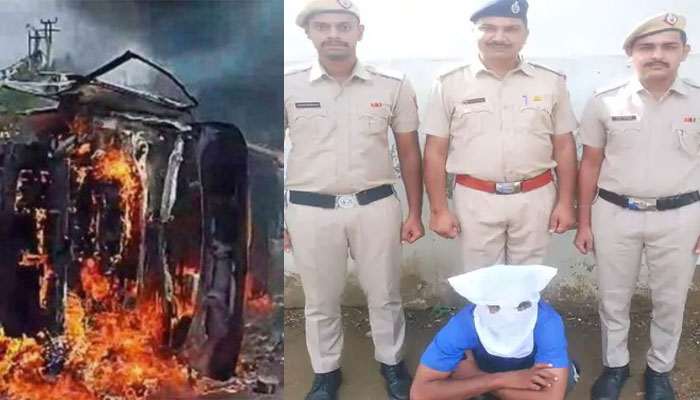
On 12th August, it was reported that the Haryana Police team and Special Task Force arrested a person identified as Afzal from Firozpur Jhirka for circulating provocative videos and audio on social media and messaging services. He was a part of the violence that Islamists had unleashed in Haryana’s Nuh district on July 31. He has been accused of publishing videos of rioters indulging in arson and damaging public and private property by the name of ‘Mewat Ka Badla’ (revenge of Mewat) on social media.
Afzal is a resident of Firozpur Jirka, a village near Nuh. Haryana police’s cyber cell has filed two FIRs against him. Notably, 11 FIRs have been registered in total for posting provocative posts on social media.
‘Should kill 20-30 people’
A few days ago, two audio files made it to headlines where a person was heard provocating Muslims living in and around Nuh, Haryana. Afzal posted the audio in two groups. In the audio, he said that only 2-4 people (Hindus) were killed at the Khedla roundabout. He urged his fellow community members to kill at least 20-30 people (Hindus) when Yatra reached Bhadas.
Afzal and other rioters snatched mobile phones and videos from the media personnel covering the Islamist violence in Nuh. He was also making provocative videos and circulating them on WhatsApp groups to instigate the Muslim community further.
218 arrests so far in Nuh violence
So far, Haryana police have arrested 218 people in Nuh violence. Besides, 110 suspects are still in police custody. Superintendent of Police Narendra Bijarniya has instructed the police to detain suspects and arrest them once the police have evidence against them.
Congress defends the rioters
As the Haryana police continue the crackdown on Islamists who unleashed mayhem on the streets of Nuh in Haryana, Congress has come in support of these rioters. Standing strong in defence of these Muslim rioters, Congress MLAs Aftab Ajmed and Mohammed Ilyas have condemned the Haryana Police’s actions, calling it an attack on ‘innocent’ people.
Brij Mandal Shobha Yatra rescheduled for 28th August
On 13th August, it was announced that Brij Mandal Shobha Yatra had to be rescheduled for 28th August as the Islamists brutally attacked it on 31st July. The decision was made during Mahapanchayat held at Palwar.
“The Hindu Mahapanchayat during a meeting in Haryana’s Palwal has decided that on 28th August, we will complete the incomplete yatra which fell victim to the genocidal attack by jihadists and terrorists. It is our pledge that those killed by the mob get Rs 1 crore in compensation along with a government job while the injured get Rs 50 lakh,” Alok Bansal, VHP spokesperson said.
Nuh Shobhayatra attack
On 31st July, a mob of hundreds of Muslim rioters attacked Hindu devotees participating in the Brijmandal Jalabhishek Yatra in Nuh, Mewat of Haryana. At least six people, including innocent 4 Hindus and two policemen, were killed as a result of the riots.
Furthermore, a cyber crime police station was attacked in Nuh. Police officials were injured. Home guards were killed. The rioters first shot one of the Bajrang Dal activists Abhishek, then his throat was slit and his head was crushed leading to his death.
During the investigation into the riots, OpIndia accessed over 25 FIRs and complaints that provided a clearer picture of what happened during the violence. Based on information available via FIRs, complaints and witnesses, it appeared that the attack was pre-planned. OpIndia came across several videos posted two days before the Jalabhishek Yatra instigating Muslims against Hindus.
Muslims have claimed the riots happened because of Bajrang Dal activist and Gau Rakshak Monu Manesar. Old videos of Manesar were circulated to instigate Muslims saying he was going to Nuh on that day. The video that was mostly circulated was from October 2022. Detailed reports can be checked here.
OpIndia’s complete coverage of the Mewat Shobha Yatra Attack can be checked here.
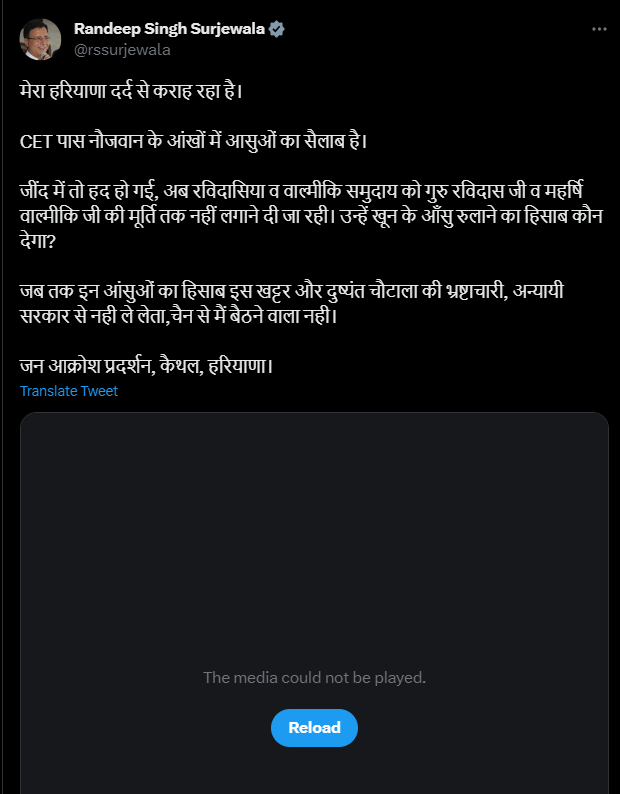
In a dramatic address in Haryana’s Kaithal, Congress leader Randeep Singh Surjewala “cursed” the voters of the BJP calling them “rakshas” (demons). Kaithal is the same constituency where Surjewala had lost by around 500 votes in the 2019 Lok Sabha elections.
#WATCH | In Kaithal, Haryana, Congress MP Randeep Surjewala says, "…Those who vote for BJP and are BJP supporters are of 'raakshas' (demons) tendency. I curse from this land of Mahabharat…"
Surjewala, while addressing the “Jan Akrosh” rally, at the Uday Singh fort in the district, Surjewala sparked controversy by hitting out at those voting for the BJP.
“Demons of the BJP and JJP, you are demons. Those who vote for the Bharatiya Janata Party and those who support the Bharatiya Janata Party have demonic tendencies. I curse from the land of Mahabharat today,” Surjewala said.
The BJP in a scathing retort has said that the same Surjewala had called Afzal Guru as Afzal Guru ji. BJP spokesperson Shehzad Poonawala said, “Congress has crossed all its limits. Randeep Surjewala, who calls ‘Afzal Guru’ as ‘Afzal guru ji’ and his party members calls ‘Osama’ as ‘Osama ji’, has started abusing Indian voters now. Congress party says on foreign land that democracy has died and ‘Bharat Mata’ has been murdered.”
#WATCH | BJP spokesperson Shehzad Poonawala says, "Congress has crossed all its limits. Randeep Surjewala, who calls 'Afzal Guru' as 'Afzal guru ji' and his party members calls 'Osama' as 'Osama ji', has started abusing Indian voters now. Congress party says on foreign land that… https://t.co/INpUOR3U5spic.twitter.com/swQTNesfN1
“Now Randeep Surjewala has said that voters who vote have the nature of demons. So now he’s calling at least 23 crores, who vote BJP as the demon. Citizens are a form of god in democracy, but Congress is calling them demons. This shows that Congress is living in which arrogance, they abuse the position of PM, OBC, democratic institutions, and now they have abused the citizens,” he added.
The Congress leader had uploaded some clippings from the address on his Twitter account. The video, which now appears deleted on Surjewala’s Twitter, is now viral all over the internet.
Shameless @rssurjewala calls people who vote for BJP 'राक्षस'
Till now Congress and Rahul abused PM Modi, now they have started abusing Public too.
Same public voted for Congress for 70 years. But when they voted for development and against corruption, they became Rakshas? pic.twitter.com/wYplyGYvDt
It is not precisely clear if Surjewala’s statement resulted from his defeat in 2019 to BJP candidate Leela Ram in the same constituency which he had won in 2014 and 2009.
Randeep Singh Surjewala last made headlines when he was seen in Bengaluru attending an official government meeting. Surjewala, the All India Congress Committee (AICC) general secretary, reportedly attended an official meeting in Bengaluru which was presided over by the deputy chief minister and Bengaluru Development Minister DK Shivakumar. The meeting was organised to discuss the upgrading of infrastructure in Bengaluru.
Moreover, he has been known to make controversial statements in the past. In May this year, Surjewala cited “various sources” alleging that Indian Electronic Voting Machines (EVMs) were being deployed in South Africa and then used for Karnataka polls without re-validation and re-verification. The allegations were shot down by the Election Commission.
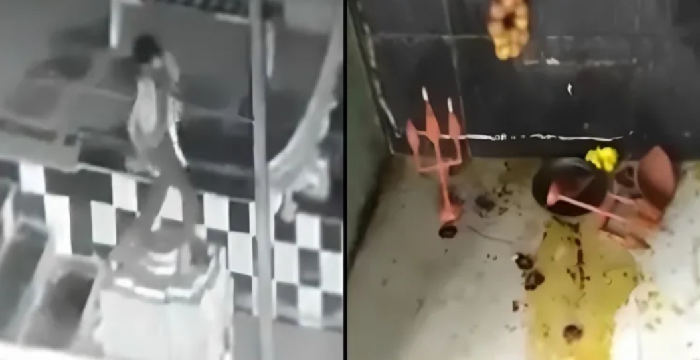
On August 8, an unidentified individual vandalised the Kal Bhairav Dada temple next to the Dudheshwar crematorium along a river bank in Gujarat’s Ahmedabad. The miscreant vandalised the riverfront temple and also caused damage to the Hindu idol deities. Based on the CCTV video footage, the Sabarmati Riverfront East Police registered a complaint against an unknown person and began an investigation into the case.
As per the reports, the event has heightened tensions between the local communities who are demanding strict action against the miscreants. The Police official stated that a police team on August 9 was patrolling the river bank near the Dudheshwar cremation site at around 2:30 pm when they received information about the vandalism of the Kal Bhairav Dada temple.
‘Following the inputs, a police team rushed to the spot to take stock of the situation,” the police said. Further, reports reveal that the miscreant has broken the lamps installed in the temple. The Hanuman idol and other idols also stand vandalised. The police checked the CCTV footage of the incident in which it could be seen that a man entered the temple premise and damaged the idols.
The police also noticed that the eye of the idol of Kal Bhairav Dada in the temple was missing. There was a small idol of Lord Shankar which was also completely broken. Further, the miscreant broke several tiles of the temples which had photos of Hindu Gods and Goddesses printed on them.
CCTV camera examination further showed that the event took place on August 8 between 8:50 to 9:50 pm. The accused could also be seen removing his clothes and dancing after damaging the temple.
PI VD Jhala of Riverfront East police station commented on the issue, saying, “Different teams have been set up to nab the youth seen in the CCTV. The reason behind committing this act will come to the fore after the accused is caught.”
Lord Bhairav, also known as Lord Kal Bhairav, is a Shaivite God who is worshipped by Buddhists, Jains, and Hindus. Reportedly, local Hindu community people have stated that their religious sentiments have been hurt as a result of the incident. Hindus have demanded strict punishment against the accused.
Based on the CCTV footage, the Sabarmati Riverfront East Police has registered a complaint against the unidentified person under Sections 295, 153-A(2) of the IPC for hurting the religious sentiments of Hindus and is conducting further investigation to trace the accused.
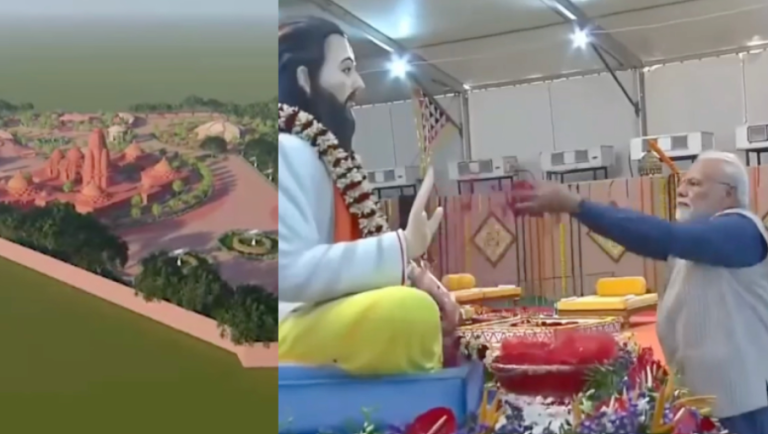
On Saturday, August 12, PM Narendra Modi performed Bhumi Pujan and laid the foundation stone of a Temple-cum Museum dedicated to the 16th-century Bhakti saint, Sant Shiromani Gurudev Shri Ravidas ji at the Badtuma village of Sagar district in Madhya Pradesh. The temple cum museum will be built in Nagar style on 11.21 acres of land at more than Rs 100 crores.
VIDEO | PM Modi performs 'Bhoomi Pujan' for Sant Ravidas temple in Sagar, Madhya Pradesh. pic.twitter.com/Ip0TEpy7Wg
PM Modi performed Bhumi Pujan on Saturday in the presence of CM Shivraj Singh Chouhan Governor Mangubhai Patel, Union Minister Virendra Kumar and many other saints. He Modi bowed down before the idol of Sant Ravidas with folded hands to seek blessings after which the prime minister inspected the miniature model of the upcoming memorial-cum-temple at this function. He then addressed a public programme at Dhana in Sagar district of Madhya Pradesh.
Notably, Madhya Pradesh CM Shivraj Singh Chouhan had taken to the microblogging site X (formally Twitter) on August 11, 2023, to share a video showcasing the miniature model of the upcoming memorial cum temple dedicated to Sant Ravidas, being built in the state.
"संत रविदास जी सामाजिक समरसता के अग्रदूत थे"
हमारा सौभाग्य है कि कल आदरणीय प्रधानमंत्री श्री @narendramodi जी सागर के बड़तूमा में 'संत रविदास मंदिर एवं स्मारक' का भूमिपूजन करेंगे। ₹100 करोड़ से अधिक की लागत से 12 एकड़ भूमि में आकार लेने वाले इस विशाल स्मारक में संग्रहालय,… pic.twitter.com/ZZ9g0iG3Pf
After laying the foundation stone of the temple cum museum, PM Modi said, “The foundation for the temple is being laid today when the country has completed 75 years of Independence. Sant Ravidas was born at a time when the Mughal dynasty was ruling the country, and he had fought for educating the people at that time. Being the MP of Kashi (Banaras), I am happy that I got the opportunity to lay the foundation for the temple in Sagar today.”
“Sant Shiromani Gurudev Shri Ravidas ji Memorial will have grandeur as well as divinity which will flow from the teaching of Sant Ravidas ji,” the prime minister further said.
मुझे पूरा विश्वास है कि मध्य प्रदेश में बनने जा रहे संत रविदास स्मारक और संग्रहालय में भव्यता भी होगी और दिव्यता भी। pic.twitter.com/zS5c2dURu9
PM Modi added that the soil from thousands of villages and water from more than 300 rivers became part of Sant Ravidas’ upcoming temple-cum-memorial. “The memorial is steeped in the spirit of ‘Samrasta’ as the soil of more than 20,000 villages and 300 rivers have been used in it. Families from Madhya Pradesh have sent grain for ‘Samrast Bhoj’ and five yatras also concluded here at Sagar. These yatras mark a new era of social harmony,” PM Modi said,
Assuring that the temple will be completed in one and a half years Modi said he knows that with the blessing of Sant Ravidas, he will come to inaugurate it as well. “With blessings of Sant Ravidasji, will come to inaugurate the temple as well,” he said.
VIDEO | "Sant Ravidas memorial will enrich the country's tradition. Sant Ravidas will give me an opportunity to inaugurate the temple as well after 1-2 years," says PM Modi in Sagar, Madhya Pradesh.
PM Modi further spoke about the teachings of Sant Ravidasji. He said, “The emergence of evils in society is a natural occurrence. It is the strength of Indian society that a Sant or a Mahatma like Ravidas ji emerges time and again to ward off such evils. Sant Ravidas was born in the Mughal era of instability, excesses and atrocity; he created an awakening against social evils.”
“Sant Ravidas ji was raising his voice against malpractices prevalent in the society. The Sant said dependency is the biggest sin and that those who accept it and do not take a stand against it are not loved by anybody. Sant Ravidas ji provided strength to the society to fight oppression, and Chhatrapati Shivaji used it as an inspiration to lay the foundations of Swarajya,” Modi added.
“Today, the nation is moving forward with the same spirit of liberation and rejecting the mentality of slavery,” he added.
Talking about the inspiration drawn from the Bhakti Saint, the PM said, “I know the pain of hunger and self-respect of the poor. I am a member of your family and I don’t need to look into the books to understand your pain. Free ration was ensured for more than 80 million people under Pradhanmantri Garib Kalyan Anna Yojana during the pandemic to support my family members.”
Further explaining how so many schemes have been launched by the BJP government to improve the lives of Dalits, the poor, tribals and women at every stage of life, Modi added, “Matru Vandana Yojana, Mission Indradhanush, Sickle Cell Anaemia elimination, a campaign to free India from Tuberculosis by 2025, Ayushman Card and others schemes have changed the lives of people.”
He said that the Standup India program and MUDRA loans were benefiting Dalits and the impoverished the most.
He referenced the 400-acre Lakha Banjara Lake and claimed that as part of the Jal Jeevan Mission, Dalit villages, underdeveloped regions, and tribal areas are receiving piped water.
“Neither the members of this society nor their past are weak. These societal segments have produced some great characters. The country is proudly preserving their legacy, Modi said, citing the beautification of the temple at Sant Ravidas ji’s birthplace in Banaras, the construction of the Sant Ravidas-named Global Skill Park in Bhopal’s Govindpura, the designation of significant locations associated with Baba Saheb’s life as Panch-Teerth, and the establishment of museums in numerous states to preserve their cultural legacies.
According to the prime minister, numerous states around the nation are currently building museums to preserve the illustrious past of tribal life. The nation has also begun the custom of observing Lord Birsa Munda’s birthday as Tribal Pride Day, he added.
According to officials, this temple-cum-memorial dedicated to Sant Ravidas will be spread over 11 acres of land. The building will display Sant Ravidas’ teachings and include residential accommodations for his followers in addition to a museum, an art gallery, and other features.
Notably, besides laying the foundation stones of the Sant Ravidas temple cum museum, PM Modi, during his visit to the state, also laid the foundation stones of various road projects and dedicated to the nation the doubling of the Bina-Kota railway line project.
Who is Sant Ravidas?
Sant Ravidas was a mystic poet from the 15-16th centuries who was part of the Bhakti tradition. He propagated spiritual freedom by advocating to get rid of differences in caste and gender. Fourteen of his devotional verses are also included in the Guru Granth Sahib and are hence revered among Hindus and Sikhs equally.
The ‘Ravidasias’ is seen today as a breakaway community from the Sikh community to whom worship of Sant Ravidas in central. They hold considerable social and cultural clout in North India, particularly in the states of Punjab, Haryana and Himachal Pradesh.