Home Blog Page 1962

Islamists accuse 2 Hindus of burning a Gurugram under-construction mosque, Hindus say they were on their way from Nuh after Islamists unleashed violence

On 31st July, almost 4000 Hindus participated in a Jalabhishek Yatra by Vishwa Hindu Parishad. The religious procession came under attack by an Islamist mob in Nuh, Haryana. While Hindus were trapped in a hostage-like situation, news emerged that two home guards have been killed in the violence unleashed by Islamists during the Jalabhishek Yatra on a Shravan Somvar, the auspicious Monday of the Sravan month. 

The police told OpIndia that one of the home guards was killed in the stone pelting by Islamists while the other was shot dead when the violence by Islamists was unleashed. 

Speaking to OpIndia, VHP also informed that several temples had come under attack in the Nuh area of Mewat after the Islamists unleashed premeditated violence against Hindus. 

VHP also said that the violence was planned and that the stones and bricks had been collected by the Islamists at least 2 days in advance. OpIndia was told that they were using Bajrang Dal activist ‘Monu Manesar’ as an excuse to spread fake news and incite violence. Interestingly, almost on cue, several Islamists on Twitter started sharing an old video of Monu Manesar alias Mohit Yadav, claiming that he was present at the Shobha Yatra and therefore, the violence erupted. This, however, turned out to be false. 

OpIndia did a detailed fact-check confirming that the video was from last year and that Monu Manesar was not present at the religious procession. 

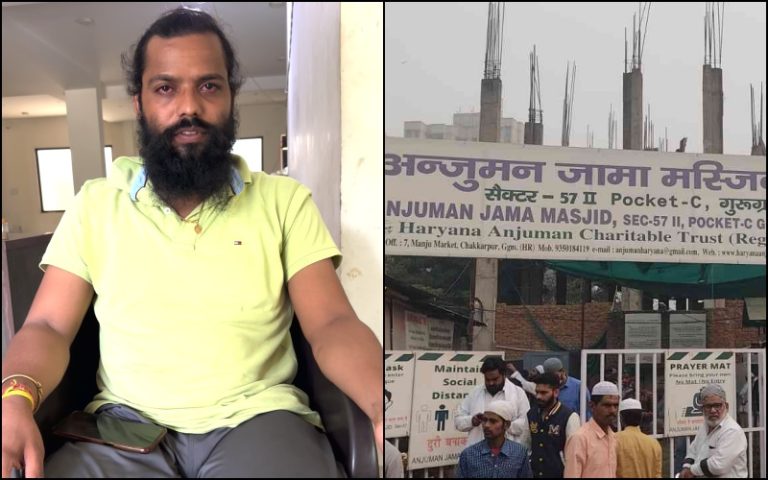
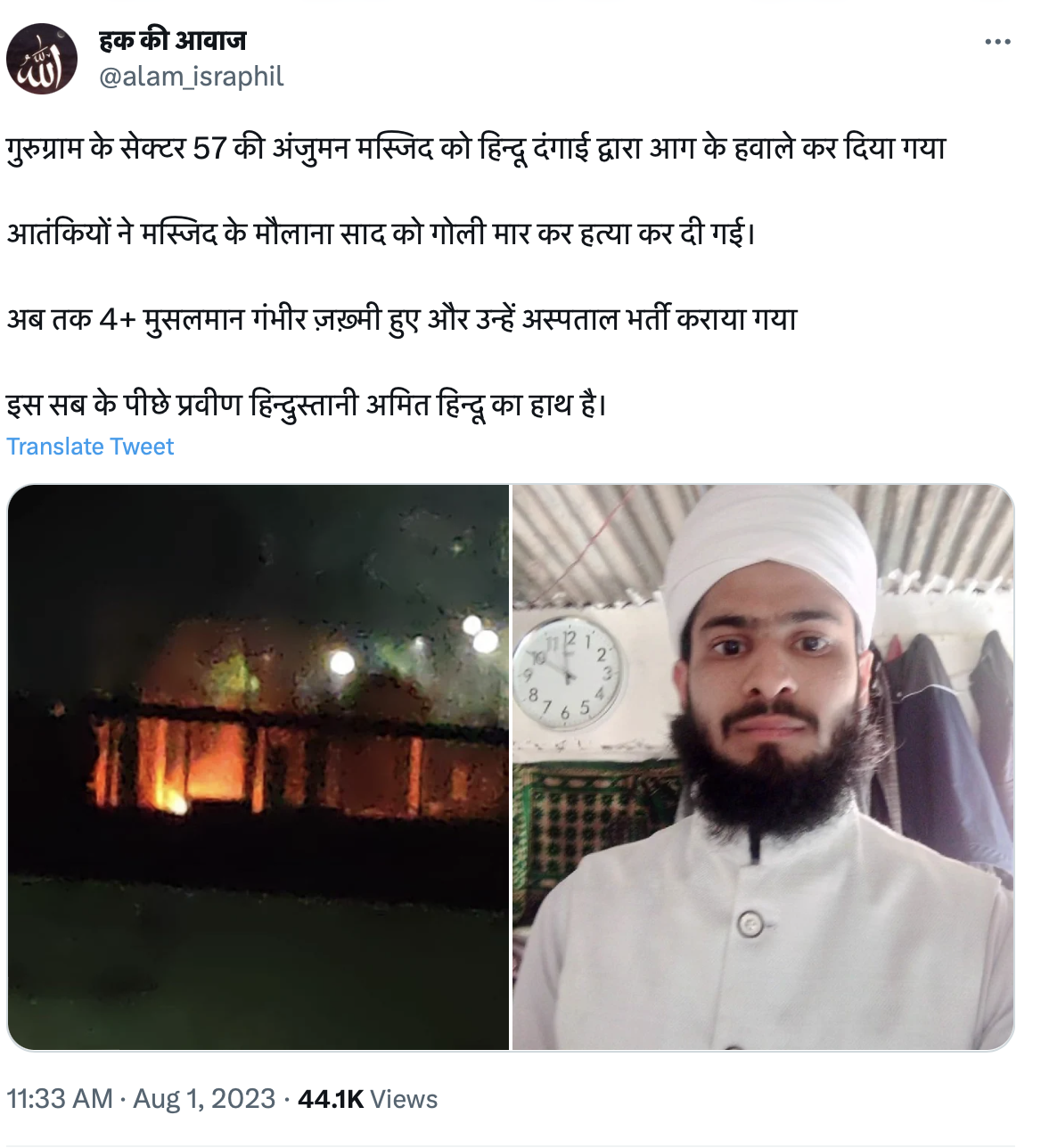
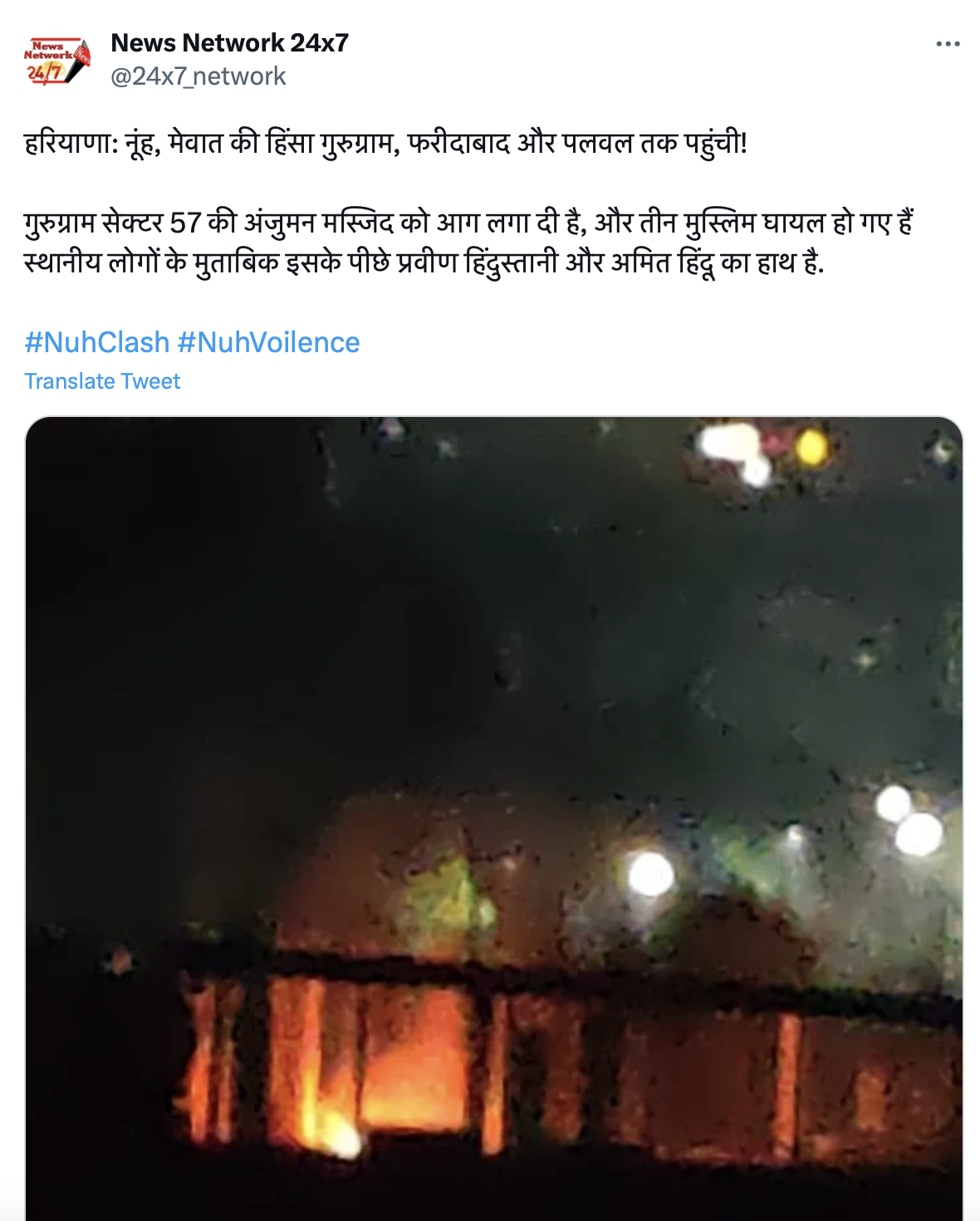
After spreading fake news and defending the violence that Islamists unleashed against thousands of Hindus, the Islamists on social media started alleging that two Hindus, VHP workers, were responsible for burning an under-construction, disputed mosque in Gurugram hours after the Nuh violence had been unleashed against Hindus. According to reports, a “mosque” was allegedly burnt down on the night of 31st July in Sushant Lok Phase-III in Sector 57 of Gurugram. Identified as the Anjuman Imam Masjid, it was reportedly attacked by a group of 70-80 people. During the incident, the imam of the ‘mosque’ was allegedly killed while another person was injured. They were later rushed to the hospital.

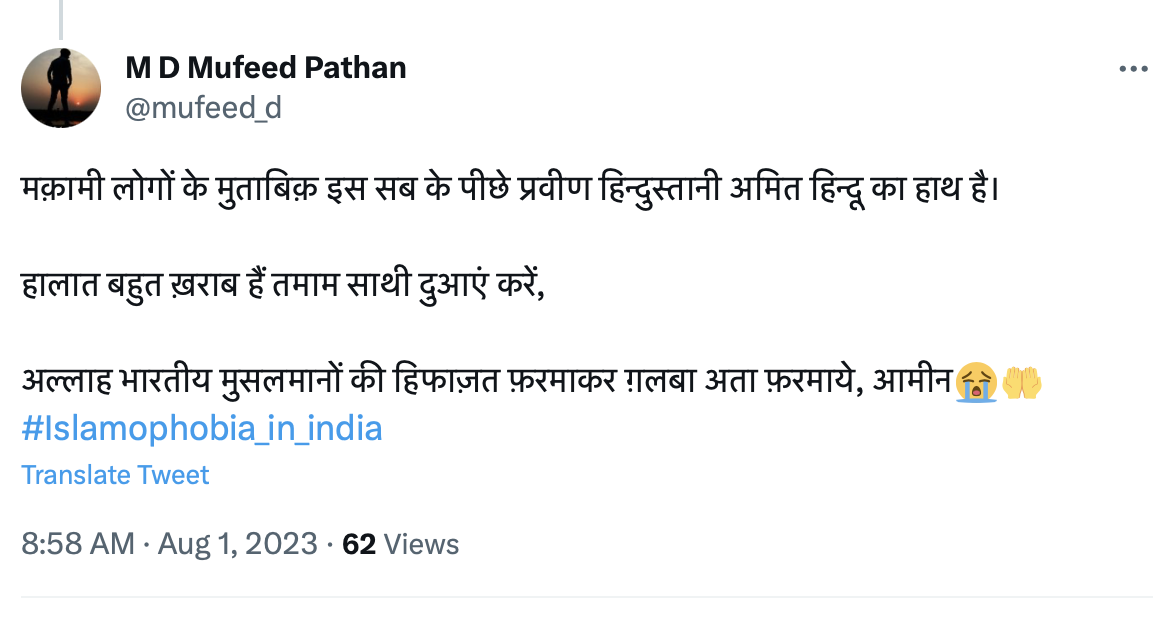
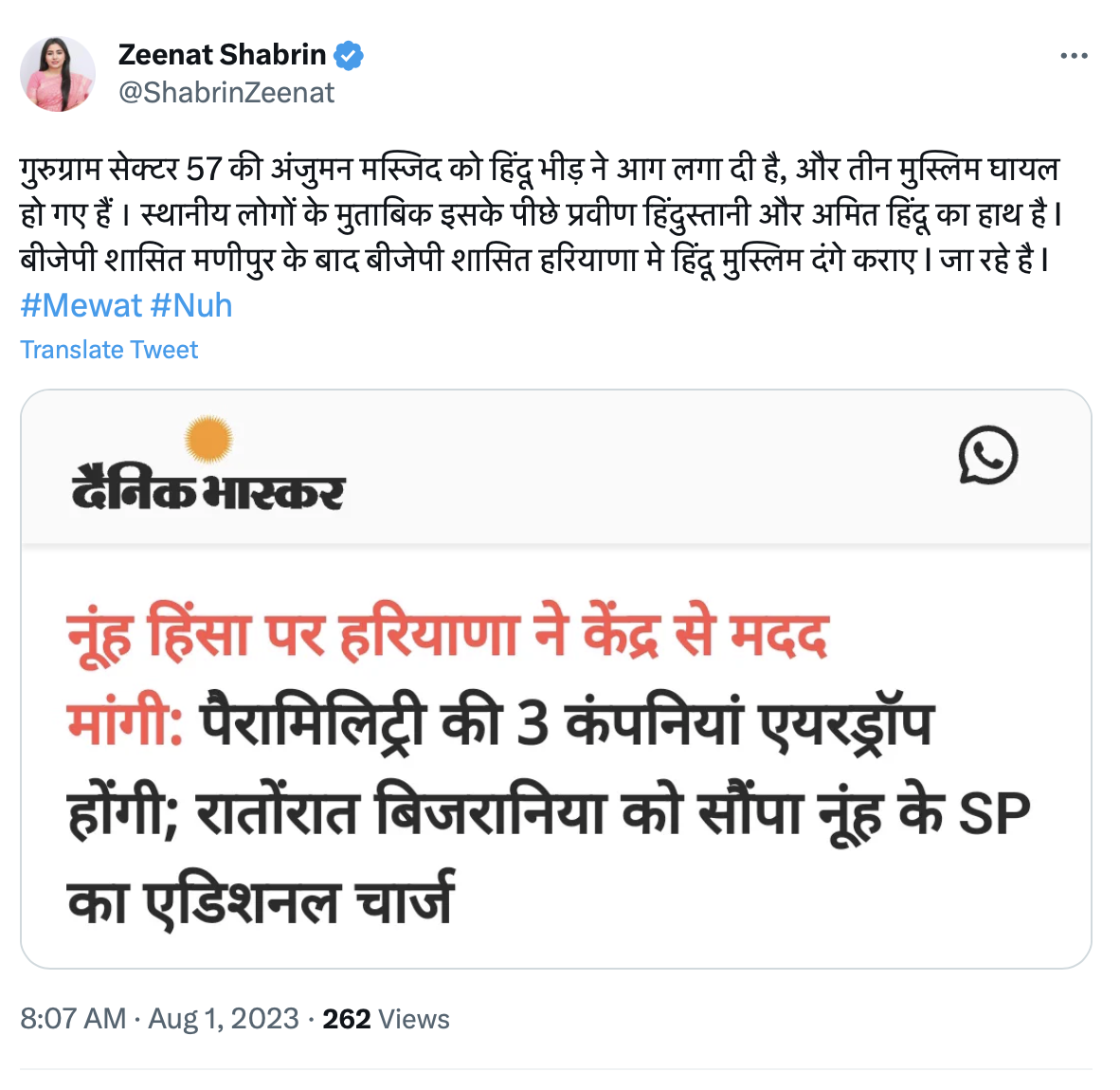
There were several social media accounts that alleged that two Hindus called Amit Hindu and Praveen Hindustani were responsible for burning the mosque.

OpIndia reached out to both the individuals who were being named by these Muslim handles as the accused who had allegedly burnt the mosque down. Talking to OpIndia, Amit Hindu said that he and Praveen Hindustani were a part of the religious procession that came under Islamist attack in Nuh. He said that they only reached Gurugram by 2-2:30 AM on Tuesday morning under the protection of the police, after they were rescued from Nue, Mewat.

Amit Hindi said that they were returning from the Mandir at 1 AM when they were attacked with stones, petrol bombs and gun fire. After that, they had taken shelter in the mountainous area. Post which, they had reached Gurugram at 2 AM – 2:30 AM under the protection of the police. He alleged that the Islamists are trying to frame them because they work extensively on the ground for the protection of Hindus. They save Hindu girls from love jihad when they get a call from the family, they work extensively in trying to protect cows and are also on call when Hindus are in duress. He believes this is why the Muslims are trying to frame him and paint a target on his back.

While speaking to OpIndia, he also demanded that the Haryana police investigate and book the culprits who were spreading fake news and painting a target on Praveen and his back. He said that because of this fake news, there could be more unrest in the city.

Speaking about the violence at Nuh, Amit told OpIndia that he was attacked and had hurt his knee. He also said that red chilli was thrown into his eyes. Further in the conversation, Amit said that he did not know who had burnt down the Mosque and he sees a dangerous conspiracy in the burning of the mosque. He also says that he suspects the Hindus involved in the religious procession had nothing to do with it.

Interestingly, according to sources, 5 individuals have been arrested in the case of mosque burning in Gurugram, none of them are Amit Hindu and Praveen Hindustani. We were also told that there could be an angle of personal enmity between the people who have been arrested and the Imam of the mosque. All angles are being investigated and strict action will be taken against the culprits.

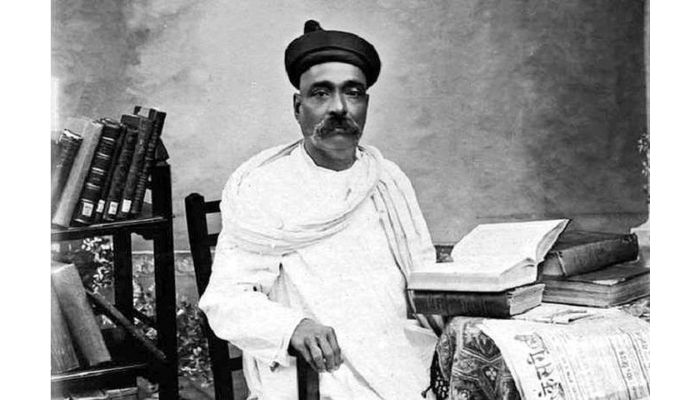
Remembering Lokmanya Bal Gangadhar Tilak on his death anniversary, the greatest freedom fighter

Lokmanya Bal Gangadhar Tilak, a prominent Indian political leader, a modern commentator on the Bhagvad Gita, an expert in ancient Indian scriptures, and a great Indian freedom fighter.

Tilak was born in Ratnagiri on 23rd July 1856, and his original name was Keshav, but he later became known as Bal. His ancestral village was Chikhali, now in the Ratnagiri district. His father, Gangadharpant, and mother, Parvatibai, faced financial difficulties, which led Tilak’s father to leave their native place to work as a schoolteacher. Bal Gangadhar Tilak completed his traditional Sanskrit studies at home. In 1866, due to a transfer of his father’s job, the family moved to Pune, where Tilak’s mother passed away shortly after their arrival. While living in Pune, Tilak matriculated in 1872.

Humble Beginnings of Tilak

Gangadhar Pant passed away in 1872. To support his children’s education, Gangadhar Pant Tilak managed to save some money and therefore Bal Gangadhar Tilak enrolled at Deccan College, in Pune. In his first year of college, he focused on maintaining and earning good health by exercising regularly. This was of great use to him later in his political life and especially during his imprisonment years. In 1876 he passed his B.A. in the first class. However, he could not become an MA. He eventually earned the degree of LLB.

In Deccan College, Tilak and Gopal Ganesh Agarkar developed a strong friendship and made a resolution to contribute to the country’s welfare. Around this time, Vishnushastri Chiplunkar, a renowned essayist, decided to quit his government job to start a school, and both Tilak and Agarkar joined him. On 1st January 1880, they established the New English School, with Tilak voluntarily becoming an unpaid teacher.

Starting Public Life and Activism with Journalism

Later, in 1881, Chiplunkar, Tilak, and Agarkar founded two newspapers, Kesari in Marathi and Maratha in English. Initially, Agarkar was the editor of Kesari, while Tilak held that position for Maratha. Through these newspapers, they began their historic work of promoting public education, raising political awareness, and fighting against governmental injustices imposed by British Rule.

Some of their articles, especially criticising the policies of the British government and the administration of Diwan Madhavarao Barve of Kolhapur State, gained widespread recognition. They strongly criticised his mismanagement and the attitude of the British government towards Chhatrapati Shivaji. Tilak and Agarkar were sentenced to four months in jail and lodged in Dongri jail. They were released on October 26, 1882.

More Work in the Field of Education

In 1882, Vishnushastri Chiplunkar passed away, but in 1884, with the help of friends like Wadarburn, Wordsworth, Mandlik, Telang, Dandekar, YM Kelkar, RG Bhandarkar, and others, Tilak and Agarkar established the Deccan Education Society. In 1885, they founded Ferguson College as part of this society. Tilak taught subjects like Mathematics and Sanskrit there. However, later on, differences arose between Tilak and Agarkar regarding the management principles of the institution.

Tilak believed that the institution’s financial management should be based on “salary based on needs” or “salary as per financial capacity,” and it should run as a self-sufficient organization, whereas Agarkar advocated for relying on government aid for running the institution.

The Great Debate Tilak and Agarkar

Another debate between this duo was centred around the question of whether the focus should be on social reforms or political reforms. Agarkar considered social reforms important and preferred social reforms to improve the country or freedom. Tilak’s position was that as long as the pride of freedom or nationality is bright and awake, no matter what the social structure is, its faults do not come in the way of the progress or prosperity of the nation.

Tilak acknowledged the importance of social progress, but he argued that without political progress and a sense of nationalism, society’s issues couldn’t be effectively resolved. He believed that the true spirit or soul of the nation lies in its sense of pride, enthusiasm, and commitment to nationalism. He saw this spirit as the driving force behind social reforms as well.

However, Agarkar’s stand was the exact opposite. He argued that the country would not be eligible for freedom without social reform, so first, it should be freed from the shackles of society’s customs, ignorance, superstitions, ideas of sin, and caste discrimination and these evils should be eliminated. Agarkar believed that foreign governments should make appropriate laws for reform, regardless of public opinion.

Tilak would, on the other hand, contend, “We will do our reforms, foreign power or governments should not interfere in our social or religious affairs. However, if public opinion is favourable and there is a compromise on the scriptures, then we have no objection to making such a law.”

Both Tilak and Agarkar played crucial roles in society, but their approaches differed. While Agarkar focused on social reforms as a necessary step towards independence, Tilak emphasised the importance of nationalism and political progress to fuel social reforms.

Lokmanya Tilak and Hindu Nationalism

Tilak was as proud of Hinduism as the nation. Dharma was his subject of interest. He studied the Vedas, Upanishads, philosophy, the scriptures, and the Geeta and Shankaracharya’s commentaries. He believed that Hindutva is the essence of one’s selfhood. He used to say that anyone who is not proud of Hindutva or Hinduism or his Hindu identity has no right to tell the Hindu people what social reforms they should undertake.

In a society where the caste system and religious beliefs from the Vedas and other scriptures were prevalent, debates and discussions on such topics were common. Tilak also played a significant role in these religious matters, driven by his deep faith in Hinduism and nationalism.

In simpler terms, Tilak emphasised the importance of Hinduism and Hindu pride in bringing about social reforms. He believed that without a strong sense of Hindu identity and pride, people wouldn’t be motivated to work towards the betterment of Hindu society.

Tilak’s brief stint in social work became the foundation of political endeavours in future

Tilak’s work in the early years of 1890-97, after leaving the Deccan Education Society, was diverse. During this period, the following cases arose: (1) the Law of the Consent Age, (2) the Gramanya case, (3) Pandita Ramabai’s Sharda Sadan, (4) the Hindu-Muslim riots, (5) public social work, etc.

In all these cases, his role was that of a political man and a desire to act for the objective of Swaraj was his primary notion underlying all his activities. Tilak started by critically analysing and commenting on the flaws and injustices of the British government through his newspapers and publications. He became the first person to handle legal matters in this regard with utmost integrity. He actively participated in the Provincial Council and Congress activities, gradually transforming himself into a nationalist leader who inspired people with a strong sense of patriotism and love for freedom. He constantly engaged in a relentless struggle against the narrow-minded policies of the British government and made efforts to instil the spirit of nationalism and freedom in the hearts of the people.

He had to constantly fight against the moderate group within the Congress party that was doing politics through mere applications and requests rather than an assertion of rights. Moderates would often contend that ‘British power being active in India is a part of our destiny and the best policy is to rely on the goodwill of the liberal British who will gradually accept India’s political rights’. On the other hand, Bal Gangadhar Tilak would assert that leaving this submissive stance and taking people to the position that ‘Swarajya is my birthright and I will get it’ is his resolve. He effectively worked to awaken the people with brilliant articles in Kesari and Maratha as well as on occasion intense speeches. Let us now see the contribution and roles played by Tilak in various issues during this period one by one.

Law of the Consent Age

Tilak led the anti-law party in the uproar that prevailed across India over the law of consent age for marital relationships. Tilak espoused the idea that reform should be done, but it should not be done by government law, rather it should first come from within the community through a proper understanding of the issue. The controversy involved the complexity of theology, so Dr Bhandarkar wrote an article supporting the law. At that time, Tilak strongly countered it.

Even though Tilak started a movement against the law, he was thinking of setting up an institution to implement some reforms. Some fundamental reforms were also discussed by the organisation. These discussions took place about issues like Girls should not be married before sixteen years and boys should not be married under twenty years, no one should give dowry to anyone, heads of the widows should not be shaved, etc.

This confirms that Bal Gangadhar Tilak was not against social reforms. He was willing to see a Hindu society where no evil practices prevail. But he essentially wanted those things to come from community education and discussions rather than by imposing a law through a colonial establishment.

The Sharda Sadan Controversy

Pandita Ramabai had set up Sharda Sadan for women’s education. Pandita Ramabai was originally a Hindu but later became a Christian. Tilak believed that the institution was not actually aimed at the intellectual, educational, and practical advancement of adult girls or widows, but was primarily aimed at spreading Christianity.

She began seeking help from Christian missionary organisations and enlisted the help of Christians. During this, two girls from Sharda Sadan converted to Christianity. At that time, Tilak heavily criticised this evangelist activity running in the guise of education. As a result, Pandita Ramabai left Pune and continued her work on women’s education in Kedgaon. It is notable that Daund Taluka shares a border with the Ahilyanagar (formerly Ahmednagar) district of Maharashtra. Today this district leads the chart of the Christian population in the state.

The Hindu-Muslim Riots

Hindu-Muslim riots occurred in many places in 1893. Tilak proposed that the causes of the riots would not be known unless we realised that there were not only two parties in this conflict, but that the government was a third party. He criticised the government’s biased policy as contributing to the riots.

It was only after these riots that the idea of making Ganpati Utsav and Shiv Jayanti public festivals appeared. These festivals were made public gatherings as a means of public awareness. In two issues of Kesari on September 18, 1894, and April 15, 1896, respectively, Tilak explained the purpose of these festivals: to create national awareness, to increase the aspirations of freedom, to remember great men and to make the common people aware of religion and culture.

Tilak guided farmers to ask for their rights

Pune Sarvajanik Sabha was a club of elite social activists in Pune. It was dominated by people inclined towards moderate thoughts. In 1895, Bal Gangadhar Tilak decisively defeated that clout and took control of the society in his hands. Through this society, he initiated the works for drought relief.

During the drought of 1896, he told the farmers that if the crop was low, then the waiver was their right, so they should ask for it. According to the government’s policy, people should ask for help as the government is responsible to take care of the people, he asserted.

Tilak laid ideological grounds for armed revolution

The famine was followed by the plague. At that time, when the British officers under Commissioner Rand, appointed for the prevention of plague, made a ruckus and bullied Indians, Tilak strongly criticised it. He set up cheap ration shops and opened public hospitals for the epidemic victims.

Rand was murdered by the Chaphekar brothers on June 22, 1897. Lokmanya Tilak’s fierce criticism of the British Rule was an inspiration for them. At that time, the British government unleashed endless atrocities in Pune. Tilak wrote sharp and pointed articles against it one after another. His editorials were characterised by fierce headlines. ‘To rule is not revenge’, and ‘Is the head of the government in place?’ are must to mention here.

As a result, Tilak was charged with sedition and sentenced to eighteen months in prison. “He’s a great scholar, so it’s not good to punish him,” Max Mueller told the government. As a result, the government reduced his sentence by six months and he was released from prison on September 6, 1898. It should also be noted that it was Lokmanya Tilak who recommended Veer Savarkar’s name to Shyamji Krishna Varma to get a scholarship for him to get higher studies in the UK.

Bal Gangadhar Tilak corrected the course of the Congress

Tilak’s real political career and his prime leadership in freedom struggle for the rest of his life gained momentum only after 1899. At that time Tilak had returned from the punishment of sedition and his popularity had increased. Despite jail sentence, his goals were not changed in the slightest, as is evident from his editorial article in Kesari titled ‘पुनश्च हरिः ॐ !’ written on July 4, 1899.

He criticised Lord Curzon’s tenure, especially the restrictions on the educational institutions he imposed. Moreover, he strongly attacked the policy of colonialism, and in his editorial, he said that England was undergoing moral and intellectual decline. It was at this time that he offered new ideas about the functioning of the National Congress. He believed that the strength of the whole nation should be put behind the demands of the Congress by building a massive movement among the people.

The partition of Bengal

Lord Curzon declared the partition of Bengal on 20 July 1905. There was outrage all over the country and violent protests broke out. Tilak supported the movement in Bengal. He championed the four pillars of the movement namely Swadeshi, Boycott, Nationalist Education and Self-government. The first three were activities taken up by people while the fourth was the demand put before the British government with a fearless approach. Use Made in India things, Boycott foreign manufactured things, impart a Nationalistic Education through dedicated schools started by patriots, and keep pursuing the demands of Self-government through parliamentary affairs was the agenda.

The rift between the extremists and the moderates

As the anti-Partition movement became more and more aggressive, the National Congress members differed over the programmes of moderates and extremists. Swadeshi, boycott, etc. were principally accepted by the Calcutta session of the Congress. However, the Congress session held in 1907 in Surat saw violent dispute between the members themselves.

Tilak had objected to the election of the president itself, which caused a ruckus. Tilak was standing firm still amid that ruckus, even though he was attacked sticks and shoes were thrown at him. The police later seized the pandal. Tilak was against reducing the intensity of the anti-partition movement by any means. And he did not let the moementum go in the hands of moderates who were relying more on collaborating with British rule rather than openly opposing and criticising their policies.

Another sedition case landed Tilak into Mandale

Soon after this split in the Congress, on June 24, 1908, Tilak was again arrested in Mumbai on charges of sedition and he was tried in the court. The reason for this was the editorial articles he wrote in the Kesari with headlines – ‘the misfortune of the country’ and ‘these measures are not sustainable’ on May 12, 1908 and June 9, 1908 respectively. There were seven Englishmen and two Indians on the jury panel. The jury found him guilty by a vote of seven versus two, and the court sentenced him to six years of jail at Mandalay in Myanmar and a fine of Rs 1000 was also imposed. Tilak’s bold statement after the sentencing is memorable and

Tilak said, “I maintain that I am innocent. There are higher powers that rule the destiny of things and it may be the will of Providence that the cause which I represent is to prosper more by my suffering than by my remaining free.” A marble plaque still exists outside room no 46 of Bombay High Court with Tilak’s words etched on it. Court room no 46 has been kept preserved and is not used for regular hearings but used only on special occasions and events.

Tilak was kept in Mandalay jail in Burma for punishment. Two important events took place in Tilak’s life while he was in Mandalay jail. During this captivity, he wrote his famous book, ‘Geeta Rahasya’, while his wife Satyabhamabai died in Pune in 1912. He was released by the government on June 15, 1914, after six years in prison.

The Home rule League

In 1915, Tilak wrote four articles on the subject of Hindi Swarajya Sangh and explained what kind of polity and government would be desirable in India. On May 1, 1916, he founded the Home Rule League or Hindi Swarajya Sangh in Belgaum. It was only in 1915 that Annie Besant founded the Home Rule League in Madras. The movement of Home Rule was jointly run by Tilak and Benzat. In March 1918, he went to England with a delegation from the Home Rule League. Before that, he rejoined the Congress in 1916 during the annual Congress session held in Lucknow.

When Tilak was in England, the Rowlatt Act was promulgated and the Jallianwala Bagh massacre took place when people were protestig against this act as appealed by MK Gandhi. “I am sorry that I was not with you during Gandhi’s Satyagraha, and the terrible events that followed,” Tilak said as soon as he landed in Mumbai.

Lokmanya Tilak became the Father of the Indian Unrest

Tilak had filed a defamation suit in a London court against Sir Valentine Chirol for publishing defamatory content against Tilak in his book ‘Indian Unrest’ in 1915. In February 1919, its verdict went against Tilak. Tilak suffered a great loss in this case, but it was this book that introduced Tilak’s glorious title of ‘the Father of the Indian Unrest’.

On the occasion of Tilak’s 60th birthday a grand ceremony was held in June 1916 in Pune and a sum of one lakh rupees was offered to him. Announcing that all that money will be used for national causes, he said, “Our motherland is appealing to all of us to join this movement. Let us all contribute our lives for the national cause without any discrimination as we hear this call of the motherland.”

Leaving the Congress again

Lokmanya Tilak was among the first few mass leaders who realised that with less inclusion of and importance given to the people with a staunch nationalistic attitude and pride for the Indian civilisation and culture, Congress remains a useless platform for the work of a national cause. Afterall, it was not started by an Indian but a British officer AO Hume.

With the intention of deploying political reforms at the will of the Indians themselves – rather than depending upon the mercy of the British rulers or being a collaborator with them like what Congress did later – Lokmanya Tilak founded the Democratic Swarajya Party. The party’s manifesto was published on April 20, 1920. This declaration is a historical document. It mentions the principles of India’s equal place along with Great Britain in the Empire, the establishment of world peace, freedom from commercial plunder, etc. He had shown it to MK Gandhi before publishing the manifesto and Gandhi had agreed to it.

Social Service beyond politics and varied topics of interest of Lokmanya Tilak

In addition to political work, Tilak’s various social activities were going on. After the Surat Congress, he started the movement for prohibition of liquor. He also wrote an article on it and gave many lectures against alcoholism. The movement went so far as to actual deterrence on ground. Tilak raised millions of rupees for social welfare through an activity called ‘Paisa Fund’. Almanac research was ingrained in him at an early age. He later published it in a more scientific way through his independent ‘Panchanga’.

Tilak was always thinking about the industrial progress of his country and he used to discuss on occasion what businesses could be taken up with a little capital. Instilling industrious entrepreneurial attitude among the youths was his motive. The idea of improving the Marathi script alphabets for the printing purpose was there in Tilak’s mind for many years. He also actually experimented with it in 1904. Later, while in England, his efforts were successful and many improvements were made to the Marathi typeset accordingly.

Literary contribution of Lokmanya Tilak

Tilak wrote most of his Marathi articles from Kesari. Apart from Kesari, Tilak wrote some writings in his English newspaper Maratha. Tilak had a deep study of Sanskrit and English literature. His favourite subject was Indian philosophy. He also studied Western philosophy. The best reflection of his broader interest can be seen in the ‘Geeta Rahasya’.

While tilak was working in the political field, sometimes in jail and at other times he got a little rest, during which time he wrote some books. Most of his writings are research-oriented, and in each book he expresses some independent opinions. His major works are Geeta Rahasya, Orion, Arctic Home in the Vedas and Vedang Jyotish.

In the Mandalay jail, Lokmanya Tilak wrote ‘Geeta Rahasya’ in the winter of 1910-11 and published it in 1915. This book is a commentary on the Geeta and is essentially focussed on the ‘Karma Yoga’. In its initial parts, Tilak has explained the understanding of the Geeta he had by observing only the Geeta separately putting all commentaries and criticisms aside. According to him, Geeta promotes Pravrutti – which means proactive nature in a person and provokes the possibilities of great activities hidden within; rather than inspiring Nivrutti – which means a retiree attitude of giving up actions.

‘Orion’ is one of his dissertations. He prepared it for the Oriental Conference in London in 1892. It dealt with the subject of ascertaining the time of the Vedas. Tilak was of the opinion that ‘since Max Müller had decided the time of the Vedas on linguistic research, it was not correct and this method of research was one-sided’. Therefore, he combined all the references to astrology in divine scriptures, linguistics, various samhitas and Brahmanas of Vedas and determined the time of the Vedas as 4500 BC with the mathematical calculations of this astrology. The book has been praised by Western Orientalist scholars Jacobi and Bloomfield.

Arctic Home in the Vedas is also a research thesis of Tilak and he came up with the idea in 1898 when Tilak was in jail in Yerawada. In this book, he has tried to propose that the origin of the Aryans must be somewhere in the region of the North Pole, and this he deduced mainly on the basis of the verses of the Vedas.

The End of the Tilak Era

Lokmanya Tilak’s name was suggested by Pandit Malviya as the president of the historic Congress session which was then to be held in Calcutta, but before that Tilak died in the Sardar Grih in Mumbai following a few days of illness. He had diabetes for 15 years. In the last few days, malaria fever and overwork had led him to an unrecoverable fatigue. At the time of his death, he was survived by his sons, daughters and other relatives, as well as NC Kelkar, Dr Sathe, Dr Deshmukh, KP Khadilkar and other friends were also present there.

The news of Tilak’s death spread in Mumbai and across the country. The whole country was plunged into a sea of sorrow. Tilak gave the freedom movement the supreme and authentic acceptance of people from all walks of life. He was truly a leader accepted by people – not imposed by some colonial legacy or political dynasty. Lokmanya literally means accepted by people. Therefore, the Tilak era is considered to be a very important phase in the history of modern India.

References Used: Old Archieves of Kesari quoted in various biographies of Lokmanya Tilak, Lokmanya Tilak in the Makers of India Series by (Sahitya Akademi), Lokmanya Tilak by Bharatiya Prakashan Nagpur, and articles on Lokmanya Tilak, Gopal Ganesh Agarkar, Pandita Ramabai, Vishnushastri Chiplunkar etc. in the Marathi Encyclopedia published by the Government of Maharashtra.


Rajasthan: Nasiruddin, Rashid, and Mushtaq among 7 arrested for assaulting a woman for allegedly being a BJP supporter

A disturbing video from Rajasthan’s Jaipur is going viral on social media in which a mob can be seen thrashing a woman while police officials are trying to save her from getting lynched. The mentally challenged woman, who belongs to the Muslim community, was attacked by co-religionists allegedly for some slogans she wrote on her house.

The incident reportedly took place ten days ago, however, the video of the assault on the woman surfaced recently. The attempted lynching occurred on 21 July in Kalyan Nagar, located in Malpura Gate Police Station area. 

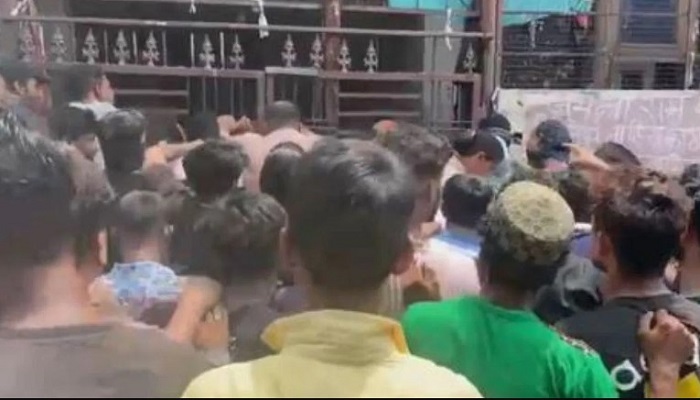
On the day of the incident, an angry mob gathered outside the house of the woman. Threatened for her life, the woman locked herself in her house. But the Islamist mob forcibly entered the woman’s house and broke the house gate. Later, they broke down the door of the room on the upper floor and started brutally assaulting the woman. 

They dragged her out by pulling her hair and clothes and threw her into the mud. On receiving the information, Police reached the spot. 

After an hour or so, Constable Dholi Bai posted at Malpura Gate police station and other police personnel saved the 40-year-old woman from getting lynched. 

Constable Dholi Bai said information was received that a woman has locked herself in a house in Kalyan Nagar. A crowd of about 100 to 150 people has gathered outside her house and is trying to kill her. Subsequently, she along with Harlal and SI Anil reached the spot.

She added that there we saw that a mob had gathered outside a house. There some people were trying to break the gate of the house by climbing on the second floor. In no time, they broke the gate of the house and started beating the woman. Police personnel also went inside with the mob, but they were outnumbered and overpowered by the mob and they forcefully dragged the woman out.

After dragging the woman out of her home, the mob continued to thrash her in the presence of police personnel. Constable Dholi Bai added that the mob also pushed and tried to attack the police personnel. But they held the woman and tried to protect her while the mob kept thrashing the woman for about an hour. 

When more help arrived, they successfully rescued the woman from the mob and sent her to the hospital.  

According to the Police officials, the woman is mentally challenged and it is alleged that she had written some objectionable things on her house walls which hurt the sentiments of the local residents. 

Muslim woman targeted by co-religionist for writing pro-BJP slogans

On the basis of the complaint of the woman’s husband Sahadat Ali, Police filed a case of assault. The police stated that in the wake of Muharram, they didn’t arrest the accused back then. However, on the basis of the video footage of that day, they arrested seven accused who were part of the mob on Sunday, 30 July, ten days after the incident took place. 

Malpura Gate station in-charge Satish Kumar said that the arrested accused include Kalyan Nagar residents Nasiruddin, Rashid, Mustaq, Irfan Khan, Ejaz Khan, Ikram Deshwali, and Kalamuddin.

Navbharat Times reported that the Muslim woman was attacked by the Islamist mob because she is a BJP supporter and the alleged objectionable things were Pro-BJP slogans. The report added that the Muslim woman is a BJP supporter. She drew a lotus flower on the wall of her house and wrote some slogans in support of the BJP. This allegedly infuriated her co-religionists and it culminated in the attempted lynching. 


However, Times Now reported that the mob alleged that the woman had allegedly burnt pages of the Quran which led to the violent assault.

ED raids Hero MotoCorp chief Pawan Munjal’s residence in connection with Revenue Intelligence case

0

On Tuesday, August 1, the Enforcement Directorate raided Hero MotoCorp’s chairman and Chief Executive Officer (CEO) Pawan Munjal’s residence and other locations linked to him in Gurugram. As per reports, around 12 locations are being raided by the central agency’s officials.

In a statement to the news agency ANI, ED said, “The searches are being conducted at Hero Group chief Pawan Munjal’s residence and many other locations after taking cognisance of a Directorate of Revenue Intelligence (DRI) case.”

Recently, the Directorate of Revenue Intelligence (DRI) apprehended a close aide of Munjal in possession of undeclared foreign currency. PTI quoted unnamed sources in ED that the raid at locations linked to Munjal was part of a money laundering probe.

IT raid at Hero MotoCorp in March last year

In March 2022, the Income Tax department raided 40 premises, including Hero MotoCorp officers and the chairman’s residence, as part of a tax evasion investigation.

In a statement, the company said, “Officials from the Income Tax Department visited two of our offices in Delhi and Gurugram and the residence of our Chairman and CEO Pawan Munjal on Wednesday. We have been informed that this is a routine inquiry, which is not uncommon before the end of the financial year.”

During the investigation, the IT department found bogus expenses worth Rs 1,000 crores. Furthermore, it was reported that property worth Rs 100 crores was bought was Pawan Munjal to save taxes. It was believed he used black money to buy those properties.

‘Masjid’ allegedly burnt down in Gurugram after Islamist violence was a disputed structure, construction was put on hold by courts: Details

Amid the violence unleashed by Islamists in the Nuh district of Haryana, a ‘mosque’ was allegedly set ablaze on Monday (July 31) night in Sushant Lok Phase-III in Sector 57 of Gurugram.

Identified as the Anjuman Imam Masjid, it was reportedly attacked by a group of 70-80 people. During the incident, the imam of the ‘mosque’ was allegedly killed while another person was injured. They were later rushed to the hospital.

While speaking about the matter, police commissioner Kala Ramachandran informed, “The attackers have been identified by the police and following raids conducted throughout the night, several of the attackers have been rounded up. Security around places of worship has been tightened.”

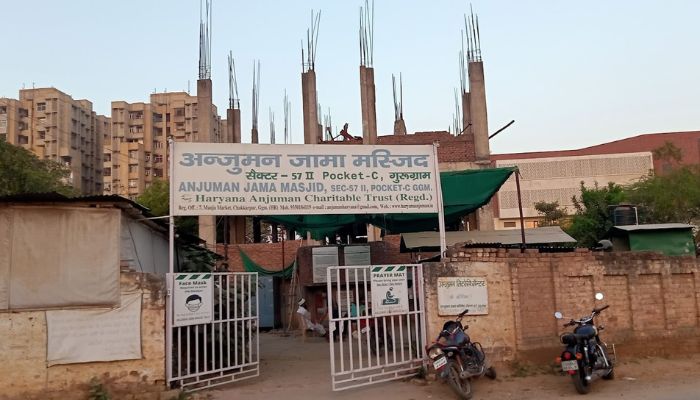
It has now come to light that the said masjid is a disputed structure, the construction of which was stopped by the courts on several occasions. As per reports, the Anjuman Jama Masjid is built on ‘government-allocated land’ in the New Gurugram area.

According to the Chairman of the Haryana Anjuman Charitable Trust, Aslam Khan, the Om Prakash Chautala-led-Haryana government allocated the land for the ‘mosque’ in 2002.

He claimed, “In 2002, the Government allocated land for 17 temples, two gurdwaras, one church and one mosque. Though one mosque is not enough in view of the growing population of Muslims, the stay on construction has added to our woes.”

The construction of the ‘mosque’ began in 2004 but it came to a halt within 6 months. According to the Sushant Lok Extension Residents Welfare Association, the land was originally earmarked for the construction of a police station as per the demand of the local residents.

However, the land was later allotted to the Haryana Anjuman Charitable Trust in Gurgram and converted into a religious place by allowing a change of land use.

Several petitions, including Public Interest Litigations (PILs) were filed over the years to stop the construction of the ‘mosque’, including one by the Malibu Towne Residents Welfare Association and a resident of Malibu Towne named Mukesh Bhanont.

Punjab and Haryana High Court directed regulatory mechanism for mosque, SC ordered status quo maintenance

A Division Bench of the Punjab and Haryana High Court however held that “since the mosque is in an area which is predominantly residential in character, it would be wise for the authorities to ensure that no nuisance is caused to the residents of the area by the devotees and that a proper regulatory mechanism is established to eliminate traffic and noise pollution etc.

In an order on June 6, 2012, the Supreme Court ordered the maintenance of the status quo. Given the matter was sub-judice in 2013, a 2-Judge Bench of Justice Satish Kumar Mittal and Justice Amol Rattan Singh refused to entertain petitions that objected to the change in land use.

The matter is yet to be decided by the apex Court. As such, the construction of the disputed structure had been stopped half-way. In pictures taken from the site, iron rods could be seen protruding from unplastered pillars. A board at the entrance reads, “Anjuman Jama Masjid”, although the matter is still stuck in court.

Demands for additional 5 mosques turned down by BJP government in 2016

Vice-President of the Haryana Anjuman Charitable Trust, Mohammad Abul told The Hindu, ” In 2013, the construction for the ground and the first floor began after we won the case in the High Court. But the opposite party moved the Supreme Court and the construction was stayed yet again.”

“This time we did not even find time to remove the shuttering for the ongoing construction. The construction was immediately stopped and the trust ended up paying lakhs for the shuttering,” he said.

The disputed structure serves as the place of congregation for the Muslim community during Juma Namaz, with more than 1500 people use the site for prayer. Demands for the allocation of areas for an additional 5 mosques in Gurugram were turned down by the BJP-led-Haryana government in 2016.

Violence in Nuh

On Monday (July 31), tensions gripped several parts of Haryana when stones were pelted at the Jalabhishek Shobha yatra in the Muslim-majority region of Mewat. The procession was taken out to mark the auspicious occasion of Shravan Somwar.

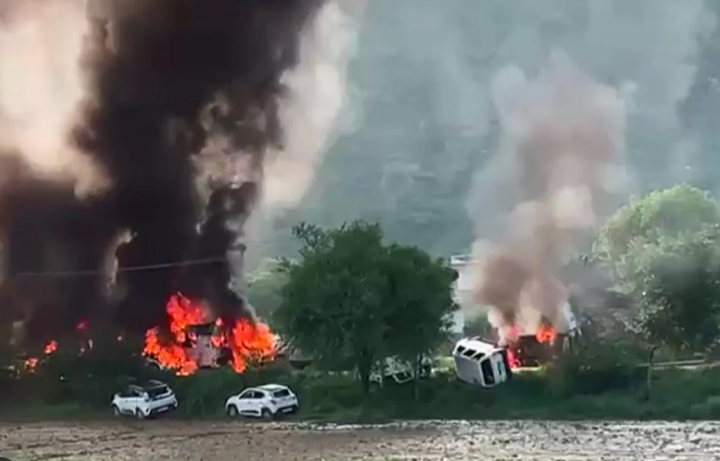
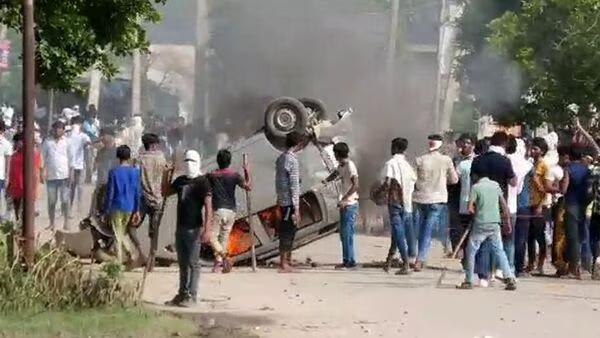
In several videos of the clashes, a mob charging in a hostile way at the yatris ccould be heard raising “Allahu Akbar” and indulging in riotous activities.  Two home guards were killed and about a dozen policemen injured as a mob in Haryana’s Nuh district tried to stop a Vishva Hindu Parishad procession, pelting stones and setting cars on fire, police said.

To stop the spread of misinformation and rumours, internet services were suspended in the region. Following the violence at Nuh, VHP president, Alok Kumar issued a video statement urging the police and administration to quickly rescue the devotees stuck at several locations including Nuh temples, chowk, and near the police station. He stressed that the yatra is an annual affair and this year it was targeted in a pre-planned and organised attack

Meanwhile, the Union government deployed 20 companies (about 2000 personnel) of Central Armed Police Forces (CAPF) to bring the law and order situation under control. It is worth noting that Haryana’s Mewat has been under the spotlight for the last few years for the increase in terror activities, cow smuggling, and forced conversions.

Media peddles communal angle in Jaipur-Mumbai train shooting case, but Chetan Singh had demanded early release citing illness: What the FIR says

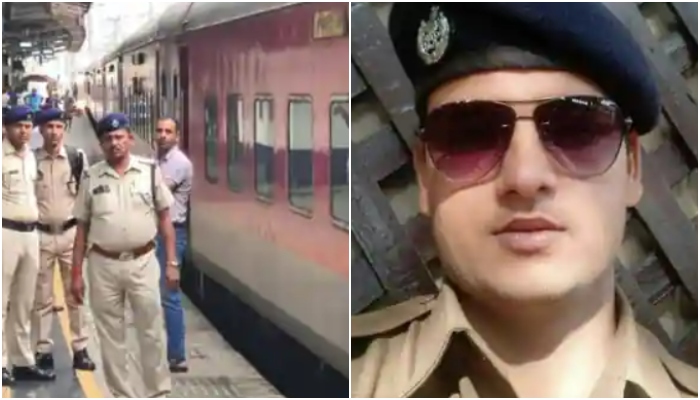
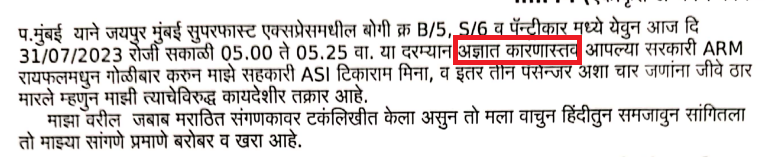
On July 31, a 33-year-old Railway Police Force constable identified as Chetan Singh was arrested by the police after he fired 12 rounds of his service rifle killing his senior and three other passengers on the Jaipur-Mumbai Express. Singh was not well and wanted some hours free from duty but his seniors didn’t allow him and asked him to complete his duty instead. In a fit of rage, Singh is said to have fired on the train killing his senior ASI Tikaram Meena and 3 other passengers.

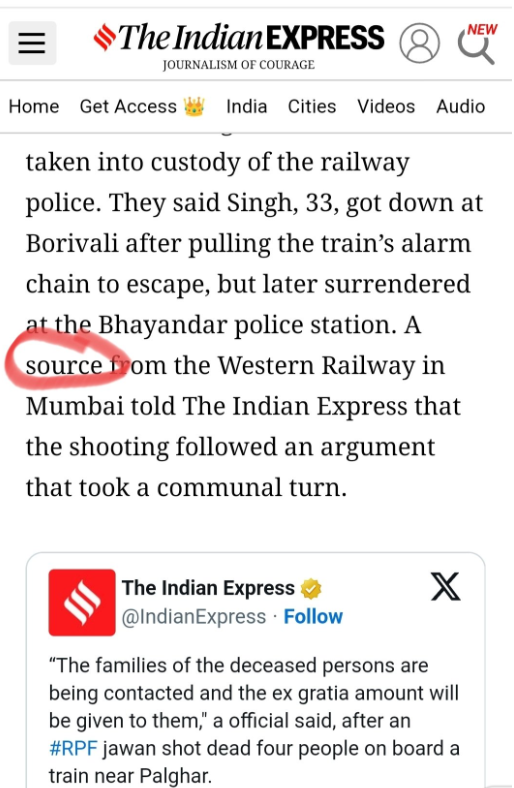
According to the initial reports, Singh was arrested when he tried to flee from the train in the Dahisar region of Mumbai. While the police and the FIR mention no actual reason for the firing, the incident is being given a communal turn after the Indian Express reported that the passengers identified as Asgar Abbas Ali (48), Abdul Kadar Mohamed Hussain Bhanpurwala (64) and one another were killed following a spat that took a communal turn.

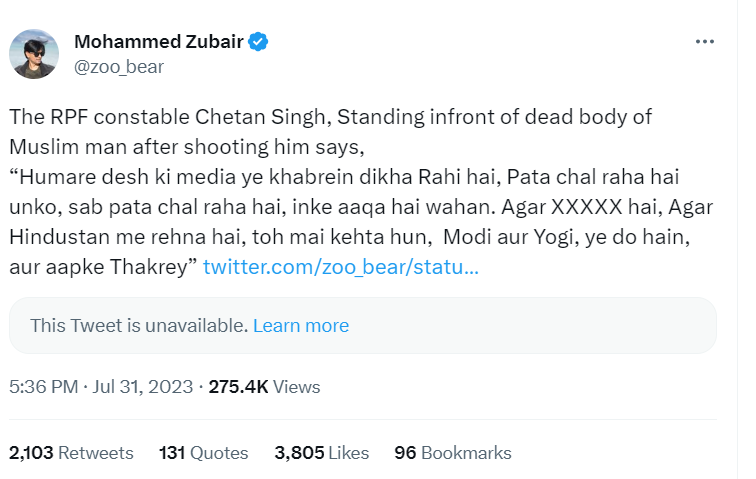
The Indian Express also said that it had obtained a video in which Singh could be allegedly heard saying that “… Pakistan se operate hue ye, aur media yehi coverage dikha rahi hai, unko sab pata chal raha hai ye kya kar rahe hain. inke aaqa hai wahan… Agar vote dena hai, agar Hindustan mein rehna hai to mai kehta hoon Modi aur Yogi, ye do hain, aur aapke Thackarey”.

The authenticity of the viral video cannot be established: Western Railways

The Railway authorities commented on the video and said that the authenticity of the video could not be established and that it was quite possible that the video was a morphed product. “Its location and authenticity cannot be established. It can also be morphed. The matter is under investigation,” Sumit Thakur, the spokesman for Western Railway, was quoted as saying by the Indian Express.

In spite of the official statement, Islamists and leftists furthered the video and claimed that Singh had killed the passengers following a fight over two communities. Islamists, leftists Twitter users and several other leftist media channels based their say on an anonymous ‘source’ from Western Railways who told the Indian Express that a fight had allegedly broken out following an argument over communities.

Leftists, and Islamists further the incident as ‘hate crime’

Alt News Co-founder Mohammed Zubair raised the issue on social media and indicated that Singh had killed the passengers over a community issue. He further tried to give a communal angle to the incident even as the police is still investigating the case.

Later the Alt News co-founder also happened to delete some of his tweets.

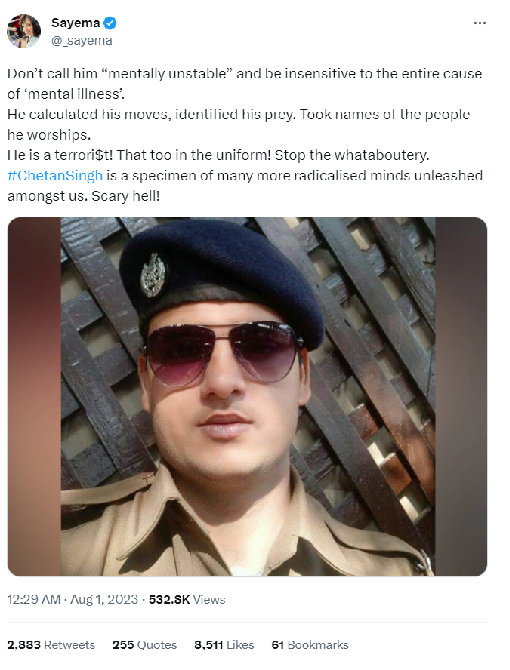
Following Zubair, several other leftist liberals posted the video whose authenticity could not be established by the authorities and claimed that Singh was no less than a ‘terrorist’. “Don’t call him mentally unstable and be insensitive to the entire cause of ‘mental illness’. He calculated his moves, and identified his prey. Took the names of the people he worships. He is a terrorist! That too in the uniform! Stop the whataboutery. Chetan Singh is a specimen of many more radicalised minds unleashed amongst us. Scary hell!” tweeted Radio Mirchi RJ Sayema.

Author and ‘journalist’ Sagarika Ghosh, who is infamous for peddling fake news of semen-filled balloons hurled at women on Holi, also furthered the claim that the incident was a ‘hate crime’ though neither the police nor the FIR copy has mentioned any specific reason behind the firing imposed by Singh.

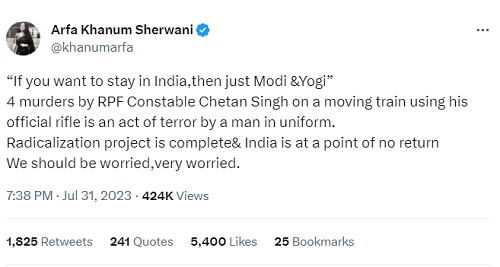
The Wire’s ‘journalist’ Arfa Khanum Sherwani indicated that the youth of India was radicalised by the ruling government and that it was a fact to worry about. “4 murders by RPF Constable Chetan Singh on a moving train using his official rifle is an act of terror by a man in uniform. Radicalization project is complete and India is at a point of no return We should be worried, very worried,” Sherwani tweeted.

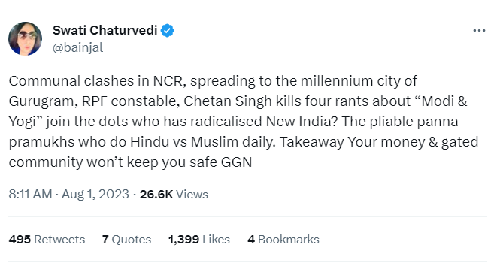
Print ‘journalist’ Swati Chaturvedi said, “Communal clashes in NCR, spreading to the millennium city of Gurugram, RPF constable, Chetan Singh kills four rants about “Modi & Yogi” join the dots who have radicalised New India? The pliable panna pramukhs who do Hindu vs Muslim daily. Takeaway Your money and gated community won’t keep you safe GGN.”

Some of the anti-Modi and anti-India global media channels like Al Jazeera also reported the news claiming that Singh had fired the Muslim passengers after they engaged in a fight over communities. Basing its report on one of the ‘sources’ of the Indian Express, the global media report indicated that this was the result of the hate that has been allegedly spread all over the nation by the ruling government in India.

Political parties also call it deliberate targeting

Further political parties like the Indian National Congress and the AIMIM also called the incident a hate crime and claimed that the passengers were deliberately targeted by Chetan Singh who has now been arrested by the police. “The cold-blooded murders carried out by an RPF constable is the result of a hyper-charged and highly polarised news media and social media atmosphere. The genie of hate is now out of the bottle and it will take a lot of collective effort to put it back in,” Congress’ Jairam Ramesh said.

“It is being said that the terrorist of Mumbai Express who killed 4 innocent people was mentally ill. If saying that “If you want to live in India, vote for Modi, Yogi or Thackeray” is a sign of mental illness, then don’t know how many people of Watan-e-Aziz are patients. If he was mentally ill then why was he put on duty? If someone had taken my name even after being caught in a minor crime, I would have been crucified by now,” tweeted AIMIM chief Asaduddin Owaisi.

Western Railways denies the angle of argument over communities

While it suits the narrative of left-leaning propagandists and opposition political parties to brand the incident as a ‘hate crime’, it is worth noting that Western Railways has denied the claims that the firing took place after an argument over communities. The Railways has also hinted that the video that is doing the rounds on the internet could have been edited and morphed.

“Its location and authenticity cannot be established. It can also be morphed. The matter is under investigation,” Sumit Thakur, spokesman for Western Railway, said in a statement to the Indian Express.

Also, GRP Commissioner Ravindra Shisve commented on the issue and said that the police are yet to ascertain the motive of the killing. The Railway officers meanwhile also said that the accused officer was hot-headed and that he had some mental health issues. “Apparently he is known to be hot-headed. But then we found no such instance in his record of the past five years. His record has been clean and that’s why I posted him in Mumbai when he requested six months ago,” P C Sinha, Principal Chief Security Commissioner of Western Railway was quoted as saying.

Refusing any angle of argument in the incident, Sinha further said, “He had a short fuse. He was quite hot-headed. There was no altercation. He just lost his temper and shot his senior, then fired at whoever he saw.” The officers further say that the investigation in the case is at a premature stage and that a high-level committee has been constituted to conduct an inquiry into the incident.

Here’s what actually happened on July 31 as per the FIR

Team OpIndia accessed the FIR in the case and learned that 33-year-old Chetan Singh was not feeling well and had informed the same to his colleagues. He wanted some hours free from his ongoing duty but was suggested by his seniors to rest after finishing the duty hours. As per the FIR filed by another RPF constable Amey Acharya, Singh continued to say that he was unwell and that would get off the train at Valsad station.

But his senior, ASI Tikaram Meena contacted the Mumbai Central Control and complained about Singh. The Control then asked Singh to stay calm and finish off his pending duty of three hours. Meena then asked the Acharya to get some cold beverages for Singh but the accused RPF officer refused to have any.

“I had gone to see ASI Meena as I wanted to submit my work report. On reaching his bogey ASI told me that Chetan Singh was not well and that he wanted the rest of his work hours off. I touched Singh to check but I could not gauge whether he had a fever. Singh did not agree as ASI insisted he completes his duty,” Acharya said in the FIR.

He then added that ASI asked him to take Singh’s rifle and allow him to take rest for some time. However, Singh could not sleep for more than 15 minutes. “I was seated next to him while he was resting but after 10 to 15 minutes he suddenly got up and forcefully took the rifle from me. As I was not ready to give the rifle, he even tried to strangle me,” the FIR read.

Later, Acharya realized that Singh had accidentally exchanged his rifle so he along with other RPF men chased Singh. “Even while returning my rifle and taking possession of his own rifle, I saw that Singh was very furious. Meena was still trying to explain to him but Singh kept arguing. Even I intervened in between and tried to make him understand to stay calm, but he was not listening to either of us. So I decided to go away from there,” Acharya’s police statement read.

The firing happened but the reason is unknown, mentions FIR

Meanwhile, Acharya also noticed that Singh had removed the safety catch of his rifle and that he suspected that he was in the position to fire. Acharya informed ASI about the same and left as Singh was not ready to listen to anyone. “After half an hour one of the RPF officers called me from the office and informed me that ASI Meena had been shot. I ran to the bogey in which ASI Meena was sitting. Later I saw Singh with rifle and he was still furious. I asked passengers to be safe and informed the control room. Singh moved with the rifle and continued to fire the train,” the FIR read.

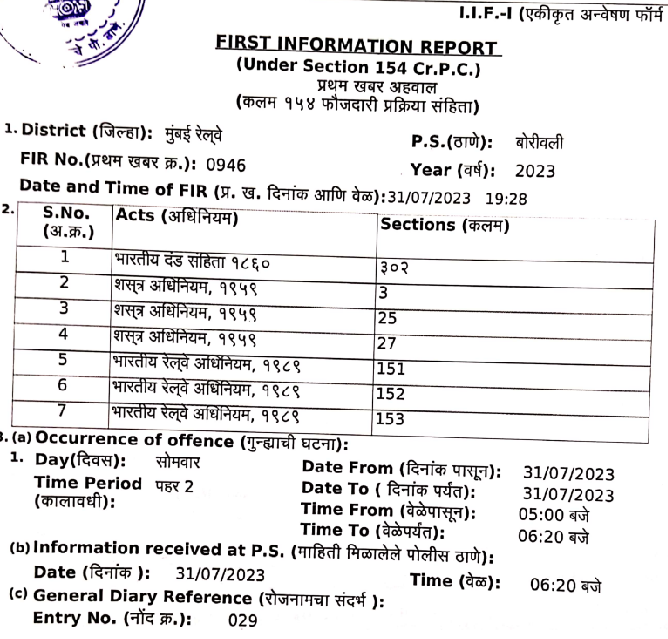
FIR copy obtained by OpIndia

Notably, the FIR clearly mentions that Singh fired bullets from his rifle due to unknown reasons and not the communal angle attached to the incident by the leftists. FIR against Singh has been filed under the Indian Penal Code, 1860, Arms Act, 1959 and Railways Act, 1989. While Singh has been arrested, the police are investigating the case to know the reasons behind the firing and are also verifying the viral video.

Nuh violence: How the media crafts a narrative to whitewash violence unleashed by Islamists and blame Hindus instead

On 31st July, almost 4000 Hindus participated in a Jalabhishek Yatra by Vishwa Hindu Parishad. The religious procession came under attack by an Islamist mob in Nuh, Haryana. While Hindus were trapped in a hostage-like situation, news emerged that two home guards have been killed in the violence unleashed by Islamists during the Jalabhishek Yatra on a Shravan Somvar, the auspicious Monday of the Sravan month.

The police told OpIndia that one of the home guards was killed in the stone pelting by Islamists while the other was shot dead when the violence by Islamists was unleashed.

Speaking to OpIndia, VHP also informed that several temples had come under attack in the Nuh area of Mewat after the Islamists unleashed premeditated violence against Hindus.

One video which went viral on social media was a Hindu talking about how a Temple had come under attack and how the Islamists had burnt alive 3 Hindus. It was a live video that was uploaded on Instagram.

There were several other videos and pictures that emerged which showed the extent of the violence unleashed by Islamists. VHP has claimed that almost 30 temples came under attack in Nuh, however, the police have not confirmed the exact number of temples that were attacked.

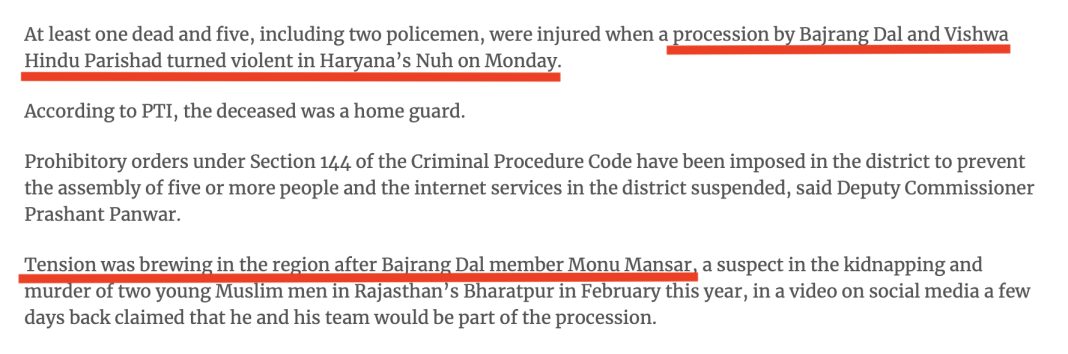
VHP also said that the violence was planned and that the stones and bricks had been collected by the Islamists at least 2 days in advance. OpIndia was told that they were using Bajrang Dal activist ‘Monu Manesar’ as an excuse to spread fake news and incite violence. Interestingly, almost on cue, several Islamists on Twitter started sharing an old video of Monu Manesar alias Mohit Yadav, claiming that he was present at the Shobha Yatra and therefore, the violence erupted. This, however, turned out to be false.

OpIndia did a detailed fact-check confirming that the video was from last year and that Monu Manesar was not present at the religious procession.

Essentially, the Islamists seem to have meticulously planned to unleash violence against a Hindu religious procession that takes place every year. The police have confirmed that the procession had the required permission from the police. After unleashing planned violence against thousands of Hindus, they started spreading fake news on Twitter claiming that the violence was unleashed because of the presence of Monu Manesar. This turned out to be fake since Manesar was not present at the procession at all.

The media extended all the help to the Islamists to blame the victims after the violence

The media, on its part, ensured that they extend help to the Islamists to blame the victims after unleashing violence against devotees.

Maktoob media, the Islamist portal which had tried to shield Islamists during the JNU violence after anti-CAA protests and the Delhi anti-Hindu riots, peddling fake news regularly, published two reports on the issue that deserve a harder look.

Their first report on the issue was headlined, “Haryana: 1 killed, 5 injured as clashes breakout during VHP rally in Nuh”.

The headline itself hinted that the rally turned violent, essentially insinuating that it was the Hindus who were a part of the religious procession turned violent. Note how in the headline they fail to even acknowledge that it was a religious procession.

The first part of their report also fails to identify the “rally” as a religious procession. It further repeats the trope that the rally itself turned violent, not that it was attacked from the outside, insinuating that it was the Hindus who unleashed violence and not the Islamists – this, when 2500-4000 Hindus were stuck in a hostage-like situation for hours in a temple, rescued only on Tuesday morning.

In the report, they also inserted the Monu Manesar angle, further claiming that the Muslims were opposing Manesar being a part of the procession because it would “disturb harmony”.

They write, “The violence broke out around Monday noon when around half-a-dozen vehicles carrying devotees reached Nuh Chowk leading to rumors that Monu Manesar was inside one of the vehicles”.

While Maktoob acknowledges that it was a “rumour”, it failed to include in their report that the rumour was also spread by Islamists themselves and then, this rumour was used to justify the violence.

Manesar was not a part of the procession. But even if we assume for a moment that he was, it is interesting that Islamists used that as an excuse to unleash mass-level, planned violence against Hindus, attack on Temples and holding almost 4000 devotees hostage. They used this to even justify the murder of 2 home guards and several Hindus who were injured.

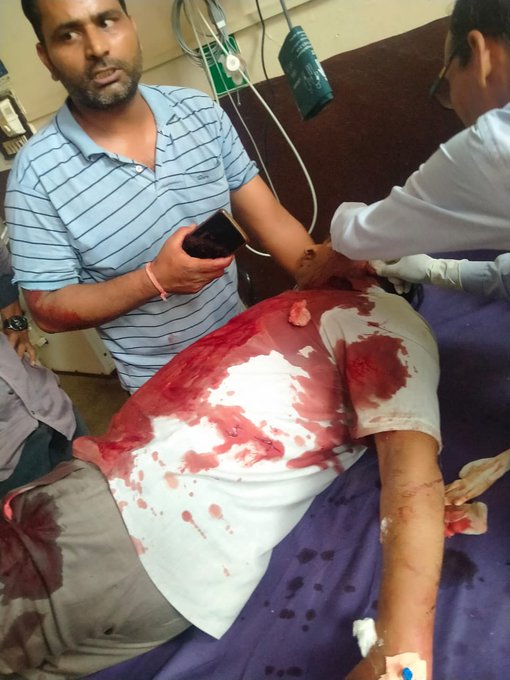
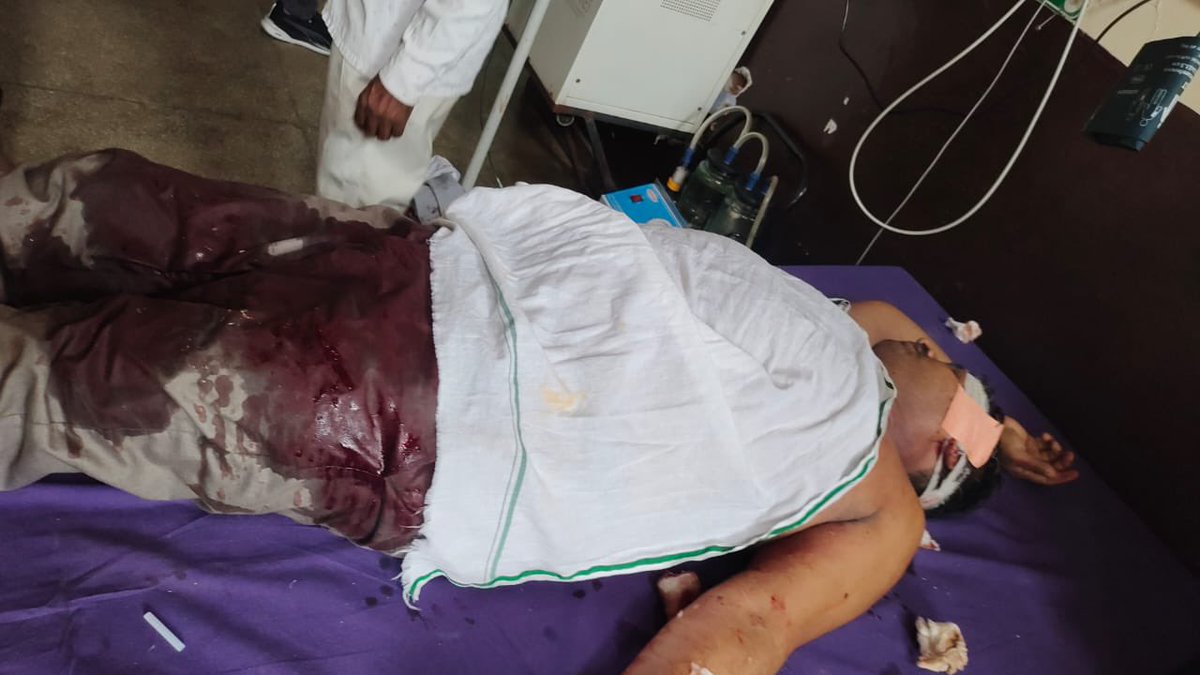
Here are some images of Hindus who were seriously injured during the violence which was unleashed by Islamists.

Injured person in Nuh violence

Here is a video of an injured Hindu after the mob violence by Islamists.

This is the condition of Hindus due to a mere rumour that one individual would be present at a religious procession that was attended by thousands. And the rumour is being used to paint the Muslims as the victims and whitewash the unbridled violence which was unleashed against Hindus on a religious procession and the attack on temples.

Yogendra Yadav, who was also involved in the planning stages of the Delhi anti-Hindu riots “reacted” to the violence and blamed the Hindus instead. This quote was used by Maktoob media to further shield the Muslim mob.

Maktoob Media concluded their article with Yogendra Yadav saying that the Shobha Yatra was “calculated to create communal violence”. He does not really mention who was creating the violence but from his statement, it is clear that he hints that it was the Hindus who were responsible for the violence by Muslims because they dared to enter the Mewat area in the first place. Further, he also blames the police for “allowing” the religious procession to enter Mewat. Therefore, it is evident that for Islamist media and elements like Yogendra Yadav, the Muslims are justified in unleashing violence against thousands of Hindu devotees and attacking several Hindu temples because they dared to enter a Muslim-populated area, which is famously called a “mini-Pakistan”.

In essence, Monu Manesar was merely an excuse to unleash violence. The real problem was that thousands of Hindus had dared to enter a “Muslim area”, as the Islamists call it, and therefore, their mere existence was a trigger that justifies the Muslim mob going on a rampage against Hindu devotees and their religious places.

After the initial report placed the blame on Hindus for violence that was clearly planned, initiated, and executed by a Muslim mob, Maktoob media filed another report where they further demonized Hindus, almost solidifying their narrative that it was the Hindus who initiated violence. So far, they had blamed Hindus for the violence committed by Islamists. With the second report, they craftily tried to shift the narrative and blame the Hindus for the entire thing.

Their second report was headlined, “Haryana violence: Mosque set ablaze in Gurugram; Imam shot dead by Hindutva mob”.

In the first paragraph of the report, Maktoob writes, “As the violence broke out during a procession organized by the right-wing group Vishwa Hindu Parishad (VHP) in Haryana’s Nuh district on Monday, it quickly escalated to other parts of the state, including Gurugram, where a Hindutva mob set a mosque on fire and fired gunshots”.

First and foremost, they brand the mob Hindutva while they failed to identify who started the violence in Nuh. Then, even in their first paragraph, they fail to mention that the violence was started by the Muslims and give the impression that the attack on the mosque is also a part of the same violence that was done by the Hindus in Nuh, while it was the Muslims who started the violence.

It is pertinent to note that the under-construction building, which is a disputed structure and the case is in court, was set ablaze in Gurgaon after the violence spread to Sohna Chown on the 31st of July. Investigation is underway and the police have not ascertained details. There are some Hindus and Muslims who have been detained by the police.

While the first report failed to mention Temples being under attack, the second report mentioned a mosque. While the first report failed to identify Islamists and even justified the violence by a Muslim mob, the second report targeted Hindus without giving context to the violence being initiated by the Muslim mob in Nuh.

It is evident that the aim of Islamist and Leftist media is to create confusion and shield the Islamists who attacked thousands of Hindus in Nuh. Maktoob media is just one of the foot soldiers shielding the mob and normalizing violence against Hindus.

OpIndia Investigation: How Islamists used social media to plan the violence 2 days before Nuh attack and mobilised a mob against Hindu religious procession

On 31st July, an Islamist mob attacked over 4,000 Hindus in Nuh, Haryana. Hindus were on Jalabhishek Yatra on Shravan Somvar. The way the attack happened, there were signs that the events that ensued were planned well in advance. Several social media users also shared screenshots of posts from 29th July to the morning of 31st July, pointing towards possible planning behind the attacks.

During the investigation, OpIndia came across several posts on Twitter and Facebook that showed Islamists were instigating their followers to attack Jalabhishek Yatra. They claimed Gau Rakshak Monu Manesar was scheduled to join the procession. In a previous report, we showed how Islamists shared an old video of Monu Manesar claiming it was recent and that he was the reason behind the violence against Hindus.
OpIndia investigation into Islamists’ social media posts instigating violence

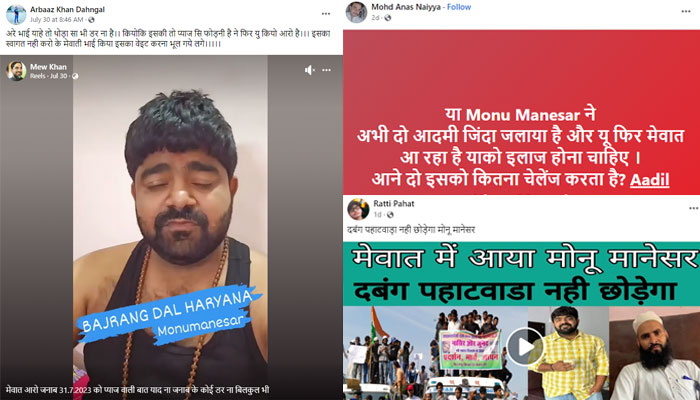
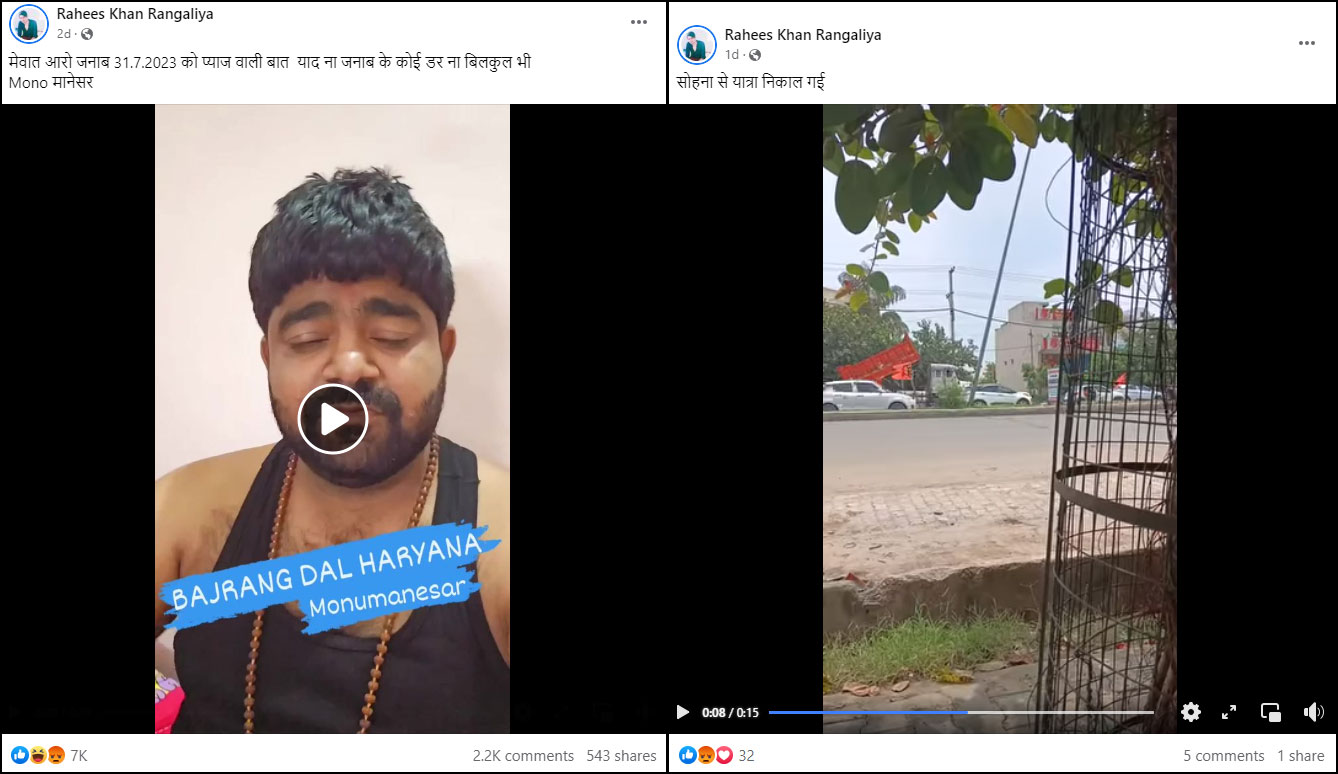
We came across a Facebook user Rahees Khan Rangaliya who not only published a video of Manesar on 30th July saying he [Manesar] was not afraid of coming to Mewat but also tracked the procession.

Source: Facebook

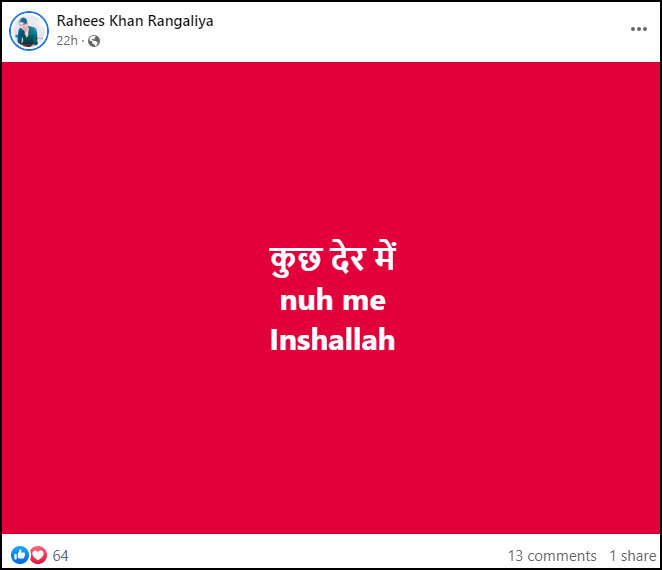
Later, Rahees published a post informing that Nuh was not far away.

Source: Facebook

In a video shared by one Shahid on Facebook, the moments when the Yatra was attacked in Mewat were shown. In the background, Shahid kept using abusive language. Here is the link to the post.

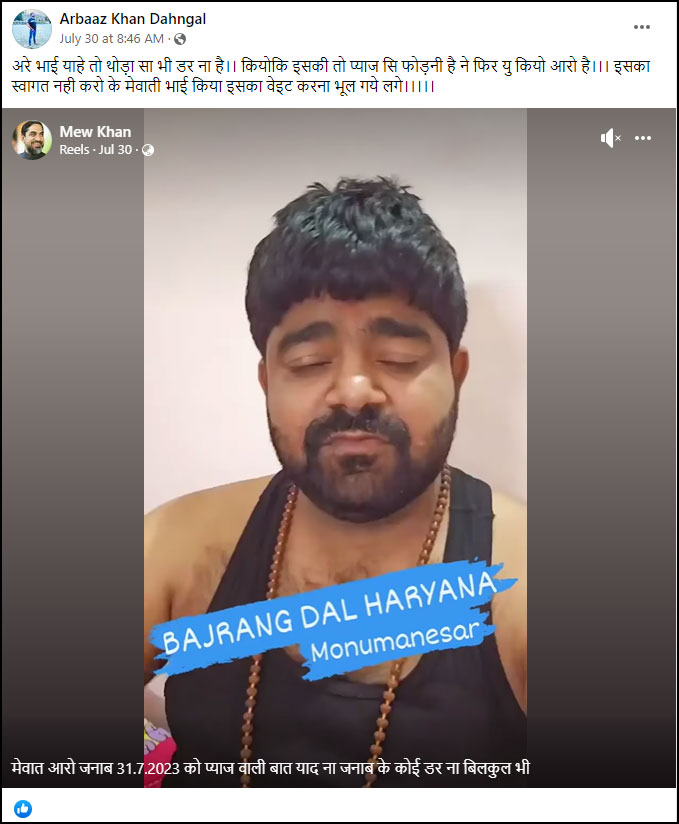
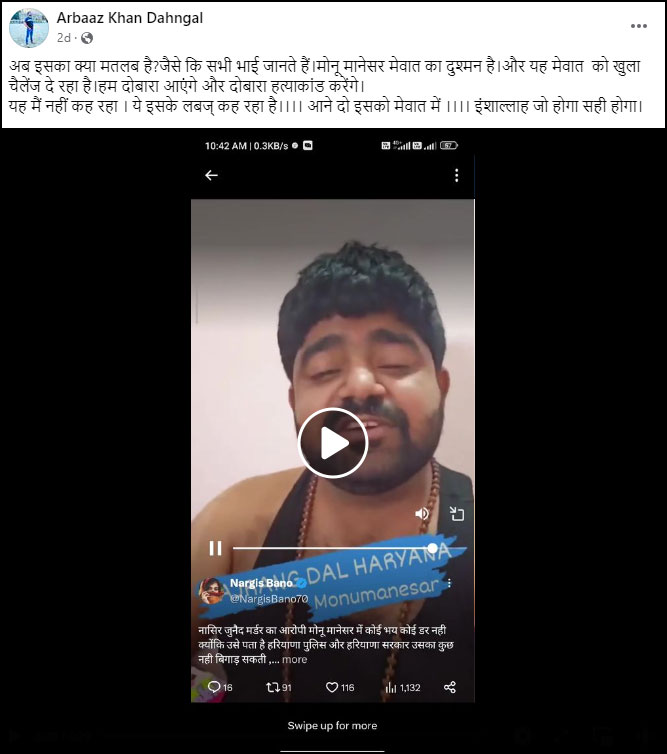
Another Facebook user Arbaaz Khan Dahngai shared Manesar’s video and said, “Brothers, he is not afraid at all. Why is he coming when he knows [people will] peel him like an onion? Won’t you welcome him, Mewati brothers, or you forgot that you were waiting for him…”

Source: Facebook

In another post, Arbaaz claim Manesar said they would kill people in Mewat. However, there was no such statement in the video he shared.

Source: Facebook

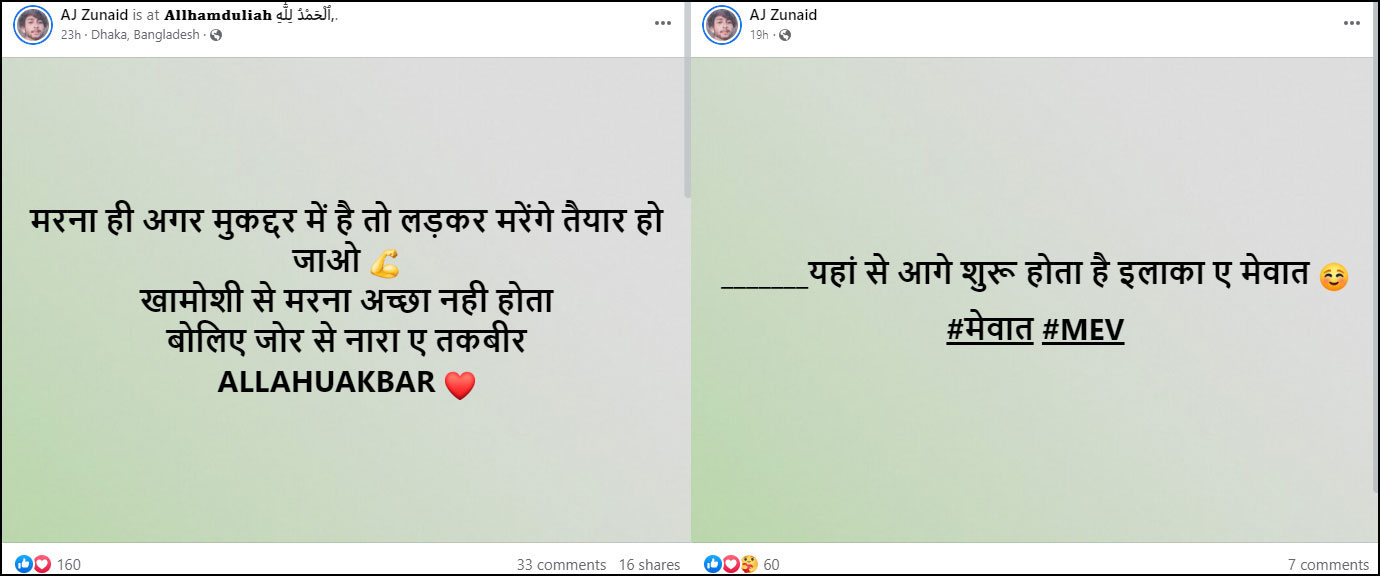
Another Facebook user AJ Zubaid published a cryptic message saying, “If death is written in your fate, prepare to die during a battle. It is not good to die silently. Say loudly Nara-e-Takbeer Allahuakbar”. In the next post four hours later, he wrote, “Ilaka-e-Mewat starts from here”.

Source: Facebook

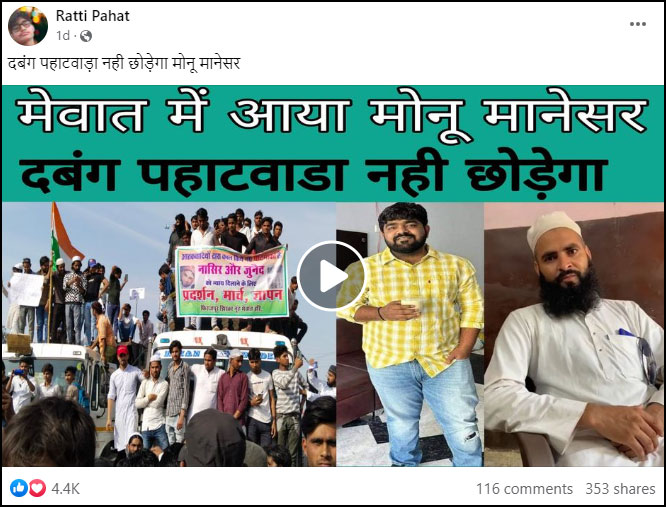
A Facebook user Ratti Pahat shared multiple videos against Manesar instigating his followers.

Source: Facebook

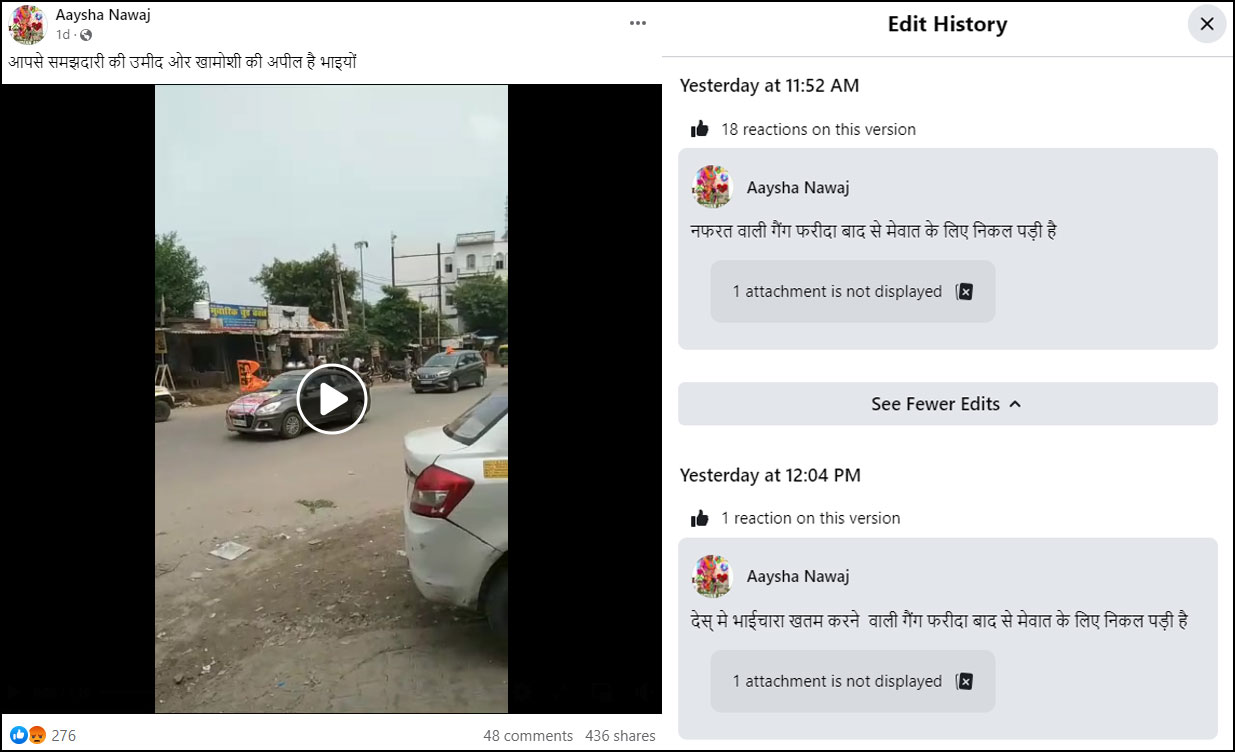
A Facebook user Aaysha Nawaj urged people to be mindful and maintain silence. At first glance, it looked like a sensible post but in reality, she had edited the post. Earlier, the post read, “The hatred gang has left Faridabad for Mewat”. She edited it and changed it to “The gang whose aim is to end brotherhood in the country has left Faridabad for Mewat”. Eventually, after 4-5 edits in 24 hours, she finalised the text urging people to maintain peace.

Source: Facebook

The Pamphlet shared a screen capture of a deleted video post by Mohd Sabir Khan. In the post, he wrote, “Monu Sonu come tomorrow; we are ready for your welcome in Mewat. You will be peeled like an onion in a way you will never be able to recover. Inshallah.” In the video, gas cylinders lined up on the road showing the preparations Islamists have made to attack the Yatra.
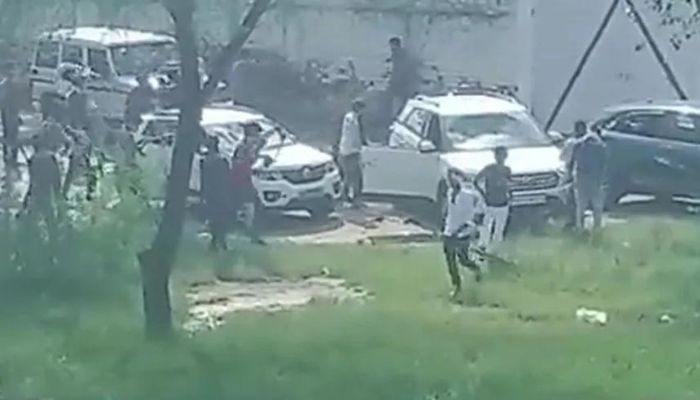
Twitter user Anshul Saxena shared a screenshot of a video where Islamists were pelting stones from the rooftop. It is evident they had gathered stones as a part pre-planned conspiracy to attack the Yatra.
Saxena shared another post by Juned Jsr Khan, who urged truck drivers from Mewat to reach on 31st July.
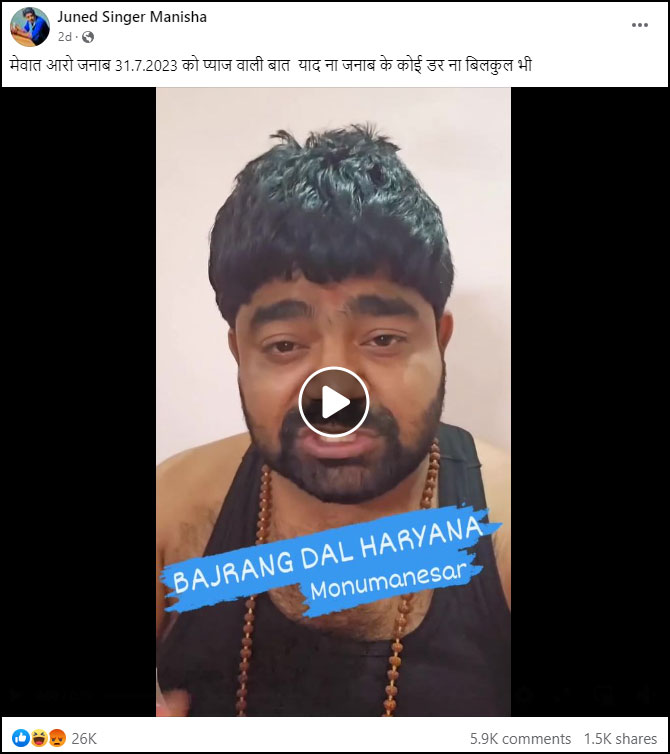
In a post shared by a Facebook user Juned Singer Manisha, he reminded his followers of taking revenge from Manesar.

Source: Facebook

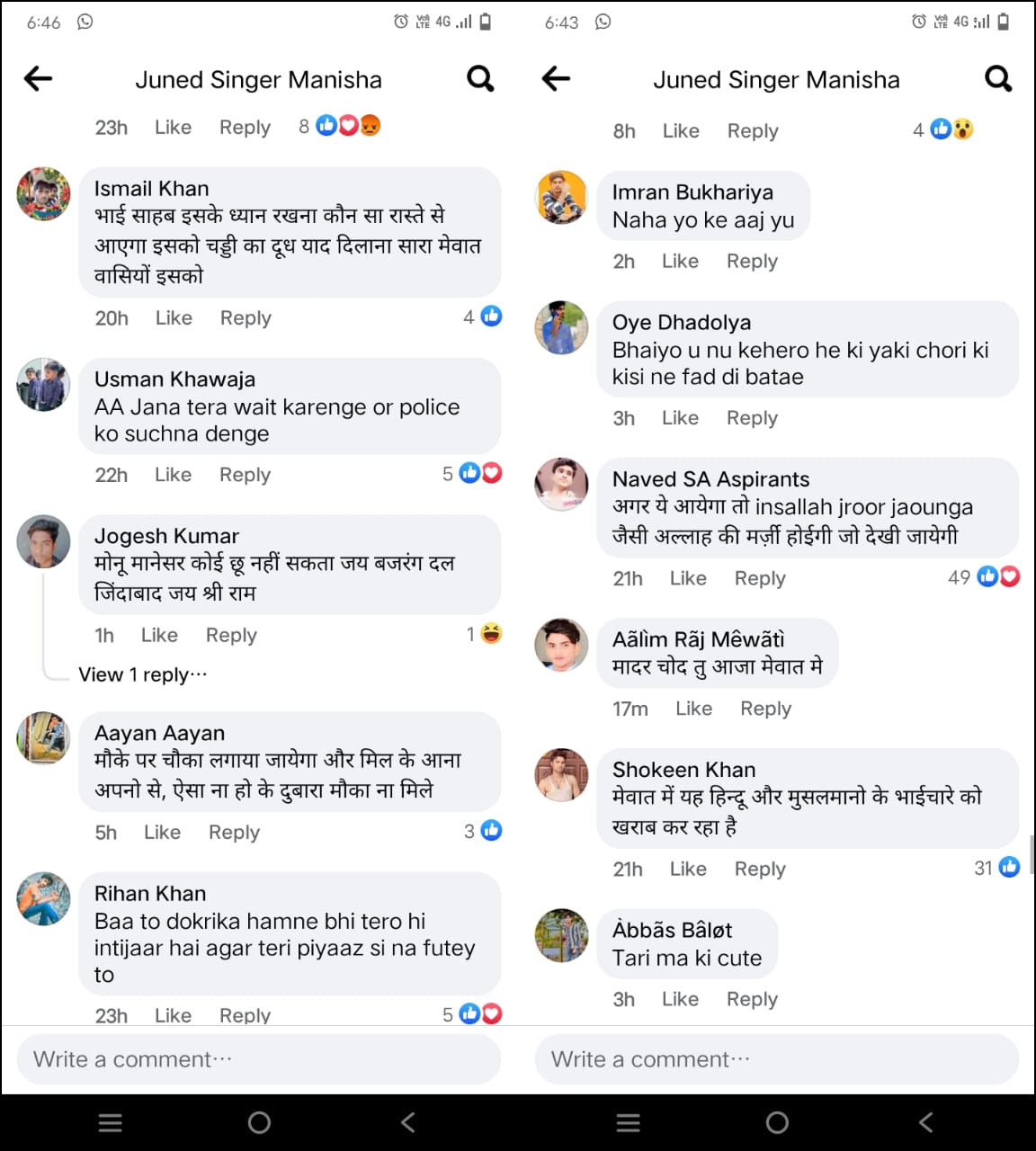
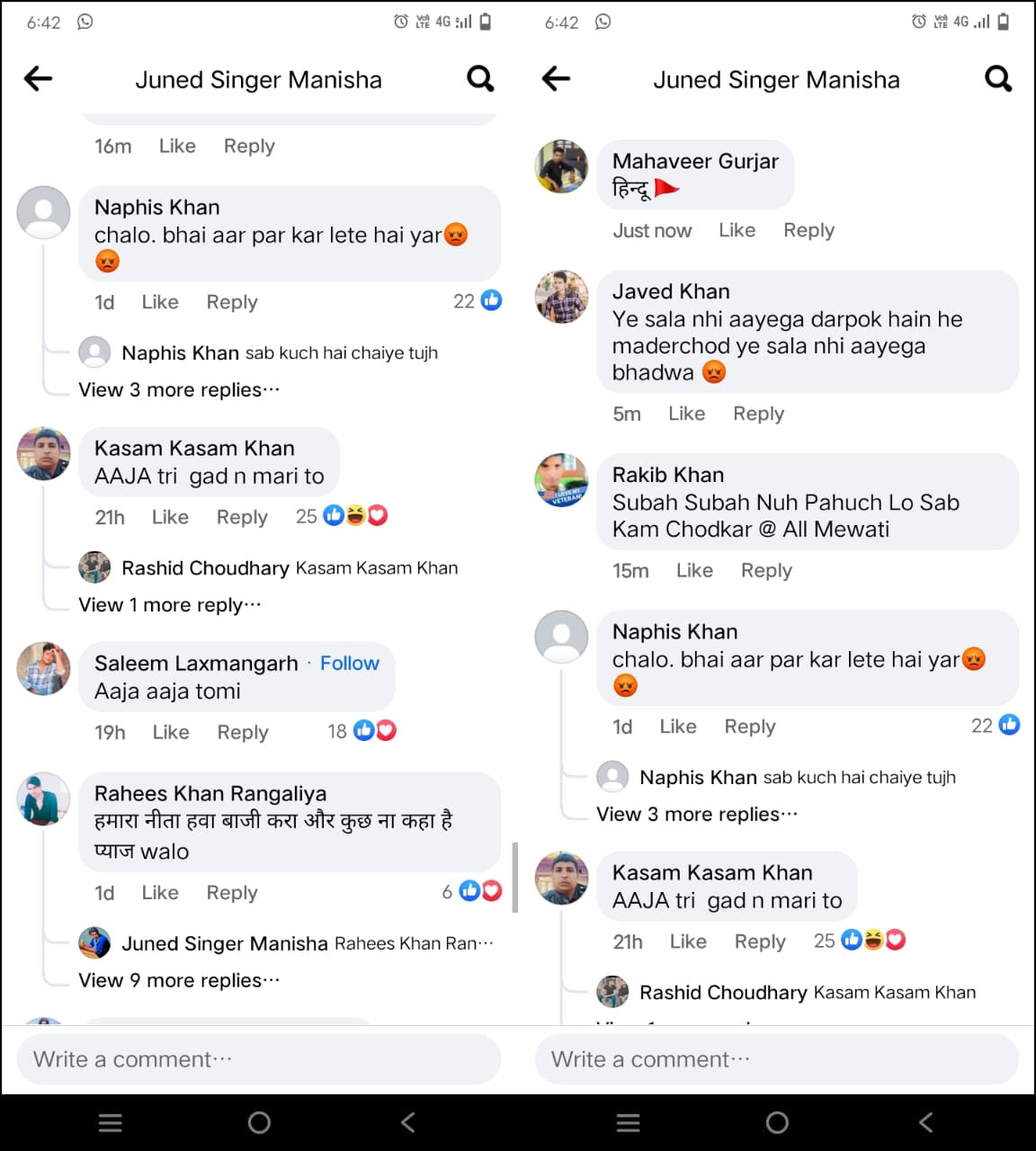
There were over 5,000 comments on this post. Some of the comments have been added below.

Source: Facebook
Source: Facebook

Islamists used social media not only to instigate violence against Hindu processions but also to lay an elaborate groundwork in the form of holding Monu Manesar responsible for the violence that followed.

Mewat Riots: Sweets seller Shakti Saini murdered in Nuh, mob dragged him from his shop and threw his body at the square: Details

Violence broke out in Haryana’s Nuh on Monday, 31st July 2023, during the Jalabhishek Yatra taken out by Hindu organisations. A total of 5 people, including 2 Home Guard personnel, were killed in this violence. Section 144 has been imposed in the area.

According to the latest information, on August 1, 2023, 3 bodies have been recovered from the Nagina area of Haryana. Two of the bodies have not been identified. The third body is said to be of a 34-year-old man named Shakti Saini. Shakti Saini had a sweets shop in Nagina.

Rituraj, an office-bearer of the Haryana Shiv Sena (Shinde faction), told OpIndia that the name of the deceased Shakti Saini’s father is Sompal. He was a resident of a Muslim-dominated Bhadas village. Shakti Saini used to feed his family by running a sweets shop.

Rituraj further told us that it is suspected that Shakti Saini was present at his shop during the attack. He was abducted from the shop and taken elsewhere and later killed and then the dead body was dumped at the same Badkali square around which his shop was located.

It was also reported that the village of Bhadas, where Shakti Saini was a resident, is Muslim-dominated. At the same time, Rituraj described the entire Nagina as part of Mewat and described it as Muslim-dominated. Satya Bhardwaj, another resident of Gurugram, described the situation in neighbouring Nuh as worrisome and appealed that more resources and powers should be given to the police.

OpIndia called the SHO of Nagina to confirm the matter. He said, “I’ll tell you. A case has been registered in this regard.” After this, he disconnected the phone, saying that he was very busy.

‘Jihadis pelted stones, indulged in riots, arson, and rained bullets on Lord Shiv pilgrims’: Bajrang Dal calls for a protest against Nuh violence

0

A day after violence swept the restive region of Nuh in Haryana’s Mewat region, where Islamists went on a rampage against devotees of Lord Shiva participating in Hindu processions, the Bajrang Dal stated that the annual rally organised by them witnessed stone-pelting, violence, vandalism and arson by Islamic jihadis.

In protest against the violence, Bajrang Dal has called for a massive demonstration on August 2 to protest against Islamic Jihadis and terrorism underway at the district level.

“Religious Brajmandal Yatra” organized annually by Bajrang Dal, Islamic Jihadis pelted heavy stones, violence, arson and direct bullets from the hills on the pilgrims on the ancient “Religious Yatra” of Nallahad Shiv Temple, the centre of faith and reverence of Hindus in Nuh, Mewat. In which hundreds of vehicles were damaged and burnt to ashes,” said a statement shared by Bajrang Dal on Twitter.

“Two Home Guard jawans have died and pilgrims and Bajrang Dal workers have been injured. Against this, on August 2, 2023, Bajrang Dal will hold a massive demonstration against Islamic Jihad, and terrorism at the district level,” the statement further added.

Nuh violence: How Islamist attack against participants of Hindu procession triggered violence and riots in Mewat

Tensions escalated in Haryana’s Mewat region following an incident on Monday where stones were thrown at the Brij Mandal Jalabhishek Religious Mewat Yatra. According to reports, individuals from a minority community attacked one of the vehicles in the religious procession. In response, the police intervened, using teargas shells to disperse the crowds and calling for reinforcements from neighbouring areas as both sides engaged in stone-throwing. 

Vehicles were burnt and stones pelted at the Vishwa Hindu Parishad’s Jalabhishek Yatra as clashes erupted between two communities in the Muslim-majority region of Mewat in Haryana.

The VHP members also highlighted that the mob had targeted the procession in an organised manner as a result of this many devotees had turned hostage finding shelter to protect themselves from stone pelting and gunshots. According to media reports, around 2,500 people had taken shelter in a temple near Gurugram.

It was reported earlier that several devotees were stuck at various locations including Nuh temples, chowk, and near the police station after the mob raising slogans of “Allahu Akbar” attacked the Yatra in a planned attack. Following the violence, VHP president Alok Kumar had urged the police and administration to quickly rescue the devotees stressing that the yatra is an annual affair and this year it was targeted in a planned and organised manner.

During the violence, stones were pelted and several cars were set on fire. Police, which initially tried to disperse the mob using teargas shells and by firing shots in the air, had to call in reinforcements. ADGP (Law and Order) Mamta Singh later went with additional forces to try to rescue the people who took shelter at Nalhar temple in Nuh. The police later informed OpIndia that all the Hindus who were trapped in the temple had been rescued and escorted home.