Home Blog Page 2178

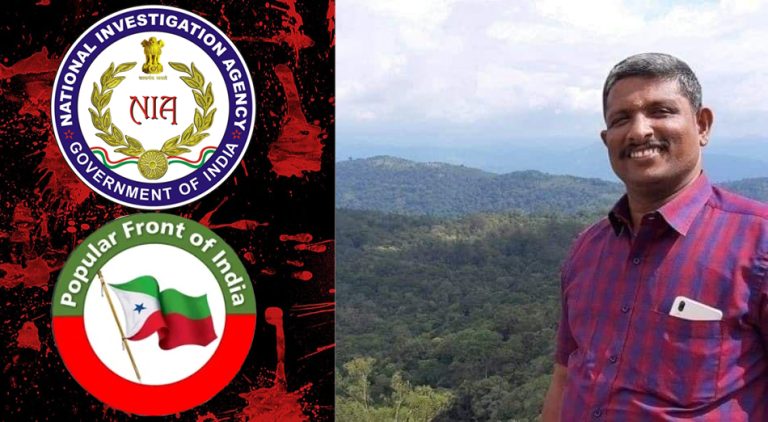
NIA arrests banned PFI member Saheer KV, accused in RSS leader Srinivasan’s murder case

0

In a major breakthrough, the National Investigation Agency (NIA) has arrested another Popular Front of India (PFI) member who was wanted in the gruesome murder of Rashtriya Swayamsevak Sangh (RSS) leader Srinivasan in Kerala’s Palakkad district in April last year.

The accused, Saheer KV, was absconding since the crime and was carrying a reward of Rs 4,00,000. An NIA Fugitive Tracking Team (FTT) tracked him to a relative’s house in Palakkad district and arrested him. A resident of Palakkad, Saheer was part of the PFI Assault and Protection Team that had carried out the targeted killing. Saheer was also responsible for providing protection to the main assailants of Srinivasan.

NIA investigations showed that the accused, who was PFI’s Pattambi Area President, was involved in various conspiracies of the PFI leaders to eliminate Srinivasan, as part of the banned outfit’s bigger scheme to create terror among members of a particular community and to establish Islamic Rule in India by 2047.

Earlier on March 17, the NIA filed a chargesheet against 59 accused, including the PFI as an organisation in the case.

One of these accused, identified as Abdul Naser, died on January 2 this year, said the NIA, adding “Efforts are on to track and trace the remaining 11 absconding accused, out of the total of 59 identified as involved in the conspiracy so far.”

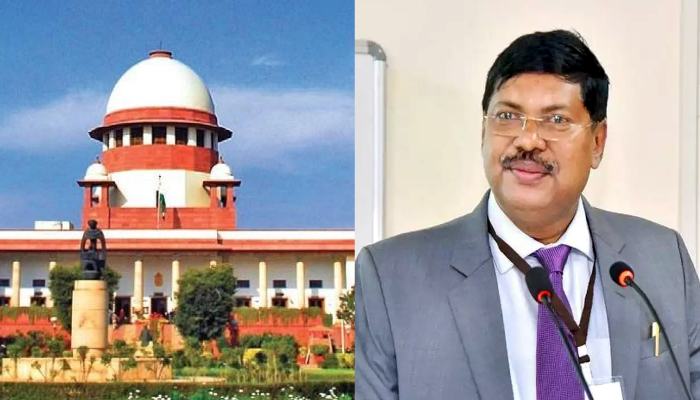
‘Most divorces are arising from love marriages only’: Justice BR Gavai of the Supreme Court

A transfer case resulting from a marriage conflict was being heard by the two-judge bench of the Supreme Court, made up of Bhushan Ramkrishna Gavai and Sanjay Karol on Wednesday, when an attorney revealed that the union was a love marriage, to which Justice BR Gavai responded, “Most divorces are arising from love marriages only.”

The spouse objected to the court’s suggestion of mediation. However, the Court declared that it may award divorce without his assent in light of a recent judgement. The bench thereafter urged for arbitration.

The highest court said earlier this month that it might use its authority under Article 142(1) of the Constitution to grant a divorce on the grounds of irretrievable breakdown of a marriage, regardless of whether the parties agree to it or not.

According to a five-judge constitution bench led by Justice Sanjay Kishan Kaul, it is apparent that the supreme court should be thoroughly persuaded and satisfied that marriage is totally unworkable, emotionally dead, and beyond salvation and that, as a result, dissolution of marriage is the best course of action.

The factual determination and firm establishment of the court’s claim that the marriage has irretrievably broken down will depend on a number of factors, including the length of time the parties had lived together after getting married, the date on which they had last cohabited, and the nature of the accusations made by the parties against one another and their families.

The bench added that there were additional elements that needed to be taken into account, including orders made periodically during legal proceedings, the cumulative effect on the relationship, whether and how many attempts were made to resolve the disputes through court intervention or mediation, and the timing of those attempts.

The top court has the discretion to dissolve a marriage on the grounds of irretrievable breakdown in the exercise of its plenary power under Article 142 (1) of the Constitution and can grant a divorce by mutual consent while forgoing the six-month waiting period required by the Hindu Marriage Act, 1955, the bench noted in its ruling.

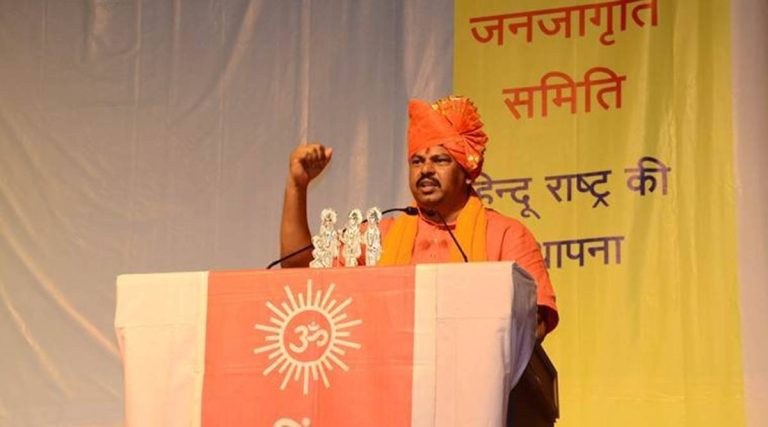
‘We will definitely lift his suspension’: Union Minister G Kishan Reddy says Tiger Raja Singh’s suspension will be revoked at the right time

Months after the Bhartiya Janata Party (BJP) suspended its Goshmahal MLA Tiger Raja Singh from the party in August last year, the party has decided to revoke the suspension. In a recent interview given to ABN Telugu, Union Minister G Kishan Reddy said that the party will soon revoke Tiger Raja Singh’s suspension and bring him back to the party.

Interacting with ABN journalist on the show Open Heart With RK, the Union Minister said, “We will definitely lift the suspension, we are talking with the national leadership. They will take a decision at the right decision.”

Before this, the BJP leader was asked about some BJP leaders saying that the party does not need the support of Muslim voters, to this Reddy clarified that the BJP is not against the Muslim community adding that a significant number of Muslims are working for the party in the Old Town. 

“The BJP is not anti-Muslim. The BJP solely opposes Muslim extremists and Majlis sympathizers. In the old town, the BJP has a high number of Muslims working for the party. In Kerala, a substantial number of Christians are joining the BJP. The BJP alliance parties are in power for the fifth time in Nagaland, where 85 percent of the people are Christians.”

It is pertinent to recall that on August 23, 2022, Tiger Raja Singh was suspended by the BJP for an alleged post on Prophet Muhammad. In the letter issued by the Central Disciplinary Committee of the party, it was mentioned that Raja’s views were contrary to Party’s stand on various matters, and he violated Rule XXV 10(a) of the constitution of the Party that reads, “Breach of discipline includes acting or carrying on propaganda against any program or decision of the Party.”

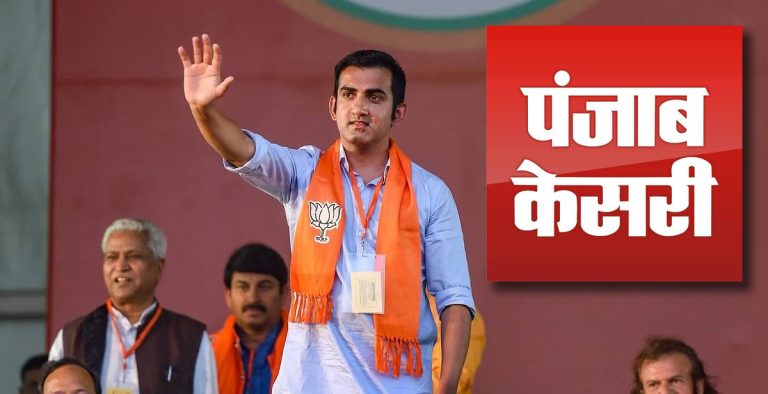
Some words improper but public persons should be thick-skinned: Delhi HC on Gautam Gambhir’s defamation suit, issues notice to Punjab Kesari & others

In response to a defamation lawsuit brought by former Indian cricketer and current Bharatiya Janata Party MP Gautam Gambhir, who charged that the Hindi newspaper Punjab Kesari intentionally published false and defamatory articles against him and used defamatory language, the Delhi High Court on Wednesday served notice to the publication and others. 

The Court, however, declined to provide temporary relief and said that no interim order had been made in the case today. The BJP lawmaker has asked the media outlet for both an unequivocal written apology and ad-interim relief.

The court also observed that even though some of the language used by Punjab Kesari in its reportage on him was objectionable, a public figure must have thick skin.”Any public person should be thick-skinned. With this social media and all even judges have to be thick-skinned,” the bench of Justice Chandra Dhari Singh stated.

In addition, the bench rejected the motion to have one of the news pieces removed since it purportedly used the phrase untouchable. The bench did note, nevertheless, that some of the terms or sentences used may not have been appropriate for the Hindi daily and that the stories emphasised by the plaintiff did give the appearance that the reporter was out to get him.

“If you read all the articles, it is my prima facie opinion that the reporter is behind this person. Some of the words and sentences that he has used is not proper for your paper,” the judge proclaimed.

The bench recognised throughout the arguments that the issue seems to merit examination and was scheduled to be heard before the Joint Registrar in August and the court in October.

The cricketer’s mentioned articles, according to his attorney Jai Anant Dehadrai, went beyond the bounds of fair and impartial reporting. “These two reporters, maybe at the behest of someone else, are targeting me. I ignored them on multiple occasions but this has been like a campaign,” he asserted.

“They are showing me as someone who is not interested in serving the people of my constituency and is busy with the IPL. One of the articles say that I practise untouchability,” the lawyer emphasised.

“If the reporter has gone to the area and found such comments being made then. You are a public servant, an elected person, you need not be so sensitive,” the justice responded.

The counsel submitted that he is requesting an injunction and instructions that the reporters use his client’s account when publishing reports, adding that this is the standard journalistic procedure.

“There can’t be a blanket order. What article is defamatory what is not? As per me, the first article is not defamatory. Any blanket order can’t be there,” the bench replied by rejecting the demand.

When senior attorney Rajshekhar Rao spoke on behalf of the newspaper and its editor, he claimed that the lawsuit had already been published on the Bar & Bench website before the case had even been considered in court. He argued that several other journals had published identical allegations about the politician, but he had only filed an opposition against Punjab Kesari.

The senior solicitor contended, “The difficulty is that this person decides to become an MP, he has decided to sail in two boats. They should explain, are they saying don’t report on me unless Gautam Gambhir likes it? My friend is so touchy about Punjab Kesari, why is he not so touchy about other publications.”

He proceeded by adding that while some of the terms may have been utilised more effectively, this does not constitute defamation. The bench then issued a notice about the application for an injunction after taking the arguments into account.

Background of the case

In the lawsuit filed against Punjab Kesari, its editor Aditya Chopra, and journalists Amit Kumar and Imran Khan, Gautam Gambhir said that they had abused their journalistic freedom by publishing multiple defamatory and libellous stories that were specifically directed at him.

He staked that the newspaper gave its stories a deceptive twist by citing a number of reports. It was alleged that one of the stories even went as far as to equate him to the fabled Hindu demon Bhasmasur.

Sansad Gautam Gambhir Lapata Gali-Gali Me Lage Poster (MP Gautam Gambhir goes missing, posters come up in streets), Dilli ke lapata Sansad Lucknow Super Giants ke liye bane Bhasmasur (Delhi’s missing MP becomes Bhasmasur for Lucknow Super Giants), Adesh Gupta bolte reh gaye, Gautam Gambhir uth chale (Adesh Gupta kept talking, Gautam Gambhir left) and Ye Naye Mijaz ke Sansad hai Jara Faaslo se Mila Karo (This is the MP of a new frame of mind, please keep distance while meeting him) were some of the reports mentioned in the suit.

He insisted that these reports gave readers a misleading and severely damaging impression of his work and credentials as a member of parliament. It was highlighted that the stories show him as a casteist and a haughty politician.

He has also demanded that 2 crores in damages be donated to charitable causes. Furthermore, he urged the defendants to provide an unqualified apology, which should be printed in all editions of Punjab Kesari (including digital ones).

Additionally, he argued that the paper should be given instructions to retract all of the negative articles that had been written about him.

British Board of Film Classification clears The Kerala Story for theatrical release days after causing a delay in certification

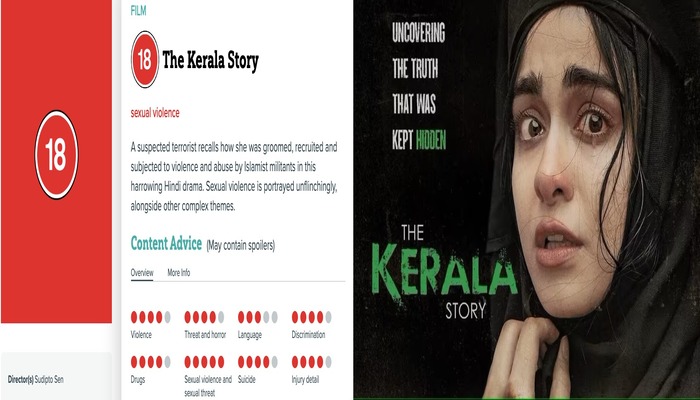
Days after causing a delay in giving age rating and classification to the film The Kerala Story leading to the cancellation of its scheduled release on May 12, the British Board of Film Classification (BBFC) on May 16 granted certification and age rating to the Adah Sharma starrer. The BBFC has given an ’18’ age rating to the film and also issued extensive “content advice” stating that sexual violence is portrayed unflinchingly, alongside other complex themes.

Under its ‘Threat and Horror’ rating the BBFC stated, “A consistent level of threat is maintained throughout, as women are isolated from their families and live in fear of Islamic State militants. Some women are held captive and transported to camps where they are subject to sexual violence.”

The British film certification body under its ‘Discrimination’ rating wrote, “The film presents a partial and unbalanced view of Islam which focuses on radical Islamist characters and motivations to the exclusion of more moderate and mainstream forms of the faith. There are regular scenes of discrimination on the basis of religion and gender. A woman spits on her dying father for not sharing her faith.”

Interestingly, the BBFC opines that the film presents a partial and unbalanced view of Islam, without being mindful of the fact that the film is not based on Islam or intends to portray Islam in a good or bad light, rather the film focuses on terrorism and how non-Muslim girls were brainwashed by Muslim youths into converting to Islam abandoning their original faith and culture and carry out terrorist activities. These recruited converts were sent to Syria to join ISIS or become ‘ISIS brides’.

Notably, OpIndia had reported how even several non-Muslim men were converted to Islam and were later found to be involved in terrorist activities. 

The Kerala Story director Sudipto Sen took to Twitter to share his joy over the film getting a classification by the BBFC saying that “terrorism lost” and people of Britain will watch the “biggest revolution against terror”.

“Congratulations #GreatBritain. You won. Terrorism lost. Shall wait for your reaction. Oh… now British people shall watch the biggest revolution against terror… #TheKeralaStory,” Sen tweeted on Tuesday.

The lead actress of the film, Adah Sharma who plays Shalini Unnikrishnan in the film quoted Sen’s tweet and congratulated the audience awaiting the film’s UK release and wrote, “Congrats all of you, see you in UK #TheKeralaStory,” Sharma tweeted.

On May 12, the day The Kerala Story was scheduled to release in UK theatres, the BBFC informed that the film is still going through its classification process adding that the film will be available for screening in the UK after receiving age rating and content advice.

This sparked criticism on Twitter as people questioned the BBFC over its failure to give certification before the film’s release date. 

Amidst the controversies, debates, and bans, the film is continuing its dream run at the Indian box office and crossed the Rs 150 crore mark becoming the second-highest grosser of the year 2023.

Taking to Twitter noted film critic Taran Adrash wrote, “#TheKeralaStory is now the SECOND HIGHEST GROSSING #Hindi film of 2023… Overtakes #TJMM and #KBKJ to claim the second spot… [Week 2] Fri 12.35 cr, Sat 19.50 cr, Sun 23.75 cr, Mon 10.30 cr, Tue 9.65 cr. Total: ₹ 156.69 cr. #India biz. #Boxoffice.”

The film’s story revolves around the life of Shalini Unnikrishnan, a Hindu girl played by Adah Sharma who is brainwashed into embracing Islam by her Muslim friend, married a Muslim man, and escapes to Syria along with her spouse where she is sent to ISIS (Islamic State of Iraq and Syria) and is tortured there.

Fact Check: viral video showing Muslim couple helping Hindu priest is old, dramatised and scripted

On Wednesday, a video went viral over social media platforms showing a priest of a Hindu temple being helped by a Muslim couple after he fainted on the street in Uttar Pradesh. The video was posted by a Muslim user named Mohammad Sher Ali who claimed that the video portrayed true humanity as the Muslim couple didn’t see the religion of the ill man before offering help.

“The priest of the temple was crossing the road with his son in his arms, when suddenly he fell down due to ill health, no one from the neighborhood came, but the hijab-clad sister and her husband saw the priest while on the bike, and immediately stopped. They helped and saved the life of the priest. This is humanity,” the user tweeted.

The said video is from May 2022, dramatized and scripted

However, team OpIndia checked on the video and discovered that this video is a year old, from May, 2022 and is actually scripted. The dramatized video was widely shared last year with captions suggesting it to be a real incident. It was shared by several Muslim social media users who claimed that the incident was true and that it needed to be lauded.

Reports back then meanwhile mentioned that the viral video had been scripted and created by a YouTube channel named 3RD EYE, which is known for making such ‘public awareness’ videos to garner millions of views.

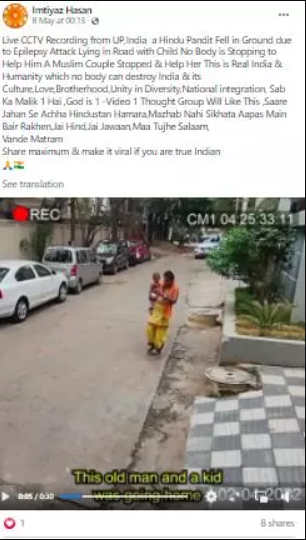
In the trending video, a man carrying a baby while posing as a priest is seen moving along a byway. After some time, he abruptly drops the infant to the ground, lies down, and begins to tremble as though having an epileptic fit. Soon after, a Muslim couple on a motorbike passing by stops and assists the man. They offer to give him a lift home on the motorbike and some water.

The video was also shared last year by several Muslim users on Facebook who captioned the video saying, “Live CCTV Recording from UP, India a Hindu Pandit Fell in Ground due to Epilepsy Attack Lying in Road with Child No Body is Stopping to Help Him A Muslim Couple Stopped and Help Her This is Real India and Humanity which no body can destroy India and its Culture, Love, Brotherhood, Unity in Diversity, National integration… Share maximum and make it viral if you are true Indian.”

Screenshot of the video (Boom Live)

Similar other claims were made by several other Muslim users who stated that Islam taught its followers to help people without seeing the religion of the needy.

3RD EYE YouTube channel created the video last year for entertainment purpose and garnered 14 million views

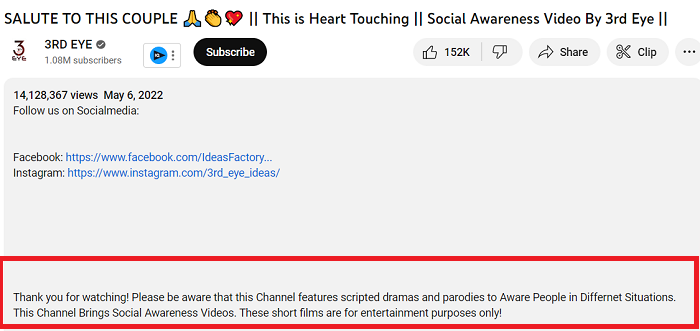
However, it was known that the video was scripted and created for entertainment purposes. The YouTube channel named ‘3RD EYE‘ shared the video in May last year and garnered 14 million views. It also declared that it was a social awareness video and created for entertainment purposes only. The channel has till date created hundreds of such videos for ‘raising social awareness’ in society.

“Thank you for watching! Please be aware that this Channel features scripted dramas and parodies to Aware People in Differnet Situations. This Channel Brings Social Awareness Videos. These short films are for entertainment purposes only!” the channel mentioned in the description box of the said video.

Screenshot of the description box

Similar old video went viral on WhatsApp today

Earlier in the day, similar video made rounds on WhatsApp saying, “Watch! A beautiful example of our great secularism. How a Muslim couple is helping a old Hindu man survive.” The Muslim woman and her husband in the video could be seen helping a old man posed as Hindu priest and offering medicine.

Old video going viral over WhatsApp

The said video is also old and was posted on a YouTube channel named ‘Spy On’ a year ago. The channel also mentioned in the description of the video that the video was created for entertainment purpose.

“Please be aware that this Channel features scripted dramas and parodies, CCTV captures as well. These short films are for entertainment & educational and awareness purposes only!” it said.

New York’s Metropolitan Museum of Art returns 16 smuggled artefacts worth over Rs 9.8 crore to India, were sold by jailed smuggler Subhash Kapoor

The Metropolitan Museum of Art (Met) in New York, which has faced intense criticism and legal scrutiny over some of its listed treasures, including at least 77 Indian artworks connected to imprisoned smuggler Subhash Kapoor, has announced that 16 of those items have been repatriated to India. These 16 antiquities were “illegally removed” which made their way to the New York Museum.

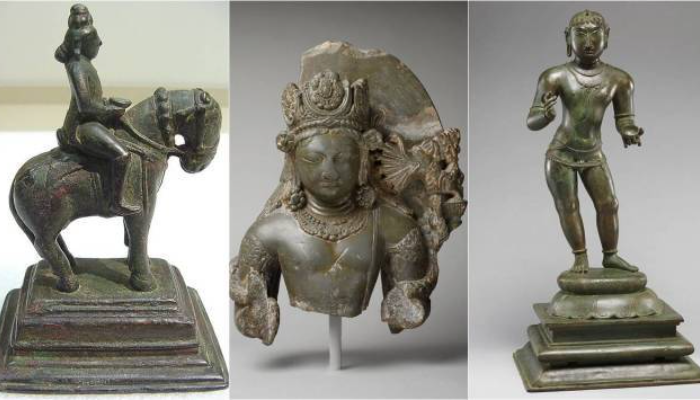
“Last month, in light of new provenance information, we returned 16 works to India, including the Celestial Dancer, a sculpture that enraptured visitors for decades,” museum director Max Hollein mentioned in a statement issued earlier this month. The Celestial Dancer is an 11th-century sandstone sculpture of an Apsara from Madhya Pradesh valued at more than $1 million. The Met said that all the 16 antiquities were sold at one point by Subhash Kapoor.

According to an investigation conducted in March by The Indian Express in collaboration with the International Consortium of Investigative Journalists (ICIJ) and the UK-based Finance Uncovered, the artworks are part of the catalogue at the Met Museum comprising at least 77 antiquities spanning centuries, including 59 paintings, that was linked to Subash Kapoor, who is currently serving a 10-year prison sentence in Tamil Nadu for smuggling antiquities.

An official from the Ministry of External Affairs (MEA) stated, “We can’t comment more than this as of now,” on the Met returning the antiques while legal proceedings were ongoing. Furthermore, the Archaeological Survey of India (ASI) added that it was unaware of any restitution of the works.

The ASI, which is the custodian for returned objects of art, is notified by the MEA after the treasures are often handed over to Indian officials overseas, missions or High Commissions. Afterwards, a team from the ASI verifies and documents the relics and a decision is reached about their actual relocation to India.

The Met pronounced that it is conducting an intensive review of its collection and that a committee has been established to investigate the process by which it acquired artworks and antiquities. Additionally, the museum commented that it will work with a manager of provenance studies to assist in tracing the origins of its assets.

‘We will broaden, expedite, and intensify our research into all works that came to the Museum from art dealers who have been under investigation. Most of these objects came to the Museum in the period between 1970 and 1990. We will convene thought leaders, advocates, and opinion makers in the area of cultural property in various ways, both within the Museum and outside,” the notification read.

“We live in a time when the idea of a cosmopolitan, global society is being challenged, and some, more nationalist voices embrace cultural artefacts less as ambassadors of a people but more as evidence of national identity,” it added.

The New York State Supreme Court issued a search warrant against the Met on March 22. Justice Felicia A Mennin gave the New York Police Department or any agent of the Department of Homeland Security 10 days to seize the possessions and bring them before the court without unnecessary delay.

Upon learning that the sculptures had been forcibly removed from India, the Met asserted that it will transfer 15 sculptures for return to the government of India and pointed out, “All of the works were sold at one point by Subhash Kapoor, a dealer currently serving a prison sentence in India.” The total value of the 15 artefacts was estimated at $1.201 million (nearly Rs 9.87 crore).

At least 94 artworks from Jammu and Kashmir were included in the impressive Asia collection of the Met, including 81 sculptures, five paintings, five pages of a manuscript, two Kashmir carpet antiquities, and one page of calligraphy. None of these objects had information about their provenance, or background records, that would have indicated when and who moved them.

Awarded the title of “one of the most prolific commodities smugglers in the world” by the US Department of Homeland Security, Subash Kapoor was detained in Frankfurt on October 30, 2011, and extradited to India in July 2012.

He was found guilty of burglary and the unauthorised export of idols from the Varadharaja Perumal temple in Kanchipuram, Tamil Nadu, and was given a 10-year prison term by a court there on November 1, 2022. He is now incarcerated in Trichy to complete his sentence. He is also accused in the US of smuggling Asian idols and relics.

“The total value of stolen antiquities known to have been trafficked by Kapoor exceeds $145.71 million,” charged The Homeland Security Investigation (HSI)  in a lawsuit submitted in July 2019.

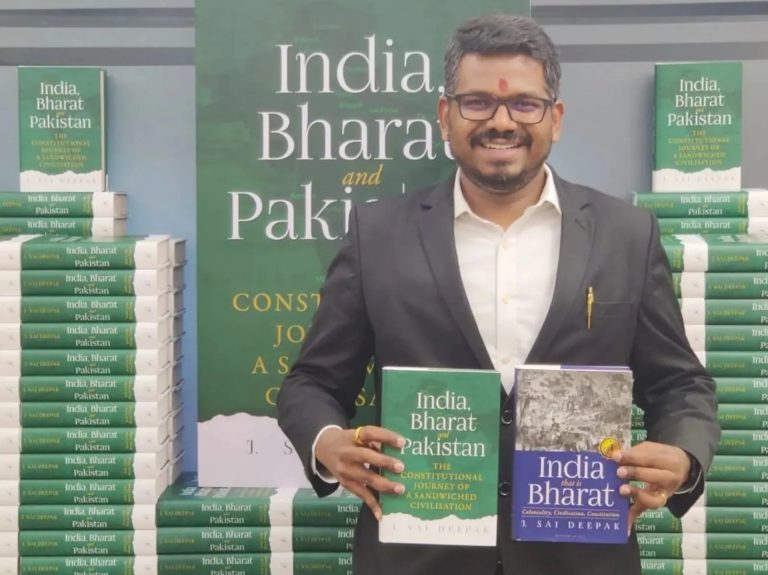
J Sai Deepak demolishes Nehruvian-Marxist monopoly over history in two books: European and Middle Eastern coloniality, truth about partition, pan-Islamism and more

India’s medieval and colonial history and its journey towards a constitutional entity have always been told through a specific perspective, keeping in line with the Nehruvian-Marxist ideology that gained currency in the wake of India’s independence and which wielded a monopolistic influence on the literature produced since August 1947. Very few authors have ventured to challenge the leftist narrative, much less provide a scholarly exposition of calling out the obvious bias in India’s history-telling and its deep-rooted contempt for its civilisational history and evolution.

J Sai Deepak, through being richly persuasive and in possession of unmatched scholarship, brings a stirring and edifying take on topics hitherto pushed into oblivion: how coloniality continues to influence contemporary consciousness among Indians, the urgent need to embrace decoloniality as our first steps towards reclaiming civilisational identity, the impact of the combination of European and Middle Eastern coloniality on native consciousness, and its consequent influence on India’s partition movement, its evolution towards a constitutional entity, and how it continues to inform contemporary consciousness in post-independence India.

In the first two books of the trilogy: ‘India, that is Bharat: Coloniality, Civilisation, Constitution‘ and ‘India, Bharat and Pakistan: The Constitutional Journey of a Sandwiched Civilisation‘, JSD takes on the path less travelled, expounding how the concept of “coloniality” extends beyond the physical occupation of land and exploitation of resources and is a product of a deep-seated mindset that fuels colonialism. He traces the individual and combined impact of European consciousness through British rule and the Middle East consciousness through centuries of Muslim rule on the Indic consciousness, their role in shaping India’s constitutional journey, and the bloody partition of the country.

In his book “India, that is Bharat: Coloniality, Civilisation, Constitution,” J Sai Deepak, a lawyer and thinker, contends that although the colonisation of India’s geographical terrain may have been undone, its people’s minds are still under the influence and constrained by a historical narrative imposed upon them by outsiders, referred by him as ‘coloniality’. Deepak argues that coloniality is so deeply ingrained in the psyche of an average Indian, chiefly through the inheritance of the educational system bequeathed by the coloniser, that the native consciousness, even after seven decades of independence, is still a product of a colonial mindset and informed by western ideals and principles.

He presents a compelling case of how a majority section of Indians are still prisoners of the subconscious colonialism that continues to inform their beliefs and notions, explaining how suppression of indigenous beliefs and the mere desire to express native principles are increasingly labelled as “illiberal” in comparison to other countries where such expressions are celebrated as acts of courage and agency.

In ‘India, That is Bharat’, Deepak takes on the role of an intrepid explorer. His quest leads him to the very core of the idea of Bharat, where he immerses himself in an exploration of its fundamental underpinnings. Starting with a deep dive into historical accounts, he unearths the gradual corrosion that has plagued this concept throughout the ages.

With his profound knowledge of the legal realm, Deepak marshals persuasive evidence to highlight the enduring nature of Bharat. Armed with his findings, he sets out to carve a path towards a decolonised interpretation of the Constitution. His aim is to rectify distortions and breathe new life into the true essence of Bharat, restoring its authenticity and reclaiming its rightful place.

Among few of the most momentous things uncovered in the book is Deepak’s attempt at dismantling the widely held belief that the notion of India as a nation-state did not exist prior to the 1857 mutiny. He presents that India had a ‘civilisational identity’ long before the advent of European colonisers and Middle East invaders on its shores. He professes that there was a rudimentary framework of a “civilization state” that was systematically and rapaciously exploited by an invasive mindset. JSD asserts that the religious motivations behind Columbus’ missions and the British government’s casual infusion of missionary ideas into the Indian social fabric are difficult to refute, and are damning evidence of the British’s imperial conquest of India being guided by the ‘Christian Exercise’.

He goes on to cite various instances when the European and Middle East consciousness asserted itself—from the interference of the Church in India’s daily affairs to the two-nation theory propounded by the likes of Shah Waliullah Dehlawi, Syed Ahmed Khan, Syed Jamal al-Din al-Afghani, and other subsequent Muslim ideologues—which played a massive role in suppressing India’s civilisational identity and supplanting it with imported notions of ‘Nation States’ and ‘pan-Islamism’.

His second book, ‘India, Bharat and Pakistan: The Constitutional Journey of a Sandwiched Civilisation’, charts a path exploring the combined influence of European and Middle Eastern consciousness on India’s Constitutional evolution. The author effectively debunks the concept of the two-nation theory as a 19th-century phenomenon, highlighting how a pan-Islamist ideologue Shah Waliullah Dehlawi was among the first progenitors of the notion that Muslims constitute a separate nation—a belief taken forward by many others, including Syed Jamal al-Din al-Afghani, Syed Ahmed Khan, and subsequent Muslim League leaders such as MA Jinnah, Raja of Mahmudabad, Syed Salimullah—built on the idea that engendered pan-Islamism among Indian Muslims and effectively led to India’s partition.

Sai Deepak’s distinctiveness among previous authors who have tackled this subject lies in his original thinking, which unveiled the true origins of the Two-Nation theory, tracing it back to the decline of the powerful Mughal Empire in India. Following its disintegration, Islamic scholars sought solace by returning to the fundamental principles of their religion and striving to revive it. During this period, Shah Waliullah Dehlawi emerged as a prominent cleric who espoused the intolerant doctrines of Wahhabism, which he had encountered during his time in Arabia.

Shah Waliullah urged the Muslims of the Indian subcontinent not to assimilate into society, as he believed that contact with Hindus would taint their Islamic purity. He encouraged them to perceive themselves as part of the global Ummah, the religious community and mandated adherence to the customs and traditions of the Prophet. While he allowed the Shias to observe their festivals publicly, albeit with strict moderation, Hindu infidels were denied even this modest privilege. Waliullah harboured such animosity towards his homeland, India, that he invited the Afghan warlord Ahmed Shah Durrani to invade the country and teach the non-Muslims a lesson. In his letter, he provided a detailed assessment of the strengths and weaknesses of the Marathas and Jats. This laid the foundation for the sprouting of the Two-Nation theory in India.

JSD provides a context of the partition of India by explaining in detail the sequence of events that led to the partition of Bengal, which he describes as the earliest manifestation of the two-nation theory in the early nineteenth century. The author busts the popularly held belief that Bengal’s partition was a result of Britain’s ‘Divide and Rule’ policy, highlighting how Muslim ideologues, including Muslim League leaders, vociferously demanded the partition of the state in such a manner so as to turn the erstwhile Bengali Hindu majority into minority and achieve Muslim dominance.

The author also demolishes another myth popularised by Nehruvian historians that Hindu-Muslim unity existed long before the Britishers took control of India and it became the first casualty of Britain’s ‘Divide and Rule’ policy. However, that was not the case, and Hindu-Muslim riots predated Europeans and were a source of constant problems for several Mughal rulers, right from Akbar to Bahadur Shah Zafar. The Hindu-Muslim dissension obviously aggravated during the British period, owing to the colonial policy of pitting one community against the other, however, Deepak argues that the race-conscious Britishers’ overt support to the Muslims, whom they considered to be closer to the Christians being the people of the book, to blunt the numerical superiority of more educated and highly rebellious Hindus, deepened the fissures between the two communities.

However, the Hindu and Muslim leaders did come together to fulfil their individual goals and put up a pretence of interfaith harmony to extract better bargains from their colonial overlords. Deepak explains that while Hindus had the realisation of self-government in mind, the Muslims, on the other hand, wanted a communal electorate in a democratic form of government proposed to be introduced in the country, with a higher proportion of seats reserved in every province of the country compared to their numerical strength.

The interfaith harmony, Deepak avers, was a mirage, as the Hindu-Muslim unity always remained contingent upon Hindus relinquishing their beliefs and objections to practices such as cow slaughter, and their attempts to overthrow the British yoke, since the former offended the religious sentiments of the Muslims while the latter would result in Muslims living in a Hindu-majority India.

Even the Congress party, which claimed to be secular, collaborated with the deeply communal Muslim League, agreeing with the latter’s problematic demand of separate electorates for Muslims and standing beside the League for its demand to release the Ali brothers in the period between 1916 to 1917, who would later go on to spearhead the Khilafat movement that saw large-scale anti-Hindu riots across India, including the infamous Moplah Genocide, when 38 Hindus were slaughtered and thrown in a well by Muslim mob demanding a Caliphate in Malabar.

Here again, Deepak reveals another truth bomb that Gandhi alone was not responsible for shaping Congress’ policy towards appeasing Muslims and strengthening pan-Islamist sentiments among the Muslims. Even before Gandhi arrived on the scene and became a ‘force to reckon with’, Congress was favourably disposed toward the Muslim League, including its ‘Extremist’ leaders such as Tilak, Anni Besant, and Pal, beseeching the British to release the Ali brothers and passing resolutions in support to the Ottoman Caliphate that was in the decline, especially in the wake of the Balkan Wars, when the four Balkan states: Greece, Serbia, Montenegro, and Bulgaria, declared war upon the Ottoman Empire and emerged victorious, resulting in the Ottoman Empire losing its European provinces.

JSD also presents the craven role assumed by the Congress party, which went to great lengths to make common ground with the Muslim League and attain the chimera of Hindu-Muslim unity, agreeing to their every demand without receiving commensurate benefits in return, while being equally submissive if not more towards the British, imbibing the coloniser’s worldview with the belief that India did not have a bright and prosperous future without the ‘benevolent’ presence of the British colonisers.

Drawing on historical records and accounts to reproduce speeches and public statements from both prominent and not-so-prominent leaders of the time, including opinions of the British Viceroys and Secretary of State to India, discussions in the British Parliament, correspondences exchanged between British rulers and their Indian counterparts, and so on, the book provides a deeper insight into the Indian history as against the reductionist and one-dimensional version peddled by the Nehruvian-Marxist historian post India’s independence.

JSD’s second book delves into the events spanning from 1905 to 1924, effectively setting the groundwork for the third book of the trilogy. In this forthcoming instalment, the author will carefully examine historical incidents that profoundly influenced the destiny of the Indian subcontinent as we recognise it today. These include the emergence of irreconcilable differences between the Muslim League and the Congress party, as well as the culmination of the constant subjugation of Indic consciousness by the combined forces of European and Middle Eastern colonialism, the lingering impact of these events continues to shape the thought process of contemporary India.


Gujarat: Altaf and Musa pretend to be Hindu tantrics, exploit Hindu devotees and extort lakhs by performing fake tantric rituals

In Gir Somnath, Altaf and Musa from Talala deceived Hindu devotees by promising them immense wealth through fraudulent quasi-tantric rituals, ultimately swindling them out of lakhs of rupees.

According to reports, Altaf Musa, a resident of Panikotha village in Talala, befriended Harishbhai Sadhu from Rajkot approximately two years ago. During this interaction, Altaf noticed Harishbhai dressed in saffron attire, prompting him to inquire if Harishbhai was operating an ashram.

In response, Harishbhai expressed his financial limitations in running an ashram. Taking advantage of this situation, Altaf gained Harishbhai’s trust and made false claims that his father, Moosa Bapu, had received a divine vision from a goddess. Allegedly, Altaf promised to accumulate a staggering sum of Rs 500 crores through tantric rituals.

Upon further investigation into the fraudulent activities of Altaf and Musa from Talala, shocking details have emerged. It has been revealed that the father-son duo, accompanied by their associates, lured Harishbhai, a member of the sadhu community, to their garden. Under the cover of darkness, Altaf’s father, Abu Musa, constructed a makeshift structure resembling a sacred kunda. The victim was coerced to sit inside it while Altaf chanted mantras, claiming to unveil the presence of ‘Mataji’ (Goddess – a divine entity). To substantiate the authenticity of this nighttime ritual, Altaf adorned a long bamboo pole with clothing, resembling the form of an eight-foot-tall Mataji, complete with a helmet and black attire. The complainant was then positioned before this fabricated deity, as part of an elaborate scheme to deceive him into believing that he would be blessed with a vast fortune of 500 crores.

Subsequently, upon the manifestation of Mataji, Musa, standing in the guise of the deity, conveyed to Altaf that the individual adorned in saffron attire required financial assistance. Curiously, right after Musa made this statement, Altaf mysteriously vanished from the scene. Witnessing the apparent divine intervention, the victims began to trust Altaf’s persona and Musa, assuming the role of an intermediary, instructed the victims to procure worship materials worth Rs 5 lakh as an offering to please Mataji.

In order to fulfil this demand, the complainant borrowed money from relatives and handed it over to Musa. Once again, Musa performed the ritual in the presence of Mataji, just as he did it before. However, this time, Altaf, donning the guise of Mataji, announced that the money given was to be considered a donation, while the remaining 500 crores would be granted during subsequent ceremonies.

Subsequently, Musa accompanied Harishbhai to a room and carefully inspected it, ensuring that it appeared completely empty. Once Harishbhai had left the room, Musa seized the opportunity and accessed a pre-existing hidden tunnel within the room that led to the market. There, Musa retrieved the money belonging to Harishbhai, while adding a small sum of his own. Returning to the room, Musa handed the altered amount back to Harishbhai, deceitfully suggesting that the remaining 500 crores could be acquired by performing rituals at Harishbhai’s own residence.

When Harishbhai went home and called Musa at the appointed time and called him to perform the rituals at home, the vial of ‘miracle oil’ was empty from the material that Musa had brought earlier. After which he told the complainant, “When you went back, a ghost has drunk this oil on the way and it will be five and a half lakh rupees to order it again.”

Upon returning home, Harishbhai contacted Musa as scheduled, requesting him to perform the rituals at his residence. However, when Harishbhai examined the materials provided by Musa, he discovered that the vial of ‘miracle oil’ Musa had brought earlier was empty. Musa, in response, informed the complainant, “During your journey back, a malevolent spirit consumed the entire contents of the oil, and it will cost five and a half lakh rupees to procure it again.”

Following the aforementioned incident, Musa summoned the complainant once again, this time to his garden, where the apparition of Mataji reappeared, resembling their previous encounters. However, in this instance, Altaf assumed the role of Mataji and made a peculiar request for a ‘virgin girl’s skull’ to be used in the final phase of the ceremony. Altaf further demanded a sum of Rs 3 lakh to acquire the skull of a virgin girl. Strangely enough, the individual who had previously provided the empty oil bottle also presented the requested skull. Musa then performed a ritual by sprinkling water on the skull, inciting its power, and expressed readiness to visit the complainant’s house to carry out the remaining rituals.

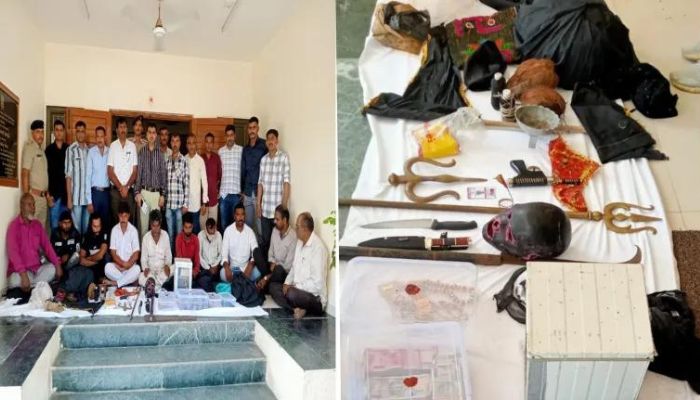
According to sources, Musa and Altaf, accompanied by the victim, embarked on a car journey towards the victim’s residence to perform the anticipated ritual. However, upon reaching the designated location, the police officers, disguised as the victim’s relatives, were waiting in a police van. They swiftly boarded the vehicle and initiated a thorough search, discovering the skull and other ritual-related items. As they proceeded to arrest Altaf and Musa on charges of murder and other crimes, Musa contacted the complainant, only to abruptly terminate the conversation after expressing the so-called Mataji’s anger, claiming that no further rituals would take place. By that time, the group had allegedly swindled Rs 15 lakh from the complainant.

As per an official press release from the police, it has been revealed that Musa Haji Sama had been involved in a long-standing fraudulent scheme, deceiving people under the guise of conducting rituals for several years. Prior to this incident, Musa had previously defrauded his acquaintances of substantial amounts of money by falsely claiming to possess a non-poisonous snake and promising a gold snake as an offering in the name of a deity. These fraudulent activities were carried out using a similar modus operandi by invoking the presence of ‘Mataji’.

The police were taken aback by the revelations made by Musa during their interrogation. Musa confessed to all the crimes he had committed thus far, divulging that he had perpetrated various fraudulent acts. One such incident involved duping a person residing in Kuvadwa, Rajkot, by snatching Rs 25 lakh in cash and a 110-gram gold idol of a naga, while deceitfully promising to rain down a sum of Rs 700 crore upon them. Additionally, Musa had previously swindled another individual in Rajkot by taking a 35-lakh idol of Nag weighing 320 grams, under the guise of performing a ritual that would result in amassing 2500 crores.

Musa’s trail of deceit and fraud extends further, with numerous victims falling prey to his schemes. Among those affected was an Ahmedabad-based couple who were swindled out of 7.50 lakh in cash under the pretext of accumulating a staggering sum of Rs 600 crore. Additionally, Musa targeted the sarpanch of a village in Ahmedabad district, absconding with 11 lakhs in cash and a 110-gram Nag idol. He also deceived Yusuf from Veraval, causing a loss of 11 lakhs, and managed to extract 4 lakhs from two individuals in Bamangir. The list of individuals who suffered financial losses due to Musa’s fraudulent activities is thus unending.

The police have taken legal action in this matter and have filed a case against Musa Hazi Sama, his son Altaf Musa Sama, Sagarita Sikander Shamdar, Abdul alias Vakil, Abdul Ismail Majgul, Imtiaz Sama, Nazim Rafai, Jagdish, Deepak, and Vajesang. These individuals have been charged under sections 406, 419, 420, and 120 (B) of the Indian Penal Code, pertaining to offences such as criminal breach of trust, cheating, and criminal conspiracy.

Following the exposure of this incident, the police issued a public message urging vigilance. They highlighted that even educated individuals can fall victim to deceitful tantric and may hesitate to approach the authorities. In light of this, the police encouraged victims to come forward fearlessly and lodge complaints, while also discouraging the promotion of superstitions perpetuated by such individuals.

US State Dept criticises India on religious freedom using dubious data fed by Christian evangelists and radical Islamist groups. Read Details

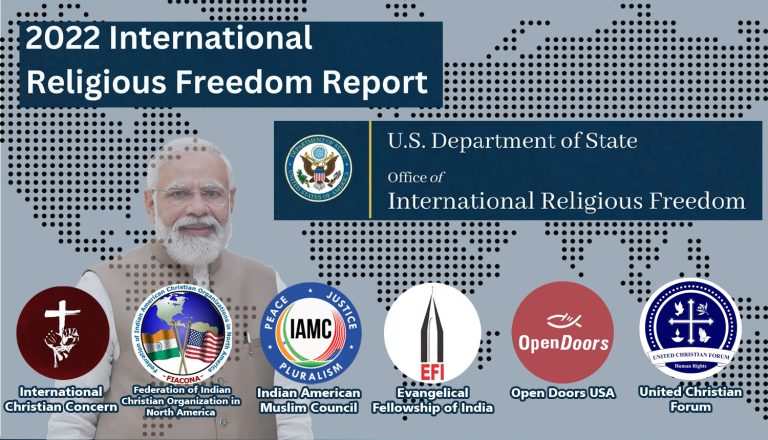
On Monday (May 15), the US State Department released a contentious report, decrying the supposed lack of religious freedom in India based on falsified and misleading data sourced from Christian evangelist groups and radical Islamist outfits. The 2022 Report on International Religious Freedom has been published by the Office of International Religious Freedom under the state dept.

According to Open Source Intelligence (OSINT) Twitter handle, Disinfo Lab, the report placed reliance on organisations such as the Federation of Indian Christian Organization in North America (FIACONA), United Christian Forum, Open Doors USA, Evangelical Fellowship of India (EFI), International Christian Concern and Indian American Muslim Council (IAMC) to allege atrocities on religious minorities in the country.

FIACONA, one of the organisations at the helm of fabricating data on atrocities on Indian Christians, is based in the United States. Founded by one John Prabhudoss, the annual reports by FIACONA have been cited in several news articles to suggest the increasing marginalisation of the Indian Christian community.

In a detailed Twitter thread, ‘Disinfo Lab’ pointed out, “Data is full of duplication, fabrications, and in some cases outright imagination. FIACONA has THREE different data on atrocities on Christians in India in a single report! Talk of precision and records.”

It stated how the Christian evangelist outfit used three different figures in the same report, even extrapolating supposed cases of violent atrocities against Indian Christians to a whopping 30 million (3 crores).

In a classic case of data manipulation, FIACONA relied on dubious calculations, alternating references and sources related to other Christian evangelist groups.

“In FIACONA’s 2022 report about 53.6% of cases are based on 2 sources: EFI-RLC’s report (287) & witness-victims reports (120). But EFI in turn has no references. FIACONA also refers to Persecution.Org or International Christian Concern (ICC). But ICC’s reference is EFI!” the OSINT handle stated.

‘Disinfo Lab’ highlighted how the 4 Christian evangelist outfits, namely, Evangelical Fellowship of India, International Christian Concern, Open Doors USA, and FIACONA kept referencing each other, which was shrewdly picked up by the US State Department for its report on religious freedom.

It found several instances of ‘data duplication’ to create a magnified sense of victimhood. “A cursory look at the data shows majority of ‘documented cases’ are duplicate entries. In Indian States, max duplication is done for UP & Chhattisgarh where single case is repeated 7-8x;~50 duplicate entries on UP alone!” it added.

According to the OSINT handle, one incident is counted thrice (based on reports by three different newspapers). Cases of family disputes, crackdown of the State governments on predatory conversion practices and illegal encroachment by evangelist groups were also counted as ‘atrocities.

“A pastor is jailed is an atrocity. But his release from jail has been counted as yet another atrocity by FIACONA! You can’t make this stuff,” Disinfo Lab exposed the modus operation followed by FIACONA to manipulate data on ‘atrocities against Indian Christians.’

Besides their obsession with ‘Hindu nationalists,’ the Christian evangelist organisations, which fed their data to the US State Department, also misled people by counting cases of child sexual abuse by pastors as atrocities on the community.

FIACONA had also released guidelines, wherein it made clear that any resistance to its right to convert others to Christianity will be considered an atrocity.

“In a webinar held in 2020, FIACONA members boasted the success of ‘increasing conversion’ in India. Ironically, in the same webinar, they stated their agenda of getting India blacklisted!” the OSINT handle underlined.

It further added, “Based on this report, FIOCONA Chair John Prabhudoss infers that the increasing atrocity on Christians is a grave threat to US National Security Interests!(sic) Will the fact of fabrication of atrocity data impact ‘security calculation’ of the US?”

Another organisation, which has been falsifying the data on atrocities is ‘Open Doors.’ It has reportedly placed India on a list of countries known for ‘extreme persecution’ of Christians. It works in close coordination with Islamist outfits such as Indian American Muslim Council (IAMC).

Opindia has reported that IAMC is a Jamat-e-Islami-backed lobbyist organisation claiming to be a rights advocacy group. In the past, it had collaborated with and even paid money to various groups in the USA to get India blacklisted by the USCIRF.

IAMC founder Shaik Ubaid and member Abdul Malik Mujahid have headed the Islamic Circle of North America (ICNA), the US front for Jamaat-e-Islami, Pakistan. According to DisInfo Lab, ICNA has established links with Pakistan-based terror groups like the Lashkar-e-Taiba.

‘Disinfo Lab’ has unearthed that World Watch List (WWL), released each year by ‘Open Doors’, relied on dubious data surrounding the Indian Christian population. Besides, it found a clear mismatch between the violence against Christians in India and ranking of the country on the list.

“…The violence rate per WWL and their corresponding ranking does not tally. Several countries with a lower violence rate are ranked higher, while countries with much higher numbers are given better grading,” it pointed out.

Evangelical Fellowship of India is another Christian outfit which helped propagate misleading data about atrocities on Christians in India.

“EFI ‘documents’ atrocities on Christians in India, but report is replete with stories having ZERO references. Most of the EFI inputs come from another organization: United Christian Forum (UCF) which uses a helpline no. to document cases!” noted Disinfo Lab.

It added, “To recap, the basis of IRF Report is Open Door and FIACONA, which in turn rely on host of other documentation, which in a circular evidence refer to each other. The data is almost deliberately fabricated.”

“Worth noting that the Supreme Court quashed a PIL filed by these fronts accusing the ‘increasing atrocities’ on Christians in India. It is surprising why they were not reprimanded/ fined for such a frivolous PIL based on fabricated data,” the OSINT handle highlighted.

‘Disinfo Lab’ tweeted, “US based Christian orgs and their Indian affiliates create fabricated data, which is lapped by media to build narrative of Christian atrocities – which is then used by US Govt religious watchdog to target India – from a US national security perspective!”

“But all these fabrications and faulty data must not interfere in the narrative building, where the mainstream media is happily following the lead. USCIRF has done its bit, let the pliant media follow. If only ‘journalists’ could read before write,” it concluded.

Similarly, the United States Commission on International Religious Freedom (USCIRF) has also been at the helm of anti-India propaganda for several years. It has cast aspersions on the integrity of Indian institutions and peddled hysteria about an impending genocide in India.

USCIRF, which was created in 1998 by the Clinton administration, has been reporting on religious freedom in India for the past two decades. The US federal government commission has been interfering in India’s internal affairs and portraying a falsified image of India to the rest of the world.