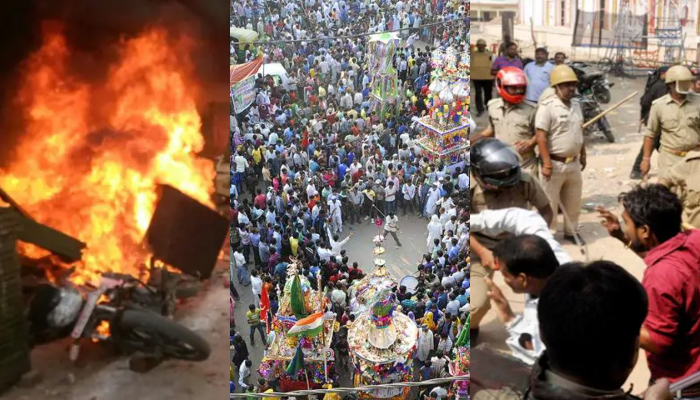
Muharram is viewed as one of the most revered months in Islam, second only to Ramzan. It is particularly significant for the followers of Shia, the second largest branch of Islam, who commemorate and grieve the death of Imam Hussein, the grandson of the Prophet Muhammad, during the Battle of Karbala. However, like other Islamic occasions, it is often marred by violence and unrest, where Hindus are targeted, maintaining law and order turns into a challenge and communal tensions grip entire regions.
The situation has deteriorated progressively over time. This year similarly witnessed multiple incidents from different parts of the country as the weapon wielding processions attacked Hindus, their temples as well as authorities and even raised Pakistan’s flag. Such instances have become the norm nationwide where Muslim mobs create chaos and disorder under the pretext of religious processions.
The following list details multiple major incidents in which law and order was rendered ineffective as the unruly “mourners” rampaged and assaulted Hindus, cops and destroyed properties, during Muharram gatherings from 2011 to 2024.
Hindus assaulted, a youth killed and beheading threats
On the evening of 19th July 2024, some individuals began to play drums in front of a temple, during the Muharram procession in Gausganj village of Uttar Pradesh’s Bareilly which led to a dispute between the two communities. Subsequently, the disagreement escalated into a confrontation as the stone pelting ensued.
The members of Muslim community started hurling stones at Hindus and their houses from the street and harassed women. Numerous individuals sustained injuries as a result which created a tense atmosphere in the area. 26-year-old Tejpal was brutally thrashed and later died while being treated at Bareilly Medical College.
Two individuals, Alamgir and Nizakat, were taken into custody by the police, a day earlier. Alamgir was shot in the leg. A motorcycle and a pistol were found at the scene. It was disclosed that they wanted to instigate trouble during the procession. The police apprehended 35 individuals and conducted a search for those who had fled.
The administration also identified 16 structures, including a place of worship and residences of two primary perpetrators, related to this matter. The houses were demolished as a significant number of police personnel from various stations were stationed in the vicinity.
Superintendent of Police (SP) Manush Pareek infromed that two cases had been registered in relation to the occurrence. It was also revealed that the accused had unlawfully occupied land belonging to the village community and hence, the administration took it down.
Meanwhile, during the intervening night of 16th-17th July, murderous clarion calls such as “Sar Tan Se Juda” were chanted outside the residence of a Bharatiya Janata Party councillor in Kanpur. “Hindustan main rehna hoga Allahu Akbar kehna hoga” (One must say Allahu Akbar if they wish to live in India) was also heard during the Muharram procession.
Shop attacked and looted
On 17th July 2024, Shubham Kirana Store was vandalized and looted during a Muharram procession and the shopkeeper was assaulted with sticks when he protested. The incident which was recorded on CCTV camera happened in Madrasa Gali of Raja Bazar in Patna, the capital of Bihar. Afterward, a large number of cops were stationed in the area and the administration urged the public to uphold peace.
The CCTV footage showed how the shop was relentless attacked by the assailants. The refrigerator was also damaged and when the shopkeeper attempted to intervene, he was struck with a stick as well. He expressed that he had no enmity with anyone. “The attackers claimed that the Muharram procession was approaching and instructed me to close the shop. I lowered the shutter, but they came and started breaking the refrigerator.”
Nevertheless, he refuted the accusation of vandalism following his meeting with the police. His family members stated that the matter pertained to their locality and they did not wish to engage in conflict with anyone as they had to live and conduct business there. They only wished that such an incident should not repeat itself in the future and caution was exercised regarding this matter.
Bricks, stones and attack on police
Bricks and stones were thrown, resulting in numerous injuries, during the Muharram procession at the Karbala ground in Donwa village, located in the Sakra police station area of Muzaffarpur, Bihar, on 17th July 2024. The police rushed to the scene promptly after receiving reports of unrest in the wake of the disturbances during the Tazia procession.
Earlier, a police team that had arrived to confiscate a DJ in Sipahpur Bakhri neighbourhood which is under the jurisdiction of Ahiyapur police station in Muzaffarpur was also attacked. The Muslim crowd targeted the cops with stones, resulting in injuries to around 12 officers, including women. They chased the police for a kilometer, continuing to throw stones at them.
Those who could not flee were assaulted by the throng. Several police vehicles, notably the 112 unit, were subjected to attack. Somehow, the Ahiyapur police and the official automobiles managed to leave from there. The mob also blocked the road and initiated a commotion. People who were traveling through the area were also attacked and stones were thrown at the vehicles.
Over twelve vehicles, both large and small, including buses and cars, were damaged and two passengers experienced head injuries, while one person suffered a broken arm due to the stone pelting. Moreover, Palestinian flag was waved during the Tazia procession in the Mehsi police station area of Motihar after which a youth was caught by the police and was questioned after the video gained traction on social media.
Shopkeeper, his staff assaulted
On 15th July 2024 Muslim youths abused and attacked the owner of Das Music, on the main road in Ranchi following an argument over a forced Muharram donation from a store close to Sankat Mochan Mahavir Temple. The entire incident was captured on CCTV camera and it soon became viral on social media.
The victim, Rinku Das, filed a complaint at the Lower Bazaar police station, stating that two unidentified individuals arrived at his shop and inquired about a donation for Muharram. He refused to contribute and they started to abuse him. His son who was also present there tried to step in but they attacked him and their employee with a rod which wounded the two. The police then arrested the accused.
Jharkhand Bharatiya Janata Party president and former chief minister Babulal Marandi took to social media to condemn the instance and stated that these occurrences could jeopardize the peace and harmony of the entire city.
Hindu family targeted with swords, sticks
On 14th July 2024, a Hindu family inside a car was attacked with sticks and swrods by young Muslim men who took part in the Muharram procession in Dalsinghsarai of Samastipur district in Bihar. They were hurt and their vehicle was wrecked. Afterward, five persons were arrseted by the police after a FIR (First Information Report) was launched.
दलसिंहसराय में मधुबनी के रहने वाले कार में सवार एक परिवार पर ताजिया जुलूस में शामिल लोगों ने तलवार से हमला कर गाड़ी के शीशे तोड़ डाले. कार मालिक का कहना है कि उसने मौके पर @Samastipur_Pol को एवं एसपी को फोन किया पर कोई रिस्पॉन्स नही मिला. एसपी फोन नहीं उठाते ये सही है, अनुभव है pic.twitter.com/Put7hxZfbY
— Bishnu K Jha | Darbhanga (@bisnujha) July 14, 2024
The procession was organized to collect soil for Tazia and participants were engaging in sword stunts while the assembly moved along the main road. During this period, Abhitesh Kumar, a resident of Madhubani district, was traversing the area on his way to Patna. His wife and son were present with him. He had parked his car along the roadside. The culprits broke the windows of his four-wheeler as well as injured him and his family.
The accused also shattered glasses of other vehicles and assaulted bike riders as well as pedestrians. The incident caused unrest as people felt scared of individuals armed with swords and sticks and vacated their vehicles to escape. The police present with the procession reportedly did not take any action and the perpetrators soon absconded.
Common people, police assaulted
On 30th July 2023, unrest broke out during the Muharram procession in the Nangloi area of Outer Delhi, leading to injuries to several policemen and pedestrians. Multiple automobile on the road, including police vehicles, were also damaged. The police indicated that the Tazia procession had more than 10,000 participants. There were attempts to divert the procession from its prescribed route and to forcibly enter the Maharaja Surajmal Stadium, which is located near the Maharaja Surajmal Stadium Metro Station.
The cops attempted to halt their movement as they lacked authorization to access the place which resulted in a confrontation and stones were thrown at the police. Several policemen and bystanders sustained wounds as well as various DTC buses and cars including those belonging to the police were hit. Some officers also incurred injuries.
According to the official complaint filed on Station House Officer Nangloi Prabhu Dayal’s statement, the organizers of the Tazia procession, who arrived on 6-7 carts, began to provoke the crowd to enter the stadium. They were armed with weapons such as swords, knives, iron rods and sticks. When the police denied entry, they retaliated by throwing stones and a member of the crowd assaulted a sub-inspector with a knife.
They also launched stones at people who were walking on the road. They destroyed the glass windows of the passing buses, frightening the passengers. Hundreds of youths were seen racing down the road as people closed their shops and left the area. Traffic was severely congested on the Nagaloi Rohtak road.
Senior police officials including Joint Commissioner of Police also arrived at the scene accompanied by a significant police presence, as cops had to resort to lathichrge to disperse the mob. A case was lodged against the accused under multiple sections of the Indian Penal Code (IPC).
Pro-Pakistan slogans raised
During a Tazia procession on 29th July, 2023, anti-India and pro-Pakistan slogans were shouted, leading to the arrest of 33 individuals in Godhna village of Mirganj police station area in Uttar Pradesh’s Jaunpur district. The action followed the circulation of a 30-second video clip on social media, which captured Muslims chanting slogans such as Allahu Akbar, Nara-e-Takbir and Pakistan Zindabad.
The police immediately took cognizance of the video and submitted a case against 33 people under sections 153A (promoting enmity between different groups on grounds of religion), 153B (imputations, assertions prejudicial to national integration, if made in a place of public worship, etc), 259A (deliberate and malicious acts, intended to outrage religious feelings of any class by insulting its religion or religious beliefs), 188 (wilful disobedience of any order duly promulgated by a public servant empowered by law to do so) and 505(2) (hate speech) of the Indian Penal Code.
A similar instance happened in Jaunpur in 2022. A Tazia procession was held in the neighbourhood on 10th August when pro-Pakistan chants were yelled. Four people were apprehended by police after a video of the incident went viral.
Minor girl gang-raped
A 17-year-old girl who went to attend a stunt show involving sticks during Muharram was gang raped by two local boys, Mohammad Ashfaq and Mohammad Mumtaz. They abducted her and brought her to a field where they violated her sequentially. The incident occurred in a village within the jurisdiction of the Forbesganj police station in Araria of Bihar, on the night of 28th July 2023.
The perpetrators escaped the scene, leaving her in an unresponsive condition. The victim’s mother stated that she went missing during the event after which a search was carried out and she was discovered naked and unconscious in a nearby field. The culprits were nabbed and thrown behind bars after the minor girl unveiled their names.
Hindus attacked and wounded, swords brandished
On 9th August 2022, violence erupted in Kardhana, located within the jurisdiction of the Mirzamurad police station in the Varanasi district of Uttar Pradesh. Individuals transporting Tazia from Jansa village arrived at the Kardhana market via Pampapur. There was a Jamun tree along the path and the people in the procession tried to cut its branches.
However, the Hindus stopped them, but the mourners attacked them and started to throw bricks, stones and even used sticks. Witnesses indicated that swords were also brandished. Adarsh Jaiswal (19), Rajan Jaiswal (25), Rahul Jaiswal (22), Khaderu Jaiswal (55), Bablu Jaiswal (56), Satya Prakash Jaiswal (29), Monu Jaiswal (30), Jamuna Jaiswal (65) and Jwala Jaiswal (60) were gravely injured.
The atmosphere in the Lohta police station area of Varanasi was equally strained. When the Tazia procession from Korauta village arrived at a person named Bhagelu Singh’s doorstep in Kotwa, the participants climed onto his door while shouting slogans which provoked a clash when people voiced their objection. Dinesh Kumar Maurya, the Kotwa outpost in-charge, swiftly reached with his police team and brought the situation under control.
On the other hand, stones were pelted at stores in Bhojipura’s Majhoua Gangapur neighbourhood in Bareilly, on the same day. The footage of the incident, which featured even women from a particular community taking part in the violence, landed on social media. According to reports, the stone-throwing lasted for almost 30 minutes before the police arrived and made an effort to defuse the situation.
➡️जौनपुर में लगे पाकिस्तान जिंदाबाद के नारे
— TV9 Uttar Pradesh (@TV9UttarPradesh) August 1, 2023
➡️मोहर्रम के दशमी जुलूस के दौरान लगे नारे
➡️सोशल मीडिया पर वीडियो हो रहा वायरल
➡️पुलिस ने 33 लोगों के खिलाफ केस दर्ज किया
➡️मीरगंज थाना क्षेत्र के गोधना का मामला।@jaunpurpolice #jaunpur pic.twitter.com/91fuf4wZ8C
The Hindu residents of Majhoua hamlet reportedly filed a complaint against the procession organisers for incorporating DJ music, which caused chaos in the vicinity. They charged that a new custom was being established thereby unsettling the social order. “If anyone tries to start a new tradition, strict action will be taken against him. Hunt is on to nab the stone pelters,” declared the authorities.
Arson, rioting and stone pelting
On 9th September 2019, chaos was witnessed at the Shajapur district headquarters in Madhya Pradesh after stones were allegedly thrown at the Muharram procession which led to a riot as arson and stone pelting commenced. Pankaj Srivastava, the Superintendent of Police for Shajapur district, mentioned that during the late-night Muharram procession, unknown assailants suddenly hurled stones at the procession on Nai Sadak Nathwada, due to which a stampede took place.
He pointed out that during the stampede, unidentified individuals initiated acts of vandalism and arson. As a result, three motorcycles were entirely consumed by fire. Later, senior police officials arrived at the scene and managed to restore order and legal proceedings were started against the anonymous accused. Cops were deployed to the area as a preventive measure.
Hindu man, two others attacked in car
On 9th September 2019, a ruckus transpired during the Muharram procession near Arya Kanya Chauraha (square) in Mutthiganj in Prayagraj of Uttar Pradesh when a car was vandalized and the individuals inside were assaulted. The protesters blocked the square, calling for the arrest of the perpetrators. Police officials, with the support of local leaders, successfully placated the situation by providing reassurance to the public.
The procession was advancing from Arya Kanya Square to Mutthiganj Square at night when the vehicle of a man named Ravi Kesarwani, son of transporter Anil Kumar, was targeted. The glass of his car was smashed and he along with Saurabh Gupta and Ravish Verma, who were accompanying him were assaulted. Ravi was seriously wounded. Once the news spread, residents of the area began to gather and demanded action against the accused. However, they returned after officers assured them.
Cops attacked, violence erupted in many areas
Multiple instances of violence came to light during the Tazia procession in the Gorakhpur district of Uttar Pradesh and its neighboring regions of Uttar Pradesh on 27th September 2018. A Taziadar was electrocuted, after which the mob not only assaulted police officers but also set a police vehicle ablaze. A sub-inspector was left battered and covered in blood, in Bhathat. They also damaged other cars on the road.
This incident occurred in Pipraich, close to Gorakhpur. A young man, who was seated on a DJ vehicle during the Tazia procession, died after he came into contact with the electric wire from the Doordarshan Center in Bhathat. Afterward, the crowed stormed the police station and assaulted a sub-inspector and a home guard who sustained serious injuries. They also vandalized the sub-inspector’s vehicle.
Moreover, another case of unrest in Gorakhpur emerged near Tarang crossing where angered people blocked the road after a youth was attacked with a weapon during a dispute over the movement of the Tazia. Police arrested one person in relation to the issue.
There have been reports of violent incidents in the nearby areas in addition to Gorakhpur. There was one instance in Kushinagar where a dispute over the route of the Tazia procession led to violence, injuring numerous people. At the same time, disagreements over the procession’s route caused Tazias to be obstructed at several locations in Maharajganj, which led to reports of unrest in the area.
Violence was also reported in Deoria. A young person was hurt in the the procession and apparently did not receive adequate medical attention after which the agitated mob damaged Rampur Chauraha, in the district’s Gauri Bazaar. Many automobiles, including an ambulance and police cars, were wrecked by the crowd.
Arson, vandalism and communal tension
On 2nd October 2017 communal tension spread concerning the movement of the Tazia without an established route, in Parampurwa located in the jurisdiction of the Juhi police station in Kanpur district of Uttar Pradesh. It resulted in stone pelting between two groups.
Afterward, six individuals endured injuries and eight vehicles including two cars and four motorcycles were set on fire amidst vandalised, during the Muharram procession. Bricks and stones were also launched.
Param Purwa (Kanpur): Tension between 2 groups over Tazia procession route. Nobody reported hurt, situation under control (earlier visuals). pic.twitter.com/AGpANsht77
— ANI UP/Uttarakhand (@ANINewsUP) October 1, 2017
“The Muharram procession in Parampurva was to be taken out through a certain path but it was suddenly changed which led to a dispute between the two parties. The police force present on the spot managed the situation. But some unruly elements started setting fire to vehicles parked on the roadside. After that, stone pelting started,” highlighted Additional Director General of Police Avinash Chandra.
Law enforcement officials, including senior personnel, were deployed to uphold law and order and to take stock of the violence. The district and police administration requested that citizens stay indoors, owing to the critical situation.
Meanwhile, on the same day, violence was unleashed in Gujarat’s Vadodara during the immersion procession of Tazia, resulting in stone-throwing and three injuries. They wounded were taken to a private hospital. Police had to fire four tear gas shells and three rounds to bring the situation under control.
Violence led to imposition of curfew
On 1st October 2017, several individuals were injured during a Muharram procession in the Jamui district of Bihar after which a curfew was slapped in the area. A considerable number of police personnel were deployed. Superintendent of Police Jayant Kant informed that a minor argument between two groups transpired at Masaurhi Chowk, reported Aaj Tak. Afterwards, members of a specific community took part in arson during the Tazia procession, which resulted in violence and many persons were wounded, including police personnel.
Stone pelting and curfew
On 24th August 2015 curfew was imposed after stone pelting was reported in a locality over a dispute about the procession route.
Shops damaged, houses set on fire
On 5th November 2014, unrest transpired in various districts of Awadh in Uttar Pradesh during the Muharram procession. The crowd engaged in vandalism, damaged shops and torched them. Additionally, multiple instances of gunfire were reported. During the Tazia procession in the Bahraich district, a chaat cart was looted in Parampur of Rupaidiha as a dispute took place. Additionally, a hut was set ablaze and a flour mill was damaged.
The authorities managed to restore order after considerable effort. Likewise, disturbances were reported from Baundi and Payagpur. Another conflict started over climbing onto the platform of a religious place duirng Muharram procession in Mathura Bazar of Balrampur district. Afterward, numerous shops were set on fire and gubshots were heard.
The market remained quiet the following day as well. Police filed a case against several individuals and arrested four. Tensions ran high in Anbhula village of Rasulabad in Musafirkhana, Amethi district when a peg that was in the way of the procession was removed and a house’s thatched roof was put on fire by the participants.
Violence and assault on police personnel
Several individuals were wounded on 5th November 2014, as the Muharram procession in Rajasthan’s Bhilwara descended into violence. Jyoti Swaroop Sharma, an additional superintendent of police, was hurt when the Muslim residents of the old city threw stones at the cops. The crowd was then dispersed by the police using batons. 50 unnamed individuals were booked for rioting and stone-throwing and two were arrested.
A traffic bottleneck also resulted from the brief halt of the Muharram procession near Old Kuthcery Road. Sharma was struck in one eye by a stone that was thrown at him after police ordered the mourners to leave. Two young people were then apprehended for interrogation at the Bhimganj police station after the cops used lathi-charge.
This infuriated the crowd even further and the protesters demanded the their release, pausing the procession for about an hour. The procession was able to continue after the police intervened, but the mourners once more stopped at Tejaji Ka Chowk. After some time, the Muslim mob gathered at the same location and the police had to use force.
Muslim mob instigates terror against Hindus
On 15th November 2012, violence erupted in a bustling market located in the Bhadohi Kotwali area of Uttar Pradesh during the Muharram procession, resulting in a devastating situation in the city. Muslim mobs unleashed chaos in predominantly Hindu neighborhoods.
Additional Superintendent of Police, Shubham Agarwal, reported that 50-year-old Shamim Ansari, son of Hafiz Ansari, along with several associates, unleahsed terror on the area. They blocked the road, did vandalism, arson and threw stones at houses and trains.
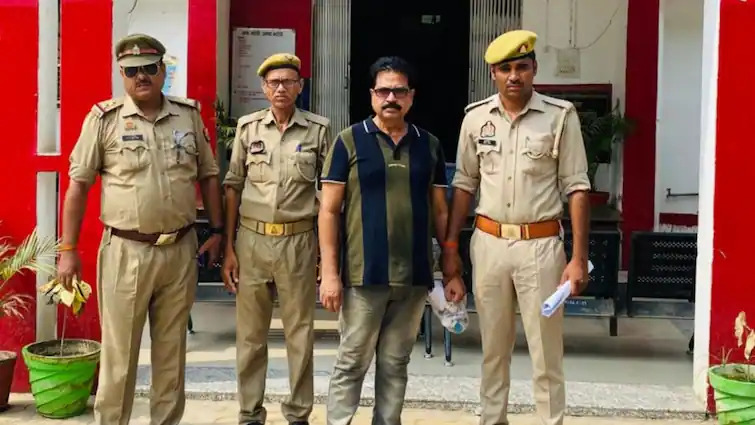
Several sections of Indian Penal Code were slapped on him alongside 152 Railway Act, 4/5 Explosive Substances Act and 7 Criminal Law (Amendment) Act at Bhadohi police station. He was arrested last month following a tip-off from an informant.
Cops targeted, Hindus attacked
A disagreement began on 8th December 2011, when Muslims attempted to take out the Muharram procession by a different route from Malokhar village in the Dulhipur region under the jurisdiction of the Mughalsarai police station in the Chandauli district of Uttar Pradesh. However, members of the other community objected to the start of a new practice which enraged the mob which went on a frenzy and engaged in mayhem, claiming that Tazia was damaged.
A car, many motorcycles, a pumping set, hutments, fodder and mounds of upla (cawdung cakes used as fuel) were set on fire by them. The cops had to use force to break up the rowdy mob. However, the irate crowd started brick-batting, injuring many police officers, members of the media and even residents.
Two of the five seriously wounded police officers were transferred to Varanasi after they were taken to Chandauli District Hospital. 200 people from roughly 25 families were impacted by the violence. Section 144 was imposed on the area.
“After lodging of FIR (First Information Report) against 43 identified persons and over 400 unidentified persons for indulging in violence and arson and interrupting the government work, efforts for their arrest have been intensified. Video clippings are also being utilised to identify the demonstrators. The policemen suffered injuries during violence are out of danger,” stated Superintendent of Police, Chandauli, Shalabh Mathu while talking to The Times of India.
Conclusion
The aforementioned cases represent merely the tip of the iceberg, as Muslim mobs have historically, whether in the name of mourning or celebration, consistently exploited such events to attack Hindus and display their street power in the most reprehensible ways. They provoke with the most offensive slogans, brandish weapons, embark on a rampage and make a complete mockery of law and order. At the same time, the authorities and administration have also largely failed to control them or prevent such incidents.