A report by the Comptroller and Auditor General of India (CAG) has flagged some serious irregularities of the Kerala government regarding purchasing Personal Protective Equipment (PPE) kits, N95 masks, and other essential commodities during the COVID-19 pandemic. The CAG report entitled ‘Performance Audit of Public Health Infrastructure and Management of Health Services’ for the period between 2016 and 2022 was presented in the state assembly on Tuesday.
The report highlighted various flaws in the state’s health infrastructure, including shortage of manpower, poor infrastructure, inadequate supply of drugs, and a lack of minimum essential services as prescribed by Indian Public Health Standards (IPHS) in the state’s health sector.
The Kerala government chose vendors selling at up to 300% higher rates
As per the CAG report, the Vijayan-led government in Kerala refused to purchase the PPE kits from a firm that was supplying the kits at a lower rate and instead purchased the kits from a vendor that was selling the kits at much higher rates. This was done despite the state government order that fixed a rate of Rs. 545 per unit of PPE kit to regulate the market prices during the pandemic. The state government allowed special sanctions to the Kerala Medical Services Corporation Ltd. (KMPSCL) to procure PPE kits, N95 masks, and other essential medical equipment.
Notably, for no apparent reason, the KMPSCL reduced its purchase order from 25,000 units to 10,000 units from the firm offering the base rate and increased orders from 15,000 to 2 lakh units from the vendors charging up to 300% more than the standard rate. The audit report found that the Kerala government’s decision to prefer companies offering inflated rates over companies offering base rates led to an additional expenditure of Rs. 10.23 crore. As per the CAG report, on March 28, 2020, the Kerala government purchased PPE kits for Rs. 550 per unit, and just two days later it purchased the kits at Rs. 1550 per piece.
“Although the procurement was made during an emergency, this does not justify cancelling orders that were more economical for the government. The purchases made from new suppliers at much higher rates resulted in additional expenditure of Rs. 10.23 crore,” the report said. The report alleged that the Kerala government gave undue favours to San Pharma Company. The KMPSCL made a full advance payment to San Pharma, which was selling at Rs. 1550 per unit, violating the authorised limits set by the State Level Crisis Management Group (SLCMG). Besides, the KMPSCL made the full advance payment without even verifying the quality of the kits.
Unsatisfactory implementation of centrally sponsored schemes
The centrally sponsored schemes were not properly implemented by the LDF (Left Democratic Front) government in the state as per the CAG report. “Under the Pradhan Mantri Jan Arogya Yojana (PMJAY), inordinate delay in the payment of insurance claims of beneficiaries was noticed. A District Implementation Unit to support the implementation of PMJAY and a combined unit for anti-fraud, medical audit, and vigilance at the state level with district-level officers were not formed. The number of beneficiaries covered under Janani Suraksha Yojana and Janani Shishu Suraksha Yojana Karyakram was low,” the report stated. The basic patient amenities like seating facilities, toilets, drinking water, ramps, etc. were not taken care of in district and taluk hospitals. The report also pointed out a shortage of staff, including doctors, nurses, pharmacists, and lab technicians, against sanctioned posts in the hospitals.
The report found the doctor-to-population ratio to be most adverse in 2 out of the 14 districts in Kerala. In 13 districts, the shortage of accredited social health activists ranged from 3 to 33 per cent.
Opposition hits out at the state government
VD Satheesan, the leader of the Opposition from Congress, slammed the Kerala government after the findings of the CAG report. He accused the government of being involved in corruption. He said that the state government saw the COVID-19 pandemic as a ‘golden opportunity to fill its own pockets beyond saving the lives of the people’. “The report tabled by the CAG confirms all the allegations raised by the opposition regarding corruption during the COVID-19 pandemic,” alleged Satheesan. He accused CM Vijayan and former Health Minister KK Shailaja of being complicit in the corruption. “The corruption took place with the knowledge of the Chief Minister and former Health Minister KK Shailaja. The first Pinarayi Vijayan government carried out this massive looting during the pandemic when people were living in uncertainty,” he said.
KK Shailaja defends the state government
Former Health Minister of Kerala KK Shailaja dismissed the allegations regarding the purchase of PPE kits in the CAG report saying that the PPE kits had to be bought at higher prices due to shortage. “When there was a shortage of PPE kits, the prices increased. Then, a few kits had to be bought at a higher price. Although lakhs of kits were purchased, only a few were bought at inflated prices. The extraordinary time called for such a decision,” she claimed.
Responding to the allegations of the opposition, she said that the issue was raised several times by the Congress-led UDF in the assembly and a clear answer was given. Therefore, the issue need not be raised ‘repeatedly’.
During the pandemic, the Kerala government was also accused of violating the privacy of people under quarantine. The Communist-led government allegedly collected the personal information of 1.75 lakh people of the state under quarantine, including details of their symptoms and health conditions. The data was compiled by the grassroots-level workers of the state and was transferred to a private company – Sprinklr.
On 21st and 22nd January, prominent Pakistani YouTubers Sohaib Chaudhry and Sana Amjad came forward with chilling accounts of abduction and torture. Both YouTubers had vanished, only to return with shocking details about their disappearance. Their sudden absence sparked widespread speculation on social media platforms, with rumours ranging from voluntary exile to being hanged by the Pakistan Army for their pro-India content. However, in detailed video accounts shared on their YouTube channels, they revealed that a coordinated campaign had been orchestrated to silence their voices and threaten their families.
Sohaib Chaudhry recounts torture and mock executions
Sohaib, well-known for addressing controversial political issues, described his ordeal in painstaking detail. In the video, he said, “At around 2 AM, armed men stormed my home, blindfolded me, and took me to an undisclosed location.” Over the next three weeks, Sohaib was subjected to physical and psychological torture. “I lived in constant fear, thinking each day might be my last. They even staged a mock execution to terrify me into submission.”
He alleged that his captors were linked to a major political party and that they pressured him to join their ranks. “They told me I had three fabricated FIRs against me and warned me that if I didn’t comply, they would destroy my life,” he said.
Despite the threats, Sohaib remained defiant. He added, “Their methods only strengthened my resolve. I will continue to expose the truth and fight for justice.”
He further challenged his abductors, declaring, “You can imprison me for 21 years, but you cannot silence me. I will not stop speaking against corruption and the misuse of power in Pakistan.”
Sana Amjad reveals threats against her mother
In a video statement, Sana Amjad revealed a disturbing aspect of her ordeal, threats against her family. She said, “They targeted my mother, a widow, to force me into submission. They used fake calls and pretended to deliver a wedding card to gain access to her house.” Sana added that unknown individuals intimidated her mother, demanding her location. “My mother refused to disclose anything, despite their threats. This incident left her traumatised and fearing for her life,” she said. Notably, she had recieved notices over her content few months back and there were investigation against her.
Sana, known for her pro-India stance, consistently advocates dialogue between India and Pakistan. Her videos have drawn ire from powerful figures. She questioned, “They believe praising India is a crime in Pakistan. But if leaders, including the Prime Minister, can do so, why can’t I?”
She also shared that during her captivity, she was subjected to verbal abuse and constant intimidation. “They told me that to silence my voice, they would have to ‘switch me off.’ But their torture has removed all my fear. I will continue to make videos that tell the truth,” she vowed.
A pattern of silencing dissent
Both YouTubers suggested that their abductions were part of a broader effort to suppress critical voices in Pakistan. Sana said, “In 2019, I stood in Liberty Market, openly asking people about their views on India. Back then, it wasn’t a problem. Why is it an issue now, in 2024? What has changed?”
Sohaib added, “It’s common in Pakistan to accuse someone of blasphemy or label them an ‘Indian agent’ to destroy their reputation and silence them. I was accused of praising India, but I will continue to speak facts. India’s GDP is ahead of Pakistan’s, and that’s the truth.”
Furthermore, he criticised the lack of support from fellow content creators. “Where are those who claim to champion free speech? Many stayed silent during my disappearance, either out of fear or selfishness,” he said.
Social media silence and international support
Both YouTubers thanked their supporters and Indian media for amplifying their plight. Sana expressed disappointment with Pakistani media and influencers. “Indian media stood by us, but most of our own media chose silence. This silence speaks volumes about the challenges we face as independent voices in Pakistan,” she remarked.
Sohaib, who plans to release more videos with evidence of his allegations, said, “I will expose the people responsible for my abduction. Each proof will show how political parties use intimidation to suppress dissent. They can no longer hide behind their power.”
The future remains uncertain
Both Sohaib and Sana acknowledged the risks they continue to face. Sohaib candidly stated, “My life is still in danger. They may succeed in their plans to eliminate me, but they cannot kill the truth.” Sana echoed his sentiments, adding, “Even if I am silenced, my videos will remain to speak for me.”
The shocking revelations have highlighted that freedom of speech is increasingly under siege in Pakistan. Their ordeal is a stark reminder of how Islamic states like Pakistan treat those who dare to dissent against the government.
The Chhattisgarh Police on Monday, 20th January, conducted a joint operation with the Central Reserve Police Force (CRPF) and the Special Operation Group (SoG) Odisha to kill around 16 Naxalites in the Gariaband district near the Odisha-Chhattisgarh border. As per the reports, the security forces also recovered a large number of weapons and ammunition, including AK-47s, SLRs, INSAS, and other automatic weapons from the accused Naxalites.
Earlier, the Gariaband Superintendent of Police, Nikhil Rakhecha, in a statement, stated that more than 14 Naxals were killed during a joint anti-Naxal operation by the Gariaband Operation Group E30, Cobra 207, CRPF 65 and 211 Battalions, and SOG Nuapada. However, later two more dead bodies were recovered taking the toll of deaths to 16.
Notably, the security forces were also able to kill a member of the Naxalite Central Committee, Jairam alias Chalpati, who had a reward of one crore on his head. Home Minister Amit Shah lauded the operation and hailed the officers for taking a step ahead to make India a Naxal-free country.
“Another mighty blow to Naxalism. Our security forces achieved major success in building a Naxal-free Bharat. The CRPF, SoG Odisha, and Chhattisgarh Police neutralized 14 Naxalites in a joint operation along the Odisha-Chhattisgarh border. With our resolve for a Naxal-free India and the joint efforts of our security forces, Naxalism is breathing its last today,” he said.
Another mighty blow to Naxalism. Our security forces achieved major success towards building a Naxal-free Bharat. The CRPF, SoG Odisha, and Chhattisgarh Police neutralised 14 Naxalites in a joint operation along the Odisha-Chhattisgarh border. With our resolve for a Naxal-free…
Chhattisgarh Deputy Chief Minister Vijay Sharma also said that the elimination of Jairam was a success for the security forces and many automatic weapons had been seized in the encounter.
“14 Naxalites have been killed in 2 days. The special thing is that Odisha cadre CC member Jairam has been killed in Chhattisgarh and the killing of a CC member is the first such incident in the history of Naxal operations to date. Overall, there must have been a reward of more than one crore rupees on his head. So the police have had a big success. Many automatic weapons have also been recovered in this… By March 2026, Naxalism will be completely eradicated not only from Chhattisgarh but from the whole of India,” he said.
VIDEO | Visuals of huge cache of arms and ammunitions recovered following an encounter along the Chhattisgarh-Odisha border in Chhattisgarh's Gariaband district, in which 14 Naxalites have been killed. pic.twitter.com/Wgd7MIEO8V
The Odisha Police released an official statement in the case and said that they had obtained intelligence inputs about the presence of a large number of Maoists since 19th January. “Since the night of January 19, there were intelligence inputs about the presence of a large number of Maoists in the Kularighat reserve forest of Chhattisgarh, just 5 km from the border of Nuapada district of Odisha. A joint inter-state operation was launched by Odisha and Chhattisgarh police and CRPF personnel in the border areas of Nuapada district of Odisha and Gariaband district of Chhattisgarh on the night of 19th January,” it said.
The police said that the slain Naxals included women cadre too and a large quantity of firearms, ammunition, and Improvised Explosive Devices (IED) including one SLR were recovered by the security forces on the very same day.
“In continuation to the above, in the ongoing operation, 12 more Maoists have been killed during the late night and early morning encounter with the SOG team during the ongoing joint inter-state operation on the early morning of 21 January 2025. The number of Maoist casualties may increase. Arms and ammunition have been seized in massive amounts,” the police added in an official statement.
Naxalism set roots in India in 1960s-70s
It is crucial to note that the movement of Naxalism began in the late 1960s when the locals from the Naxalbari village of West Bengal rebelled against the landlords who allegedly tortured the peasants over a land dispute. The movement soon spread to less developed areas such as Chhattisgarh, Odisha, Andhra Pradesh, and the eastern part of Maharashtra, Karnataka, etc. However, later these Naxals began supporting Maoist political sentiments and ideology that aimed at capturing state power through armed insurgency and mass mobilization.
Since then, India has faced security threats at the hands of insurgency groups, often supported by Communists and even terrorists. At times, the involvement of ISI Pakistan has also been reported in such cases. Currently, though many states have Maoist activities, Chhattisgarh is the only state in India where Maoists maintain a significant presence and the ability to launch large-scale attacks.
Over one-third of all Maoist-related violence and between 70% and 90% of all Maoist-related deaths have occurred in Chhattisgarh over the decade.
The movement has been posing a threat to India’s democratic system for years, but if we go on to specifically look at the data from the past two years, several security personnel have been killed, many innocents have been killed assuming they were ‘police personnel’ and many others have faced threats.
Naxal incidents from the past two years
In November 2023, a few hours before Prime Minister Narendra Modi’s rally in Kanker, Chhattisgarh’s Bastar region, Naxals murdered three villagers, labeling them as “police informers.” It was reported that, alone in the Bastar region, the Naxals had murdered 569 innocent villagers in the past 10 years.
In addition to their targeting of security forces, politicians, and government officials, Naxals have consistently resorted to the abduction and execution of villagers as their standard operating procedure. In addition to their targeting of security forces, politicians, and government officials, Naxals have consistently resorted to the abduction and execution of villagers as their standard operating procedure.
In April of that year, an IED blast by Naxal terrorists killed 10 personnel of the District Reserve Guard (DRG) and a civilian driver. The IED blast was aimed at the vehicle carrying the DRG personnel. The incident occurred in the Aranpur area of Dantewada during an anti-Naxal operation. Many jawans were injured and several vehicles were damaged.
#WATCH | On reports of an IED attack by naxals on security personnel in Dantewada, claiming the lives of 11 personnel, Chhattisgarh CM Bhupesh Baghel says, "There is such information with us. It is very saddening. My condolences to the bereaved families. This fight is in its last… https://t.co/n1YV67sIoipic.twitter.com/CC8Dj0uAca
In March 2023, an officer of the Chhattisgarh Armed Forces (CAF) was killed by unidentified Naxals in an explosion triggered by an improvised explosive device (IED) blast in Bijapur of Chhattisgarh. The police informed that the officer belonged to the 19th battalion of CAF’s D-Company and was a native of Uttar Pradesh. The Naxals fled the area taking advantage of forest cover.
In February 2023, BJP district vice president Sagar Sahu (47) was killed at his home in Chhote Dongar village, by Naxals in Narayanpur, Chhattisgarh. Two Naxalites reached Sahu’s home on a bike, knocked on his door, and fired two rounds from an AK-47 as soon as the door was opened. Following the encounter, both Maoists rode away into the jungle.
Sahu killed by Naxals (Times Now)
On February 5 of that year, Neelkanth Kakkem, the head of the Usoor Block (Bijapur District) of the BJP Mandal, was dragged from his house and mercilessly hacked to death by axes and knives in front of his family by Maoists.
In November 2023, a CRPF jawan was injured in a Sukma IED blast set off by Naxals in the midst of the state elections.
In 2019, at least 15 security personnel and one driver were killed in a Maoist attack in Maharashtra’s Gadchiroli district. Naxals had also allegedly set ablaze 27 machines and vehicles near a road construction site in Kurkheda of Gadchiroli district.
Recently in July 2024, two personnel of the Special Task Force (STF) were killed and four others were injured after Naxalites denoted an improvised explosive device (IED) in Chhattisgarh’s Bijapur district. “The incident took place on Wednesday night in Tarrem area when a joint team of security personnel was returning after an anti-Naxalite operation in forests on the tri-junction of Bijapur-Sukma-Dantewada districts,” the police was quoted as saying.
In January 2025, 2 personnel of the Border Security Force were injured when Maoists set off an improvised explosive device (IED) in Chhattisgarh’s Narayanpur district. This happened on 17h January, 5 days after a 10-year-old girl was injured in Sukma district and two policemen sustained wounds in Bijapur district in similar pressure IED blasts.
Notably, on 6th January of this year, Eight police personnel and their civilian driver were killed when Maoists blew up a vehicle with an IED in the Bijapur district.
It is crucial to note that these are a few incidents reported from the last two years in which either innocent villagers or government officers have lost their lives at the hands of left-wing extremists (LWE). As per the government data released in July 2023, there have been 7,649 LWE-related incidents and 2,020 deaths since 2014. In 2023 alone around 31 security personnel lost their lives and in 2024 around 23 did, all at the hands of Naxal leaders.
Naxal-affected districts in India
Notably, the districts affected by Naxalism in the country of India are Giridih, Gumla, Latehar, Lohardaga, West Singhbhum- in Jharkhand; Bastar, Bijapur, Dhamtari, Mohalla-Manpur-Ambagarh chowki Gariyaband, Kanker, Dantewada, Kondagaon, Mahasamund, Rajnandgaon, Khairgarh-Chhuikhadan-Gandai, Sukma, Kabirdham, Mungeli, Narayanpur- in Chhattisgarh; Bolangir, Kandhamal, Malkangiri, Kalahandi, Nabrangpur, Rayagada, Nuapada- in Odisha; Bhadradri Kothagudem, Mulugu- in Telangana; Alluri Sitarama Raju in Andhra Pradesh; Kannur, Wayanad- in Kerala; Balaghat, Mandla, Dindori- in Madhya Pradesh; Gadchiroli, Gondia- in Maharashtra and Jhargram in West Bengal.
Image- Drishti IAS
These districts continue to be affected by the presence of Naxal leaders and Maoists however, there has been a decline in the Maoist violence and the Left Wing Extremism in the country under the national BJP rule.
Maoist violence decreasing under Modi-rule
The Ministry of Home Affairs in the year 2021 stated that the Maoist violence in the country had gone down by 77% since 2010. The government said that steadfast implementation of the National Policy and Action Plan to address the Left Wing Extremism had led to a 77% fall in the LWE. The National Policy and Action Plan (2015) is a multifaceted strategy that includes development projects, security measures, and protection of the rights and entitlements of local communities. Reports mention that violence from 2258 incidents in 2009 had come down to 509 in 2021. Also, the number of resultant deaths has reduced by 90% from 1,005 in 2010 to 98 in 2022.
The Indian government has taken several measures to eradicate Left-Wing extremism. The Ministry of Home Affairs in the year 2006 formed a special division to address effectively the Left Wing Extremist insurgency in a holistic manner. The LWE Division implements security-related programs aimed at increasing capacity in LWE-affected regions. The Division also keeps an eye on the LWE situation and the countermeasures implemented by the states that have been impacted.
The LWE Division further coordinates the execution of various development schemes of the Government of India’s Ministries/Departments in LWE-affected States. In the past few years, the Indian government has also conducted several anti-Naxal operations killing Naxalites, in a step forward to make India a Naxal-free country.
On 16th January 2025, twelve Naxal terrorists were neutralized during an encounter between the security forces and Naxalites in Bijapur, Chhattisgarh. The encounter ensued when a joint team of security personnel was conducting an anti-Naxalite operation in the forest of the south Bijapur region.
On 12th January 2025, 5 Naxals including two women, were killed in an encounter with security forces in Bijapur. Security forces intensified anti-naxal operations in Bijapur after a ghastly IED attack was carried out by Maoists on a vehicle of security forces on January 6th.
In June 2024, eight Naxals were killed in an encounter in Chhattisgarh’s Narayanpur district. “The gunfight between Naxals and security forces broke out in the forest of Abhujmad when a joint team of the security personnel from four districts, Narayanpur, Kanker, Dantewada, and Kondagaon was out on an anti-Naxal operation,” the police said.
In October 2024, security forces in Chhattisgarh conducted the state’s largest anti-Naxal operation in its 24-year history resulting in the death of 31 Maoists, with no casualties on the side of the security forces.
In January 2025, two women Naxals were killed in an encounter with security forces in Gariaband district of Chhattisgarh.
In July 2024, 12 Naxalites were killed in a major anti-Naxal operation in the Wandoli village on the Chhattisgarh-Maharashtra border. CM Eknath Shinde had taken cognizance of the event and congratulated the state police on the operation.
In November 2024, Naxalite Vikram Gowda was killed in a gunfight in the state of Karnataka.
On 22nd January 2025, security forces in Jharkhand neutralized two Naxals.
Amit Shah echoes zero-tolerance towards LWE & 100% implementation of govt schemes
There are several such cases to cite from the past two years portraying the Centre’s non-tolerance approach towards Naxalism. Home Minister Amit Shah in October 2024 lauded the state efforts and said that all LWE-affected states, working shoulder to shoulder, are committed to completely eliminating Naxalism by March 2026. He mentioned that Prime Minister Modi has set the goal of making India a developed nation by the year 2047, and our 8 crore tribal brothers and sisters have a very important role in it.
Amit Shah lauding state efforts to combat Naxalism
“The biggest obstacle in bringing development to remote areas and tribal communities today is Naxalism. Naxalism prevents education, healthcare, connectivity, banking, and postal services from reaching villages. In order to ensure that the development reaches the last person in society, we must completely eliminate Naxalism,” Shah opined.
“Through the joint efforts of the central and state governments, we aim to replace the darkness created by left-wing extremism with constitutional rights and start a new era of development and trust instead of the violent ideology of left-wing. With a zero-tolerance approach towards left-wing extremism and 100% implementation of government schemes, we want to fully develop the LWE-affected areas,” he added.
Development by centre in LWE affected areas
As per the data released by the Centre, more than 10,300 km of roads have been already constructed in LWE-affected areas under the specific schemes. 2,343 mobile towers have been installed under Phase I and a work order has been issued for 2,542 towers under Phase II of the mobile connectivity project for LWE Affected Areas. Rs 3,078 crore has been released to the Most LWE affected districts under the scheme ‘Special Central Assistance (SCA)’ to fill the critical gaps in public infrastructure and services. A special focus has further been given to the skill development and entrepreneurship of the youth. 47 ITIs and 68 Skill Development Centers (SDC) have been approved under the Skill Development Scheme in 47 LWE Districts affected by LWE’.
For financial inclusion of the local populace in these areas, 1,236 bank branches have been opened, 1,077 ATMs have been installed and 14,230 banking correspondents have been made functional in most LWE-affected districts under the leadership of PM Modi. Further, 4,903 post offices have also been approved for LWE-affected areas in the last 7 years, of which, 3,053 have been made functional.
As per recent data, from 2014-2024, around 8551 Naxal terrorists have been neutralized, and many thousands have surrendered across the country. In major events in 2024-2025, 11 Naxals surrendered in Gadchiroli, Maharashtra; six surrendered in Karnataka; in December 2024, 11 surrendered in Odisha; in April 18 Naxals surrendered in Chhattisgarh’s Dantewada in April 2024; in July 4 surrendered from the state; 9 surrendered in Odisha; and the list goes on.
Nine Naxals surrendered in Odisha (The New Indian Express)
Conclusion: Difference between India’s social, and economic realities and Maoist ideology needs to be highlighted
Though the center is taking massive steps to fight the problem of Naxalism, there are several areas in Chhattisgarh, Jharkhand, and even parts of Maharashtra that remain affected by the problem. Notably, considering the Centre’s efforts through a holistic approach focusing on development and security-related interventions, the LWE problem can be successfully tackled. The extremists certainly do not want any kind of development in LWE-affected areas and so their frequent targets remain school buildings, roads, railways, bridges, health infrastructure, and communication facilities. As stated by the Centre, these attacks stem from a “desire to keep the population in their areas of influence marginalized to perpetuate their outdated and failed ideology”.
The influence of LWE has held up development in several affected areas across the nation. Civil societies and media must recognise this and raise their voices against Naxal activities, pushing extremists to abandon violence and surrender to the authorities. The difference between India’s social, economic, and political realities and Maoist ideology needs to be highlighted as violence can in no way lead to a democracy that strives to offer accessible means and resources to address grievances.
Ahead of the assembly election in Delhi, the pollution of the Yamuna River has become an election issue, with opposition parties targeting the ruling Aam Aadmi Party for failure to fulfil its promise of cleaning the river. Amid this, former CM Arvind Kejriwal has made a shocking claim, as he has denied spending around ₹7000 crore to clean the river.
The AAP supremo made the claim in an interview with journalist Subhankar Mishra. During the interview, Mishra cited a 2023 report by the Delhi Pollution Control Committee saying that nearly ₹6,856.91 crore was spent in five years, from 2017 to 2021, to clean the Delhi stretch of Yamuna, and asked why there was no visible sign of the work done after spending such a huge amount.
To this, Arvind Kejriwal shot back at the journalist, accusing of alleging that AAP has pocketed ₹7000 crore of govt money meant for cleaning river water. When Subhankar Mishra tried to explain that he was not alleging corruption, and only wanted to know why the river remained dirty after spending the amount, Kejriwal counter-questioned him asking where the money had been spent.
When Mishra said that it was reported by major media houses, the former Delhi CM said the reports are wrong. He said that the journalist should use his brain to know that the report is wrong. Kejriwal kept trying to play the victim by pretending that the journalist was accusing the party of misappropriating the money, adding that if the party had so much money, CM Atishi would be doing crowd funding her election campaign.
Notably, the Delhi Pollution Control Committee is an autonomous regulatory body in the Delhi government, and its budget is part of the budget of the Government of the National Capital Territory of Delhi.
Arvind Kejriwal refused to directly address the issue of why the Yamuna has not been cleaned yet, only listing the causes of why the river is dirty. He didn’t forget to target other states for the issue, blaming people from other states of settling near the river.
Delhi Pollution Control Committee report of spending around ₹7,000 crore to clean Yamuna River is wrong, claims Arvind Kejriwal, says he does not know how much was spent pic.twitter.com/TUbaZQAdeZ
The former CM did say that his govt has built sewer pipeline networks in the colonies on both sides of the river but refused to divulge how much was spent on it. He said that the govt is in the process of building new sewer treatment plants and upgrading the existing ones, and assured that the river will be cleaned by the next term.
The AAP leader also declined that he had promised in 2015 to clean River Yamuna within 5 years so that people could go for picnics at the river, claiming that he said this only in 2020. But when Mishra said he said it in 2015 and there are videos of the same, Kejriwal said it does not matter whether he said it in 2015 or 2020, as he has now promised to complete the job in his next term of the AAP govt.
Arvind Kejriwal has been promising a clean Yamuna River for 10 years, with no result, and now he has claimed the Delhi Pollution Control Committee report of spending around ₹7000 crore is also wrong. In 2015, the AAP supremo had promised to clean and revive the water body within a span of 5 years i.e. by the year 2020. “We will revive Yamuna within five years,” he had claimed then.
In November 2019, he said his government has planned to clean the Yamuna in the next four to five years, claiming that people would be able to take a dip in it. In December same year, he promised that by the next elections in 2025, he would take the whole village for a dip in the Yamuna.
In January 2020, just before the assembly elections, Arvind Kejriwal claimed, “The Yamuna will be cleaned and made pollution-free. We promise that after five years, anyone will be able to take a dip in the Yamuna without fear of diseases due to dirty water.”
That five years have also passed, and Kejriwal has made another promise to clean the river by the next term. In the meanwhile, data obtained from the Delhi Pollution Control Committee (DPCC) suggests that the pollution in the Yamuna River has doubled between 2015 and 2023.
Muslim-dominated Sambhal in Uttar Pradesh has recently been in the news following the unrest during a court-ordered Archaeological Survey of India (ASI) survey of the Shahi Jama Masjid. The violence against authorities led to casualties, injuries and destruction of property. Notably, there have been anti-Hindu riots in the region on multiple occasions, including in 1976, 1978, 1986. Likewise, there have been frequent reports of Hindu migration from there as well.
Yogi Adityanath, the chief minister of Uttar Pradesh, recently addressed the state assembly and highlighted the same issues.
The violence of 1986 which was largely forgotten, has been grabbing attention again as stories emerge. Due to politicial reasons, many victims still await justice. A son has applied to the Judicial Investigation Commission regarding the murder case of his father, who was killed while being locked inside a store. He stated that his family used to deal in wholesale sugar and the shopkeeper who murdered his father was their retail customer, reported Dainik Bhaskar.
“He took my father inside the store and, with the assistance of his staff, assassinated him when the rumors began to circulate following the deaths of two Muslims,” the son shared. Rashtra Bandhu Rastogi, who lives in the Sambhal Kotwali neighborhood of Kot Purvi, submitted the petition to the Judicial Inquiry Commission on 21st January at the PWD Guest House. He informed that the 1986 violence claimed the life of his late father, Bhagwat Sharan.
He expressed, “I revealed everything about the incident. The intersection of Chaman Sarai and the hospital was marked with a flag. There was a rumour at the time that two Muslims had been murdered by Hindus which resulted in a lot of tension and something akin to an unofficial curfew was imposed. Pushpa Singhal of the BJP (Bharatiya Janata Party) had arrived that day, and my father had gone out of the house to hear her speech.”
“He needed to buy sugar and went to Kheru Halwai’s shop to do so. My father walked into his shop after the shopkeeper directed him to come inside because he might tumble in the crowd that was shouting from the direction of Ghantaghar market. He shut the store’s front door and then the employees along with the owner murdered him,” Rashtra Bandhu Rastogi recounted the horrific incident.
According to him, the only reason his father was killed since he was the first to bring RSS (Rashtriya Swayamsevak Sangh) to Sambhal. His acquaintance Kallu called him inside the shop to end his life, per a report in News18 Hindi. Rastogi was one of the people that moved out from Khaggu Sarai many years ago. He relocated to Sambhal’s Kot Purvi locality with his family. Rashtra Bandhu Rastogi mentioned that his father founded RSS in Sambhal. The former fought the case against all of the accused for half of his life, but he was unable to obtain justice owing to hostile witnesses.
The location of the temple in Khaggu Sarai was once home to numerous Hindu households, according to Rashtra Bandhu Rastogi, who had experienced the hardships of migration in Sambhal. However, people left Sambhal after the bloodshed there. He once owned several warehouses but then lost everything and now in his old age works in a post office to make ends meet. The accused even attacked him multiple times when he went to court to seek justice for his father. He asserted that a large scale riot would have transpired if the police had not been present during the rioting by Muslim mob on 24th November.
Rashtra Bandhu Rastogi stated that his father had gone out to buy sugar at the time of the unrest in Sambhal in 1986 when the rioters came from behind. His father was well-known in the community and was associated with the RSS. A shopkeeper had called him and assured him that he would be saved if he came inside the store. However, he was the one who stabbed his father with a knife after the shutter was pulled down. Afterward, an ice cutter was used to slash him from neck to head and he passed away from the assault.
He unveiled that the perpetrator was well known to their family. “We used to sell sugar and sulfur at wholesale prices. He used to make batashas (sweets) by taking the material in retail from our place. The murder was planned. I also filed a complaint from Moradabad, and despite a lot of effort and advocacy, he was not punished. The case lasted for three or four years. Due to litigation, I was in financial despair, and my business failed as well. I had to stop doing carpet business with Muslims. I was unable to fight the case in the high court because of my poor economic state.”
Rashtra Bandhu Rastogi informed that the judicial inquiry team had arrived and he had presented the case to them. “We informed them that we had not received justice at the time and requested for the same at the earliest. We told them that we survived the events of 24th November 2024 but my father was slain in 1986.”
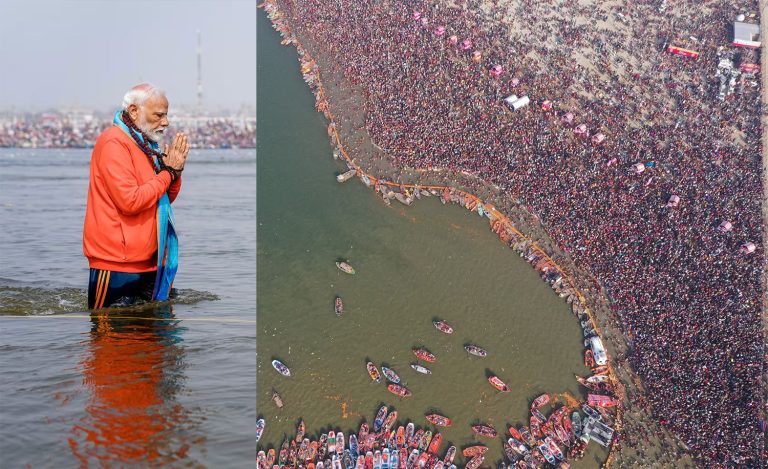
A special cabinet meeting of Uttar Pradesh government, chaired by Chief Minister Yogi Adityanath commenced on Wednesday at Maha Kumbh in Prayagraj.
UP Deputy CM Keshav Prashad Maurya has informed that important decisions will be taken in the meeting.
“Many important decisions will be taken in the Cabinet meeting today. All cabinet members along with the CM will also take a holy dip at Sangam today.”
Earlier, Uttar Pradesh Deputy Chief Minister Brajesh Pathak who is also attending the meeting, welcomed saints and devotees in Maha Kumbh.
“I welcome all the saints and seers who have come here to attend the Maha Kumbh. There will be a Cabinet meeting here and all members will take a holy dip,” Pathak said.
UP Minister Om Prakash Rajbhar said, “We will be briefed only after the cabinet meeting. Afterwards, all the ministers will go together to take a dip (in the Ganga).”
All 54 ministers of the Uttar Pradesh cabinet have been invited to this meeting, which is expected to approve several significant proposals and schemes for the state.
Following the meeting, Chief Minister Yogi Adityanath, along with the entire cabinet, will take the holy dip in the sacred waters of the Triveni Sangam.
This isn’t the first time CM Yogi has led his cabinet to the Sangam. In 2019, during the Kumbh Mela, he took a ceremonial dip along with his ministers, Akhada Parishad President Narendra Giri, and other saints.
Maha Kumbh is one of the largest and most significant religious congregations in the world. The key ‘snan’ dates left are: January 29 (Mauni Amavasya – Second Shahi Snan), February 3 (Basant Panchami – Third Shahi Snan), February 12 (Maghi Purnima), and February 26 (Maha Shivaratri).
Uttar Pradesh police deployed over 10,000 personnel, including local police and paramilitary forces for the event’s security. The National Disaster Response Force (NDRF) has deployed a “water ambulance” stationed at Sangam to ensure the safety of devotees.
The Maha Kumbh began on January 13 and will continue until February 26.
(This news report is published from a syndicated feed. Except for the headline, the content has not been written or edited by OpIndia staff)
In Rajasthan, protests have been going over the state government’s decision to abolish 9 newly created districts. The BJP government in the state had on 28th December 2024 revoked the district status of 9 districts out of 17 and 3 divisions created by the erstwhile Congress government.
While the CM Bhajanlal Sharma-led government emphasised that the creation of these districts was neither in the public interest nor practical, several Muslims led by Qazi Syed Sharafat Ali took out a protest rally in Shahpura on Tuesday (20th January) against the revocation of this area district status. The “Aakrosh Rally” was taken out from Phuliya Gate and reached the office of Upkhand via Balaji’s Chhatri, Sadar Bazaar and Trimurti Chowk. Meanwhile, slogans were raised against MLA Lalaram Bewra and CM Sharma. Zila Bachao Sanghash Samiti joined the rally.
Before this, the members of the Property Dealer Association registered their protest by sitting on a hunger strike outside the subdivision office. The protest was organized under the leadership of Property Dealer Association President Rajendra Bohra in the presence of Sangharsh Samiti President Durga Lal Rajora and Convener Ramprasad Jat.
During the rally, the protesters garlanded the Barhat memorial and raised slogans demanding that Shahpura remain a district. Alongside the members of the Property Dealer Association, councillors and officials of the Bar Association also participated in the protest. Sangharsh Samiti general secretary Kamlesh Mundetia said that the movement is continuing peacefully and this struggle will continue until Shahpura gets back the district status.
On 28th December, the state government abolished 9 of the 17 districts established by the previous Congress dispensation, claiming they were neither feasible nor in the public interest.
A cabinet meeting presided over by Chief Minister Bhajan Lal Sharma dissolved three additional divisions implying that the state will now have seven divisions and 41 districts.
This, however, did not go well with the opposition Congress party and former minister Sukhram Vishnoi led a ‘mahapadav (large sit-in)’ outside the Sanchore Collectorate. The nine Rajasthan districts that have been abolished are Anupgarh, Dudu, Gangapur City, Jaipur Rural, Jodhpur Rural, Kekri, Neem Ka Thana, Sanchore, and Shahpura. Other than Shahpura, similar protests took place in Anupgarh, Neem Ka Thana, and other affected localities.
The government of Uttar Pradesh has informed the Joint Parliamentary Committee that 78% of the land in UP that the state Waqf Board is claiming own actually belongs to the government and the Waqf Board has no legal ownership rights on it.
The Joint Parliamentary Committee on the Waqf (Amendment) Bill conducted its last meeting of field visits on Tuesday in Uttar Pradesh’s Lucknow.
The meeting was held under the chairmanship of JPC chief MP Jagdambika Pal. All the stakeholders including members of Shia and Sunni Waqf Boards and the Minority Commission participated in the meeting.
As per reports, Monika Garg, the Additional Chief Secretary of the Minority Welfare Commission of the UP government, told the JPC that the Waqf Board claims to have 14 thousand hectares of land in the state. But 11.7 thousand hectares of it belong to the government as per official records. The Sachar Committee report earlier had also said that 60 properties that the Waqf Board is claiming belong to the government.
The revenue department informed the JPC that a large portion of the land properties that the Waqf Board is claiming to be its own is registered under class 5 and class 6 in the revenue records. Class 5 and 6 mentions are for government properties and Gram Sabha properties.
As per reports, the Waqf Board in UP is claiming the ownership of over 1.3 lakh different properties, these include ASI monuments, Balrampur Government Hospital, LDA lands and many more such areas that belong to the government.
Additionally some properties of LDA and Residence Development department that the Waqf Board is claiming as its own were officially allocated to the respective departments from the respective city municipalities.
The UP government informed the JPC that the State has guidelines and rules in place for marking Waqf Properties. When the Waqf Board claims the ownership of a land, the said land’s official records are tallied and ownership details as per 1952 records are matched. If these details are verified and the land is officially found to be owned by the Waqf Board, the board can request the government to remove encroachments on that land.
The UP government also informed the JPC that Lucknow’s famous monuments Bada Imamwada, Chhota Imamwada and The Begum ka Maqbara in Ayodhya are all government properties, but the Waqf Board is wrongfully claiming the ownership of these protected monuments.
MP Jagdambika Pal informed that the JPC will submit its report on 31 January in the next Parliament Session. “The JPC has been meeting continuously for the last 6 months, holding meetings across the country. I am confident that we will all come to a consensus and present our report. Last time we had to present it in the winter session but it was extended, so we are going to present this report in the budget session,” Pal added.
The Waqf Act of 1995, enacted to regulate Waqf properties, has long been criticised for issues such as mismanagement, corruption, and encroachments.
Notably, the budget session of Parliament will commence on January 31 and continue till April 4, with the union budget to be presented on February 1.
Details of the Waqf Act 1995 and how it came to be can be read here.
On 21st January, the World Bank-appointed neutral expert declared that it has the authority to resolve the disputes between India and Pakistan regarding two hydropower projects in Jammu and Kashmir under the terms of the Indus Waters Treaty of 1960. Notably, the ruling supported New Delhi’s stance. An official statement from the Ministry of External Affairs (MEA) was released which conveyed, “India welcomes the decision given by the neutral expert under Paragraph 7 of Annexure F to the Indus Waters Treaty, 1960.”
According to the Indus Waters Treaty’s Annexure F, paragraph 7, a neutral expert will decide if the Permanent Indus Commission is unable to reach a consensus. After hearing from both sides, the neutral expert will determine whether the disagreement is covered by the treaty. MEA further expressed, “The decision upholds and vindicates India’s stand that all seven (07) questions that were referred to the neutral expert, about the Kishenganga and Ratle hydroelectric projects, are differences falling within his competence under the treaty.”
The ministry pointed out that India has consistently and firmly maintained that the neutral expert is the only person authorized by the treaty to resolve these conflicts and highlighted, “Having upheld his own competence, which comports with India’s view, the neutral expert will now proceed to the next (merits) phase of his proceeding. This phase will culminate in a final decision on the merits of each of the seven differences.”
Given its dedication to upholding the treaty’s sanctity and integrity, the statement mentioned that India will continue to take part in the neutral expert process. It wants to ensure that disagreements are settled in a way that complies with the treaty’s clauses prohibiting concurrent proceedings on the same set of issues. “For this reason, India does not recognize or participate in the illegally constituted Court of Arbitration proceedings,” it added and assured, “The Governments of India and Pakistan also remain in touch on the matter of modification and review of the Indus Waters Treaty, under Article XII (3)” of the same.
According to persons acquainted with the situation, the verdict favours India’s position in the procedures surrounding the Kishenganga and Ratle hydropower projects. One of the individuals noted, “It is basically a setback for Pakistan.” Another person stated, “The neutral expert’s decision is in line with the graded mechanism of dispute settlement envisaged in Article IX of the treaty, which Pakistan contravened by simultaneously approaching the Court of Arbitration.”
India requested the appointment of a neutral expert to examine similar concerns with the two hydroelectric power projects, while Pakistan urged the World Bank to help establish a Court of Arbitration to address its reservations regarding the designs of the two projects. Pakistan protested against India’s position on Kishenganga and Ratle hydropower projects in the union territory of Jammu and Kashmir. The Kishanganga hydropower plant, which is situated on the Indus tributaries, started construction in 2007 and the Ratle Hydroelectric Plant, built on the Chenab had its foundation stone placed in 2013.
Despite Pakistan’s protests, Prime Minister Narendra Modi inaugurated the Kishanganga project in May 2018. Over 300 megawatts of electricity might be generated and at least 30,000 hectares of land can be irrigated using the approximately 0.65 million acre-feet (MAF) of water that the Kishanganga project stores from the Ujh river. Then-Union Minister of Water Resources, River Development and Ganga Rejuvenation Nitin Gadkari declared in 2019 that India might cut off water supplies to Pakistan in response to the deadly Pulwama attack.
Why a neutral expert was appointed
Pakistan wanted the appointment of a “neutral expert” to examine its technical objections to India’s Kishenganga and Ratle hydroelectric power plants in 2015. However, the country unilaterally withdrew its decision and sought an arbitration hearing, the next year. A neutral expert and a chairman of the Court of Arbitration (CoA) had been nominated by the World Bank about the two projects in November of the same year. However, once India protested, the processes were stopped. World Bank representatives then met with India and Pakistan to discuss a solution.
Although both proceedings were placed on “pause” by the World Bank, they were reactivated in March 2022 when Pakistan demanded it. Meanwhile, India has participated in discussions with the neutral expert but has refrained from attending the Permanent Court of Arbitration hearings in The Hague, citing the incompatibility of the two processes. Furthermore, Pakistan declined to address the matter in any of the five Permanent Indus Commission meetings from 2017 to 2022, despite India’s persistent attempts to negotiate a compromise.
On 20th January, the neutral expert, Michel Lino, the president of the International Commission of Large Dams (ICOLD), proclaimed that he is qualified to “determine the merits of the points of difference” between India and Pakistan over the two hydroelectric projects. He added in a statement from Vienna that after hearing from both sides, a decision will be formed. However, the verdict would have rattled Islamabad.
Earlier, India formally notified Pakistan in August 2024 that the 63-year-old agreement needed to be reviewed and modified, primarily due to Islamabad’s uncooperative attitude in resolving cross-border river disputes. The notice was given by Article XII(3) of the treaty, which stipulates that provisions of the pact could be modified from time to time by a duly ratified treaty concluded for that purpose between the two governments.
On 30th August, the notice came out in conformity with Article XII(3) of the treaty following the Indian side’s “notification for modification” of the treaty on 25th January 2023. India delivered the notice in an attempt to compel Pakistan to start government-to-government talks to revise the treaty per Article XII (3). Significant disagreements between India and Pakistan concerning how to handle conflicts about the Kishanganga and Ratle hydropower projects on the Chenab and Neelam rivers in Jammu and Kashmir were the backdrop for the occurrence.
“Fundamental and unexpected changes in circumstances that require a reassessment of obligations under various articles of the Indus Waters Treaty” were highlighted in India’s notification. The impact of ongoing cross-border terrorism, environmental concerns and the need to speed up the production of clean energy to fulfil India’s emission targets and changes in the country’s population demographics were some of India’s main worries over the treaty.
The notification was sent out amid a protracted dispute over the 850-MW (Megawatt) Ratle and 330-MW Kishanganga hydropower projects. Pakistan opposed the two projects and alleged that they violated the Indus Waters Treaty. Islamabad criticized the Kishanganga project, claiming it restricted water flowing into the country. The World Bank’s involvement is mostly procedural and is restricted to appointing the chair of the arbitration court or neutral experts. Notably, it allowed India to build hydroelectric power plants on the tributaries of the Jhelum and Chenab rivers under the treaty, in 2017.
The treaty remained unaltered since it came into existence in Karachi on 19th September 1960. It was signed by WAB Iliff who was the Vice President of the International Bank for Reconstruction and Development (IBRD), also known as the World Bank and then-Indian Prime Minister Pandit Jawaharlal Nehru and former Pakistani President Muhammad Ayub Khan.
Indus Waters Treaty and its provisions
The Indus River has been a source of contention between the four nations it flows through, India, Pakistan, China and Afghanistan ever since India was divided in 1947. The source of the river is Tibet. Water to Pakistan was temporarily cut off by India in 1948, but it was reopened following the truce. Pakistan brought the issue before the United Nations (UN) in 1951, alleging that India had cut off water to numerous Pakistani hamlets. This agreement was developed in 1954 by the World Bank based on the recommendations of the United Nations.
The World Bank was one of the signatories to the Indus Waters Treaty, which India and Pakistan signed in 1960 after nine years of discussions. The two nations eventually reached an agreement that shared ownership of six rivers. Pakistan was the lower riparian state at the time of India’s independence in 1947 since the border between the two countries was defined across the Indus Basin.
Some important irrigation projects, such as those at Madhopur on the Ravi River and Ferozepur on the Sutlej River, which were entirely dependent on irrigation canals in Pakistan’s Punjab region, were in Indian territory, which led to a conflict. The Indus, Jhelum, and Chenab rivers in the west were given to Pakistan by the Indus Waters Treaty, while the Ravi, Beas, and Sutlej rivers in the east were assigned to India. It permitted each nation to use the rivers allotted to it in a specific way.
The pact gave India sole usage of the waters of three eastern rivers, which had an average of about 33 million acre-feet (MAF). Pakistan was granted similar control over the waters of the western rivers, the Indus, Jhelum, and Chenab, with an average of about 135 MAF, however, a condition was also put forward. The treaty guarantees India the right to produce hydroelectricity through run-of-river (RoR) projects on the western rivers, provided that certain design and operation requirements are satisfied.
The United Nations established a Permanent Indus Commission to settle any disagreements over water sharing, along with an arbitration process to settle issues peacefully. The agreement permits India to use the water from the western rivers for non-consumptive domestic purposes including irrigation, storage, and energy production. According to the treaty, Pakistan receives 80% of the water from the Indus River System, while India receives 20%.
It pointed out that India and Pakistan will, to the greatest extent possible, prevent any material harm to each other when implementing any flood protection or flood control plan. The two counties also have no right to restrict the use of the natural routes of the rivers for the release of floodwaters or other excess water, and neither nation could hold the other accountable for any damage brought on by such activities.
Now, the latest judgement rendered by the neutral expert has provided a massive relief and a major boost to New Delhi concerning the significant hydropower plants.
Industrialist Gautam Adani, who was at the Maha Kumbh to offer Aarti, dismissed swirling speculations and widespread social media chatter about his son Jeet’s upcoming wedding being a grandiose affair. Responding to a question in Prayagraj about whether the event would be a “Maha Kumbh of celebrities,” the billionaire firmly replied, “Definitely not!”
The response came in the wake of rumour mills active on social media that claimed a galaxy of international stars and prominent figures would grace Jeet Adani’s wedding to Diva Shah, daughter of Surat diamond merchant Jaimin Shah. The rumoured guest list included Elon Musk, Bill Gates, Mark Zuckerberg, Daniel Craig, Taylor Swift, Justin Bieber, Kanye West, the Kardashian sisters, Rafael Nadal, Diljit Dosanjh, Sundar Pichai, Satya Nadella, Billie Eilish, Coldplay, King Charles, and even the Pope.
Speaking after performing the Ganga Aarti at Prayagraj’s Triveni Sangam with his family, Adani emphasized, “Our values and way of life are rooted in simplicity and the working class. Jeet has also come here to seek Ma Ganga’s blessings. The wedding will be a modest and traditional family event.”
Adani confirmed that the wedding, scheduled for February 7, would be a private ceremony in Ahmedabad. His announcement came during a visit to the Maha Kumbh Mela, where he was accompanied by his wife Dr. Priti Adani, sons Karan and Jeet, daughter-in-law Paridhi, and granddaughter Kaveri. At the Kumbh, the family offered prayers at the Lete Hanuman Temple and participated in the Mahaprasad Seva at ISKCON, where Adani is funding the distribution of over one lakh free meals daily. Additionally, he is donating one crore prayer books printed by the esteemed Gita Press of Gorakhpur.
Describing the Maha Kumbh Mela as an “unparalleled experience,” Adani commended the Modi and Yogi administrations for their exceptional arrangements, particularly in policing and sanitation. He suggested that the event’s successful organisation should be studied by management schools and corporate entities for its operational excellence.