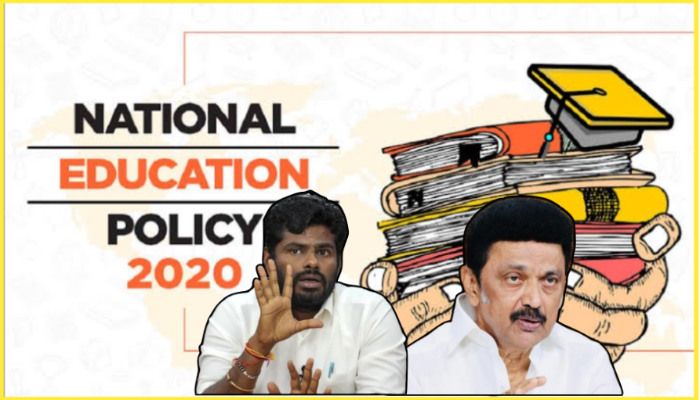
According to a famous Chinese proverb, “To learn a language is to have one more window from which to look at the world.” However, DMK (Dravida Munnetra Kazhagam) members and their ecosystem are unreasonably fixated on the notion that Tamils shouldn’t learn Hindi or Sanskrit and they have repeatedly voiced the same.
M K Stalin, the chief minister of Tamil Nadu, hence has been adamantly against the adoption of the National Education Policy (NEP) 2020, claiming that it will cause a “2,000-year regression” in the state. Speaking at a public event in Cuddalore on 22nd February, he reaffirmed that the state would reject the proposal even if the union government provided Rs 10,000 crore in financial incentives. Stalin further attacked the centre for trying to force Hindi on Tamil Nadu and criticized the NEP’s three-language policy.
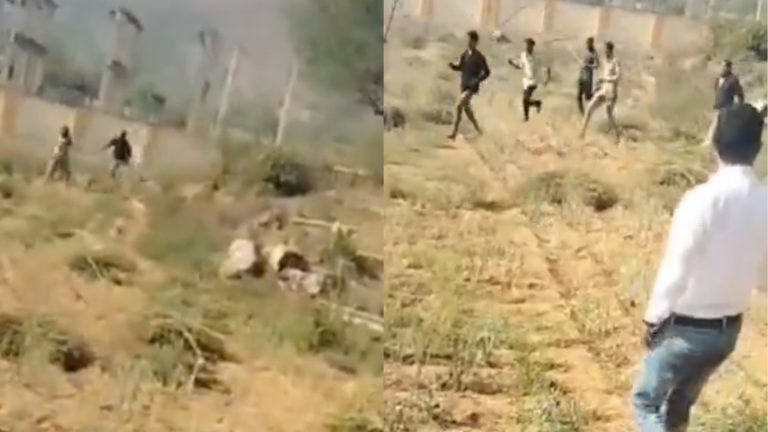
Meanwhile, some DMK cadres, emboldened by their leadership’s unbridled hatred towards Hindi and fabricated allegations, painted the Hindi letters on the name boards of the St. Thomas Mount Post Office in Alandur and the nearby BSNL office on Chennai’s GST Road in black. They also covered the Hindi letters on the name boards of the railway stations at Palakkad, Palaiyamkottai, Sankarankovil, Kadayanallur and Pavoorchatramhere in black.
Stop disregarding the sentiments of our HINDI-speaking brothers and sisters.
— Amar Prasad Reddy (@amarprasadreddy) February 24, 2025
Sh @RahulGandhi, it's clear that the INDI alliance is opposed to Hindi.
The DMK Morons need to stop this ugly activiy. The governor must take decisive action, @rajbhavan_tn.
pic.twitter.com/j3wYIrvJWh
K Annamalai condemns DMK’s double standard
However, Tamil Nadu Bharatiya Janata Party (BJP) president K Annamalai soon criticized the shallow political rhetoric, exposing the party’s hypocrisy and doublespeak on the alleged imposition of Hindi. He reacted to these vandalism incidents and asked why DMK leaders are against the three-language policy while their own kids attend schools that offer multiple languages.
He remarked, “Had seen a few misguided individuals roaming around with a can of black paint, striking Hindi Letters in opposition to the three-language formula in the New National Education Policy.” Annamalai advised them to bring a similar can of black paint to the Enforcement Directorate and Income Tax Office and told them to ask corrupt DMK Ministers for the addresses as they often visit these places.
He referred to the partys as “bunch of confused nincompoops who have different standards for their families and others.” According to Annamalai, they either run CBSE/Matriculation schools that have three language option or make sure their kids or grandkids are enrolled in them. He further charged them of first securing their children’s future and then disseminate disinformation against the same three-language program which he termed as “irony of things.”
Had seen a few misguided individuals roaming around with a can of black paint, striking Hindi Letters in opposition to the three-language formula in the New National Education Policy. We would humbly suggest that they visit the Enforcement Directorate and Income Tax Office with…
— K.Annamalai (@annamalai_k) February 24, 2025
Stalin was challenged to respond to some pointed questions by Annamalai, who admonished him not to hide behind the outcry about the bogus Hindi imposition allegation. “While the DMK ministers to councillors enrol their children in private schools where 3 languages or more are taught, why is it deprived of students studying in government schools,” he inquired and questioned the party about the same choice available in the institutions run by its politicians.
He added, “Why is the right to learn a third language refused only for students studying in government schools? Is the right to learn an additional language a privilege only for those who can afford it?” Annamalai even pointed out that union Education Minister Dharmendra Pradhan had frequently explained that Hindi is merely an optional third language among many others and is not mandatory. “The same is proposed in the National Education Policy 2020. Why is the DMK deliberately confusing people,” he slammed the misinformation campaign by the party.
He stated that there are more than twenty-five languages classified as Dravidian languages. “Having named your party the Dravida Munnetra Kazhagam, why is the State Government opposed to Government school students learning a third language such as Kannada, Telugu and Malayalam,” Annamalai asked pertinently. He further brought out DMK’s hypocrisy and reminded, “Did your party founder, Thiru Annadurai, not say that Tamil Nadu is willing to adopt the three language formula if other states also adopt it?”
He maintained that transparency and not hypocrisy, is what the people of Tamil Nadu deserve. “Will Stalin dare to answer these questions, or will he continue to hide behind false narratives,” he demanded and sarcastically mocked, “Stalin should also bring his I.N.D.I. Alliance partners to Tamil Nadu and give them also a box of black paint.”
What does the fresh NEP policy says
The three-language formula was implemented as a consequence of an agreement reached by the chief ministers of numerous Indian states at their 1961 meeting. Rather than being a goal or limitation on language learning, it was designed to serve as a convenient starting point for the analysis of the nation’s evolving body of knowledge and emotional integration. NEP 2020 has promoted the same as a means of fostering multilingualism and bolstering national unity.
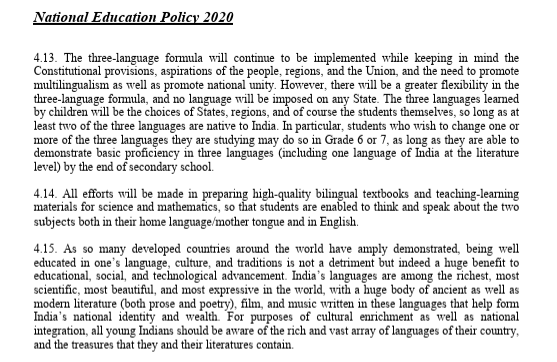
The primary objective is to encourage multilingualism in India and provide students with the resources they need to communicate successfully throughout the country. Additionally, it seeks to promote acceptance for linguistic diversity and expose kids to a variety of cultures and languages in order to build national integration. However, NEP clearly mentioned, “The three languages learned by children will be the choices of states, regions, and of course the students themselves, so long as at least two of the three languages are native to India. In particular, students who wish to change one or more of the three languages they are studying may do so in grade 6 or 7, as long as they are able to demonstrate basic proficiency in three languages (including one language of India at the literature level) by the end of secondary school.”
The policy does not require students to take up any one language or languages and instead allows the choice to the states and the learners. The formula underlines that each Indian student must study three languages: a foreign language and two native including one regional. English is automatically selected as a foreign language since it has become popular in India as a result of its colonial past and its subsequent prominence as a global language. Any of the three languages could be used as the medium of instruction and it is for both public and private institutions.
Every effort is going to be made to use the mother tongue, home language, local language or regional language as the primary language of instruction until at least grade 5, but ideally until grade 8 and beyond. According to NEP, this system will be more flexible and no state will be compelled to use a particular language. Of course, the students themselves will pick the three languages that can be taught to them, provided that at least two of the three are native to India, its states or its regions.
Dharmendra Pradhan writes to MK Stalin
Importantly, the same was conveyed to Stalin by Dharmendra Pradhan in a letter in which he urged the southern state to “rise above political differences” for the benefit of students. “There is no question of imposing any language on any state or community. National Education Policy (NEP) 2020 upholds the principle of linguistic freedom and ensures that students continue to learn in the language of their choice,” he asserted in the letter.
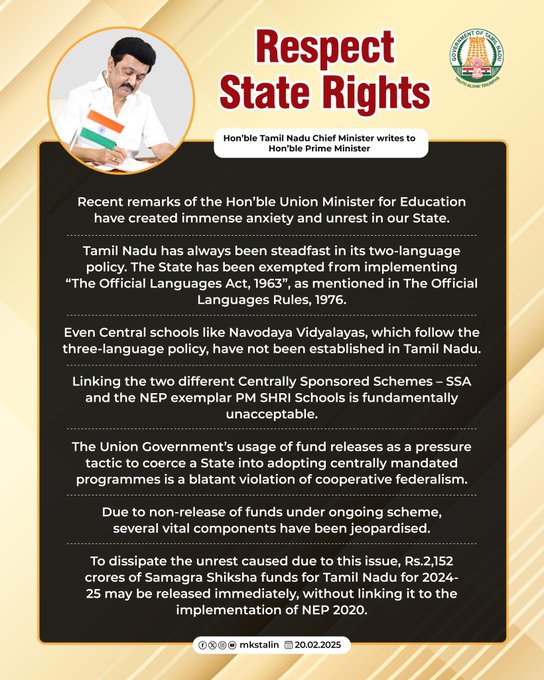
According to Pradhan, the NEP 2020 is a “transformative vision that seeks to elevate India’s education system to global standards” with the aim of modernizing the educational system in the nation. NEP will achieve this, he added, by “preserving and strengthening our linguistic and cultural diversity.” Interestingly, the union responded after Stalin wrote to Prime Minister Narendra Modi demanding the release of Rs 2,152 crore under the Samagra Shiksha Abhiyan (SSA) in the midst of the intense dispute.
He stated, “This brings me to a crucial point – the three-language policy, which has been the backbone of India’s education framework since 1968. Unfortunately, despite being part of successive education policies, it was never implemented in letter and spirit, leading to a decline in the systematic teaching of Indian languages in schools. Over time, this has resulted in an over-reliance on foreign languages, limiting exposure of students to their linguistic roots. NEP 2020 seeks to correct this historical oversight by ensuring that every Indian language, including Tamil, receives its rightful place in education.”
Highly inappropriate for a State to view NEP 2020 with a myopic vision and use threats to sustain political narratives.
— Dharmendra Pradhan (@dpradhanbjp) February 21, 2025
Hon’ble PM @narendramodi ji’s govt. is fully committed to promote and popularise the eternal Tamil culture and language globally. I humbly appeal to not… pic.twitter.com/aw06cVCyAP
The Education Minister accused the state of having a “myopic vision” and converting “progressive reforms into threats for politics.” Notably, the conflict between Tamil Nadu’s ruling DMK and the BJP-led central administration escalated when Pradhan highlighted that the state would lose Rs 5,000 crore if the PM Shree initiative, which is a component of NEP 2020, wasn’t implemented in the state.
“One point I want to re-emphasize is that the NEP is not recommending imposition of any language on the respective students of a state. That means, in no way the NEP is recommending imposition of Hindi in Tamil Nadu,” he affirmed in a press conference. “Through social media, I came to know that Tamil Nadu CM MK Stalin has written a letter to PM Narendra Modi. He has not written the letter in good spirit. He has mentioned few imaginary concerns through that letter and his letter is full of political motivation and looking into his own political convenience, he has written that letter,” Pradhan stated.
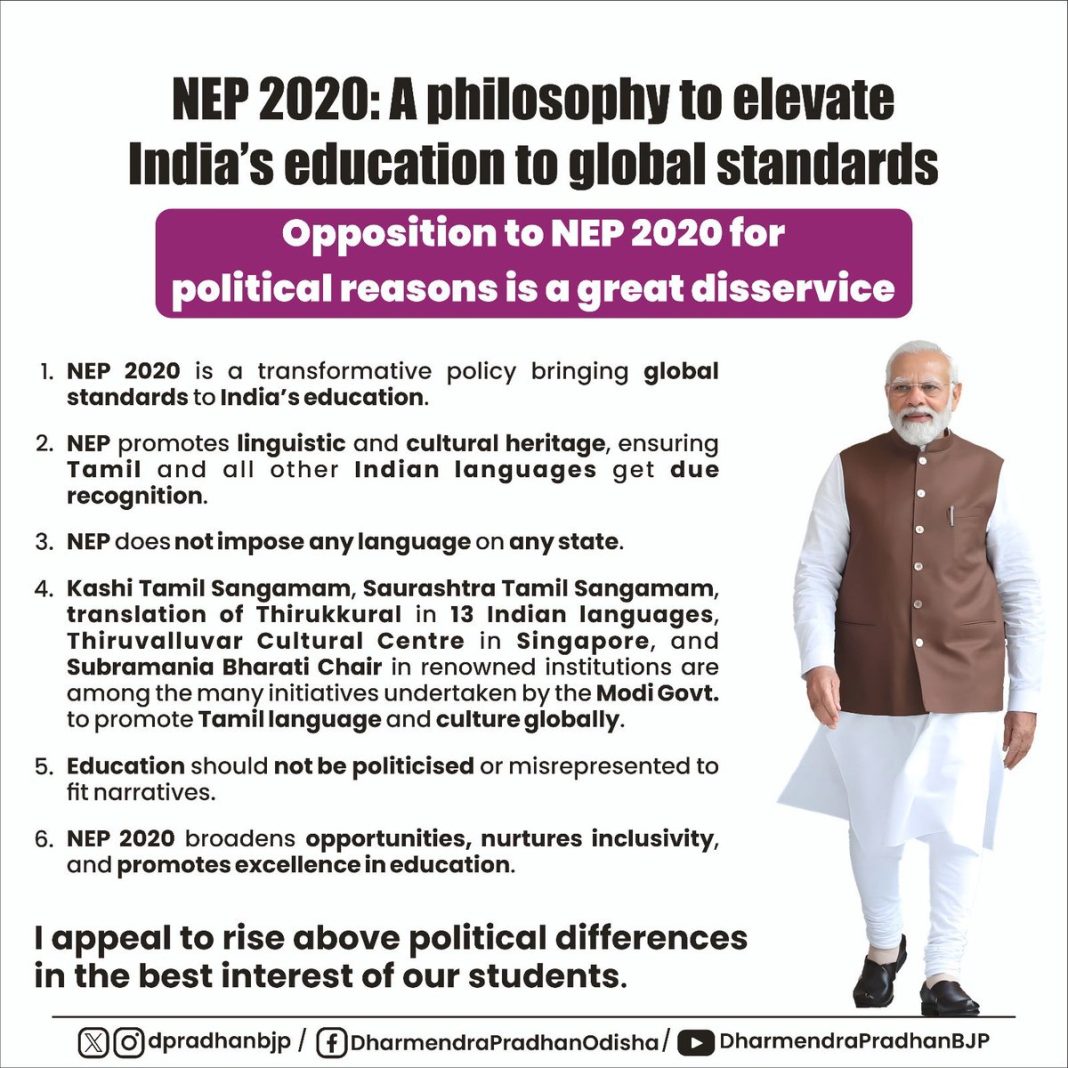
Pradhan stressed that the main goal of the National Education Policy (NEP) 2020 is to raise educational standards to international norms while also ensuring that it has Indian roots. “It has to promote linguistic and cultural heritage from states like Tamil Nadu. The Government of India is conducting all the entrance examinations in all major 13 languages and one among them is Tamil also,” he declared.
Stalin, however, retaliated against the center by making unfounded charges. “Is the blackmail that fund release only if the trilingual policy was accepted, not politics? Is imposing Hindi in the name of NEP, not politics? Is converting a multi-lingual and plural country into a single-language country and one nation, not politics? Is not converting the funds meant for a scheme as a ‘condition’ for implementing another scheme, not politics,” he asked and added, “I warn the centre, don’t throw stones at beehive. Don’t aspire to see the unique fighting spirit of the Tamils. As long as I and the DMK exist, no activities against Tamil, Tamil Nadu, and its people will be allowed to set foot in the state.”
It is noteworthy that schools across India are already teaching three languages and some even offer four languages in their curriculum. However, Tamil Nadu has refused to align with the rest of the nation and wants to follow two-language policy, teaching only Tamil and English in its schools.
Stalin has doubled down on the two-language policy, making it a political ego battle for the DMK. The CM of Tamil Nadu even boasted that central government-run Navodaya Vidyalayas have not been established in the state because of the state’s emphasis on two language policy (only in government schools).
However, it is interesting to note that private run institutions in Tamil Nadu, private CBSE schools do teach three languages in Tamil Nadu. As Annamalai pointed out, many of these institutions are run by DMK leaders and their family members and DMK leaders send their own children to private schools where they learn multiple languages, including Hindi.
As per a report in Commune, MK Stalin’s own daughter is associated with an organisation called Sunshine Group, which runs CBSE schools with a three language system, including Hindi.
Aversion to Hindi and acceptance of Arabic
The DMK, which is petrified by Hindi, keeps quiet about the widespread Arabic invasion in Tamil Nadu. Schools, madrassas and colleges can be found all over Tamil Nadu that only offer instruction in Arabic, reported News18. The state is home to Arabic-language name boards for various institutions, but the DMK is unable protest against them. The deliberate plan to maintain a firm grip on the Tamil-speaking populace, guaranteeing that they have access to only Tamil, is the root of the hostility to the three-language formula.
This tactic, along with loud rhetoric about Tamil culture being ‘threatened’ by North Indians, is fanned to peddle the political idea that only the DMK can protect the state and its culture. It is rooted in vote-bank politics that the DMK family has played for decades. The DMK leadership has recognized the close connection between language and culture since the party’s inception.
The phrase “Tamil and its culture are in danger” is one they continue to use to incite an uproar among their party members, particularly during election season, and to hide government failures and inefficiency. The same is used by vested interests, who dub themselves as “Dravidian stock,” to promote enmity between the north and the south, divide the nation on linguistic basis and even envision South India as a sovereign entity in the future.
On the other hand, the DMK has consistently presented itself as viciously anti-Hindi. Stalin announced last month that the student arm of his party would protest the University Grants Commission (UGC) draft proposals in New Delhi. “The introduction of the three-language policy and the National Education Policy (NEP) are blatant attempts to impose Hindi and Sanskrit on non-Hindi-speaking states,” he alleged and vowed to carry on the purported linguistic war and stop Hindi being “imposed” in his state.
“To save the education and language of our state, I have come here to protest against the union government. I have not come to participate in this protest as a DyCM. I have come here to participate in a DMK youth wing cadre. In the union budget 2025, the funds that must be shared with all states were majorly given to Uttra Pradesh and Gujarat states and Tamilnadu was neglected completely,” Stalin’s son and deputy chief minsiter Udhayanidhi claimed during a protest in February 2025 which was also attended by its alliance partners including the Congress party.
In 2024, Udhayanidhi’s comments on Ayodhya Ram Janmabhoomi Mandir in which he declared that the DMK was opposed to constructing the temple after demolishing the mosque were criticized by the BJP on its official social media account. However, he replied by by posting a picture of himself sporting the “Hindi Theriyathu Poda (I don’t know Hindi, Get lost)” T-shirt along with a smiley. The T-shirt campaign with “Hindi Theriyathu Poda” was launched by the party in 2020 in the name of fighting “Hindi imposition.”
Conclusion
Tamil politics have been plagued by anti-Hindi sentiments since before independence. The British planted the seeds of this widespread disdain when they introduced the Aryan Invasion Theory, which is now categorically refuted by contemporary science. It was fueled by ambitious politicians who were hungry for support and afterwards mainstreamed into the public discourse by the DMK.
The DMK has consistently opposed Hindus, Hindi speakers and people from northern India. It has become routine for the party to label persons from Uttar Pradesh and Bihar as inferior and insulting Hinduism to appease its deranged audience. Udhayanidhi who boasted of being a ‘proud Christian’ called Sanatan Dharma as “dengue and malaria,” a statement which was endorsed by DMK’s other prominent leaders like A Raja and even Congress leaders including Priyank Kharge who is a minister in Karnataka government and son of party president Mallikarjun Kharge.
“When the Nagaland residents, who eat dogs, displayed such dignity in their actions, driving Ravi out of their state, we must not lose sight of the self-respect of the Tamil people who season their meals with salt,” DMK’s organisation secretary RS Bharathi expressed during an event in November of 2023. “I had earlier stated that those who sell Soan papdi and Panipuri don’t know the pride of Tamil Nadu. I said this in a meeting. I came to know that many have come from Bihar and I think the Governor (RN Ravi) has similarly come by train,” he stated in January of the same year.
“Hindi-speaking people are cleaning toilets and roads for us,” DMK Lok Sabha MP Dayanidhi Maran announced in December 2023 a few weeks after the Hindi heartland was denigrated by another party leader Senthil Kumar as “gaumutra states.” The same petty political objective is evident in the current opposition to NEP 2020 and the three language formula.
Meanwhile, the head of I.N.D.I. Alliance, the Congress party which the DMK initially accused of forcing Hindi on the state, has also been following its lead in an attempt to win over some support following its disastrous political campaign across India under the failed leadership of Rahul Gandhi. The erroneous narrative propagated by Dravidian politics, spearheaded by the DMK and other vested interests has only been reinforced by this.