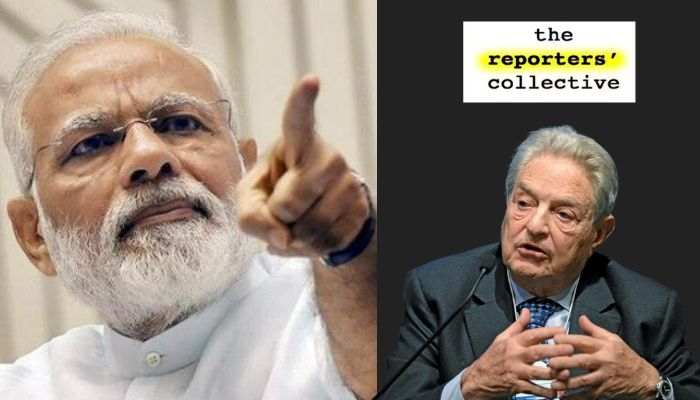
On Tuesday (28th January), Reporters’ Collective took to X (formerly Twitter) to inform that the Modi government has stripped it of its ‘non-profit status.’
The development comes a month after the controversial group of journalists, funded by the American Deep State, published fake news about the Centre rigging data to show a dramatic decrease in poverty in India.
In a statement, the Reporters’ Collective claimed that the group had been existing as a ‘non-profit trust’ since July 2021.
Tax authorities have revoked our non-profit status, claiming journalism does not serve any public purpose and therefore cannot be carried out as a non-profit exercise. It severely impairs our ability to do journalism. Our statement: https://t.co/79tTEVW8URpic.twitter.com/ZXRkCaSMcv
“But now the tax authorities have cancelled our non-profit status, claiming journalism does not serve any public purpose and therefore cannot be carried out as a non-profit exercise in India,” it alleged.
The Reporter’s Collective claimed that being revoked of ‘non-profit status’ by the tax authorities would hinder its ability to continue its ‘journalistic work’.
The Soros-funded group of journalists alleged, “The order cancelling our non-profit status severely impairs our ability to do our work and worsens the conditions for independent public-purposed journalism in the country.“
The Reporter’s Collective announced that it would seek legal remedies to undo the action of the Modi government.
“We are seeking legal remedies to protect the idea of journalism as a public good and our right to carry out investigative journalism, research and training free of encumbrances, fear or threats at The Collective,” it concluded.
Lies peddled by Reporters’ Collective
Reporters’ Collective published a report on 18th December 2024 alleging that the Narendra Modi government had rigged a “Homemade Poverty Index” to show a dramatic decrease in poverty in India.
It claimed that the government’s report of pulling 25 crore people out of poverty in 10 years was false because the govt of India added two important parameters to the global index.
The report alleged that because international agencies that publish global rankings couldn’t be bullied, the Modi govt invented its own index, and rigged the results to show good results.
Revealed: To show dramatic reduction in poverty, Modi gov't conjured up a new index and cherrypicked data to fit predetermined results, show confidential records.
Reporters’ Collective provided no evidence at all about this claim of rigged data and just made several vague claims.
The Global Multidimensional Poverty Index was developed by the Oxford Poverty & Human Development Initiative (OPHI) and the United Nations Development Programme (UNDP).
And, the Reporters’ Collective report itself mentioned that the NITI Ayog, which created India’s own Multidimensional Poverty Index, partnered with OPHI and UNDP to develop the index.
Therefore, the creators of the global index agree with the addition of extra parameters for the Indian index. But dimwits at the Reporters’ Collective believe that it made the data ‘rigged’.
Links to American Deep State
It is important to look at the organisations behind Reporters’ Collective. A look at the list of donors of its parent organisation shows that it is backed by usual suspects behind the ongoing anti-India campaign.
Reporters’ Collective is run by the National Foundation for India, an FCRA-registered NGO.
A perusal of its donor list shows that the National Foundation for India is funded by the Ford Foundation, the Open Society Foundation of George Soros, the Omidyar Network, and the Rockefeller Foundation, among others.
National Foundation for India’s donor list from its annual report
All these organisations are part of the American Deep State network and have funded numerous anti-India campaigns and initiatives. The Reporters’ Collective is a part of the anti-India front of the American Deep State.
The fake news published by it in December last year is in line with the textbook approach adopted by George Soros and his Open Society Foundations to influence civil society and ‘distort’ public perspectives across different nations.
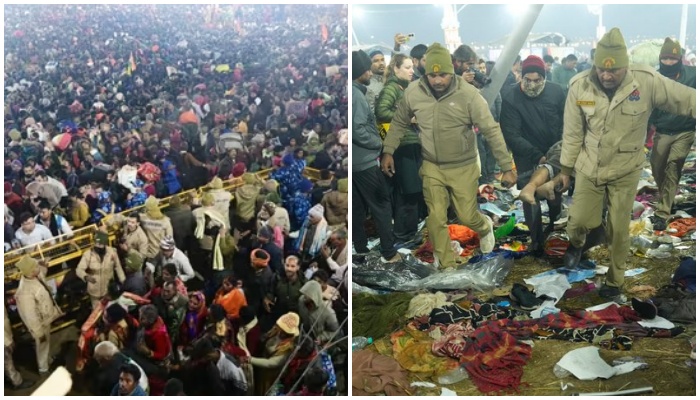
In Prayagraj, Uttar Pradesh, a stampede situation occurred near the Sangam during the ongoing Maha Kumbh 2025. People had gathered in large numbers due to the occasion of Mauni Amavasya on 29 January.
As per reports, while a large number of people were moving towards Sangam ghat, at around 1.30 am in the night, a sudden stampede like situation emerged and people started running over fallen persons. Visuals from the incident site shared by news channels show many women lying unconscious. There has been no official confirmation on the number of casualties yet.
Over 70 ambulances were reportedly rushed to the site. Inured persons were taken to the government hospital at Sector 2. Bhaskar reported that their ground reporter at Swaroop Rani Hospital stated that around 14 bodies had been taken away for post-mortem. There has been no official confirmation of deaths from government sources yet.
Dainik Bhaskar has reported 14 deaths while Jagran has reported 17 deaths so far. But there has been no official confirmation from government sources yet.
CM Yogi has shared posted on X asking people not to try to move towards Sangam area and take the holy dip in their nearest ghat.
मुख्यमंत्री श्री @myogiadityanath जी महाराज ने की श्रद्धालुओं से अपील –
माँ गंगा के जिस घाट के जो समीप है, वहीं स्नान करें, संगम नोज की ओर जाने का प्रयास न करें।
प्रशासन के निर्देशों का अनुपालन करें, व्यवस्था बनाने में सहयोग करें।
As per reports, both PM Modi and HM Amit Shah have spoken to CM Yogi about the issue and have asked for all possible help from the Central government.
On the occasion of Mauni Amavasya, over 5 crore people are expected to be inside the city limits of prayagraj and tent city area.
As per reports, NSG and other security personnel have taken full control of the Sangam area. The Amrit Snan procession of all 13 Akharas has been put on hold and new devotees are currently barred from entering the Prayagraj city.
#WATCH | Prayagraj | Massive crowd of devotees continue to gather in Mahakumbh area to take holy dip in Triveni waters on Mauni Amavasya
1.75 crore people have taken holy dip today till 6 am; a total of 19.94 crore people have taken holy dip till 28th January, as per UP govt. pic.twitter.com/AsNs81fUa9
In the meanwhile Maha Kumbh snan is ongoing as usual in Prayagraj. ANI reported that by 6 am in the morning over 1.75 crore people have already taken the holy dip. A total of 19 crore people have taken holy dips in the Ganga so far in this Maha Kumbh.
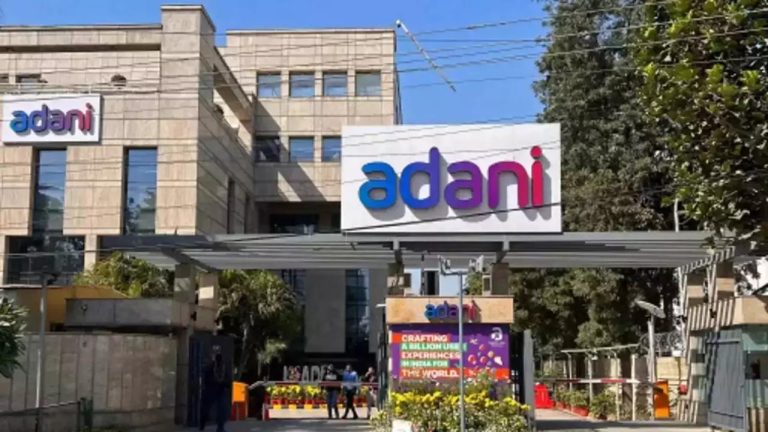
Adani Group has committed to invest Rs 2.3 lakh crore in Odisha over the next five years across sectors such as power, cement, industrial parks, aluminium and city gas.
Karan Adani, MD, Adani Ports and SEZ Ltd, met Odisha CM Mohan Charan Majhi and exchanged MoU for investments in Odisha over the next five years.
‘Utkarsh Odisha – Make in Odisha Conclave 2025’ was inaugurated by Prime Minister Narendra Modi on Tuesday.
The proposed investment by the Adani Group is said to be the biggest investment intent by any business group in Utkarsh Odisha 2025.
Also, the first test flight landed at Dhamra Airstrip successfully on Tuesday.
On the occasion of Utkarsh Odisha, six projects of Adani Total Gas in Odisha, were commissioned today.
The projects are EV charging station at Bhubaneswar airport, City Gate Station-cum-Mother station project completion and Gas in from GAIL Tapoff, groundbreaking for LNG Cum multi-fuel hub at Bhadrak, project completion of CNG station at JIO BP RO in Balasore (will be open to public shortly after getting PESO approval), first domestic PNG connection gas charging and burner on in Bhadrak, and CNG station project completion at Rairangpur (first in city) of Mayurbhanj district. It will be open to the public soon.
Utkarsh Odisha – Make in Odisha Conclave 2025 is a flagship Global Investment Summit, being hosted by the Odisha government, which aims to position the state as the anchor of the Purvodaya vision as well as a leading investment destination and industrial hub in India.
(This news report is published from a syndicated feed. Except for the headline, the content has not been written or edited by OpIndia staff)
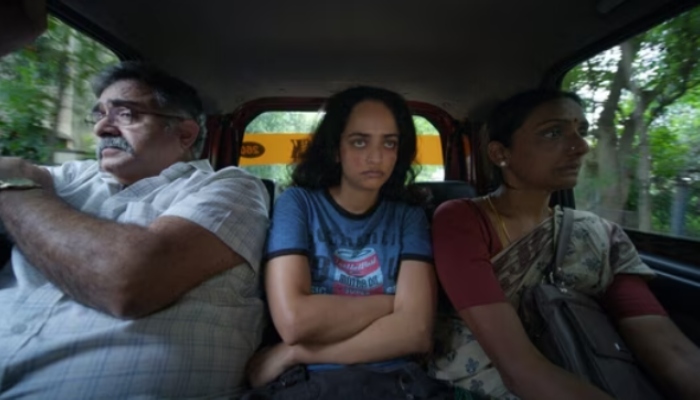
The recent release of a teaser of a Tamil movie named ‘Bad Girl’ starring Anjali Sivaraman in the lead role has sparked a controversy with many stating that the film portrays the Brahmin community in a bad light. The movie has been directed by Varsha Bharath and is produced by Vetri Maaran and Anurag Kashyap. The film is slated to be premiered at the International Film Festival in Rotterdam on January 31st, 2025.
From the teaser, it appears that the makers of the movie intend to portray the story of a young girl from the Tamlian Brahmin family who wants to be rebellious and disobeys her parents to live her life to the fullest, which involves having drinks and having intimate relations with strangers.
The movie teaser has received criticism from many, including Director Mohan G. for depicting a Brahmin girl negatively. “Portraying a Brahmin girl’s personal life is always a bold and refreshing film for this clan. What more can be expected from Vetrimaran, Anurag Kashyap & Co.. Bashing Brahmin father and mother is old and not trendy… Try with your caste girls and showcase it to your own family first,” he said on X.
Portraying a brahmin girl personal life is always a bold and refreshing film for this clan. What more can be expected from vetrimaran, Anurag kasyap & Co.. Bashing Brahmin father and mother is old and not trendy.. Try with your own caste girls and showcase it to your own family… https://t.co/XP8mtnaFws
Apart from Mohan G, several other netizens slammed the movie makers for portraying the Brahmin community in a negative light. “Encouraging harmful stereotypes against Men is “coming of age” humor? Wow,” said one of the users.
Another user stated that the movie portrayed ‘poisonous feminism’, spoke against family values, and taught school-going girls to objectify and dehumanize men. The user also said that the movie instigated violence against men as one of the girls in the movie said that she intended to kill all the men on this planet.
#Badgirlthemovie fetishizing Tamil Brahmin girls to spread pseudo-progressive ideas of wokeism & family breakdown that the West is now rejecting. Everyone looked at the Brahmin girl,& didn't realize these disturbing ideas apply to all youth! 1. Grooming – school & teenage is all… pic.twitter.com/ehcZtWYBLH
“What Nonsense is this? Aren’t the makers ashamed of producing such a movie? Don’t spoil school-going kids with these crap movies. We don’t need Bad Girls we need Good Girls in Tamil Nadu. This is not Feminism,” said another user.
What Nonsense is this Mr. VetriMaaran Aren't you ashamed of producing such a movie. Don't Spoil School Going Kids like this crap movies. We don't need Bad Girl we Need Good Girl in our Tamil Nadu. This is not Feminism.#Vetrimaaran#BadGirlTheMoviepic.twitter.com/5CuG4ftyhX
Supporting movies like Bad Girl which promote degeneracy, secretly enjoying the degradation of Brahmin women onscreen, is like growing snakes in your backyard and expecting them to bite only your neighbours. The snakes will come after your womenfolk one day.
Meanwhile, many others like actor Vijay Sethupati, director Pa Ranjith and Dhanush supported the film. “Happened to watch #BadGirl, and it’s truly a bold and refreshing film! Director #VetriMaaran deserves immense credit for backing such a daring story. The film powerfully portrays women’s struggles and society’s expectations through a unique new-wave cinema style. Congratulations,” said director Pa Ranjith in an X post.
Happened to watch #BadGirl, and it’s truly a bold and refreshing film! Director #VetriMaaran deserves immense credit for backing such a daring story. The film powerfully portrays women’s struggles and society’s expectations through a unique new wave cinema style. Congratulations… pic.twitter.com/EanrwiDE2I
“Teaser of my good friend Varsha’s “Bad Girl” produced by Vetrimaaran. God bless Varsha. Great things are waiting for you,” actor Dhanush said sharing the movie teaser.
Teaser of my good friend Varsha’s “Bad girl” produced by Vetrimaaran. God bless Varsha. Great things are waiting for you. https://t.co/2nV3Trnqx7
“#BadGirl teaser is here, Presented by @anuragkashyap72 & #VetriMaaran, this coming-of-age drama premieres at #IFFR2025! Watch the teaser now! Best wishes to the team!” actor Vijay Sethupathi said promoting the film.
The debutant director Varsha also made comments about women during the launch of the teaser which sparked outrage. She said that she, as a director, intended to build such a character that would be against the ‘flowery’ image of the women. She said that women usually are believed to be and shown as flowery, devoted, nice girls. “It’s too much pressure on them,” she said which further irked the netizens.
'Bad Girl' director Varsha about wanting to break the narrative of women being portrayed as flowers, pure, Pathini (chaste & devoted), motherly/godly because it was too much pressure for women.
The movie is being criticized for portraying the Brahmin community as regressive and orthodox. It shows that the women in the Brahmin families have to play by the rules of the parents or elders and that they can’t do anything on their own.
Apart from Anjali Sivaraman, the film also stars Shanthi Priya, Saranya Ravichandran, Hridhu Haroon, TeeJay Arunasalam, and Sashank Bommireddipalli in key roles. The film is slated for its international release at the International Film Festival Rotterdam on January 31st, 2025.
AAP MLA Naresh Balyan, on Tuesday requested the Delhi High Court for urgent interim relief and sought direction for custody parole. He stated, “I can pay for parole during custody. As a sitting MLA, I will remain in custody. My wife lacks experience, and the campaigning period is almost over.”
Special Public Prosecutor Amit Prasad countered, noting that while the Supreme Court had granted custody parole to Tahir Hussain, he was also a candidate and the investigation in his case had concluded, unlike in this case. He requested more time to file a response regarding the custody parole issue.
The bench took note of this and adjourned the matter for hearing tomorrow, clarifying that further arguments will be heard on January 29. On the next hearing date, the court will address whether custody parole can be granted in this case.
Earlier while opposing the bail plea of AAP MLA Naresh Balyan in the MCOCA case, Delhi Police revealed that the investigation uncovered the involvement of Balyan and his absconding associates in organized crime.
They allegedly conspired to dispute the legitimate properties of witnesses to gain financial or other undue advantages. The accused, along with his associate Kapil Sangwan (alias Nandu), reportedly threatened the rightful owners of these properties to coerce them into selling at significantly lower prices than those agreed upon in the sale contracts.
The applicant, Naresh Balyan, is said to have used agreements in the name of an absconding individual, Umed Singh, who has been evading arrest since Balyan’s detention. Following the agreements, Balyan would manipulate the properties into disputed status, enlisting Sangwan to intimidate the legitimate sellers.
The Trial Court has issued a non-bailable warrant against Umed Singh, and statements from public witnesses have been recorded to support these claims, stated Delhi Police in its reply filed opposing Balyan’s bail plea.
Delhi Police further stated that audio clips, allegedly containing voice conversations between Naresh Balyan and syndicate leader Kapil Sangwan (alias Nandu), have been recorded. The voice sample of Balyan was obtained after permission from the Trial Court and was sent to the CFSL for analysis. The questioned audio clips, along with the samples, were seized for further investigation.
The police also noted that several other suspects, whose names have surfaced, have yet to be identified, and further inquiries are ongoing to fully uncover the scope of the organized crime and trace the illicit financial gains made by Balyan and his associates.
Balyan, along with Kapil Sangwan and other members of the syndicate, is alleged to have assisted in committing or supporting the ongoing unlawful activities of organized crime, whether through logistical planning, providing information, or executing criminal actions. The syndicate has caused significant harm to society and accumulated vast illegal wealth. According to police, Kapil Sangwan, the syndicate’s leader, is currently abroad, living a lavish lifestyle, which suggests that the proceeds from these crimes are being used both domestically and internationally, said Delhi Police.
Senior Advocate Vikas Pahwa, in his argument, strongly contended that the charges against Naresh Balyan under the MCOCA were baseless and lacked any substantial evidence. He pointed out that the case was politically motivated, especially given Balyan’s active role in the upcoming assembly elections and his wife’s candidacy.
Pahwa further criticized the allegations as being part of a larger attempt to hinder his client’s political involvement, asserting that there was no material connection between Balyan and the alleged criminal activities. He called for the grant of interim bail, emphasizing that Balyan’s constitutional right to participate in the electoral process should not be compromised.
In its January 15 order, the trial court, led by Special Judge Kaveri Baweja, noted that there was substantial evidence linking Balyan to an organized crime syndicate.
The court emphasized that Balyan appeared to be actively involved in ongoing unlawful activities as a member of the group.
Balyan is facing charges under the stringent Maharashtra Control of Organised Crime Act (MCOCA), and the trial court recently denied him bail in the case. He was arrested on December 4 in connection with the MCOCA case, although he had previously been granted bail in an extortion case.
Haryana Chief Minister Nayab Singh Saini, while addressing a public rally in the Narela assembly area on Tuesday, took a dig at Aam Aadmi Party (AAP) national convener Arvind Kejriwal over the ongoing Yamuna water issue.
Saini stated that Kejriwal would not be able to clean the Yamuna River no matter what efforts he put in.
Addressing the media, Saini said “He (Arvind Kejriwal) used to say that he would clean Yamuna. After 10 years, he is asking for five more years. He will not be able to clean no matter what he does…”
The Chief Minister further claimed that the people of Delhi had already made up their minds. “This is not AAP. This is ‘aapda’…The people of Delhi have made up their minds such that he will not even get the time to look outside from the Tihar jail… You sold lies, you never worked, only lied. People want work done today…” he added.
Saini also promised that the Bharatiya Janata Party (BJP) would bring a positive change to Haryana. “BJP government will bring a change to Haryana. I appeal to people to be awake and I am proud to say that the PM has stood on his word of bringing housing facilities for the people in Delhi,” he said, while applauding the BJP government.
The Chief Minister also met with the Chief Election Commissioner in Delhi to discuss the Yamuna water issue.
Meanwhile, BJP MP Manoj Tiwari also took a dig at Kejriwal over his allegation against the BJP-ruled Haryana government of ‘poisoning’ Yamuna water, saying that the national capital needs change, not excuses. Manoj Tiwari said that AAP is even stealing songs.
“They stole water, Delhi’s happiness; please don’t steal songs now,” Tiwari said.”We are saying what the public wants to say… We conducted national water sports in Haryana’s water. We bathe in the water that is coming from Haryana… Arvind Kejriwal should be ashamed… Delhi needs change, not excuses,” the BJP MP added.
The remark came after Aam Aadmi Party (AAP) national convener Arvind Kejriwal levelled serious allegations against the Bharatiya Janata Party, stating that the BJP-ruled Haryana government has “poisoned” the Yamuna water supplied to Delhi so that “people die” and the blame comes on the AAP.”
BJP’s Haryana government has poisoned the water in Yamuna. If this water had entered Delhi only to be mixed with the drinking water, many people would have died in Delhi. It would have caused mass genocide,” the former Delhi chief minister alleged. Kejriwal said in a press conference while claiming that the alertness of the Delhi Jal Board prevented the mixing of alleged poisoned water with drinking water.
The political atmosphere in the national capital has intensified, with Congress, BJP, and AAP vying against each other over various issues. The Aam Aadmi Party is eyeing a third term while the Bharatiya Janata Party — which has been out of power in Delhi for close to three decades — is leaving no stone unturned to wrest back power from the ruling party.
(This news report is published from a syndicated feed. Except for the headline, the content has not been written or edited by OpIndia staff)
On 25th January, the National Investigation Agency (NIA) arrested two proclaimed offenders in connection with the 2019 murder of PMK leader Ramalingam in Tamil Nadu. The arrested accused, Abdul Majeeth and Shahul Hameed, are both residents of Thanjavur district. They were among the six accused declared absconders in the case. Majeeth and Hameed were members of the now-banned Popular Front of India (PFI) and had been on the run for years.
The two accused carried a reward of Rs 5 lakh each, announced by the NIA. The investigative agency apprehended them from an undisclosed location and stated that efforts are underway to arrest the remaining three absconders.
Ramalingam, a PMK leader and social activist, became a target after he opposed the Dawah activities of the Popular Front of India (PFI). He was killed in a well-orchestrated manner by PFI members on 5th February 2019.
On 28th January, NIA conducted several raids across Tamil Nadu linked to the case.
Accused declared proclaimed offenders in December 2022
Notably, according to court documents accessed by OpIndia, on 12th December 2022, a special NIA court in Chennai declared six accused, including Majeeth and Hameed, as proclaimed offenders as they failed to respond to summons issued by the court. The court directed that evidence against the absconders be recorded under Section 299 of the CrPC, allowing for their trial in absentia.
Furthermore, the court also authorised the prosecution to initiate action under Section 83 of the CrPC for the seizure of properties belonging to the accused. While Rahman Sadiq, one of the proclaimed offenders, was arrested in 2021, the others continued to evade capture until the recent breakthrough.
Chronology of NIA’s investigation
The NIA’s investigation into the Ramalingam murder case has spanned several years. The matter was officially transferred to the NIA on 7th March 2019, following which the central investigative agency re-registered the case. The original FIR in the matter was filed on 6th February 2019 by Tamil Nadu police. The incident was classified as a terrorist act under the Unlawful Activities (Prevention) Act (UAPA), prompting the NIA’s involvement.
The first major action in the matter was taken by the NIA in May 2019 when the agency raided 20 locations in Tamil Nadu, including the homes of the accused, offices of the PFI, and other sites linked to the conspiracy. During these searches, the NIA seized an array of incriminating materials, including 16 mobile phones, 21 SIM cards, laptops, hard drives, and over 100 documents. The agency also recovered weapons, including a sword and a sharp-edged knife, and Rs 2 lakh in cash. The recovered evidence further established the premeditated and violent nature of the crime.
The first arrests in the case were made in May and June 2019. Key conspirators in the case, including Mohammed Faruk and Myden Ahmed Shali, were arrested. Faruk, a resident of Trichy, was apprehended after evidence linking him to the attack and subsequent conspiracy came to light. Furthermore, Shali, identified as the head of the Dawah team involved in the altercation with Ramalingam, was arrested a month later. Both arrests were critical to the investigation as they unveiled the role of PFI leaders in orchestrating the murder.
Over the years, the NIA’s investigation expanded, focusing on the absconding accused. In July 2023, the agency conducted statewide raids at 21 locations in Tamil Nadu. The agency recovered digital evidence and documents tied to the PFI’s activities.
The recent arrests of Majeeth and Hameed mark a crucial milestone in the investigation. They had been on the run since 2019 and were traced to their hideouts after years of meticulous efforts by the NIA. Three accused remain absconding, and the agency is pursuing the matter to arrest them.
The NIA filed a charge sheet on 2nd August 2019 against 18 accused in the Ramalingam murder case before the NIA Special Court in Chennai. The charge sheet invoked multiple sections of the Indian Penal Code (IPC), including Sections 341, 294(b), 302, and 120B, as well as Sections 15, 16, 18, 18B, 19, and 20 of the Unlawful Activities (Prevention) Act (UAPA). The document detailed the sequence of events leading to the murder and provided evidence of a criminal conspiracy hatched by the accused to eliminate Ramalingam for opposing the Dawah activities of the Popular Front of India (PFI).
According to the charge sheet, the confrontation between Ramalingam and the PFI’s Dawah team on the morning of 5th February 2019 triggered the crime. The accused met at the Periyapalli mosque and planned the violent attack to send a chilling message to those resisting religious conversions. Later that night, Ramalingam was ambushed near his home in Paku Vinayakam Thoppu, where he was brutally assaulted with weapons, including a billhook and knives. His hands were chopped off in the attack, and he succumbed to his injuries.
The NIA’s investigation established that several of the accused played specific roles in the conspiracy. While some carried out reconnaissance on Ramalingam’s movements, others provided logistical support, including vehicles and weapons. The head of the Dawah team, Myden Ahmed Shali, participated in planning the attack, while key PFI leaders oversaw the execution. The NIA categorised the killing as a terrorist act intended to spread communal discord and terrorise dissenters.
Among the 18 accused named in the charge sheet, 10 were initially arrested, while six were declared absconders. Two of the absconders, Abdul Majeeth and Shahul Hameed, were apprehended recently, marking significant progress in the case.
Details of the case
The investigation revealed that the murder of Ramalingam was not a random act of violence. It was a meticulously planned conspiracy. Ramalingam, a PMK leader and social activist, became a target of the Popular Front of India (PFI) after he opposed their Dawah activities. The PFI had sent a Dawah team to the village of Pakku Vinayakam Thoppu in Thanjavur district to carry out religious conversions among underprivileged Hindus.
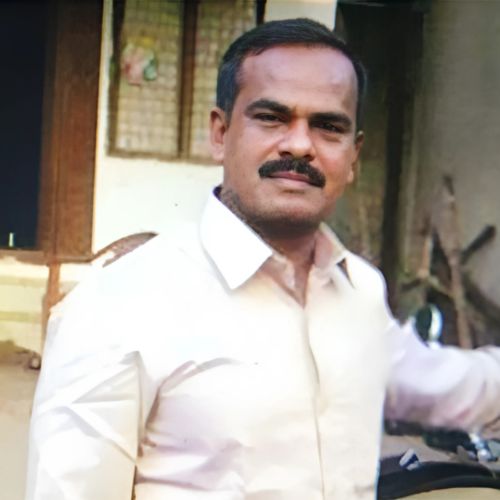
Photo of victim Ramalingam. Source: One India
On 5th February 2019, Ramalingam confronted the Dawah team and challenged their attempts to convert Hindus to Islam. During the heated altercation, Ramalingam publicly expressed his dissent against forced conversions. According to the NIA’s investigation, the confrontation enraged the PFI members, who viewed him as a threat to their conversion agenda. A criminal conspiracy was hatched by PFI and SDPI members to eliminate him and send a strong message to those opposing their activities.
OpIndia accessed copy of a bail order of accused no.2, Mohamed Riyas, in the case, that provided more details about the conspiracy and the murder. The accused named in the case are: Mohammed Asarudeen (A-1), Mohammed Riyas (A-2), Nijam Ali (A-3), Sarbudeen (A-4), Mohammed Rizwan (A-5), Mohammed Thoufik (A-6), Mohammed Farvees (A-7), Thowheeth Batcha (A-8), Mohammed Ibrahim (A-9), Mohammed Hasan Kuthous (A-10), Rahman Sadiq (A-11), Mohammad Ali Jinnah (A-12), Abdul Majeeth (A-13), Bhurkhanudeen (A-14), Shahul Hameed (A-15), Nafeel Hasan (A-16), Mohammed Faruk (A-17), and Myden Ahamed Shali (A-18). All these accused have been implicated in connection with the conspiracy and murder of Ramalingam.
According to the details mentioned in the court document accessed by OpIndia, on the day of the incident, 5th February 2019, members of the Popular Front of India (PFI), including Majeeth, Shali, and others, were engaged in Dawah work in the village of Pakku Vinayakam Thoppu in Thanjavur district. This Dawah activity was reportedly focused on converting underprivileged Hindus to Islam, a practice that Ramalingam, a local PMK leader and social activist, opposed vehemently. Around 8:30 AM, Ramalingam encountered the Dawah team and confronted them about their activities.
During the altercation, Ramalingam, in a symbolic gesture to demonstrate the equality of religions, removed the religious skull cap of Shali, a Dawah team leader, and placed it on his own head, while also applying holy ash on Shali’s forehead. The situation escalated into a heated verbal exchange, but it was temporarily defused with the intervention of local villagers. Ramalingam’s son, who was present at the scene, recorded a portion of the confrontation on his mobile phone.
Despite the peaceful dispersal, the confrontation enraged the PFI members. By late morning, a conspiracy was hatched by PFI leaders, including Shali, Majeeth, and others, near the Periyapalli mosque. They decided to “teach a lesson” to Ramalingam and deter any future opposition to their Dawah activities. The conspirators met again later that day to finalise the plan.
By night, PFI members, including Hameed, Shali, and Majeeth, organised reconnaissance of Ramalingam’s movements. Around 11:15 PM, as Ramalingam and his son were returning home in their mini-truck, the assailants ambushed them near New Muslim Street in Thirubhuvanam. The narrow street forced Ramalingam to halt his vehicle, giving the attackers the opportunity to block his path using a Maruti Swift Dzire car.
The attackers, armed with lethal weapons, forcibly stopped Ramalingam and assaulted him. They threw chilli powder at him, immobilising him briefly, and then inflicted severe injuries, including chopping off his hands. Despite his son’s cries for help and the alarm raised by nearby residents, the attackers fled the scene in their car. Ramalingam was rushed to the hospital but succumbed to his injuries shortly after midnight on 6th February 2019.
Mohammed Asarudeen and Mohammed Riyas, along with eight other accused approached the Madras High Court seeking bail. The plea was heard by a bench comprising Honourable Mr Justice P.N. Prakash and Honourable Mr Justice RMT. Teekaa Raman. However, the court rejected the bail petitions, citing the gravity of the offence and the available evidence.
While rejecting the bail plea, the court emphasised that the materials gathered by the National Investigation Agency (NIA) and the testimonies of witnesses so far did not meet the conditions stipulated under Section 43D(5) of the Unlawful Activities (Prevention) Act to grant bail to the appellants. The court noted that there were “reasonable grounds for believing that the accusations against the appellants were prima facie true” and directed the trial court to expedite the examination of protected witnesses.
The trial against 13 accused in underway in Special NIA Court in Chennai.
Details included in this report are based on Special NIA Court, NIA Press Releases and Madras High Court documents connected to the case.
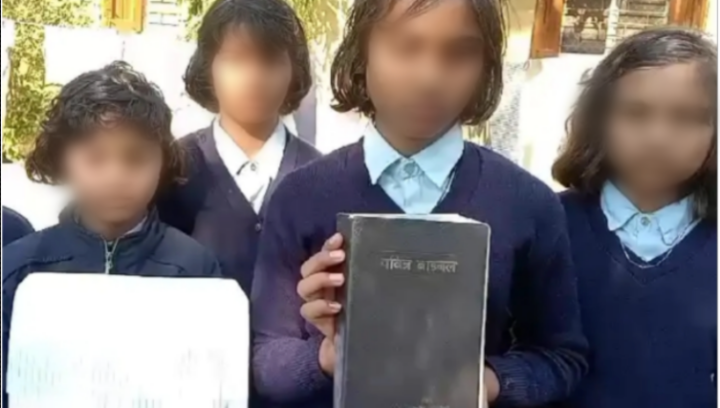
A matter regarding attempt to conversion has come to light in a hostel for tribal girls at Chirwa of Bhikangaon located in the Khargone district of Madhya Pradesh. The students have accused the warden Rita Kharte of forcing them to read the Bible and perfrom Christian prayers at night. They were also made to do other work at the facility including washing utensils and cleaning wheat.
After being subjected to mental and physical abuse by the warden, 15 pupils from classes four and five left the hostel and went home. However, they were assaulted upon their return. Dineshchandra Patel, the Bhikangaon Block Education Officer (BEO), examined the hostel after learning about the critical issue. During the investigation, Bible books and copies with religious prayers were recovered from there.
Sangeeta Yadav has been appointed as the new superintendent as Rita Kharte was removed with immediate effect after the investigation revealed that the charges were valid. The parents of the female students have called on the administration to conduct an impartial probe into the matter. The BEO has recommended severe action against the offenders in a comprehensive report that was delivered to the Assistant Commissioner Tribal Affairs Department.
All of the hostel’s students, distressed by the abuse and intimidation, went to the District Magistrate (DM) to voice their concerns. When the locals questioned the girls, they disclosed that Rita Kharte, the hostel warden, requires them to pray and read the Bible every morning and evening. She orders them to clean the utensils, restrooms and sweep. If they don’t, she even beats them.
“The warden makes us clean wheat at 5 in the morning. She sends her husband to sell it. He comes back after selling it by 6 am. Not only this, the warden also thrashes us. When two girls ran away from our hostel, she assaulted them. She also directs us to clean the bathrooms and orders us that if anyone asks, tell them that other people do it. She pushes us pray to Lord Jesus at 12 in the night and then at 5 in the morning. She even pressures us to read the Bible,” disclosed one victim.
The girls stated that they don’t bad quality food which even contains worms sometimes. They students later agreed to stay at the hostel after the former warden was ousted and the SDM (Sub-Divisional Magistrate) assured them of better treatment after reaching the spot.
As the Ministry of Finance put up a notification inviting applications for the position of Chairperson of the Securities and Exchange Board of India (SEBI), the Congress party saw an opportunity to find joy in patting itself on the back for a routine bureaucratic transition.
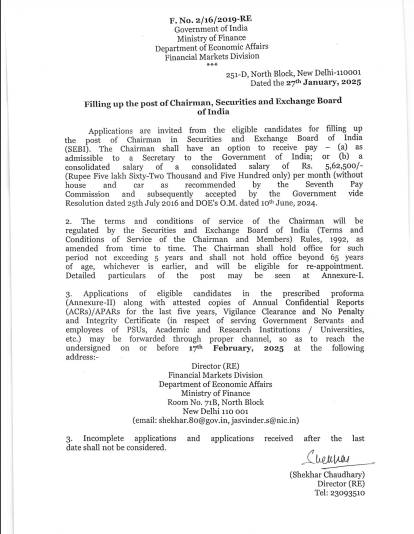
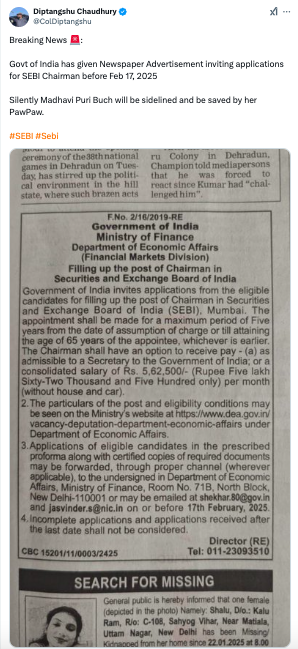
In the notification dated 27th January 2025, The Ministry of Finance, through the Department of Economic Affairs (Financial Markets Division), has advertised for the post, “Government of India invites applications from the eligible candidates for filling up the post of Chairman in Securities and Exchange Board of India (SEBI), Mumbai.”
According to the ministry, the selected candidate will have the option to receive remuneration equivalent to the pay scale of a Secretary to the Government of India or a consolidated salary of Rs 5,62,500 per month. However, this consolidated salary does not include perks such as a government-provided house or vehicle. The ministry said that the deadline for submitting applications is 17th February 2025.
Congress declares itself as the winner of the “Buch battle”
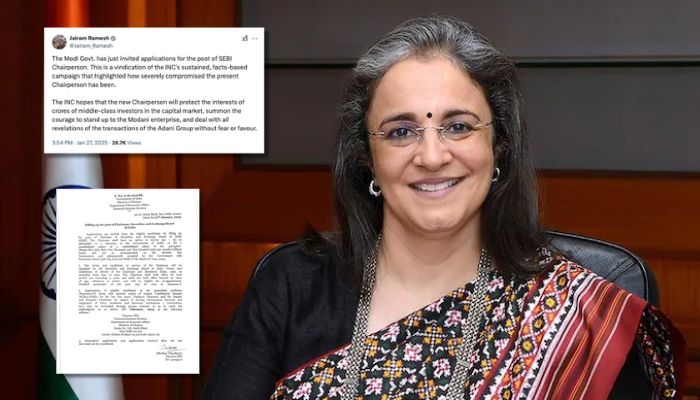
Soon after the Ministry of Finance’s notification inviting applications for the post of SEBI chairperson was issued, Congress MP Jairam Ramesh claimed that this was a vindication of Congress’s “sustained, fact-based” campaign against outgoing SEBI chairperson Madhabi Buch.
“The Modi Govt. has just invited applications for the post of SEBI Chairperson. This is a vindication of the INC’s sustained, facts-based campaign that highlighted how severely compromised the present Chairperson has been. The INC hopes that the new Chairperson will protect the interests of crores of middle-class investors in the capital market, summon the courage to stand up to the Modani enterprise, and deal with all revelations of the transactions of the Adani Group without fear or favour,” Ramesh posted on X on Monday.
The Modi Govt. has just invited applications for the post of SEBI Chairperson. This is a vindication of the INC's sustained, facts-based campaign that highlighted how severely compromised the present Chairperson has been.
The INC hopes that the new Chairperson will protect the…
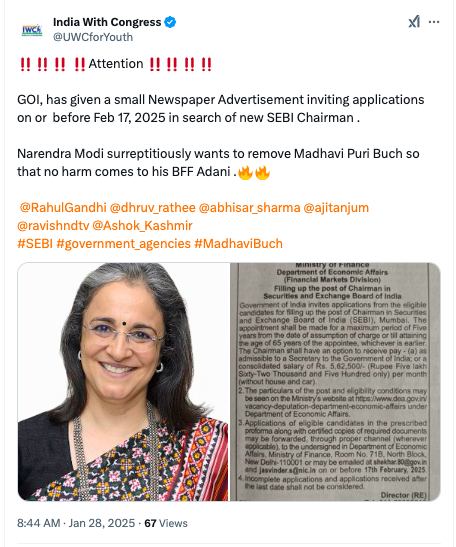
One Congress supporter “India with Congress” said, “GOI, has given a small Newspaper Advertisement inviting applications on or before Feb 17, 2025, in search of new SEBI Chairman. Narendra Modi surreptitiously wants to remove Madhavi Puri Buch so that no harm comes to his BFF Adani.”
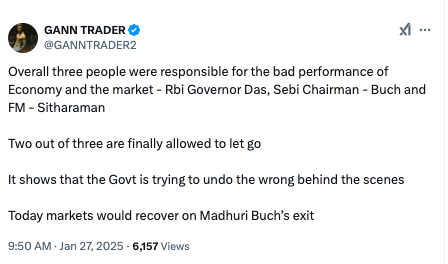
Meanwhile, another X user said, “Overall three people were responsible for the bad performance of Economy and the market – Rbi Governor Das, Sebi Chairman – Buch and FM – Sitharaman. Two out of three are finally allowed to let go. It shows that the Govt is trying to undo the wrong behind the scenes. Today markets would recover on Madhuri Buch’s exit.”
Another one said, “Govt of India has given Newspaper Advertisement inviting applications for SEBI Chairman before Feb 17, 2025. Silently Madhavi Puri Buch will be sidelined and be saved by her PawPaw.”
Is the Finance Ministry’s notification for recruiting new SEBI chief a vindication of Congress’s smear campaign against Madhabi Buch?
Congress leader Jairam Ramesh and the party’s supporters are claiming that somehow the Ministry of Finance inviting applications for replacement of outgoing SEBI chairperson Madhabi Buch’s successor is a vindication of their campaign attacking her and demanding her resignation over alleged conflict of interest and financial misconduct.
Contrary to the assertions made by the Congress party, the recruitment notification for SEBI chairperson has been issued as Buch’s tenure comes to an end on 28th February 2025. It has nothing to do with Congress’s campaign targeting her or with any alleged financial misconduct. Thus, there is no question of any ‘vindication’ and it is only a continuation of Congress’s fertile imagination of making the Modi government quiver in its boots with their baseless allegations.
Ironically, the Congress party is pushing a narrative that somehow Madhabi Buch not getting an extension or the Finance Ministry issuing notification for appointing the next SEBI chief as ‘vindication’ of the party attacks on her based on the dubious Hindenburg hit-job against Buch.
It must be recalled that in August 2024, Hindenburg Research published a report that claimed that SEBI chief Madhabi Puri Buch and her husband Dhaval Buch had investments in an offshore firm used in the Adani money siphoning case. The report also alleged that the SEBI chairperson’s involvement showed a lack of transparency in the market regulator when it came to investigating the Adani group. The next day on 11th August, SEBI chief Madhabi Buch and her husband released a joint statement, calling the report baseless and saying that their financial records were an open book. OpIndia reported earlier that Hindenburg Research’s hit job on Madhabi Buch proved nothing about her supposed ties to any offshore funds connected with the Adani Group.
Despite this, the Congress party and the anti-BJP cabal had heavily relied on the Hindenburg report to attack Madhabi Buch and the Modi government. They claimed that somehow the SEBI chairperson’s integrity is compromised and the Central government was complicit in her alleged financial misconduct.
Things, however, turn even more interesting given the fact that in October last year, Buch was cleared of any wrongdoing following a probe since the investigation found nothing incriminating against her. And just months later, Hindenburg Research, the very source of the continuous attacks on Adani Group and Madhabi Buch, announced its closure. The US-based short-seller’s shutdown came just days after US Attorney for the Eastern District of New York Breon Peace, who brought fraud and bribery charges against Adani Group chairman Gautam Adani and seven other executives, announced his resignation. Peace has been accused of having ties with regime change enthusiast and billionaire George Soros who has been vocal in his opposition to Indian Prime Minister Narendra Modi.
Soon after Hindenburg Research announced its shutdown, its founder Nate Anderson (Nathan Anderson) was accused of colluding with hedge funds like Canada’s Anson Funds. It emerged that Anderson collaborated with Anson Funds to produce targeted reports. Now when the integrity of Hindenburg Research itself is questionable, there is no doubt that its reports targeting the Adani conglomerate or SEBI chief Madhabi Buch cannot be taken seriously or relied on to level corruption allegations against them. Thus forget vindication, Congress’s attacks on the SEBI chief, Adani Group and the Modi government deserve condemnation for using dubious reports by foreign entities for political motives.
India’s democratic system, which allows citizens to actively influence governance at all levels, rests on the strength of its electoral process. However, a nation with over 1.4 billion people and the potential third-largest economy in the world shouldn’t be constantly engaged in elections. Therefore, the purpose of the “One Nation, One Election” bill, which was presented to the Parliament last December, is to bring an end to the country’s endless election cycle.
The Bharatiya Janata Party (BJP), which leads the National Democratic Alliance (NDA), is preparing to implement the party’s long-standing electoral promise across the country to streamline the complicated process, lessen the burden on the country’s resources and save valuable time. The idea, commonly known as simultaneous elections, proposes scheduling the elections for the state legislature and the Lok Sabha on the same dates. Voters would be able to exercise their democratic right to vote for both levels of government in their constituency and on the same day, even though the exercise might occur in phases across the country. The strategy seeks to minimize interruptions brought on by frequent elections, address logistical issues and cut expenses by coordinating these election calendars.
In 2024, the high-level committee report on simultaneous elections in India was published, offering an extensive implementation plan for this goal. On 18th September 2024, the union cabinet approved its recommendations, which was a major step in the direction of electoral reform that could enhance administrative effectiveness, lower election-related expenses and encourage policy stability. The idea of “One Nation, One Election” has surfaced as an essential development that specifies thorough consideration and acceptance as India seeks to streamline governance and maximize its democratic procedures.
Historical background
In India, simultaneous elections are not a novel concept. Elections to the Lok Sabha and the state legislative assemblies were held concurrently from 1951 to 1967 after the Constitution was ratified. Three more general elections took place in 1957, 1962, and 1967, maintaining the trend of holding the first general elections to the Lok Sabha and state assemblies together from 1951 to 1952.
The first general elections in 1952, which were followed by elections for the president and vice president, marked the beginning of the nation’s experiment with simultaneous Lok Sabha and assembly elections. “One Nation, One Election” was last observed in India in 1967. There were 3,563 assembly seats and 520 Lok Sabha seats at stake in the nation’s fourth general elections. The majority of the polling took place from the 15th to the 21st of February. Most states had just one phase of the election but Uttar Pradesh underwent four.
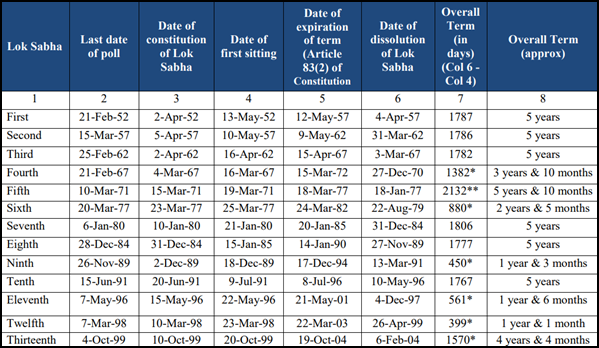
However, the early dissolution of certain state legislative assemblies in 1968 and 1969 interrupted this cycle of synchronized elections. Additionally, the fourth Lok Sabha was dissolved early in 1970, and new elections were conducted in 1971. The fifth Lok Sabha’s term was prolonged until 1977 under article 352 due to the imposition of “Emergency,” in contrast to the first, second and third Lok Sabhas, which all completed their entire five-year terms. The eighth, tenth, fourteenth, and fifteenth Lok Sabha terms are the only ones that have spanned the entire five years since then while the sixth, seventh, Nnnth, eleventh, twelfth and thirteenth were among the others that were dissolved early.
Over the years, state assemblies witnessed similar interruptions. Term extensions and premature dissolutions are now frequent problems. The current pattern of staggered electoral schedules across the nation is the result of these events, which significantly disrupted the cycle of simultaneous elections.
Image via Press Information Bureau (*Mid-term polls were held. Dissolution took place before the elections.**Extension due to proclamation of Emergency).
India saw significant social and political transformations after the 1962 elections. The battle between China and India demoralized people. Pandit Jawaharlal Nehru, the nation’s first and longest-serving prime minister, died on 27th May 1964. Lal Bahadur Shashtri, who signed a statement to end the 1965 India-Pakistan war, replaced him. He passed away in Tashkent on 11th January 1966. A two-year drought was then plaguing many regions of the nation and anti-incumbency sentiment was fueled by an astounding price increase.
On 24th January 1966, Pandit Nehru’s daughter Indira Gandhi assumed leadership of the country amid these challenges when she defeated Morarji Desai in the election of the leader of the Congress Parliamentary Party (CPP). As evidenced by the 1967 polls, this caused a split between Indira and Congress veterans like Desai. Meanwhile, parties including the Bharatiya Jana Sangh (BJS) led by Pandit Deendayal Upadhyay, the Swatantra Party headed by C Rajagopalachari and J B Kripalani as well as the Samyukta Socialist Party (SSP) helmed by Ram Manohar Lohia, the opposition went through a significant revival.
The Congress had been accumulating over half of the seats in the Lok Sabha and the assemblies till 1962. The SSP was founded by Lohia in 1964 in opposition to the Congress. His catchphrase, “Congress hatao (remove Congress)” helped him win a seat in the Lok Sabha in a 1963 by-election from Farrukhabad, Uttar Pradesh.
Political assertions of farming groups and strong opposition exacerbated Congress’ problems
Following the Green Revolution, there was an increase in political assertiveness by farming groups in addition to the struggle of the opposition parties against the Congress. The opposition parties made an effort to capitalize on their dissatisfaction by mobilizing these groups with slogans such as Lohia’s “Pichhade Paavain Sau Mein Saath (Other Backward Classes must get 60%),” which was crucial for undermining the Congress in North India. Furthermore, in states like Tamil Nadu, the Congress was defeated owing to the alliance between the Dravida Munnetra Kazhagam (DMK) and the Swatantra Party.
According to the 1961 census, 43.87 crore people were living in the country, but there were only 25.03 crore electors in that year. Voters above the age of 21 could cast votes. The turnout was 61.33%, the highest since 1952, per the surveys. The Congress won 283 seats out of 520 to gain a majority in the Lok Sabha, however despite maintaining a 40.78% vote share, this was the party’s lowest number since 1952. With 44 seats, the Swatantra Party became the main opposition in the lower house.
DMK obtained 25 seats, SSP secured 23, PSP (Praja Socialist Party) won 13, Communist Party of India (CPI) claimed 23 and Communist Party of India-Marxist (CPM) gained 19 while the BJS succeeded in 35 seats. The Swatantra Party also became the main opposition in a few states. As a result of the grand old party’s defeat, the opposition parties formed the Samyukta Vidhayak Dal (SVD) to create coalition governments in several states. Despite being the largest party in 13 assemblies, the Congress failed to secure a straight majority in states such as West Bengal, Punjab, Rajasthan, Bihar, and Uttar Pradesh.
Significant defections to the Congress in a few of the states resulted in the establishment of SVD governments in those states. Before the elections in Bengal, Ajoy Kumar Mukherjee left the Congress to start the Bangla Congress. On 1st March 1967, he took the oath of office as chief minister of the SVD. On 5th March 1967, Mahamaya Prasad Sinha, the only MLA (Member of the Legislative Assembly) of his party’s Jan Kranti Dal was sworn in as chief minister of Bihar as he became the leader of the SVD. A few days later on 8th March 1967, Gurnam Singh of the Akali Dal was elected as the chief minister of the SVD in Punjab. Rao Birender Singh quit the Congress to start the Vishal Haryana Party in Haryana and on 24th March 1967, he also took office as the chief minister of the SVD.
Other opposition figures who became chief ministers were Rajendra Narayan Singh Deo of the Swatantra Party in Odisha on 8th March 1967, E M S Namboodiripad of the CPM-led United Left Front in Kerala on 6th March 1967 and C N Annadurai of the DMK in Madras on the same date. Chaudhary Charan Singh departed the Congress on 1st April 1967 and on 3rd April he took the oath of office as chief minister of Uttar Pradesh from the SVD. Similar events occurred in Madhya Pradesh where on 30th July 1967, Congress dissident Govind Narain Singh was sworn in as the first non-Congress chief minister. The Congress fell four seats shy of a majority in Rajasthan. Governor Hukum Singh was accused of engaging in “mockery of democracy” despite administering the chief minister’s oath to Congressman Mohanlal Sukhadia.
More than a dozen parties, ranging from the far right to the far left, formed some of these governments. However, a few months after they were established, the SVD governments began to fall apart. Midterm elections were held in 1968-69 in several states, including Haryana, Punjab, Uttar Pradesh, Bihar and Bengal. Politics in these states has become progressively unstable ever since.
How Indira Gandhi broke the “One Nation One Election” cycle
The prime minister at the time, Indira Gandhi addressed the country on the evening of 27th December 1970. The announcement made by Indira Gandhi on the chilly winter night shut down the election process for decades until the country tried to switch back to the previous system of simultaneous polling. “In the present situation, we cannot go ahead with our proclaimed programme and keep our pledges to our people,” she pronounced while stating that the dissolution of the Lok Sabha was taking place fifteen months ahead of its term. She added, “We are concerned not merely with remaining in power but with using that power to ensure a better life for the vast majority of our people.”
The Lok Sabha was dissolved for the first time after India’s independence. After being expelled from the Congress, Indira Gandhi led a minority administration that was put together with the help of the DMK and other regional parties. She would have served as prime minister until February 1972 but she craved more than just power. She desired to hold an absolute grip on authority. The legislative election would be separated from the state elections due to her decision to dissolve the lower house and organise the general election fifteen months early.
The simultaneous poll cycle, which would become gradually obstructed in later decades, fell apart in 1971 when Prime Minister Indira Gandhi decided to hold the Lok Sabha elections 15 months ahead of schedule. However, several states had already conducted mid-term assembly elections, including Bihar (1969), Haryana (1968), Kerala (1970), Punjab (1969), Uttar Pradesh (1969) and Bengal (1969). Only a few states, including Bengal, Tamil Nadu and Odisha went through the 1971 assembly elections and the Lok Sabha elections.
Interestingly, in 1967, the Election Commission of India (ECI) considered setting a set time for synchronized elections to avoid issues for governments when the budget sessions started. “The best time for holding simultaneous general elections all over the country is the first week of March rather than the third week of February, but, unless the financial year is changed, e.g., to the year commencing on 1st July, we shall have to follow more or less the programme adopted as at this year’s general elections and, both at the centre and in the states, the first budget session of the newly constituted houses will have to be hustled through at the start,” read ECI’s report for the 1967 polls. Nevertheless, as the nation hasn’t undertaken simultaneous elections since such plans have remained a pipe dream.
Congress’ infighting and eventual split
The development took place throughout the 1960s, a time of significant upheaval and change within the Indian National Congress which observed a period of disintegration in the late 1960s following the passing of Jawaharlal Nehru and Lal Bahadur Shashtri. Following Prime Minister Lal Bahadur Shastri’s unexplained death, Indira Gandhi was sworn in as prime minister with the backing of the “Syndicate,” which was not supportive of her otherwise. She was not, however, the leadership’s preferred candidate as an unofficial faction predominated the party. K Kamraj, Atulya Ghosh, Neelam Sanjiva Reddy, S Nijalingappa, SK Patil and Biju Patnaik were among the members of the influential “Syndicate.”
While Morarji Desai, who also aimed for the prime minister’s chair, had to be content to be her deputy, Indira Gandhi was given the top position. Except for her brief tenure as the Information and Broadcasting Minister in the Shashtri Cabinet, Indira Gandhi’s qualifications had not yet been put to the test, even outside the Congress fold. Ram Manohar Lohia, a socialist mainstay, even called her a goongi gudiya (the dumb doll) after she seemed too apprehensive to read aloud a Budget speech. Indira Gandhi knew she was not very popular with her party members, especially the “Syndicate” and as a result, she began to solidify her standing with the general public.
According to Tariq Ali’s book “The Nehrus and the Gandhis,” an aggressive Indira Gandhi had sprung into the central ring, defying K Kamaraj’s belief that she was “a pliable, weak lump of clay they could mould and remould.” She ran a vigorous campaign with the slogan “Garibi Hatao (remove poverty)” during the 1967 Lok Sabha election. Her views on privy purse and bank privatization did not sit well with Morarji Desai and the “Syndicate.” She was expelled from the Congress in November 1969 for “violating party discipline” due to growing criticism within the party.
Pupul Jayakar in “Indira Gandhi A Biography” remarked, “The Syndicate had never forgiven her (Indira Gandhi) for the independent stand she had taken on vital issues relating to the country.”
Indira Gandhi’s new party
When President Dr Zakir Hussain died on 3rd May 1969, his selection of his successor intensified internal strife within the Congress that was in power. After being ousted, Indira Gandhi launched a new party, the Indian National Congress (Requisitionists), in opposition to the Indian National Congress (Organisation), which was headed by K Kamaraj and then Morarji Desai. This was a watershed moment in the history of the party and triggered political unrest throughout the nation. While alternative governments were established in some states, the president’s power was invoked in others.
Indira Gandhi’s party then partnered with the DMK and other left-wing parties to create a minority administration to maintain its grasp on power. President VV Giri dissolved the Lok Sabha on her recommendation. Inder Malhotra in “Indira Gandhi: A Personal and Political Biography” revealed, “Indira’s government after the split was vulnerable, and she was advised by (her secretary) PN Haksar to call a midterm election in 1971 to get the popular endorsement of her policies.”
Political scientist Myron Weiner mentioned that Indira Gandhi called the polls a year earlier in 1971 due to some factors, including the Congress’ loss in the 1967 elections, a period of drought, rising prices, two wars with Pakistan, increasing corruption, the decision to devalue the rupee, and the deaths of two prime ministers in quick succession. Despite the risks involved in the choice, Indira Gandhi’s risk paid off. The Indian National Congress (Organisation) was only able to secure 16 seats in the lower house, whereas Indira Gandhi’s Congress ultimately garnered almost 43% of the vote or 352 seats out of 518.
Therefore, Indira Gandhi’s hasty dismissal of the Lok Sabha led to an early election in March 1971, which otherwise would have happened in 1972. This was the first time Parliament had been dissolved before its entire term in India’s twenty-three years of independence. Indira Gandhi successfully separated the cycle of the national election from that of the state assembly, whose terms were not yet over, by pushing up the polls.
Notably, some states had already switched to a separate poll calendar, even though Indira Gandhi’s decision to conduct the general election early was a major element in ending the simultaneous vote cycle. The ‘first elected Communist administration in the world’ was the Kerala government under E M S Namboodiripad, which Prime Minister Jawaharlal Nehru recommended President Rajendra Prasad to overthrow as early as July 1959.
The Kerala government was dissolved on the grounds that it was unable to govern in accordance with the constitutional mandate, which historian V Krishna Ananth described as “a significant abuse of Article 356 of the Constitution.” Midterm elections were forced upon non-Congress state governments after they were overthrown in 1968 in Haryana, Bihar, Punjab and Uttar Pradesh. West Bengal’s precarious administration also fell.
Prime Minister Narendra Modi also stated that Indira Gandhi “misused” Article 356 of the Constitution 50 times to overthrow elected governments. Therefore, unstable state administrations were removed from the simultaneous election calendar, and Indira Gandhi’s 1970 decision ensured that the parliamentary election and the state polls would be held individually.
Steps taken by BJP-led central government regarding “One Nation, One Election”
The Election Commission reintroduced the idea of simultaneous polling in 1983 and the BJP pledged to bring back “One Nation, One Election” in 1984. The Law Commission also recommended simultaneous elections in its report (Justice BP Jeevan Reddy) in 1999. The BJP after storming to power in 2014 has taken the initiative to bring back “One Nation, One Election” and has even started the process. NITI (National Institution for Transforming India) Aayog in 2017 reaffirmed the 79th Parliamentary Standing Committee report’s support for simultaneous elections in 2015 which was an integral part of the saffron party’s election manifestos for 2019 and 2024. The BJP-led NDA government even hosted an all-party meeting on the issue in 2019.
Former President Ram Nath Kovind chaired the High-Level Committee (HLC) established by the NDA Government in September 2023. After six months of deliberations, the panel delivered its report to President Droupadi Murmu in March 2024. The Constitution (129th Amendment) Bill and the Union Territories Laws (Amendment) Bill were introduced by the centre in December 2024 and both were referred to a Joint Parliamentary Committee for further consultation.
A tiered strategy to synchronize elections was laid out in the 18,000-page Kovind report. Lok Sabha and state legislative assemblies will be held first, followed within 100 days by local body elections. Of the 47 political parties that responded to the panel, 32 supported simultaneous elections. The idea, according to these parties, which include the BJP, the Biju Janata Dal (BJD), the Janata Dal-United (JDU), and the Shiv Sena, will preserve social harmony, save limited resources and promote economic growth.
The state assembly’s term is also not shortened to fewer than five years under the bill. The same is guaranteed by Articles 83 and 172. The articles of the Lok Sabha and Vidhan Sabha’s mandates, unless dissolved early, were meticulously crafted by our Constitution’s founders to be no more than five years. The report discussed the possibility of amending the constitution to introduce an extra article 82A, which would change the period of state assembly and align their terms with that of the Lok Sabha.
Both the Lok Sabha and the Rajya Sabha will need to pass several tests for several constitutional amendments that address the span of the state and Lok Sabha assemblies, the duration of the assemblies in the three Union Territories (Jammu and Kashmir, Delhi, and Puducherry), elections in urban and rural wards, and a single electoral roll.
The single electoral roll is one of the bill’s overlooked but crucial proposals. With the introduction of EPIC or Elector’s Photo Identity Card, the committee advised that simultaneous elections must enable the Election Commission and multiple state election commissions to coordinate their operations in order to prepare a single electoral roll. This will provide a self-correction mechanism by replacing the traditional voter card and doing away with voting redundancy.
“Another measure that promises to redefine the terms of good governance is the Bill introduced in Parliament to synchronise election schedules in the country. The ‘One Nation, One Election’ plan can promote consistency in governance, prevent policy paralysis, mitigate resource diversion, and reduce the financial burden, apart from offering many other benefits,” pointed out President Droupadi Murmu in her Republic Day speech.
PM Modi has regularly advocated for the same. “After independence, elections at the state and central levels were held together for a long time. But over time, this pattern broke down, causing significant challenges for the country. Today, there is an important debate about ‘One Nation, One Election.’ Holding the Lok Sabha and state elections simultaneously could alleviate disruptions and enable a more focused governance approach,” he highlighted while addressing a National Cadet Corps (NCC) rally on 27th January.
In reality, “One Nation, One Election” is a pursuit of the original concept that was executed at the beginning of our growing Republic rather than a fresh start. Beyond history, though, the concurrent Lok Sabha elections and elections in Odisha, Andhra Pradesh, Arunachal Pradesh and Sikkim are evidence of India’s blossoming federalism. There have been six simultaneous elections in the state of Maharashtra, five in Haryana and three in Jharkhand, one of India’s newest states which are a testament to the country’s towering democratic traditions.