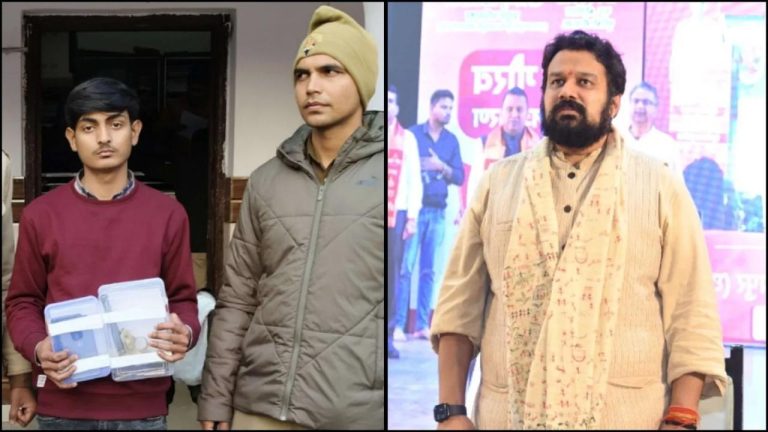
On Monday, 27th January, the Supreme Court stated that illegal religious conversion is not “as serious a crime” as murder, theft, rape, or dacoity. The court opined this while granting bail to a Maulvi who had deceptively converted a mentally challenged boy to Islam.
Justices JB Pardiwala and R Mahadevan meanwhile also slammed the trial court and the high court for not exercising their discretion while considering the bail plea. “There was no good reason for the High Court to decline bail. The offense alleged is not that serious or grave like murder, dacoity, rape, etc,” the duo said.
“Every year so many conferences, seminars, workshops, etc. are held to make the trial judges understand how to exercise their discretion while considering a bail application as if the trial judges do not know the scope of Section 439 of the CrPC or Section 483 of the BNSS,” the bench said.
“We are of the view that the High Court should have exercised its discretion by granting bail to the petitioner. There was no good reason for the High Court to decline bail. The offence alleged is not that grave like murder, dacoity, rape etc. We can understand that the trial court declined bail as trial courts seldom muster the courage to grant bail, be it any offense. However, at least, it was expected of the High Court to muster the courage and exercise its discretion judiciously” the court stated further while slamming Allahabad High Court for denying the bail.
The Maulvi accused of illegal religious conversion was charged under sections 504 (Intentional insult with intent to provoke breach of the peace) and 506 (criminal intimidation) respectively of the IPC and Sections 3 and 5 of the Uttar Pradesh Prohibition of Unlawful Conversion of Religion Act, 2021.
The court slammed the lower courts and said that the case shouldn’t have reached the top court. The trial court should have granted bail, if not, the higher court should have. “We fail to understand what harm would have befallen the prosecution if the petitioner would have been released on bail subject to appropriate terms and conditions,” the Supreme Court said.
“Discretion does not mean that the judge on his own whims and fancy declines bail saying conversion is something very serious,” it added.
Cases of illegal conversions in India
It is crucial to note that illegal religious conversions where the victims are misled, threatened and even blackmailed to convert have constantly emerged in the last few years. Islamists torture victims, especially women, assault them, and harass them mentally before forcing them to convert to Islam. On the other hand, Christian missionaries target poor tribals and lure them with money, superstitions, and food grains before forcing them to embrace Christianity.
Recently, a young Hindu woman committed suicide after being raped, cheated, and forcefully converted to Islam by accused Faraz Attar, from Shahdara in Delhi.
On 26th January, Lakhimpur Kheri police arrested two individuals, Baburam and Pastor Pramod Kumar Balmiki, over allegations of forced religious conversions in Bejham village under Neemgaon police jurisdiction. The two missionaries lured villagers into conversions with false promises, including healing powers, rice, and magical water. The accused also coerced individuals to abandon Hindu practices by removing their tilak and idols of deities from their homes.
In the given case, the accused Maulvi who converted a mentally challenged boy to Islam had been in custody for 11 months. The petitioner demanded bail saying that the allegations were not that serious. Meanwhile, the state argued that the charges included sections 504 and 506 of the Indian Penal Code, along with provisions of the state’s anti-conversion law, which prescribes a maximum penalty of up to 10 years in prison.
Rejecting the objections, the court bench clarified that keeping the accused in custody during the bail period was unnecessary, as prolonged detention could not be justified solely on the gravity of the allegations. The bench reiterated that the lower courts would have exercised their rights and shouldn’t have allowed the case to reach the top court. The Allahabad HC had denied bail to the Maulvi in May 2024.
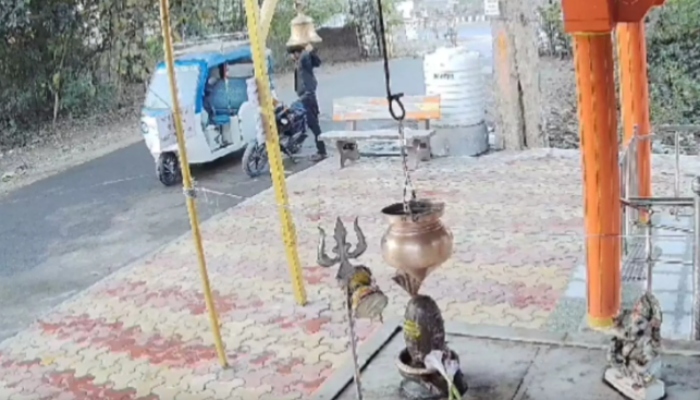
On Monday, 27th January, an auto-driver identified as Mohd Ishaq Khan threatened Hindu temple authorities for playing Hanuman Chalisa in the Bilaspur district of Chhattisgarh. He said that if the authorities had so much urge to ‘showcase’ love for their religion, they should go to Ayodhya where a huge Ram temple has recently been built. He also said that if the rendition of ‘Hanuman Chalisa’ was not stopped, he would vandalize the premises.
“If you are so much fond of becoming a Hindu, then go to Ayodhya. Don’t keep on doing ‘Hindu-Hindu’ here, otherwise, I will remove the ‘chonga’ from the Mandir and throw it away,” he threatened using abusive language as he asked the authorities to stop playing Hanuman Chalisa on speaker.
The video of the incident has gone viral over the internet in which the accused can be seen arriving in his vehicle and threatening the temple authorities. He also used vulgar language to threaten the temple authorities and made offensive remarks against Hindu deities.
"If you are so fond of becoming a Hindu, then go to Ayodhya (abusive language). Don't keep saying 'Hindu-Hindu' here, otherwise I will remove the 'chonga' from the Mandir and throw it away (abusive language)."
The incident sparked outrage among the community raising communal tensions. The Hindus started protesting against the event and demanded strict police action against the accused. Dhananjay Giri Goswami, a member of the Hindu Sanatani Group, said that Ishaq Khan needed to face the law as he had made derogatory comments about Hindu deities and abused Hindu religion.
“The sound from the temple causes discomfort to him. Who is going to tell him that the sounds of Azaan that come out of Masjids five times a day also cause discomfort to many? How dare he talk about other religions when his own religion practices the same? Ishaq Khan constantly talks against Hindus. Now this can’t be tolerated. We would continue to recite and play Hanuman Chalisa here. He can’t tell us what to do and what not to do,” Goswami was quoted as saying.
The incident is believed to have happened on the 27th of January morning at 7 AM. The Hindus gheraoed the police station after the video of the incident went viral over social media. They demanded the strictest punishment against the accused person.
OpIndia contacted the Bilaspur Police Station to know whether the FIR in the case had been filed. Later the police returned the call and confirmed that the accused had been arrested and charged under sections 170 (Arrest to prevent the commission of cognizable offenses), 126 (security for keeping the peace), and 135 (prevention of a breach of the peace or disturbance of the public tranquillity), and 3 of the Bharatiya Nyay Suraksha Samhita, 2023.
The police also confirmed that the arrest was immediately executed by the Police in an attempt to maintain peace within the district.
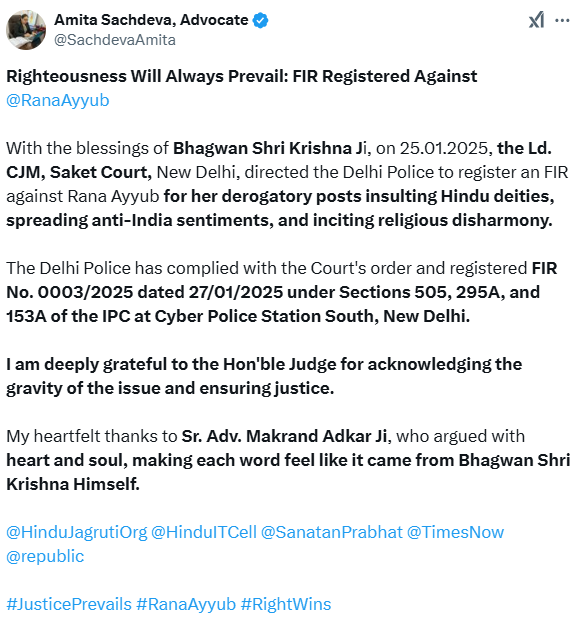
On 27th January, the Cyber Police Station South, New Delhi, lodged an FIR against propagandist and alleged journalist Rana Ayyub following directions from a Delhi Sessions Court. The FIR was filed based on a complaint by Advocate Amita Sachdeva under Sections 505, 295A, and 153A of the Indian Penal Code (IPC). OpIndia accessed the court order and the complaint filed by Advocate Sachdeva.
Advocate Amita Sachdeva confirmed an FIR has been lodged against Rana Ayyub. Source: X
FIR details
OpIndia accessed copy of the FIR registered by the police. According to the FIR, the complainant has accused Rana Ayyub of using her platform to insult revered Hindu deities, malign Indian unity, and incite hostility against India, including disparaging the Indian Army. The FIR highlighted that the case was registered following directions from the Delhi Sessions Court (Saket, South District) of Chief Judicial Magistrate Himanshu Raman Singh.
What the complainant said
In her complaint, Advocate Sachdeva said that Rana Ayyub had made multiple derogatory social media posts on X (formerly Twitter) between 2013 and 2017. These posts insulted revered Hindu deities, spread anti-India sentiments, and incited religious disharmony. She argued that such posts, amplified by Ayyub’s public profile, were provocative and intended to disturb communal harmony.
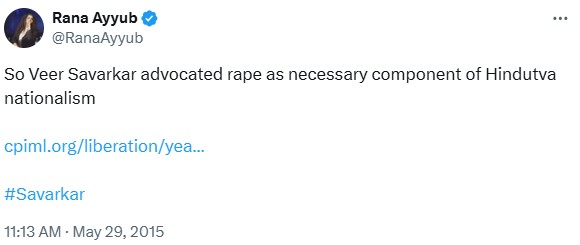
Advocate Sachdeva cited several examples of Ayyub’s posts to highlight her constant misleading claims and anti-Hindu rant. For instance, in a post against Veer Savarkar and Hindutva, Ayyub wrote, “So Veer Savarkar advocated rape as a necessary component of Hindutva nationalism.” Advocate Sachdeva categorically called the post baseless and inflammatory, adding that it sought to defame a revered historical figure and attack the Hindutva ideology, which is central to millions of Hindus.
Post on X (formerly Twitter) by Rana Ayyub against Savarkar and Hindutva. Source: X
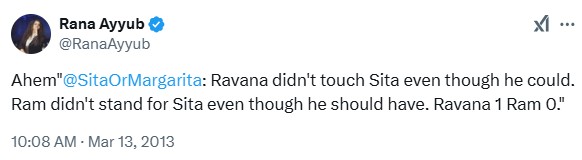
In another post from 2013, Ayyub mocked Bhagwan Ram and wrote, “Ravana didn’t touch Sita even though he could. Ram didn’t stand for Sita even though he should have. Ravana 1 Ram 0.” Advocate Sachdeva said that this post demeaned Bhagwan Ram, glorified Ravana, and insulted the core beliefs of Hindus.
Post on X (formerly Twitter) by Rana Ayyub against Bhagwan Ram. Source: X
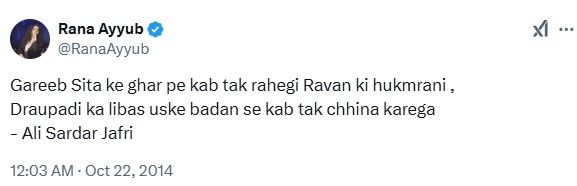
In another post from 2014, Ayyub, according to Advocate Sachdeva, trivialised the ordeals of revered figures like Mata Sita and Draupadi and wrote, “Gareeb Sita ke ghar pe kab tak rahegi Ravan ki hukmrani, Draupadi ka libas uske badan se kab tak chhina karega.” The complainant argued that this statement crossed all boundaries of decency and mocked the sanctity of Hindu traditions.
Post on X (formerly Twitter) by Rana Ayyub against Mata Sita and Draupadi. Source: X
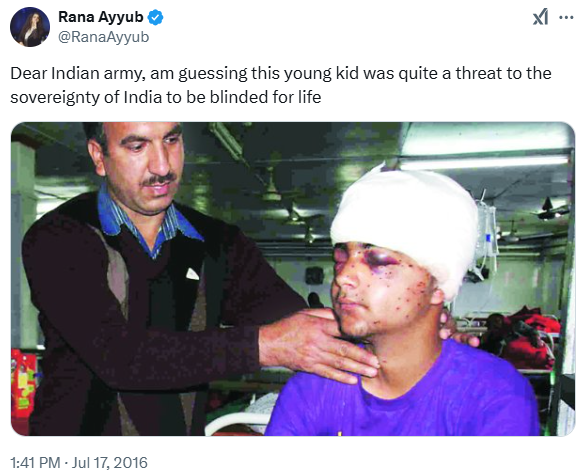
Rana Ayyub also published posts criticising the Indian Army. In 2016, she wrote, “Dear Indian Army, am guessing this young kid was quite a threat to the sovereignty of India to be blinded for life.” The complainant said that this post was an irresponsible and disparaging comment, designed to undermine public trust in the Indian Armed Forces.
Post on X (formerly Twitter) by Rana Ayyub against Indian Army. Source: X
Advocate Sachdeva pointed out that despite filing a complaint with the National Cyber Crime Reporting Portal on 11th November 2024 and repeatedly following up with the Cyber Police Station in South Delhi, no action was taken. The inaction of the police, coupled with the gravity of the offences, prompted her to approach the court.
What the court said
On 25th January, Chief Judicial Magistrate Himanshu Raman Singh of Saket Courts, South District, New Delhi, observed that the allegations presented in Advocate Sachdeva’s complaint disclosed prima facie cognisable offences under Sections 505, 295A, and 153A of the IPC. The court said, “From the facts of the case, prima facie cognisable offences are made out under sections 153 A (punishment for promoting enmity between different groups on the ground of religion, race, place of birth, residence, language, etc.), 295 A (deliberate and malicious acts, intended to outrage religious feelings of any class by insulting its religion or religious beliefs) and 505 (statements conducing public mischief) of the IPC.”
The court noted that state intervention was necessary due to the gravity of the allegations, as the complainant would not be able to collect evidence independently. “The facts pleaded by the complainant are such which necessitate intervention of the state machinery in the form of police investigation and the complainant (advocate) would not be in a position to collect evidence,” the court added.
The court directed the Station House Officer (SHO) of the Cyber Police Station South to file an FIR and conduct a fair investigation into the matter. The court further emphasised the need for expedient action. Following the court order, the FIR was registered by the concerned police station. The matter is listed for hearing on 28th January 2025.
The consecration ceremony of the Ram Mandir (temple) epitomized the culmination of the enduring struggle of Hindus, marked by the sacrifice of countless generations, to revive the indigenous faith of the nation and re-establish Dharma on the holy land of Ayodhya in Uttar Pradesh. Likewise, 74 years ago another historic event was written into the nation’s collective memory – the inauguration of the Somnath Mandir, also called Someshvara.
The majestic temple is situated near Prabhas Patan of Veraval, in the Gujarati state of Saurashtra, along the coast. It is one of Lord Shiva’s twelve sacred Jyotirlingas. The Shiva Purana’s chapter 13 also refers to the temple of Somnath. The temple is mentioned as a spot of pilgrimage in ancient Hindu texts. It is known as Triveni Sangam because of the meeting of the Kapila, Hiran and Saraswati rivers. The moon god, Som, bathed in the Saraswati River to restore his lustre after losing it due to a curse, according to Puranic history.
It is believed to be one of the locations where Lord Shiva manifested as a flaming column of light. The identity of the first shrine’s founder is not recorded in history, nonetheless, it was built many years before the Christian era, based on its mention in the scriptures. A Yadava king of Vallabhipura in coastal Gujarat in 649 was one of the first few rulers to participate in the construction of the temple.
The Chaulukya kings Mularaja, Bhima I and Kumarapala were among those who played a role in rebuilding the temple after frequent invasions. The Chudasama king of Saurashtra, Mahipala I, Paramara king Bhoj of Malwa and his son Khengara rebuilt it again after its destruction.
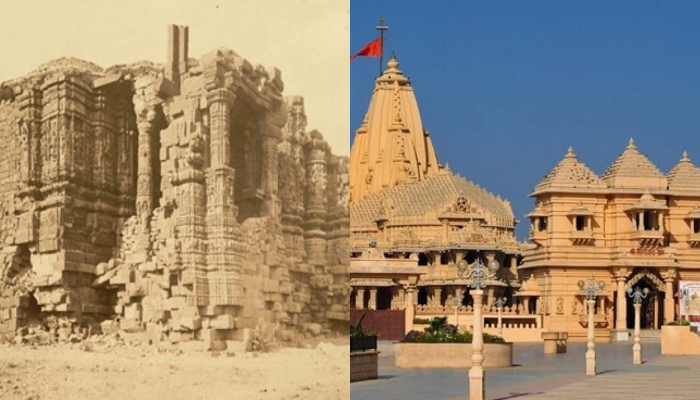
However, the temple also shares a troubled history akin to that of other prominent Hindu religious places including Ram Mandir. The temple has undergone numerous reconstructions after suffering extensive damage from various Islamic invaders, particularly Mahmud of Ghazni, who launched multiple assaults during the eleventh century. Once reduced to ruins, the temple was restored to its formal glory and it continues serve as a symbol of Hindu renaissance in post-independent India.
Somnath Mandir was formally inagurated on 11th May 1951 by late Rajendra Prasad, then President of India. The journey leading to the significant day was marked by painful memories, including attacks by Muslim tyrants and petty vote-bank politics of the Congress party, yet it also narrated a story of the unwavering determination and remarkable resolve of the Hindu community which resulted in the manifestation of its unwavering belief.
First attack on Somnath: 725 CE
During the Umayyad Caliphate, an Arab named Junayd ibn Abd ar-Rahman al-Murri, also known as Al-Junayd, was appointed as the governor of Sindh. He held power until 726 after being appointed in 723. His reign was an important period in the growth of the Umayyad dynasty in India. He invaded Gujarat and Rajasthan and ravaged, looted and destroyed the Somnath Mandir in 725. During his reign in 815, Nagabhata II, a Gurjar Pratihar monarch, visited the location. He discovered the temple was nearly destroyed. Red sandstone was used to rebuild the temple by him.
The rise of Mahmud of Ghazni
Medieval India’s history underwent an unprecedented shift with the advent of the Yamini Turks. The onset of Turkish dominance over Ghazni in Afghanistan forced the Indians to brace themselves for a new phase of barbarism after they had repelled innumerable incursions by the imperious Arabs for many years. The beginning of Turkish rule over the city of Ghazni was the product of Alptigin (Turkic), a slave commander of the Samanid Empire.
The region saw the return of aggressive tactics toward its neighbouring kingdom after the city was secured. The Turks conducted an array of attacks on the northwest regions of India after Sabuktigin took the kingdom of Ghazni later in 977 but they were opposed by Jayapala, the Shahi King of Udabhandapur. However, the Turks won after years of tenacious struggle from the courageous Shahi ruler. The conflict between the Turks and the Indians intensified dramatically when Abu al-Qasim Mahmud ibn Sabuktigin, the former’s son took the throne of Ghazni in 998.
He came to be known as Mahmud of Ghazni and reportedly swore to wage an annual ‘holy war’ against the country of the infidels. He crushed the Shahis after defeating Jayapala’s successors, Anandpala (in 1008) and Trilochanpala (in 1013) and decisively overthrew the Hindu king Jayapala as well as expanding the boundaries of his empire. He conducted at least 12 raids in India, sacking cities and temples just like other Muslim kings and generals.
He attacked Thaneswar in 1011 and destroyed all of the idols there. He burned the temples in Mathura during 1018–1019 and the idols were taken to Ghazni. This devastation persisted for twenty days. Similar to Mathura, Kanauj was pillaged as he increased his fortune due to the loot. However, his siege on Somnath was the most infamous of them all. According to archaeological research, the temple had undergone almost three reconstructions prior to the attack by Mahmud. The temple had been assaulted and destroyed at least six times.
Sack of Somnath: 1025-1026 AD
According to many historians, Somnath Mandir was constructed on enormous slabs of stone, with 56 timber pillars supporting its roof which was shaped like a pyramid and had thirteen levels with fourteen golden domes on top. A Shivalinga, measuring 7.6 feet in height and 4.6 feet in width was situated inside the temple. Furthermore, a 6-foot section of linga was concealed beneath the base. The temple accommodated up to 1000 Brahmans at a time for worship and religious rituals. The temple was a treasure trove of gold, silver, pearls and diamonds. The chamber contained a huge chain of gold that weighed 200 mann.
Mahmud of Ghazni, the cruel monarch of the Ghaznavid Empire, planned the military expedition known as the “Sack of Somnath” between 1025 and 1026 against the Chaulukya dynasty of Gujarat. This invasion resulted in the demolition of the sacred temple followed by strategic captures and pivotal battles. His army succeeded despite fierce opposition and heavy losses. The Hindus who fought to defend their lands and temples bravely opposed the onslaught on Somnath Mandir.
He gave his archer orders to assault and drive out the idolaters to force them to leave the temple. Hindus fought valiantly during the siege, which lasted for several days notwithstanding the lack of hope for victory. A sturdy fort that was guarded by Hindus encircled the Somnath temple at the time. Furthermore, half of the Hindus were likely Brahmans who were inside the temple carrying out their last pre-war ceremony.
The defenceless guardians of Somnath put up a brave resistance when Mahmud ordered a violent charge. The people, armed with only a few weapons fought until nightfall. The Hindus within the temple emerged and attacked the Turks following their earlier advance. The devotion of vulnerable Hindus stood firm against the invasion of a highly skilled military leader whose battered army chose to withdraw. The fort wall was damaged by the Turks, but the Hindus swiftly restored it and when the battle started on the second day, the latter fought even harder.
On the third day, an army of Kshatriyas arrived to support the Hindus. There was complete chaos as a result and numerous groups of individuals stormed inside the temple to defend their deities. However, Mahmud’s brutal tactics aided his wicked goals as the Turks killed over fifty thousand people. Muhammad Khandamir, a Persian historian, stated that over 50,000 people died in the mayhem as they fled inside the temple to battle to the end.
Following this slaughter, Mahmud entered the temple, dismantled the Shivalinga and stole all the riches which totalled over 20,000,000 Dirhams. Notably, the invaders nearly lost sight of their true route when they arrived at Kutch and found themselves on a desolate plain where a Hindu offered to help Mahmud’s exhausted army.
Mahmud’s army was led by the guide, a devotee of Somnath, to the hostile region of the desert devoid of water. The forces were tricked for three days by the Hindu who declared, “I had dedicated my entire life to Somnath and you mercilessly plundered it. Now I have brought you here where there is no water and the army of Hind is waiting to crush you,” in response to Mahmud’s question about their whereabouts. He killed the guide afterwards and fled to safety in the Sind region (perhaps to avoid combat with the Bhima I, who was waiting for Mahmud to pursue this route).
Mahmud stayed away from Bhima I and his army, but the Jats assaulted and tormented his troops and he arrived in Ghazni in 1026 with a hefty treasure taken after massacring innocent Hindus. Mahmud gained the notorious moniker “The Idol Breaker” after he ruined Somnath Mandir. After the temple was demolished, the linga fragments were sent to Ghazni and positioned on Jama Masjid’s stairs to further humiliate Hindus.
“When Sultan Mahmud, the son of Sabuktagin, went to wage religious war against India, he made great efforts to capture and destroy Somnath, in the hope that the Hindus would then become Mohammedans. The Indians made a desperate resistance. They kept going into the temple weeping and crying for help and then they went forth to battle and kept fighting till all were killed. The number of the slain exceeded fifty thousand. The king looked upon the idol with wonder and gave orders for the seizing of the spoil and the appropriation of the treasures. There were many idols of gold and silver, and countless vessels set with jewels, all of which had been sent there by the greatest personages in India. The value of the things found in the temples of the idols exceeded twenty thousand thousand dinars,” Persian Geographer Kazvini professed his joy over the cold-blooded murder of Hindus.
An inscription from 1169 revealed that Kumarapala of the Chaulukya dynasty renovated the temple of Somnath in “excellent stone and studded it with jewels,” which was replaced by a decomposing wooden structure by Mahmud.
Alauddin Khalji’s invasion of Gujarat: 1299 AD
The Muslim Conquest of Gujarat, also known as the Alauddin Khalji Conquest of Gujarat, started in 1299 when the ruler of the Delhi Sultanate, dispatched an army to pillage the Vaghela king Karna’s Gujarat province. Several important cities, including Anahilavada (Patan), Khambhat, Surat and Somnath were razed by his army. Later, Karna managed to retake at least some of his territories. However, in 1304, the Vaghela dynasty was permanently overthrown by Alauddin’s armies in a second invasion, which led to Gujarat’s accession to the Delhi Sultanate.
Ulugh Khan, his brother and general, commanded the Islamist army as they advanced on the Somnath Mandir with the hopes of stealing wealth, however, they encountered opposition there. Two “Vaja” warriors, Malasuta and Padamala, were killed at the entrance of the temple on 6th June 1299, while battling the Turushkas (the Turkic people), according to an inscription.
Alauddin’s forces destroyed the temple after slaughtering the Hindus on his order. Amir Khusrau, gleefully claimed that the temple was angled toward the Kaaba to imply that the Hindu God was subservient to Muslims. Persian poet and historian Hasan Nizami, who lived in the 12th and 13th centuries, also boasted about the looting of Somnath in his book Taj-ul-Maasir, the first official history of the Delhi Sultanate, about Alauddin Khilji. He noted that “more than twenty thousand slaves, and cattle beyond all calculation fell into the hands of the victors,” and that “fifty thousand infidels were dispatched to hell by the sword.”
The Rajput Prince Biram Dev of Jalore targeted the Muslim army as they were making their way back to Delhi with the Shivling, Hindu prisoners and the spoils. They defeated Ulugh Khan and took the Shivling and the treasure. The Hindu inmates were also released. Firoza, Alauddin’s illegitimate daughter, fell in love with Biram Dev. The Sultan pointed out that he should convert to Islam while simultaneously demanding his hand in marriage to his daughter. The marriage proposal was, however, rejected by him after which he attacked Alauddin’s army and seized the Shivling and the loot.
A furious Alauddin dispatched a large force to Jalore. The fight went on unabated for two arduous years. Biram Dev and his father Kanhadadev lost their lives protecting Jalore as many Rajput women committed jauhar. Alauddin’s forces killed all Hindus and ruined the entire Jalore fort as well as demolished all temples. He looked extensively but was unable to find the Shivling or the stolen goods from the Somnath Mandir. The destroyed fort was later transformed into a Muslim monument by him. According to other accounts, after stealing the temple’s riches, he took the main idol to Delhi where the pieces were dumped for Muslims to walk on. Somnath Mandir was then again reconstructed in 1308 by Mahipala Deva, the Chudasama king of Saurashtra.
Zafar Khan’s assault on Somnath: 1395 AD
Muzaffar Shah I, often called Zafar Khan, was the monarch of the Gujarat Sultanate from 1407 to 1411 and belonged to the Muzaffarid dynasty. He was selected as the governor of Gujarat by Tughluq of the Delhi Sultanate, and when Delhi was in disarray after Timur’s assault, he declared independence and formed the Gujarat Sultanate. He was a Khatri or Tank Rajput who converted to Islam. He went to Somnath in 1395 AD, when he destroyed the temple, constructed a Jumma mosque, spread Islam and set up a thana in the city of Somnath Patan, alias Deva Patan.
Mahmud Begada desecrated Somnath: 1451 AD
The Sultan of Gujarat, Mahmud Begada, also called Mahmud Shah I, desecrated the Somnath Temple in 1451. He had also launched an attack on Dwarka.
Portuguese assault on Somnath: 1546 AD
The Portuguese who first landed in India in 1498, when Vasco da Gama arrived in Calicut and ruled over the country from 1505 to 1961 also attacked the Somnath Mandir and took away its riches.
Last destruction of Somnath by Aurangzeb: 1665 AD
During his rule, Aurangzeb, the Mughal despot who captured the throne over the dead bodies of his family members, had ordered temples all around his empire to be destroyed. Although the temple of Somnath was repeatedly destroyed and its valuables plundered by invaders and malevolent foreign forces, it was rebuilt by succeeding emperors to regain its former splendour and grandeur. Hence, Aurangzeb mandated that any temples, including the Somnath, that were rebuilt must be destroyed so that Hindus would not be able to resume worship there.
The Somnath Mandir was vandalized by local Muslims of Prabhas and some of Aurangzeb’s troops under his orders, based on SH Desai’s book Prabhas and Somnath. Hindus flocked to the site in great numbers just as they were ready to demolish the temple. A Muslim official responded by killing two temple priests and butchering a calf. A confrontation broke out between the two groups. When Aurangzeb’s forces were outnumbered by Hindus, they departed the area. Only later, with a larger army, did they manage to demolish the temple and plunder the treasury.
“Local Muslims when came to know about Aurangzeb’s order directing vandalization of idols and closure of temples, tried to implement it with the help of a (local) official named Muhammad Afzal. One day, Muhammad’s troupes and local Muslims together attacked the Somnath temple and started dismantling it. As soon as this news spread Hindus, Desais, Brahmins, Mahajans etc rushed to the spot and asked Muslims not to do this. One Muslim official named Malek Zia insulted Hindus and slaughtered a cow in response. He killed a Brahmin and one priest too,” the book read.
It further read, “Agitated Desai Ganpat Sarangdhar killed Malek Zia followed by an attack on Muslims by Hindus. A clash erupted in Somnath Mandir itself. As the Muslims realized they had fewer armed soldiers, and the entire town had stood up against them, they left the place. Hindus conducted the cremation of dead bodies at Triveni( a ghaat nearby). Hindus were very well aware of the fact that this incident would result in an even bigger attack. Then arrived Fauzdar Sardarkhan who brought an end to turmoil but destroyed the dome and vandalized the Somnath temple.”
“The temple of Somnath was demolished early in my reign and idol worship (there) put down. It is not known what the state of things there is at present. If the idolators have again taken to the worship of images at the place, then destroy the temple in such a way that no trace of the building may be left, and also expel them (the worshipers) from the place,” he released another order in 1704 during his end days.
Nehru’s opposition to Somnath Mandir
One might have assumed that Hindus would at least be allowed to freely practice their religion after a century of their rights and beliefs being restricted under the repressive rule of imperial forces. However, former Prime Minister Jawarhar lal Nehru did not want them to have the authority to reclaim their most revered religious places, even after the nation suffered through a brutal religiously motivated separation. More importantly, if former home minister Sardar Patel hadn’t been actively involved in the revival of Somnath Mandir, Hindus would have been compelled to endure a rigorous struggle, just like the Ram Janmabhoomi movement.
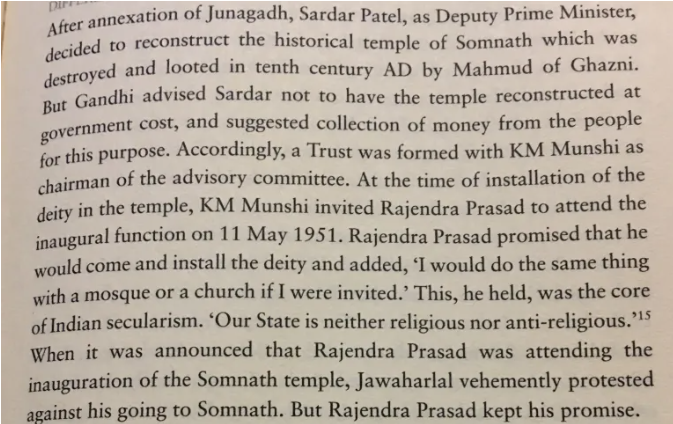
On 13th November 1947, Sardar Patel reached Junagarh to a roaring welcome from the state’s citizens, promising to restore the Somnath Mandir. After his return to Delhi, a cabinet meeting decided to reconstruct the temple and determine that the state would cover the costs. However, Mohandas Karamchand Gandhi wanted people to cover its expenses which led to the decision being overturned. He was killed in 1948 and Sardar Patel passed away in 1950 after which Kanhaiyalal Maneklal (KM) Munshi, the cabinet minister at the time became chairman of the trust’s advisory committee, which was tasked with restoring the temple.
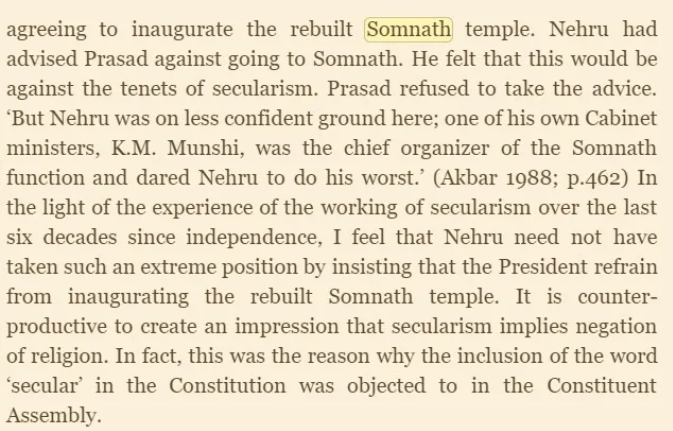
“I don’t like your trying to restore Somnath. It is Hindu Revivalism,” Nehru reportedly told Munshi. Bharatiya Janata Party patriarch Lal Krishna Advani described in detail the latter’s correspondence with Jawaharlal Nehru which read:
“Yesterday you referred to Hindu revivalism. You pointedly referred to me in the Cabinet as connected with Somnath. I am glad you did so; for I do not want to keep back any part of my views or activities. I can assure you that the ‘Collective Subconscious’ of India today is happier with the scheme of reconstruction of Somnath sponsored by the Government of India than with many other things that we have done and are doing. The intention to throw open the temple to Harijans has evoked some criticism from the orthodox section of the Hindu community. However, the objects of the Trust Deed make it clear that the temple is not only to be open to all classes of the Hindu community but, according to the tradition of the old temple of Somnath, also to non-Hindu visitors.”
“Many have been the customs which I have defied in my personal life from boyhood. I have laboured in my humble way through literary and social work to share or reintegrate some aspects of Hinduism, in the conviction that that alone will make India an advanced and vigorous nation under modern conditions. It is my faith in our past which has given me the strength to work in the present and to look forward to our future. I cannot value India’s freedom if it deprives us of the Bhagavad Gita or uproots our millions from the faith with which they look upon our temples and thereby destroys the texture of our lives. I have been given the privilege of seeing my incessant dream of Somnath reconstruction come true. That makes me feel – makes me almost sure – that this shrine once restored to a place of importance in our life will give to our people a purer conception of religion and a more vivid consciousness of our strength, so vital in these days of freedom and its trials.”
When the Somnath Mandir underwent reconstruction in 1951 Dr Rajendra Prasad was invited by KM Munshi to officially inaugurate the temple and install the Jyotirlingam. There are multiple accounts of Jawaharlal Nehru’s strong opposition to his participation in the occasion. Madhav Godbole, a former Indian bureaucrat, in his book “The God Who Failed: An Assessment of Jawaharlal Nehru’s Leadership” remarked:
The reference is found on page 462 of MJ Akbar’s “Nehru the Making of India.”
Nehru’s contempt for the renovation of the Somnath Temple is further defined on page 53 of RNP Singh’s book, “Nehru, a Troubled Legacy.”
The letter Nehru addressed to Dr Prasad explaining his reasons for not wanting him to attend the Somnath Mandir’s inauguration can be read in another book by Rajnikant Puranik. “I confess that I do not like the idea of your associating yourself with a spectacular opening of the Somnath Temple. This is not merely visiting a temple, which can certainly be done by you or anyone else but rather participating in a significant function which unfortunately has several implications,” the former wrote.
Somnath Mandir suffered through numerous instances of destruction and plunder in the most severe manners and it even encountered opposition from the Prime Minister of independent India. Nevertheless, those who have opposed and attacked the temple have been muted by the relentless passage of time, as it stands proudly, esteemed by countless Hindus across the globe.
During the riots in Sambhal, the rioters apparently wanted to kill advocate Vishnu Jain. For this, weapons were also distributed among the rioters. This conspiracy was hatched by Shariq Satha. His henchman Mulla Afroz had provided the weapons.
All these revelations have been made following the arrest of another henchman of Shariq Satha. Sambhal police has also arrested rioter Waris. Waris had also killed 2 youths during the riots.
Waris was caught by the police on Saturday (January 25, 2025). He is a resident of Mohalla Khaggu sarai. He later revealed in police interrogation that he was hiding in Delhi after the violence. Waris has told the police that the Shariq Satha gang had distributed weapons to kill advocate Vishnu Shankar Jain. The accused said that Jain allegedly insulted the Prophet. It is pertinent to mention that there is no evidence that Jain had said anything to that effect.
Shariq Satha gang had said that they have to ‘protect the mosque’ and commit murder during the survey. Vishnu Shankar Jain is the lawyer of the Hindu side in the Shahi Jama Masjid-Harihar Mandir dispute. Waris has also revealed that he fired bullets during the violence, killing youths named Kaif and Naeem. Waris said that Mulla Afroz gave him the weapons. Mulla has already been arrested.
An audio of Waris also went viral. In this, he had asked to bring ‘stuff’ during the violence. Police has said that ‘stuff’ meant weapons. His partner has already been arrested. Police have recovered a pistol, cartridges, a cartridge stuck in the barrel and two mobiles from Waris.
Waris has told that Shariq Satha’s gang wanted to incite riots across the country with these murders. With the arrest of Waris, the case of 4 deaths in the violence has been solved. Out of these, 2 murders were committed by Mullah Afroz and 2 by Waris. Police has also arrested another rioter from Sambhal. His name is Mohammad Nihal.
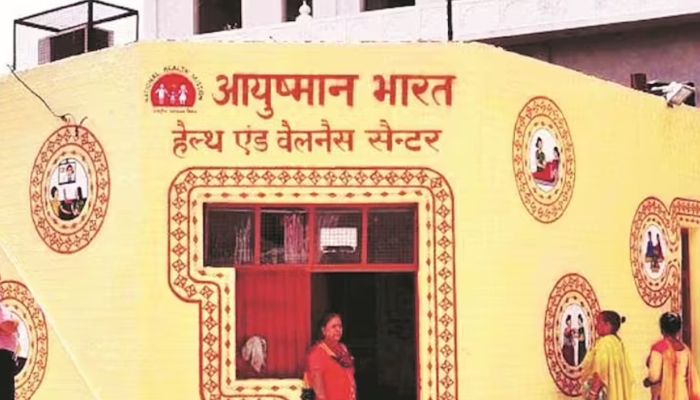
On Sunday, 26th January, the Indian Medical Association (IMA) in Haryana stated that around 600 private hospitals in the state have decided to stop treating patients under the Ayushman Bharat scheme from February 3rd. The IMA’s Haryana unit said that the patients at the private hospital relying on the slated government health scheme would hardly benefit from the scheme as the doctors would not treat them under the said scheme. The IMA’s Haryana unit said that this is because the government has not yet cleared the reimbursement of the hospitals worth Rs 400 crores.
As per the reports, there are around 1300 hospitals eligible for the Ayushman Bharat scheme of which 600 are private facilities. The Ayushman Bharat scheme launched by the BJP government in 2018 aims to provide free access to health insurance coverage for low-income earners in the country. In the state of Haryana, there are around 1.2 crore people who are registered under the scheme.
The association opined that the private hospitals were not able to manage their expenses while treating the patients under the Ayushman Bharat scheme, given no reimbursement from the government. Dr Mahavir Jain, president of IMA (Haryana) commented on the matter and said that the speed of reimbursement from the government is very sluggish. He demanded that the payment of the hospitals should be released immediately.
“Our payments should be released immediately as it is exceedingly difficult for doctors to operate hospitals without funds. Around Rs 400 crore is pending. These medical bills are already discounted by the hospitals. How will they survive if they do not receive the bare minimum,” he said.
The association said that the government to date has issued only 15-20% reimbursement of the total bills raised by the hospitals. As per the reports, the hospitals treat the patients at their cost under the slated scheme and then raise the payment to the government through online portals. As per the doctors, the government has only issued 15% of the total bills raised.
“it is extremely unfortunate that even after 15 days, the members have not received any significant amount and the funds received have ‘substantial unwarranted deductions’,” Dhirendar K Soni, secretary of IMA-Haryana was quoted as saying. Several hospitals in Gurugram, including Park Hospital, Centre for Sight, Pushpanjali Hospital, and Kamla Hospital, are among those affected by the decision.
The Ayushman Bharat scheme was launched by the Narendra Modi-led government in the year 2018 to provide free healthcare up to Rs 5 lakh per family per year. About 1.2 crore individuals in the state have enlisted under the initiative, which covers everything from regular testing to surgery.
The scheme can be availed by families with annual incomes of less than Rs 2.5 lakh, the elderly, and other eligible criteria. However, with the government’s delay in releasing payments, hospitals are finding it challenging to manage their expenses.
The Donald Trump administration has intensified its crackdown on illegal immigrants in the United States. In this vein, the Department of Homeland Security agents visited Gurudwaras in New York and New Jersey on Sunday (26th January) to check for illegal immigrants.
Reports say that the Homeland Security Department officials visited the Gurudwaras in New York and New Jersey after allegations emerged that these places of worship were being used by anti-India Khalistani separatists and undocumented immigrants. Not to forget how back in November 2023, Indian Ambassador to the US Taranjit Singh Sandhu was heckled by pro-Khalistani elements at the Hicksville Gurudwara in Long Island, New York.
Meanwhile, the Sikh American Legal Defence and Education Fund (SALDEF) raised concern over the DHS agents visiting Gurudwaras to check for illegal immigrants.
“These places are not just places of worship; they are vital community centres that provide support, nourishment, and spiritual solace to Sikhs and the broader community. We are deeply alarmed by this decision to eliminate protections for sensitive areas and then target them.”
Within hours of Donald Trump’s inauguration as the 47th President of the United States on 20th January 2025, the acting Department of Homeland Security Secretary Benjamine Huffman issued a directive rescinding the Biden administration’s guidelines for Immigration and Customs Enforcement (ICE) and Customs and Border Protection (CBP) enforcement actions that impede law enforcement “sensitive” areas such as churches and Gurudwaras.
Similar raids have also been reported to be conducted by DHS agents in churches to identify and arrest illegal immigrants. Besides, Colombian illegal immigrants are also being deported by the US government. On Sunday, high-voltage drama unfolded between the US and the Colombian government over two US military aircraft carrying illegal Colombian immigrants. The Colombian government refused to accept its citizens, however, after President Trump threatened to tariffs and sanctions, Colombia took an embarrassing U-turn and accepted its deported citizens.
The US government has initiated measures to send back illegal immigrants to their native countries right after Donald Trump assumed office on 20th January. Even during his election campaign, Donald Trump had strongly advocated for deporting illegal immigrants and ensuring that only legal immigrants make their way into America.
In September 2024, Trump said that Donald Trump raised alarms about how the Presidency of Kamala Harris would negatively impact the United States and worsen the migrant crisis. “She fought me for years on the wall. I built hundreds of miles of wall. But she was one of the people that fought me…We’ll have 100 million people in this country within four years if she gets selected. They come from prisons and jails. There’s a slight difference. And they come from mental institutions and insane asylums. And they come also as terrorists at a level that we’ve never seen before. And they’re pouring into the country. We have millions of people coming in. But hundreds of thousands of those people are criminals from Venezuela… They come from Africa, Asia, the Middle East and from South America. And they’re destroying our country.”
Meanwhile, the US Justice Department said it had begun making arrests in Chicago as part of a multi-agency enforcement operation, the New York Times reported. US Vice President JD Vance has also endorsed immigration raids on schools, and said that he hoped they would have a “chilling effect on illegal immigrants coming to our country.”
Vance said immigration raids in religious buildings and schools should not be ruled out. “If you have a person who is convicted of a violent crime, whether they are an illegal immigrant or not, you have to go and get that person to protect the public safety,” he said and added, “That’s not unique to immigration.”
Trump’s Border Czar Tom Homan has said that immigration officials will need at least 1,00,000 beds to support Trump’s sweeping deportation efforts. He called on the US Congress to “come to the table quick and give us the money we need.”
On being asked whether immigration enforcement agents would search for people in churches or schools, Homan replied that ICE would act on a “case-by-case basis.” But he seemed to suggest that high-school-aged children could be affiliated with gangs and represented legitimate targets.
Homan said that deportations would “steadily increase” as the administration moved to “open up the aperture” to target anyone in the country illegally not just those with a criminal record.
Regarding deportation funding, Tom Homan said he would “leave it up to Congress,” The Hill reported. Homan was speaking about the Trump administration’s broad immigration plan, including specifics about how they plan to fund the costly mass deportation idea.
“The Congress, I think the president has a mandate. This is the number one issue that people voted on,” Homan said. “And I think Congress has a mandate to give us money.”
The US official said there needs to be ‘pressure’ on national security. Referring to the death of Georgia student Laken Riley, who was allegedly killed by a migrant, he said the incident has become the face of the Republicans’ immigration plan.
In another major development last week, US officials also shut down an app that allowed asylum-seekers to schedule appointments for admission at a port of entry.
Homan apparently dismissed the app, which had been set up by the Biden administration, as an ‘illegitimate method’ for migrants to use. “Go to the embassy, go to the port of entry, do it the legal way,” Homan said as quoted by the New York Times. “You shouldn’t come to this country and ask to get asylum, and the first thing you do is break our laws by entering illegally.”
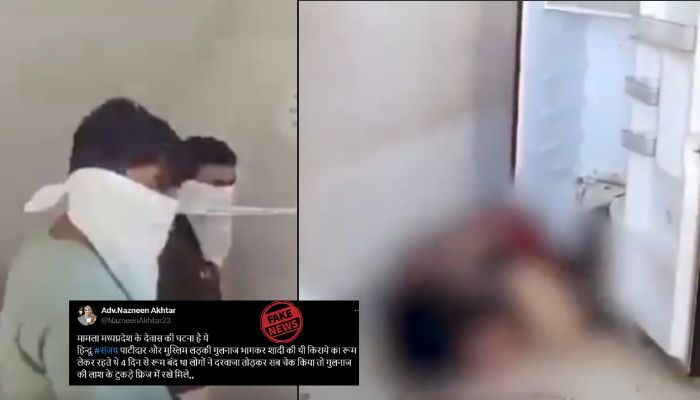
On Friday (24th January), Islamists on X (formerly Twitter) peddled fake news about the brutal murder of a Muslim woman by her Hindu husband with the nefarious objective of fuelling the ‘Bhagwa Love Trap (BLT)’ conspiracy theory.
The notorious Islamist handles include ‘Tanvir Rangrez (@virjust18)’ and ‘Adv.Nazneen Akhtar (@NazneenAkhtar23)’. They falsely claimed that the body of a Muslim woman named Gulnaz was chopped and recovered from a refrigerator.
While trying to draw parallels with the Shraddha Walker murder case, the Islamists claimed that the alleged victim Gulnaz was murdered by her Hindu husband Sanjay Patidar.
2882 ANALYSIS: Misleading
FACT: A video showing policemen recovering a body from a refrigerator has been circulated with the claim that a Hindu man, Sanjay Patidar, married a Muslim woman named Gulnaz and killed her at a rental property in Dewas, Madhya Pradesh. (1/3) pic.twitter.com/CQjjdHIzLt
“This is what happens to women who do not listen to their parents and make their own decisions,” remarked Tanvir Rangrez. His tweet was accompanied by a video of policemen investigating the crime scene. The body of a dead woman could be seen in the video.
The incident occurred in Dewas city in Malwa region of Madhya Pradesh. The deceased is not Muslim but a Hindu woman named Pratibha Prajapati. She was murdered in March 2024 and her body was kept inside the refrigerator of a rented home.
The perpetrator was none other than her live-in partner Sanjay Patidar. There is no communal angle in the case as insinuated by the Islamist handles of X (formerly Twitter).
INTENT: Propagandists are circulating sensitive videos with misleading claims to set their narrative based on religion. (3/3) pic.twitter.com/NfzZs9XbWR
The attempt to give a communal spin to an incident where both the victim and the perpetrator hail from the same Faith is part of the larger ploy to mainstream the ‘Bhagwa Love Trap (BLT)’ conspiracy theory.
Islamists have been making unsubstantiated claims about Hindu men entrapping Muslim women in a ‘love trap’ to convert them to Hinduism.
Despite no evidence to back such allegations, the BLT conspiracy theory has resonated well with radical Muslims on social media. This has translated to real-life incidents of harassment, molestation, moral policing and coordinated attacks on Hindu-Muslim couples.
OpIndia has documented over 100 cases of real-life attacks on Hindu men and their female Muslim partners/ friends by extremists in the name of combating the ‘Bhagwa Love Trap’
Adani Group chairman Gautam Adani recently visited the Maha Kumbh in Prayagraj with his family. The tycoon has shared a post on LinkedIn about his thoughts on the grand Hindu gathering and its spiritual significance from a perspective of leadership lessons.
This is a curation of what Gautam Adani wrote:
In the vast landscape of human gatherings, nothing quite compares to the Kumbh Mela. As a company, we have been deeply engaged this year in the Mela – and, every single time I have a discussion on this subject, I am humbled by the vision our forefathers had. As someone who has built ports, airports and energy networks across India, I find myself astonished by this magnificent demonstration of what I call “spiritual infrastructure” – a force that has sustained our civilization for millennia.
Probably The World’s Largest Management Case Study
When Harvard Business School studied the Kumbh Mela’s logistics, they marvelled at its scale. But, as an Indian, I see something deeper: the world’s most successful pop-up megacity isn’t just about numbers – it’s about eternal principles that we at the Adani Group strive to embrace.
Consider this: Every 12 years, a temporary city larger than New York materializes on the banks of sacred rivers. No board meetings. No PowerPoint presentations. No venture capital. Just pure, time-tested Indian jugaad (innovation) backed by centuries of iterative learnings.
The Three Indestructible Pillars of Kumbh Leadership
1. Scale with Soul
At the Kumbh, scale isn’t just about size – it’s about impact. जब समर्पण और सेवा के साथ 20 करोड़ लोग एकत्रित होते हैं, तो यह केवल आयोजन नहीं, बल्कि एक अद्वितीय आत्मिक संगम होता है। When 200 million people gather with dedication and service, it is not just an event but a unique confluence of souls. This is what I call “spiritual economies of scale.” The larger it grows, the more efficient it becomes, not just materially but in human and humanity terms. True scale is not measured in metrics but in the moments of unity it creates.
2. Sustainable Before Sustainability Was Cool
Long before ESG became a boardroom buzzword, the Kumbh Mela practiced circular economy principles. नदी केवल जल का स्रोत नहीं, जीवन का प्रवाह है। A river is not just a source of water but the flow of life. Preserving it is a testament to our ancient wisdom. The same river that hosts millions returns to its natural state following the Kumbh, having cleansed hundreds of millions of devotees and confident that it can cleanse itself of all the “impurities” it washed away. Perhaps there’s a lesson here for our modern development paradigms. Progress, after all, is not in what we take from the earth, but in how we give back to it.
3. Leadership Through Service
The most powerful aspect? The absence of a single controlling authority. सच्चा नेतृत्व आदेश देने में नहीं, सबको साथ लेकर चलने की क्षमता में होता है।| True leadership lies not in giving orders but in the ability to take everyone along. Various akharas (religious orders), local authorities and volunteers work in harmony. It’s leadership through service, not dominance – a principle that modern corporations would do well to study. It teaches us that great leaders do not command or control – they create conditions for others to work together and collectively rise.
सेवा साधना है, सेवा प्रार्थना है और सेवा ही परमात्मा है। Service is devotion, Service is prayer and Service itself is God.
What The Kumbh Teaches Global Business
As India aims for a $10 trillion economy, the Kumbh Mela offers unique insights:
1. Inclusive Growth
The Mela welcomes everyone – from sadhus to CEOs, villagers to foreign tourists. It’s the ultimate example of what we at Adani call “Growth with Goodness.”
2. Spiritual Technology
While we pride ourselves on digital innovation, the Kumbh showcases spiritual technology – time-tested systems for managing human consciousness at scale. This soft infrastructure is as crucial as physical infrastructure in an era where the biggest threat is mental illness!
3. Cultural Confidence
In an era of global homogenization, the Kumbh stands as a testament to cultural authenticity. It’s not a museum piece – it’s a living, breathing example of tradition adapting to modernity.
Is the Future Ancient?
As I walk through our ports or solar farms, I often reflect on the Kumbh’s lessons. Our ancient civilization didn’t just build monuments – it created living systems that sustain millions. This is what we must aspire to in modern India – not just building infrastructure, but nurturing ecosystems.
And, while nations compete with military might and economic muscle, the Kumbh represents India’s unique soft power. Vasudeva Kutumbukam! It’s not just about hosting the world’s largest gathering. It’s about showcasing a sustainable model of human organization that has survived millennia.
The Leadership Challenge
Therefore, for modern leaders, the Kumbh poses a profound question: Can we build organizations that last not just years, but centuries? Can our systems handle not just scale, but soul? In an age of AI, climate crisis and social fragmentation, the Kumbh’s lessons are more relevant than ever and encompass all of the following:
Sustainable resource management
Harmonious mass collaboration
Technology with human touch
Leadership through service
Scale without losing soul
The Way Forward As India marches towards becoming a global superpower, we must remember: our strength lies not just in what we build, but in what we preserve. The Kumbh isn’t just a religious gathering – it’s a blueprint for sustainable civilization. It is a reminder for me that true scale isn’t measured in balance sheets but in positive impact on human consciousness.
In the Kumbh, we see the essence of India’s soft power – a power not rooted in conquest but in consciousness, not in dominance but in service. India’s true strength lies in its soul, where growth is not just economic power but a confluence of human consciousness and service. This is the lesson Kumbh teaches us – that true legacy is not in structures built, but in the consciousness, we build – and that thrives for centuries.
Therefore, the next time you hear about India’s growth story, remember: our most successful project isn’t a massive port or a renewable energy park – it’s a spiritual gathering that has run successfully for centuries, serving millions without depleting resources or losing its soul.
That’s the real India story.
Adani Group and Maha Kumbh
Gautam Adani’s organisation has been involved in the organisation and services at the Maha Kumbh from the beginning. The Adani Group has joined hands with the International Society for Krishna Consciousness (ISKCON) to serve meals to devotees at the Maha Kumbh Mela in Prayagraj starting next week. The two organisations will offer Mahaprasad Seva to the devotees during the entire duration of the Maha Kumbh Mela, from January 13 to February 26. Gautam Adani recently visited the Maha Kumbh with his family and offered Puja at Sangam.
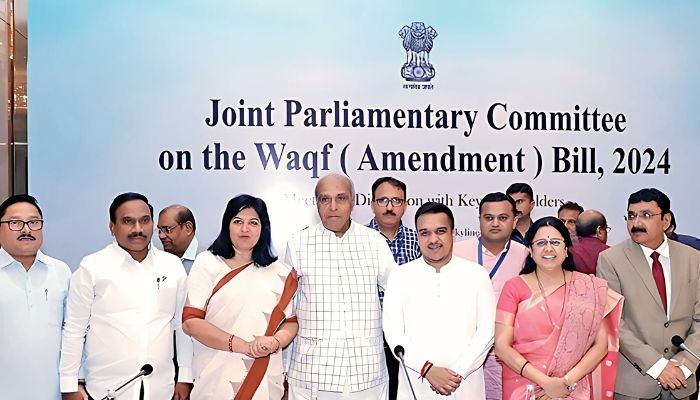
On 27th January, the Joint Parliamentary Committee (JPC) examining the Waqf (Amendment) Bill, 2024, adopted all amendments proposed by BJP-led NDA members. The decision was made during a clause-by-clause discussion. However, the amendments suggested by the opposition MPs were rejected, leading to opposition leaders crying foul over the process. The opposition leaders accused the committee chairperson of undermining democratic norms.
Amendments and voting dynamics
The amendments accepted in 14 clauses of the Bill include provisions such as allowing state government officials, along with district magistrates, to take on certain roles and increasing Waqf tribunal members from two to three. While 16 MPs from the ruling alliance backed the changes, 10 opposition members opposed them.
The opposition had proposed amendments to all 44 clauses of the Bill, which were defeated by the same 10:16 margin, deepening the divide between the two sides.
Opposition leaders called the proceedings undemocratic
Following the JPC meeting, opposition MPs expressed dismay and labelled the proceedings as “undemocratic.” Criticising the proceedings, Congress MP Syed Naseer Hussain said, “Ever since JPC meetings began, stakeholders were called. 95-98% of stakeholders opposed the Bill… Be it the chairman or Ministry, their replies were not supplied to Members. They were not discussed. Clause-to-clause discussions are held after meeting stakeholders…But it wasn’t done…We were not provided minutes of the discussion…We moved amendments. Without any discussion or explanation, they put the amendments up for voting. They defeated it (in voting)…All procedures were bypassed and Chairman made minor changes to the Bill and pushed it forward. There was no discussion at all…Entire JPC process is farce…So, we have opposed and boycotted it now.”
#WATCH | After the meeting of the JPC on Waqf (Amendment) Bill, 2024, one of its members – Congress MP Syed Naseer Hussain says, "Ever since JPC meetings began, stakeholders were called. 95-98% of stakeholders opposed the Bill… Be it the chairman or Ministry, their replies were… pic.twitter.com/8We8iWdDLx
SP MP Mohibbullah Nadvi said, “This is a joke with the minority of the country, with the Waqf Board. Constitution has been bulldozed…This makes it seem that the Bill that was brought in was just a joke…This is a process to loot Waqf Board. Parliamentary procedure was not followed.”
#WATCH | After the meeting of the JPC on Waqf (Amendment) Bill, 2024, one of its members – SP MP Mohibbullah Nadvi says, "This is a joke with the minority of the country, with the Waqf Board. Constitution has been bulldozed…This makes it seem that the Bill that was brought in… pic.twitter.com/AKTthyFjsC
Shiv Sena (UBT) MP Arvind Sawant said, “Clause by clause discussions were supposed to be held. But it was not done at all. They only held voting on the Amendments…It was not discussed…They say that the will move the final draft report on January 29. We will read it and see…Democracy is being murdered in Amrit Varsh.”
#WATCH | After the meeting of the JPC on Waqf (Amendment) Bill, 2024, one of its members – Shiv Sena (UBT) MP Arvind Sawant says, "…Clause by clause discussions were supposed to be held. But it was not done at all. They only held voting on the Amendments…It was not… pic.twitter.com/1YANtw8gRP
Ruling alliance, however, countered the allegations. BJP MP Aparajita Sarangi said, “The entire proceeding of the committee meeting was held in a democratic manner. The chairperson allowed everybody to speak and everybody to put forth his/her point. He patiently listened to all of them. As far as the opposition members are concerned, they moved amendments with respect to 43 out of 44 clauses, today. The NDA members moved 24 amendments with respect to 16 clauses. Since, they were 10 members in total, and we were 16; obviously each of their amendments which they proposed couldn’t see the light of the day and crashed. All the amendments that we moved were upheld… Tomorrow, the bill in its revised form will be circulated among the members. On the 29th (January) the committee will meet again to discuss the adoption of the bill…”
#WATCH | Delhi | JPC member on the Waqf (Amendment) Bill, 2024 & BJP MP Aparajita Sarangi says, "…The entire proceeding of the committee meeting was held in a democratic manner. The chairperson allowed everybody to speak and everybody to put forth his/her point. He patiently… pic.twitter.com/WepS6Wawiz
Shiv Sena MP Naresh Mhaske said, “There were 44 resolutions and discussion and voting was held on each one of them along with amendments… Opposition was against each resolution but their objection did not get majority of the votes… We added 14 resolutions in the bill and the final draft will be presented to us on 29th January… This was a bill for the profit of the nation and the betterment of poor Muslims, to give them stature… Opposition spread false claims that this is anti-Muslim and did politics… Bala Saheb Thackeray used to say the Waqf board should be cancelled, and his so-called successor, Uddhav Thackeray’s right-hand Arvind Sawant objected to all 44 resolutions of the bill… We condemn Uddhav Thackeray for not supporting this bill and I am grateful to Sharad Pawar for supporting it… Many of the governmental projects are halted due to Waqf Board claiming it as theirs…”
#WATCH | Delhi | On JPC meeting on Waqf Bill, Shiv Sena MP Naresh Mhaske says, "There were 44 resolutions and discussion and voting was held on each one of them along with amendments… Opposition was against each resolution but their objection did not get majority of the… pic.twitter.com/GBDmWhI8Bs
BJP MP Sanjay Jaiswal said, “All clauses we discussed…It is sad that the clauses that were very important to be moved for the improvement of this Bill were opposed too…
#WATCH | After the meeting of the JPC on Waqf (Amendment) Bill, 2024, one of its members – BJP MP Sanjay Jaiswal says, "All clauses we discussed…It is sad that the clauses that were very important to be moved for the improvement of this Bill were opposed too…" pic.twitter.com/heimGlEKH9
The Waqf (Amendment) Bill, 2024, introduced by Union Minority Affairs Minister Kiren Rijiju in the Lok Sabha on 8th August 2024, was initially expected to be tabled during the Winter Session. It was later referred to the JPC for a detailed review. The JPC has announced that the draft report will be circulated by 28th January, with formal adoption slated for 29th January.