Home Blog Page 6233

Rahul Gandhi planning a nation-wide stir over ‘EVM hacking’, may boycott assembly polls: Report

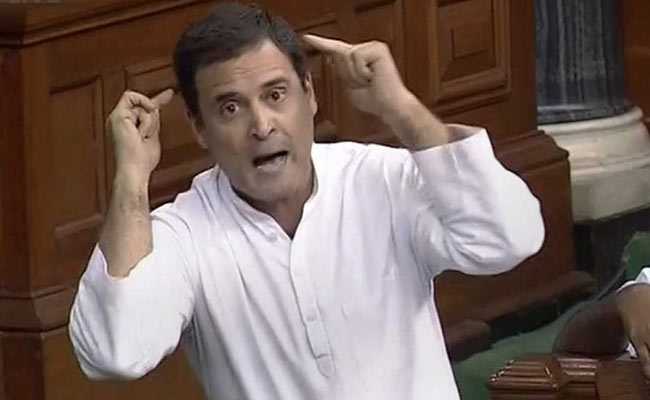
The 2019 Lok Sabha elections saw the Congress party being decimated and Rahul Gandhi’s leadership is questioned by the people. Now, a report suggests that instead of introspecting, Rahul Gandhi is planning to lead a nation-wide stir against the Modi government questioning the authenticity of Electronic Voting Machines (EVMs).

According to a report in the Sunday Guardian, the current President of the Congress party who is apparently insisting on resigning from the Presidentship of the party is planning to launch a non-cooperation movement against the Central government.

According to reports, after a report submitted by Congress’ Data Analytics Chief Praveen Chakravarty, Rahul Gandhi firmly believes that Congress has lost because the EVMs were manipulated. Rahul Gandhi has also reportedly decided to boycott the forthcoming Assembly elections, while simultaneously demanding paper ballots.

The senior leadership of the party, however, does not seem in favour of boycotting the upcoming Assembly Polls because they believe that it would lead to regional parties usurping the little space that Congress has left. However, Rahul Gandhi seems convinced that this agitation is the only way to go forward.

Sonia Gandhi, Rahul Gandhi’s mother and UPA chairperson, seems cold to the idea floated by Rahul Gandhi. She had sought advice from senior leaders of the Congress party who believe that Rahul’s plan to question the authenticity of EVMs would further erode Congress’ credibility.

After the 2019 Lok Sabha elections and even in the run-up to the elections, Congress had gone hammer and tongs trying to discredit the electoral process and question the authenticity of EVMs. Earlier, a dubious ‘expert’ was used to demonstrate how an EVM could be hacked while Kapil Sibal had watched over. The ‘expose’ ended up showing nothing authentic and was widely criticised. While Sonia Gandhi may not be in favour of Rahul Gandhi’s shenanigans now, earlier, she too had questioned the authenticity of EVMs and questioned the EC.

Jagan Mohan Reddy appoints uncle Y V Subba Reddy as the Chairman of Tirumala Tirupati Devasthanam Trust Board

The Andhra Pradesh government has appointed former Member of Parliament and uncle of Chief Minister Jagan Mohan Reddy, Y V Subba Reddy as the Chairman of the Tirumala Tirupati Devasthanam Trust Board that is entrusted with the management of the shrine of Lord Venkateswara at Tirumala. Subba Reddy who is also the General Secretary of the YSRCP will take charge today. Other members of the Board are yet to be appointed.

The outgoing Chairman of the Tirumala Tirupati Devasthanams Trust Board TDP leader Putta Sudhakar Yadav submitted his resignation as the Chairman. Yadav was reportedly adamant on holding the post of the Chairman even after the new government of YSR Congress Party was elected. However, 10 members of the Board voluntarily resigned from their posts while others were barred from holding the office as they lost the Assembly elections. As a result, a total of six members remained on the including three ex-officio members (government officials).

With few members left on the Board, the executive officer of the Board, Anil Kumar submitted a report to the State government stating that as per section 126 of the Andhra Pradesh Charitable and Hindu Religious Institutions and Endowments Act, 1987, the quorum for holding the Board meeting was five. And since there had always been some absentees in a Board meeting the required number for the quorum was not fulfilled.

Kumar also wrote a letter to the government requesting it to take action to ensure efficient functioning of the Board administration. Thereafter an order was issued by the government to dissolve the Board. The Governing Council of the temple has also been reportedly dissolved by the government.

People in Encephalitis hit Bihar put up look-out posters for Ram Vilas Paswan and local MLAs, announce rewards for finder

People in Harivanshpur village of Vaishali district in Bihar put up look-out posters on their cattle for Union Minister Ram Vilas Paswan and local MLAs announcing a reward of Rs 15,000 and Rs 5000 respectively for anyone who finds them. The banners asked the Minister to come out of his AC room and see people’s condition.


The State has been severely hit by the life-threatening disease Acute Encephalitis Syndrome (AES) which has claimed the lives of over a hundred children. Many people from Harivanshpur village have abandoned their houses and have migrated to nearby villages fearing for the lives of their children. There is also resentment against the government. People are blaming the government for not spreading awareness about the disease and for not having proper arrangements in the hospitals to deal with the outbreak of the disease.

Recently a petition was filed against Union Health Minister Harsh Vardhan and Bihar Health Minister Mangal Pandey in the court of Muzaffarpur Chief Judicial Magistrate holding them accountable for failing to control the outbreak of the disease. It was alleged in the petition that the Ministers did nothing to create awareness about the disease among the people despite the fact that the disease has been affecting the area for several years.

Watch: As India zooms to a nail-biting win, here are some hat-tricks since 1987. Which one is your favourite?

In a nail-biting finish between India and Afghanistan, Mohammad Shami took a hat-trick in the last over of the match. A hat-trick which won the game for India.

Mohammad Shami’s hat-trick is the first hat-trick of World Cup 2019, and he became the 10th bowler to take a hat-trick in World Cup history. The first hat-trick of World Cup was taken by Chetan Sharma in the 1987 World Cup, against New Zealand at Nagpur.

Overall, three bowlers from Sri Lanka, two bowlers from India and one each from Pakistan, West Indies, Australia, England, and South Africa have taken the hat-tricks in the World Cup.

Malinga is the only bowler who took it twice (in 2007 and 2011), he also the only bowler to take four wickets in 4 balls (against South Africa in 2007). Chaminda Vaas took the hat-trick in the first three balls of the match (against Bangladesh in 2003).

1. Chetan Sharma against New Zealand, Nagpur 1987

2. Saqlain Mushtaq against Zimbabwe, The Oval 1999

3. Chaminda Vaas against Bangladesh, Pietermaritzburg 2003

4. Brett Lee against Kenya, Durban 2003

5. Lasith Malinga against South Africa, Guyana  2007

6. Kemar Roach against Netherlands, New Delhi 2011

7. Lasith Malinga against Kenya, Colombo 2011

8. Steven Finn against Australia, Melbourne 2015

9. JP Duminy against Sri Lanka, Sydney 2015

10. Mohammad Shami against Afghanistan, Southampton 2019

Which one is your favourite World Cup Hat-trick?

West Bengal violence: 3 BJP workers, including a 14 year old boy shot for chanting Jai Shree Ram, BJP slams Mamata

The political violence in the state of West Bengal continues unchecked as according to BJP, 3 workers have been shot by the police in Panchasayar in Bankura district allegedly for chanting Jai Shree Ram, reported Times Now. The incident was reported after a clash broke out between BJP and TMC workers after a group of BJP workers chanted ‘Jai Shri Ram’ during TMC MP Suvendu Adhikary’s public meeting in Bankura. A 14-year-old boy was also injured in the firing.

BJP West Bengal took to Twitter to say that the 14-year-old is critically injured and is battling for his life.

They also slammed the Chief Minister of the state, Mamata Banerjee, for “using her administration to unleash terror on innocent civilians just for perceived descent”.


BJP MP from Bankura slammed the police of the state and rejected their claims that they had fired to control a rioting mob.

Earlier, violent clashes had erupted once again in Bhatpara area in North 24 Parganas district of West Bengal following the visit of a three-member delegation of the BJP to the area. Slogans condemning the West Bengal police were raised during the visit of the delegation. According to reports, bombs were also hurled after which the police charged batons on the locals to stop the violence.

“When the clash between the two groups took place, police baton-charged one group and shot at the other. We want to know who took that decision? Who was behind this conspiracy? There should be a thorough probe into this. We will submit the report to (Union Home Minister) Amit Shah and apprise him of the on-ground situation here,” IANS quoted Ahluwalia as saying.

The BJP delegation consisting of former Union Minister S S Ahluwalia, Members of Parliament Satyapal Singh and BD Ram, had visited Bhatpara to review the situation and investigate the reports of violence against BJP workers after violent clashes on Thursday claimed the lives of 2 people and injured several.

Mamata Banerjee has been agitated several times before by the chants of Jai Shree Ram. She had recently said that she will continue to oppose ‘Jai Shree Ram’ to save the secular character of the country. BJP had decided to send 10 lakh postcards to Mamata Banerjee with the slogan of ‘Jai Shree Ram’ written on them.

Earlier, around five students sustained grievous injuries after violence erupted between Trinamool Chhatra Parishad and Akhil Bharatiya Vidyarthi Parishad, the student wings of TMC and BJP, at Arambagh Kalikapur Netaji Mahavidyalaya in Hooghly over chanting of ‘Jai Shri Ram’ slogan.

Recently a BJP worker who was chanting Jai Shri Ram while preparing for a victory procession of the party after winning elections was allegedly stabbed to death by TMC workers.

Mamata Banerjee had also got 10 people arrested for chanting ‘Jai Shree Ram’ at her. She had claimed that she was being abused.

West Bengal govt to observe death anniversary of Shyama Prasad Mukherjee, Overton Window continues to move ‘right’

Mamata Banerjee appears to be shifting tactics as public mood tilts against her amidst the Saffron Surge in the state. It was observable when she finally met the protesting junior doctors who were on strike following mob violence against them and talked to them very gently and referred to them as ‘Lokkhi Chheley Meye’ (Sweet Boys and Girls) after initially threatening them.

Now, the West Bengal state government has decided to observe the death anniversary of the legendary Shyama Prasad Mookerjee, who has long been a Saffron Icon and neglected by ‘Secular’ parties due to his allegiance to Hindu Nationalism.


It appears that Mamata Banerjee has realized that the perception of Trinamool being a ‘Muslim party’ is increasingly gaining traction among the public. The results of the 2019 General Elections amply demonstrated that there was great religious polarization that fuelled BJP’s rise in Bengal. While Muslims consolidated for Trinamool, Hindus did the same in BJP’s favour.

For a while, Mamata Banerjee tried to portray the BJP as a party of ‘Outsiders’. However, that didn’t appear to be working. Moreover, she accused the protesting doctors of being ‘Outsiders’ and working for the BJP while threatening them which further diluted the charge.

Now, that all else has failed, Mamata Banerjee as a sort of the last gasp appears to have decided that it will be a good idea to celebrate some of the Bengali cultural icons that the Hindutva camp respects. However, it is doubtful whether it will have the sort of impact she expects since, until the rise of the BJP, icons such as Shyama Prasad Mookerjee were completely ignored by the ‘Secular’ camp in order to protect their Muslim voter base.

Icons such as Sri Aurobindo, who are revered widely by Bengalis, still continue to be ignored by the secular camp due to their strong leanings towards Hindu Nationalism. And people notice these things.

The celebration of Shyama Prasad Mookerjee also reflects a great victory for the Saffron Camp. For a long while, Mookerjee remained a political untouchable among ‘secular’ politicians in the country due to his political inclinations. He is considered one of the ideological predecessors of the BJP. The observance of his death anniversary by Mamata Banerjee suggests that the BJP has been successful in fundamentally altering the political dimensions of India.

The Overton Window had been continuously shifting ever since Narendra Modi was elected the Prime Minister of the country in 2014. The next big shift came in 2017 when the Peethadheesh of Gorkahnath Muth, Yogi Adityanath, was appointed the Chief Minister of Uttar Pradesh. The nomination of Sadhvi Pragya from Bhopal Lok Sabha Constituency and the refusal to withdraw her nomination even after her remarks on Nathuram Godse was another big shift in the Window. And now, the celebration of Mookerjee by Mamata Banerjee clearly demonstrates the direction in which the country is headed in.

Swati Chaturvedi spreads fake news yet again, this time about Amit Shah allegedly sleeping in the parliament

An abusive troll masquerading as a journalist, Swati Chaturvedi has yet again resorted to sharing fake news concerning India’s Home Minister Amit Shah. In a tweet put out by Swati, she alleged that the former BJP president Amit Shah was merrily sleeping in the parliamentary session.

However, as is normally the case with Swati Chaturvedi and her kind of abusive trolls, she had jumped to the conclusion of Amit Shah sleeping in the parliament without watching the relevant proceedings of the Lok Sabha. The entire video of the proceedings reveals that Amit Shah was keenly listening to the statements made by BJP minister Ravi Shankar Prasad. In one of the instances during the video, while RS Prasad is busily enunciating his points, Amit Shah starts reading some papers on his desk. The image is spuriously captured at that very moment to give an impression that Amit Shah is sleeping in the parliamentary session. The entire video of the proceedings can be viewed here.

[youtube https://www.youtube.com/watch?v=fxe97H6fCPA]

The video clearly establishes that far from napping in the parliament, Amit Shah was attentively and studiously listening to RS Prasad’s speech. In fact, the video is not of the current Lok Sabha session but of the winter session in early January 2019. Swati had clearly not felt the need to verify the claims made by her before posting it on her Twitter page. After she posted the image inferring that Amit Shah is sleeping in the parliament, several Twitter denizens pointed out the falsity in her claim, consequently forcing her to withdraw her tweet.

Swati has a chequered history of sharing fake news and fanning falsehoods on Social Media. She had recently sent a defamation notice to OpIndia accusing us of having cost her readership because of our articles where we exposed her shoddy journalism on multiple occasions. In the past, Swati had falsely claimed an image of a girl beaten up by a jilted man as being an image capturing violence in Benaras Hindu University. She had also fabricated statements of a national leader on national television.

In another instance, she had spread lies about a simple speech by Amit Shah, the former BJP Party President. She gave credence to fake news, from a dubious website. She had earlier spread false claims that Kanhaiyya Kumar attacker was a BJP office-bearer.

Bhatpara violence: Clashes erupt yet again as BJP delegation reach the area after two people died, Police lathicharge locals

Violent clashes erupted once again in Bhatpara area in North 24 Parganas district of West Bengal following the visit of a three-member delegation of the BJP to the area. Slogans condemning the West Bengal police were raised during the visit of the delegation. According to reports, bombs were also hurled after which the police charged batons on the locals to stop the violence.


The BJP delegation consisting of former Union Minister S S Ahluwalia, Members of Parliament Satyapal Singh and BD Ram, had visited Bhatpara to review the situation and investigate the reports of violence against BJP workers after violent clashes on Thursday claimed the lives of 2 people and injured several. The clashes took place again after the delegation left as locals allegedly started protesting against the police.


Many people suffered injuries in the lathi-charge by the police. Justifying their action the police claimed that there was section 144 of the CrPC in place and therefore the action was required to bring the situation under control.

Commenting on Thursday’s violence, S S Ahluwalia questioned the action of the police and demanded an investigation. “When the clash between the two groups took place, police baton-charged one group and shot at the other. We want to know who took that decision? Who was behind this conspiracy? There should be a thorough probe into this. We will submit the report to Amit Shah and apprise him of the on-ground situation here”, said Ahluwalia.

Earlier in the day, a joint delegation of CPI(M) and Congress visited the areas of Baruipara, Jagaddal, and Bhatpara and demanded a CBI inquiry into the killings.

BJP trashes US State Department Report which makes wild assertions about Minorities in India, says biased against Modi govt

The 2019 International Religious Freedom Report by the US State Department was recently made available to the public by Secretary of State Mike Pompeo. The report claimed that the condition of minorities was deteriorating. Today, the BJP National Media Head, Anil Baluni, issued a press release trashing the claims made in the report.

Baluni said, “The basic presumption in this report that there is some grand design behind anti-minority violence is simply false. On the contrary, in most of such cases, these instances are carried out as a result of local disputes and by criminal mindsets.”

Accusing the report of bias, he stated further, “Mega schemes launched and effectively implemented by the Modi government have benefited all the castes, religions and regions equally. BJP is indeed proud of its record in uplifting living standards of all poor, underprivileged sections of the society, irrespective of their faith and gender.”

“Indian people have recently reaffirmed their confidence on the development agenda of the BJP-led NDA alliance by giving Modi a massive mandate in the parliamentary election,” he added.

The US report insinuated that there was a concerted attempt to marginalize the Muslim community. “The government continued its challenge in the Supreme Court to the minority status of Muslim educational institutions, which affords them independence in hiring and curriculum decisions. Proposals to rename Indian cities with Muslim provenance continued, most notably the renaming of Allahabad to Prayagraj. Activists said these proposals were designed to erase Muslim contributions to Indian history and had led to increased communal tensions,” the report says.

“Mob attacks by violent extremist Hindu groups against minority communities, especially Muslims, continued throughout the year amid rumours that victims had traded or killed cows for beef,” it stated.

The report also made references to Gharwapsi and the crackdown on foreign-funded NGOs. “Forced conversions of non-Hindus to Hinduism through “homecoming” ceremonies (gharwapsi) were reported, and rules on the registration of foreign-funded nongovernmental organizations (NGOs) were used discriminatorily against religious minority groups,” it said.

The claims made in the report and the consequent reply by the BJP is largely inconsequential for the relationship between the two countries and is mainly meaningless posturing by the USA. Such reports have been published against India since a long time and yet, ties between the countries have continued to strengthen.

It is one of those things that the USA does regularly to claim the moral high ground despite an overabundance of skeletons in its own closet. There is very little it could do right now about any of the claims made in the report even if they wanted to (and they don’t want to), especially since the Trump administration has started a Trade War with China.

The objectives of such reports are not to unravel some dark secrets or publish authentic truths as well, as is evidenced by the ample amount inaccuracies in it. The main objective is to fill the pockets of those who are tasked with the responsibility of creating these reports. The Americans should question their government why does it even bother to commission such reports and waste taxpayers’ money when they do not intend on doing anything about it.

At the end of the day, it’s the American version of NREGA for bureaucrats. The report mentions human rights violations in Saudi Arabia and Pakistan as well, countries which the US considers its great allies. Therefore, it’s just garbage the only appropriate place for which is the nearest dustbin.

Here are the 40 new bills proposed by the Modi government in the first parliamentary session

In its very first parliamentary session of the 17th Lok Sabha, the Modi government has proposed 40 new bills, exhibiting their commitment towards ushering in reforms and demonstrating their preparedness in doing so. The Bills belong to a wide range of topics- from women safety(triple talaq) to children protection, from the Motor Vehicles Act to River Water Disputes Act, from the Unlawful Activities Prevention Act to The Human Rights Protection Act and several others.

Some of these bills are being already implemented by the dint of ordinances but having secured a comfortable majority in the lower house, the government, in the first parliamentary session has proposed bills to replace the existing ordinances and amend the existing bills with enhanced revisions in their specifications. Here are the 40 new bills proposed by the Modi government:


  1. The Finance Bill 2019: The bill is meant to give effect to tax proposals for the year 2019-2020.
  2. The Homeopathy Central Council (Amendment) Bill, 2019: The bill seeks to replace an ordinance and amend the Homeopathy Central Council Act, 1973 which sets up the Central Council of Homeopathy. The Central Council is responsible for regulating homoeopathic education and practice in the country.
  3. The Special Economic Zone(Amendment) Bill, 2019: The bill endeavours to amend the Special Economic Zones Act, 2005 that provides for the establishment, development and management of Special Economic Zones for the promotion of exports.  This bill also seeks to replace the current ordinance.
  4. The Companies (Amendment) Bill, 2019: It is proposed to bring in amendments in the certain sections of the Companies Act, 2013. The bill is intended to replace the ordinance in place.
  5. The Aadhar and Other Laws (Amendment) Bill, 2019: The Modi government plans to replace the ordinance with this bill. The bill seeks to amend the Aadhar( Targeted Delivery of Financial and other Subsidies, Benefits and Services) Act, 2016 and further to amend the Indian Telegraph Act, 1885 and Prevention of Money Laundering Act, 2002.
  6. The Banning of Unregulated Deposits Schemes Bill, 2019: In order to tackle the unregulated deposit-taking schemes, the Modi government plans to enact Central legislation. If passed, this too will replace the existing ordinance.
  7. The Indian Medical Council (Amendment) Bill, 2019: The bill plans to supersede the Medical Council of India and provide the administrative control to a Board of Governors. This bill will replace the extant ordinance.
  8. The Jammu and Kashmir Reservation (Amendment) Bill, 2019: This bill aims to bring those living in the areas abutting International Border within the scope of Reservation at par with people living in regions close to Actual Line of Control.
  9. The Muslim Women (Protection of Rights on Marriage) Bill, 2019: Fulfilling its commitment to protecting the rights of Muslim women, the Modi government proposes to replace the ordinance with a bill to safeguard the rights of Muslim women and to proscribe divorce by pronouncing talaq by their husbands and matters related therewith.
  10. The New Delhi International Arbitration Centre Bill, 2019: With the aim of resolving arbitration quickly and efficiently, the bill proposed by the government plans to establish an institution named as New Delhi International Arbitration Centre(NDIAC) for the better management of arbitration in the country and declare the Institute of national importance.
  11. The Central Educational Institutions (Reservations in Teachers’ Cadre) Bill, 2019: The bill aims to bring socially and educationally backward classes including Scheduled Castes and Scheduled Tribes under the ambit of reservations for the teaching positions in central educational institutes.
  12. The Airports Economic Regulatory Authority of India (Amendment) Bill, 2019: Legislating this bill will enhance the criteria for classifying ‘major airport’ from the present ‘one and a half million’ per annum and the authority will adopt the tariff in respect of an airport if such tariff has been notified by the Central Government as a part of bidding document or has been decided through transparent process of bidding pursuant to the guidelines issued by the government.
  13. The Aircrafts (Amendment) Bill, 2019: The bill provides for meeting the standards and recommended practices laid down by ICAO for safety and security oversight function.
  14. The National Institute of Design (Amendment) Bill, 2019: New NIDs are being planned to be set up at Bhopal, Vijayawada, Kurukshetra and Johrat within the scope of NID Act, 2014.
  15. The Consumer Protection Bill, 2019: The bill seeks to enhance the protection to the customers.
  16. The Jallianwala Bagh National Memorial (Amendment) Bill, 2019: The bill envisions to make the trust apolitical and grant powers to the Central Government to remove nominated members if it desires to do so.
  17. The Personal Data Protection Bill, 2019: The government plans to bolster the protection of the personal data of the citizens and propel the growth of the digital economy.
  18. The Information Technology (Amendment) Bill, 2019: The bill seeks to amend certain sections of the IT ACT, 2000 relating to powers to investigate and merger of the Cyber Appellate Tribunal with TDSAT.
  19. The Chit Funds (Amendment) Bill, 2019: It will aide orderly growth of the chit funds sector to provide greater financial access to the people to other financial products.
  20. The National Medical Commission Bill, 2019: If legislated the bill will supplant Medical Council of India (MCI) with the National Medical Commission (NMC).
  21. The Dentists (Amendment) Bill, 2019: It will delete certain provisions from the Dentists Act, 1948 and remove redundancy.
  22. The Surrogation (Regulation) Bill, 2019: The bill aims to regulate the practice of surrogacy by constituting National and State Surrogacy Boards and appointment of authorities overseeing the regulation.
  23. The Protection of Human Rights (Amendment) Bill, 2019: The bill provides to include the chairperson of the NCBC, the chairperson of the NCPR and the chief commissioner of the PWD as Member of the Commission. It also seeks to add woman member in the composition of the Commission and enlarge the scope and selection of the Chairperson of the NHRC and SHRC. In addition to this, it will also incorporate a mechanism to deal with Human Rights violations in UTs and enhanced powers to the concerned authorities.
  24. The Unlawful Activities (Prevention) Amendment Bill, 2019: It aims to make the legal framework for investigation and prosecution of offences relating to terrorism more robust by amending the existing sections and inserting new clauses in the Unlawful Activities (Prevention) Act, 1967.
  25. The National Investigation Agency (Amendment) Bill, 2019: Similar to the Unlawful Activities (Prevention) Amendment Bill, 2019, this bill endeavours to strengthen the legal framework for investigation and prosecution of offences relating to terrorism by altering the existing sections and inserting new clauses in the NIA Act, 2008.
  26. The Disaster Management (Amendment) Bill, 2019: The bill aims to synchronise efforts of different organisations and converge their efforts in the field of Disaster Management.
  27. The Public Premises (Eviction of Unauthorised Occupants) Amendment Bill, 2019: The enactment of the bill will provide summary eviction procedures for the purpose of eviction of unauthorised occupants from Government accommodation.
  28. The Code on Wages, 2019: The bill seeks to merge laws from the Minimum Wages Act, 1948, The Payment of Wages Act, 1936, The Payment of Bonus Act, 1965 and The Equal Remuneration Act, 1976.
  29. The Representation of People (Amendment) Bill, 2019: The Modi government plans to introduce proxy voting by overseas voters through the enactment of this bill.
  30. The Arbitration and Conciliation (Amendment) Bill, 2019: The bill seeks to further amend the Arbitration and Conciliation Act, 1996.
  31. The Motor Vehicles (Amendment) Bill, 2019: The government plans to alter certain provisions of the Motor Vehicles Act, 1988 to ensure public safety, enhancement of penalties, improving customer care facility.
  32. The Registration Amendment Bill, 2019: The bill conscripts registration compulsory, regardless of the term of the lease of the immovable property. Thus, a property leased out for less than a year will have to be duly registered.
  33. The DNA Technology(Use and Application) Regulation Bill, 2019: The bill plans to regulate the application of DNA Technology used to determine the identity of certain individuals including victims, offenders, suspects, under trials and establish a DNA Regulatory Board to carry out the functions and responsibilities assigned to it through the said Bill.
  34. The Transgender Persons (Protection of Rights) Bill, 2019: The bill provides protection to the persons of Transgender origin and deals with matters related to their welfare.
  35. The Inter-State River Water Disputes (Amendment) Bill, 2019: With the aim of resolving the vexing issues of River water disputes between neighbouring states, the government plans to streamline the water disputes by constituting standalone Tribunal with the permanent establishment and permanent office space and infrastructure.
  36. The Dam Safety Bill, 2019: Prevention and mitigation of dam-related disasters through proper and efficient monitoring and inspection, operation and maintenance of all dams in India for their safe and smooth functioning.
  37. The Trafficking of Persons (Prevention, Protection and Rehabilitation) Bill, 2019: The government plans to save the vulnerable people from the scourge of Trafficking and ensuring timely prosecution of the culprits.
  38. The Protection of Children from Sexual Offences (Amendment) Bill, 2019: The bill aims to seek amplified punishment for offences such as child pornography, sexual abuse of the children and with the virtue of stricter punishment, the bill intends to provide the provisions as a deterrent to the various criminal offences committed against children.
  39. The Juvenile Justice (Care and Protection of Children) Amendment Bill, 2019: The Juvenile Justice Act, 2015 states that the adoption of a child is final on the issuance of an adoption order by the court. The bill says that instead of the court, the local district magistrate will have the power to issue such adoption orders.
  40. The Central University (Amendment) Bill, 2019: The bill is meant to establish a new Central University and Central Tribal University in the state of Andhra Pradesh.