Home Blog Page 7208

All you need know – The Consumers Protection Bill, 2018

0

Consumer rights are essential in an open market scenario, as fraudulence in the shape of misleading advertisements and falsified claims made by corporations can rid customers of their financial and emotional faith in the market altogether. Thus, consumer rights are not only about maintaining transparency and safeguarding the consumer but also to ensure that companies who practice transparent business practices don’t get affected by the fraudulent few.

With this idea in mind, the incumbent government has proposed a new bill, titled- Consumers Protection Bill, 2018. This bill was introduced in Lok Sabha on Jan 5, 2018. Minister of Consumer Affairs, Food and Public Distribution, Ram Vilas Paswan introduced this bill on the Loksabha floor. This bill seeks to replace The consumers Protection Act, 1986. A similar bill was introduced in 2015 but that bill has been withdrawn with the introduction of this new bill.

The bill seeks to make punishment stricter for offenders, which include jail terms and hefty fines.

The rights of the consumer under this Bill-

In total six rights have been mentioned in this bill, these include but not restricted to –

  1. The consumer is to be protected against marketing of goods and services which are hazardous to life and property;
  2. The consumer must be informed of the quality, quantity, potency, purity, standard and price of goods or services;
  3. The consumer must be assured of access to a variety of goods or services at competitive prices;
  4. The consumer must seek redressal against unfair or restrictive trade practices.

The consumer has also been defined by this bill, a consumer is defined as a person who buys any good or avails a service for a consideration. This bill has also taken cognizance of the changes in the market by covering transactions offline, online through teleshopping, electronic means, multi-level marketing or direct selling.

This Bill also aims to establish a Central Consumer Protection Authority (CCPA), to promote, protect and enforce the rights of the consumers. It will also be a regulatory authority for matters related to matters of consumer rights. CCPA will also have an investigative wing, headed by Director-General, which will be empowered to conduct inquiries or investigations in cases of violation.

The Functions of the CCPA –

This bill states the functions of the CCPA, as such –

  • The CCPA will inquire into violations of consumer rights, investigating and launching prosecution at the appropriate forum;
  • The CCPA is authorized to pass orders to recall goods or withdraw services that are hazardous, reimbursement of the price paid, and discontinuation of the unfair trade practices, as defined in the Bill;
  • The CCPA can issue directions to the concerned trader/ manufacturer/ endorser/ advertiser/ publisher to either discontinue a false or misleading advertising or modify it;
  • The CCPA can impose penalties and issue safety notices to consumers against unsafe goods or services.

The penalties-

The penalties for such violations have been considerably raised under this bill. The bill empowers CCPA to impose a penalty up to 10 lakh for a misleading advertisement. The endorser can also be penalized for the same amount. The endorser can also be prohibited from endorsing that particular service or product for a time span of a maximum 1 year. Every subsequent offence will lead to an additional period of prohibition up to 3 years. All tough, there are certain exceptions in the bill in which, the endorser will not be held liable.

The manufacturer or service provider if commits a subsequent offence then their penalty will be up to 50 lakh and they can also face imprisonment for a maximum of two years, which is subjected to any subsequent offence committed, in that case, the imprisonment can be extended to a term of five years.

Grievance Redressal Apparatus  –

This bill seeks to set up Consumer Dispute Redressal Commissions (CDRC) at, district, state, and national levels. These would be quasi-judicial bodies. A consumer can file a complaint with CDRC’s in relation to –

  • unfair or restrictive trade practices;
  • defective goods or services;
  • overcharging or deceptive charging;
  • the offering of goods or services for sale which may be hazardous to life and safety.

Complaints regarding unfair contracts can be filed with only the state and national CDRC’s. The appealing procedure will follow from the district level to the national level. The final appeal will lie before the Supreme Court. The central government will appoint members to these commissions. This bill also empowers the Central government to appoint, prescribe or remove conditions of service for members in the district, state, and national commissions.

The jurisdiction of CDRC’s –

The District CDRC will not entertain any complaints where the value of goods and services is worth more than one crore INR.

The State CDRC will entertain complaints where the value is more than one crore but does not exceed 10 crore INR.

The National CDRC will deal with complaints where the value is over 10 crore INR.

This legislative initiative will surely shield consumers from fraudulent exploitation and misleading tendencies in the marketplace.

How an IIT-Kanpur student helped save a co-passenger’s life in a flight

A student of IIT Kanpur, with his determination, quick-thinking and smart usage of basic engineering skills has recently helped save a life, some 30,000 feet above the earth. Karttikeya Mangalam, who is a senior undergraduate student of Electrical Engineering in IIT Kanpur, was on his way back to Delhi after finishing a semester in EPFL (Where he was an exchange student), Switzerland when the incident happened.

Karttikeya has narrated his story and it has been shared by his institution that must be very proud of their student’s performance.


As per Karttikeya’s narration, he was on a flight from Geneva to Delhi via Moscow in February 2018, when he noticed a commotion inside the plane and flight attendants asking if there is a doctor among the passengers. Luckily there was, and Karttikeya learned that a passenger from Amsterdam named Thomas is in a state of emergency as he was a patient of Type 1 Diabetes and he had forgotten his insulin injecting device in the security check area in Moscow airport. The device was specially set for his insulin requirement and he had not received his dosage in more than 5 hours. Karttikeya was informed that the blood sugar levels of Thomas were way beyond normal. Due to his severe diabetic condition, Thomas was on the verge of passing out. Karttikeya has further narrated that the doctor was a diabetic too and he had his insulin medication with him.

The dosage and chemical composition of the doctor’s insulin was apparently different from what Thomas needed. Thomas apparently did have some spare insulin cartridges with him but they were not of the required size to fit into the doctor’s injecting device. But upon considering the emergency and Thomas’ condition the doctor and Thomas agreed to administer Thomas with the insulin the doctor had with him. Karttikeya further narrates that the attempt was not successful and after sometime Thomas was found passed out with foam coming from his mouth.

The difficulty of the situation made the flight crew decide that they needed an emergency landing at an airport near the Kazakhstan-Afganistan border and the plane was still an hour and a half away from landing even though it has already started its descent. Karttikeya further narrates that he was informed by the doctor that Thomas might be at serious risk of life due to his condition. Karttikeya was further informed that the doctor had tried injecting Thomas with his own insulin by trying to adjust the cartridge holding tube’s diameter but the injection pen was not working.

Upon hearing this, Karttikeya, who was himself nervous at the situation managed to keep a cool head and went ahead to examine the pen. He then requested the air hostess to give him access to the premium wi-fi connection accessible only to business class passengers. Once online, Karttikeya checked the manual of the injecting device from the manufacturer’s website. Being an Engineering student, he was able to decipher the Engineering drawings and parts of the pen device shown in the manual. Karttikeya then went ahead to disassemble the device and cross-check the parts. Upon examination, Karttikeya discovered that a spring was missing from the pen due to which the cartridge was not being pushed. Unable to find the spring after searching near the seats, Karttikeya decided to improvise and requested the co-passengers for any ballpoint pens they were carrying. Displaying his engineering skills and some Indian ‘Jugaad’, Karttikeya managed to fit one spring perfectly in the pen. Within minutes, the pen was ready and working.

The doctor was able to inject Thomas with the correct dosage of the specific insulin he was prescribed and soon Thomas’ blood sugar levels started coming back to normal and he regained consciousness. Karttikeya was allocated a seat next to Thomas in the business class and upon arrival in Delhi, he even assisted him to a hospital for a check-up and buying a new insulin pump. As a gesture of gratitude, Karttikeya received Thomas’ invitation to visit his restaurant in Amsterdam and have as much food and beer he wants anytime, without charge.

Karttikeya has acknowledged the importance of basic engineering skills taught in freshman years and has thanked his institution for making him capable to save a man’s life in an emergency. Karttikeya’s story is an inspiration for everyone.

RSS worker Shanoj succumbs to injuries after being attacked near Kannur, Kerala

Bloodbath in Kerala continues as RSS worker Shanoj succumbed to injuries in a retaliatory attack near New Mahe following the death of CPM worker on Monday in same area. CPM had accused RSS for the death of the worker, K Babu, following which, Shanoj was attacked.

Kannur, the hometown of Kerala chief minister Pinarayi Vijayan has been witnessing violent bloodbaths with political murders since a while now. Violent attacks and killings of RSS and BJP workers have increased ever since the Left front government took charge in Kerala in May 2016, and the situation doesn’t seem to be improving. Back in 2016, following the news of a young BJP worker named Vishnu being hacked to death, another BJP worker named Ramith was killed in Kerala.

Prior to that, it had seen murder of 27-year-old RSS worker Sujith, who was earlier a member of the communist party. Like most radical groups, communists too don’t tolerate someone leaving their lines, and they retaliate through violence. As recently as February this year, a CPM worker, who was arrested for murdering a Youth Congress leader, was also a prime accuse in RSS worker’s killing.

It is not just political murders the district is infamous for. The influence of fundamental Islam in the state Kerala has grown substantially over the last few years and is a grave cause of concern for national security. In November last year, Kerala Police confirmed that 6 more youths from Kannur, who allegedly worked with the radical group Popular Front of India (PFI), have joined ISIS.

Kannur district is notorious for left-wing terror and has been termed as India’s ‘political murder capital’ by many commentators.

‘You don’t understand so keep quiet’, Siddaramaiah snubs reporter over Mahadayi issue

Karnataka Chief Minister Siddaramaiah snubbed a news reporter when he was questioned about Sonia Gandhi’s role in the Mahadayi river dispute. He was addressing the reporters over the statement made by Prime Minister Narendra Modi on the issue.

Referring to the issue, Siddaramaiah said that the “Decision on Mahadayi water has to be taken by the Prime Minister, not Sonia Gandhi,”. However, when the reporter asked, “But did Mrs Gandhi really block process?”. Falling short of convincing words, CM Siddaramaiah rudely replied – “You don’t understand the issue so keep quiet”. On Saturday during a public rally at Gadag, Prime Minister Narendra Modi had claimed that in 2007 during the Goa assembly polls, the then Congress President Sonia Gandhi had said that her party was not “committed” to sharing the river’s water with southern states.

The two riparian states, Karnataka and Goa, are involved in a dispute over sharing Mahadayi’s water. The issue is pending with the Mahadayi Water Dispute Tribunal which was constituted in December 2010. Prime Minister had claimed that instead of finding a resolution to the dispute, it was referred to the tribunal.

The larger question still looms around whether Congress’ purported freedom of the press applies to senior leaders and even sitting Chief Ministers of the party or it is just a hogwash. Recently during Rahul Gandhi’s Janakrosh rally, a news reporter was manhandled while reporting the poor people turnout. Then, earlier, there have been incidents of women journalists being harassed. Mani Shankar Aiyar, of late the subject of many debates, was also seen snubbing a reporter when questioned over his snide remark on the Prime Minister.

These are not some new politicians who are still learning the tricks of the trade but Chief Ministers, party president, speech writers of former Prime Ministers. In the present case the answer the question should never have been condescending. Many times politicians get away with “No comments”. To be fair, that seems to be a good media management, although defensive, still face-saving. Even stray incidences are forgivable. But the “Freedom of Press” call seems to be a total farce if we link it to the chain the events that keep on happening and somehow it avoids the eyes of press freedom vigilantes. Its as if the Grand Old Party has assumed some kind of diving impunity over the course of time. But someday, someone will have to get up and hold them responsible for the same standards of press freedom that they set for others.

NCP leader insinuates Muslims need more religious land owing to their rising population

NCP leader and Rajya Sabha MP Majeed Memon made a statement on Times Now insinuating that more religious land is needed for Muslims, as their population is on the rise. He was also quoted by Times Now as alleging that the Muslims were finding it difficult to offer their prayers on footpaths:


In the video clip, Memon is heard saying that Muslims were finding it very difficult to offer their prayers in extended Mosque areas or footpaths owing to their growing population.

He claimed that the number of places where the Muslims are expected to offer prayers have in contrast remained unchanged, as he alleged that more mosques were not being allowed to be built, and even the existing ones were being prevented from being scaled up. He also tried to drive home his point by claiming that it was the constitutional right of Muslims to get proper places of worship.

The aforementioned claims though didn’t sit well with twitter user @sambitInt, who asserted that neither article 25 nor 26 didn’t guarantee free government land. He thus quoted article 26(c) of the Indian constitution which states that, “Every religious denomination shall have the right to own or and acquire movable and immovable property”.

Hence the article 26(c) raises the question whether religious institution can indeed be prevented from building prayer centres for their devotees as claimed by Memon, considering the article states that religious institutions are already free to either own or buy a piece of land (immovable property).

Besides this, article 26(b) states that the religious denomination has a right to manage its own affairs in matters of religion, thereby possibly insinuating that the religious institutions have the freedom to decide what goes on on their land.

This statement by Memon comes in the light of Haryana Chief Minister ML Khattar asserting that Namaz should not be offered at public spaces, with Mosques or Idgahs being the proper venues for the same.

His statement came in the backdrop of protests by some organisations against Namaz on public land in Gurugram, Haryana, earlier in April. This had resulted their arrest, following which, Hindu groups had demanded a ban on offering Namaz in open spaces or government land without taking prior administrative permission.

Court orders FIR against Ashutosh, complainant had also demanded ‘mental check up’ for AAP leader

Rohini Court has ordered an FIR to be registered against controversial AAP leader Ashutosh for making inflammatory remarks in his blog in 2016 against former Prime Ministers Atal Bihari Vajpayee and Jawahar Lal Nehru.


The journalist turned politician had defended AAP Minister Sandeep Kumar, accused of rape, had referred to the reported relationships of Mahatma Gandhi and Nehru in to defend the minister who was expelled for the charges labelled against him. On Nehru, he had said, “Pandit Jawahar Lal Nehru’s reported affairs with many female colleagues were juicy gossip but it didn’t spoil his political career. His relationship with Edwina Mountbatten is widely discussed. The entire world knew about it.” He wrote about Atal Bihari Vajpayee, “Atal Bihari Vajpayee was not married…  He openly lived with his college friend and society did not object even once.”

About Gandhi, he wrote in the blog, “History also witnesses to the fact that top leaders of the Congress in the 1910s were worried about Gandhiji’s relationship with Sarla Chaudhary, who was distantly related to Rabindra Nath Tagore. Gandhi Ji had confessed that Sarla was his spiritual wife. Kasturba Gandhi was very disturbed. C Rajagopalchari and other senior leaders of the party had to intervene. They persuaded, pressured, cajoled Gandhi-ji to leave Sarla. Gandhiji in his later days slept naked with his two nieces to experiment with celibacy. Pandit Nehru had told him not to do so as the country would rise against him but Gandhi-ji did not budge.” It should be kept in mind that Ashutosh wrote these lines in defence of an AAP Minister who was caught in a compromising situation with a woman in a video and was accused of rape.

Delhi Police had registered a complaint against Ashutosh for the remarks made in defence of Sandeep Kumar. The complaint filed at Jyoti Nagar Police Station had demanded that Ashutosh is sent for a “mental check-up” and a case be registered against him under an appropriate law. “Now that the debauchery of his own party leader has been exposed Ashutosh’s argument of private life and his questioning of Mahatma Gandhi’s character is a sign of his warped mindset,” complainant Subodh Jain had said in his complaint.

Members of the Aam Aadmi Party have regularly found themselves on the wrong side of the law. Earlier in February, AAP Minister Amanatullah Khan, who has a history of charges against him, was arrested by the Police in connection with the alleged assault on the Delhi Chief Secretary. Last year it was reported that the ED was likely to register fresh cases of money laundering against AAP Minister Satyendra Jain. In 2015, former Law Minister Jitender Singh Tomar was arrested by the Delhi Police on charges of fraud and cheating.

Aam Aadmi Party leader Arvind Kejriwal has himself been on an apology spree to disentangle himself from the numerous defamation cases filed against him. First, he issued an apology to Shiromani Akali Dal leader Bikram Singh Majithia, then Union Minister Nitin Gadkari and Congress leader Kapil Sibal and then Arun Jaitley.

BJP puts Congress in dock, rakes up Hublot watch controversy and Siddaramaiah’s alleged link with fugitive

In a recent Twitter war between Congress and BJP, it appears to be a battle which is tilting towards the BJP. The Congress has been put on the back foot on social media again, as BJP took a dig at Congress on the recent controversy relating to Siddaramaiah’s Hublot watch.

The Congress had tweeted that it is launching a crowdfunding campaign for its candidate in Molakalmuru.


The BJP reacted instantly to take a dig at Siddaramaiah led Congress government that they should instead pawn the Hublot watch of the Chief Minister rather than doing the drama of crowdfunding. BJP went to extent of calling Congress as the Grand Party of Looters and accused them of running the state dry for last 5 years.


The Hublot controversy is back to haunt Congress. This controversy is brewing for a couple of years now and this time BJP has made serious charges with credible evidence which accuses Siddaramaiah of nepotism. The Hublot watch controversy started when the opposition party accused the chief minister of receiving a watch worth Rs. 70 Lakh. Siddaramaiah has said that he was gifted by an old friend and had submitted before speaker of Legislature. But new evidence shows that this gift watch may have been given by fugitive Vijay Eshwaran.

The BJP called a press conference to release certain evidence in public domain and accused Siddaramaiah of not only Nepotism but also of joining hands with a fugitive to indulge in corruption. Siddaramaiah has been accused of meeting this fugitive Vijay Eashwaran and receiving Hublot watch in China.


They allege that the fugitive Vijay Eshwaran is involved in various money laundering scams through his company Qnet Ltd during 2009 under UPA regime. Qnet Ltd formerly known as QuestNet. Gold Quest is a Hongkong based company which deals with Multi-Level Marketing and deals with high-end luxury and lifestyle products including watches. It is been charged of running Ponzi schemes and multi-level marketing scams in India. Even UPA government in Parliament had said that these companies are illegal and a threat to National Security.


Vijay Eshwaran has been accused by agencies like Serious Fraud Investigation Office in 2009, Economic Offensive wing in 2013 and even SEBI had forwarded complaints to State governments in 2016 about the alleged crimes committed by Vijay Eshwaran. BJP accuses Siddaramaiah of helping the fugitive to commit serious crimes, in return had received the expensive watch as a gift.

With all these accusations, the chief minister has to come clean about his dealings with the wanted fugitive. The Chief Minister has accused BJP of facilitating economic offences but has allowed corruption to take place under his own guard. This issue will cause a severe dent in Congress chances in upcoming Karnataka Elections.

Patanjali emerges as highest bidder for debt ridden Ruchi Soya Industries

Ramdev’s Patanjali has emerged as the highest bidder for the debt-laden edible oil maker Ruchi Soya Industries. Reports suggest that Godrej Agrovet, Adani Wilmer and Emami were also in contention. Ruchi Soya was admitted for the insolvency resolution process after Standard Chartered Bank and DBS Bank moved to the NCLT in December last year. The auction is part of the government’s efforts to clear bad loans.

Times of India reported today, “Patanjali Ayurved has made a bid of Rs 4,000-4,500 crore for Ruchi Soya, beating Adani Wilmar, Godrej Agrovet and Emami’s offers. Adani Wilmar has made the second highest offer for Ruchi Soya.” However, Patanjali-Ayurved spokesman, S. K. Tijarawala, stated that the company couldn’t yet comment on the matter.

S. K. Tijarawala, spokesperson of Patanjali, tweeted, “With the highest bid for Ruchi Oils, the monopoly of international will break. Due to this, demand for ‘Swadeshi’ of edible oils will increase. The creditors must ensure that the bidding process is transparent, equitable and justiceful.”


“Patanjali will grow at a faster pace this year as compared to last year. Hopeful that Patanjali will beat HUL’s turnover in next 3-4 years,” Acharya Balkrishna, CEO, Patanjali Ayurved had told ET Now recently. Ruchi Soya brand includes Nutrela, Mahakosh, Sunrich, Ruchi Gold and Ruchi Star.

Karl Marx’ birthday is over, and so should the ‘Party’

Very few men in history have an international impact on the ideology, politics and economics of the world as is the case with Karl Marx. After his 200th birthday, the world ponders over the ideas he prescribed and their consequences.

A philosopher is as good as the actions perpetrated by his disciples. Considered ideological father of communism, Lenin ascribed to Karl Marx’ beliefs when he led the Bolsheviks to overthrow the Czars in the 1917 Russian Revolution. What pursued next was a tyrannical regime where lands of peasants were snatched in the name of collectivization and millions starved to death, many million more in Stalin era. Another inspired man who customized Marxism into Maoism was Mao Zedong of China, who is considered responsible for tens of millions of death with his economic policies broadly classified as Great Leap Forward. Besides, Kim Jong II of North Korea, Khymer Rouge Govt of Cambodia and Ho Chi Minh of Vietnam have all referred to Marxism in one form or the other and millions of deaths have been attributed to their regimes.

But has Marx caused an impact to India in any form? Pt Nehru is believed to have romanticized Russian Revolution and expected an Indian version of it against the British. There was an enormous impact of Marxism on the economic policies in the formative years. The five-year plan was directly derived from The Soviet books of economics. We did not completely adopt communism but a softer version of it – socialism, which allowed the government huge controls over industrialization and distribution of wealth among the society. Corruption was a direct by-product of this phenomenon. Government officials who realized their power on decision making didn’t mind minting extra money for themselves for doing the ‘favors’ to state subjects. Socialism was added to the preamble of India in 1976 by Indira Gandhi and the policies continued till 1991 economic reforms when we took a turn to liberalization.

Marx inspired various political parties CPI, CPI(M), CPI(ML), MCPI, CMP of which the most prominent has been the communist party of India (Marxist) which ruled in Kerala, West Bengal, Tripura and also in Centre in various coalition Governments. They came close to hold the Prime Ministership when Jyoti Basu was at the helm. Opinions may vary but most agree that development did come to a standstill in the states they ruled. Plus, a ruthless machinery they developed to keep the party in power promoted hooliganism and murders.

Even today, Kerala has reportedly one of the highest records of political murders by Left Organizations. Besides various student organizations including AISF and AISA have added to the violence in years. Karl Marx prioritized communism over everything else, even nationalism, there are scores of reports of how Communist parties were sympathetic to China in the 1962 war and to Pakistan in 1971 war of Bangladesh, since Pakistan was a Chinese ally. Even today, the Marxists do not hesitate to chant “Bharat tere tukde honge” if that is the price to pay to spread communalism in India.

However, the most profound impact that Karl Marx had over India originated in the village called Naxalbari, which spread to various parts of Central and eastern India as cancer called ‘naxalism’. Marx had said, ‘No Great movement has ever been inaugurated without bloodshed’. An armed struggle by the tribals and villagers who took it upon themselves to bring economic parity and justice through people’s court defying the state took thousands of lives over the years and deprived generations of the benefit of development. The top layers in this movement took it as an efficient means to exercise power over the Naxal belt in the name of bringing justice to the oppressed and exploiting themselves. His idea of establishing a classless and stateless communist society has bled India with numerous cuts.

Marx was blatantly against capitalism as he believed and rightly so that it increases the disparity in the rich and poor. But he grossly underestimated the capability of capitalism in wealth creation and removing poverty. A communist may have a rich and poor both at poverty levels to maintain equality, rather than rewarding the meritorious with wealth. Communism as an economic policy has failed throughout the world, as is evident in various countries, notable east Germany and USSR. It is surprising that in the land of Gandhi, who is the pioneer of non-violence, we have parties floated on the philosophies of a person who justifies violence to achieve the means of communism. It is time Indian counterparts take cognizance and corrective measures, else irrelevance is the on their way too. The Birthday is over and so should the ‘Party’.

Tripura: process to demolish illegal buildings including political party offices begins

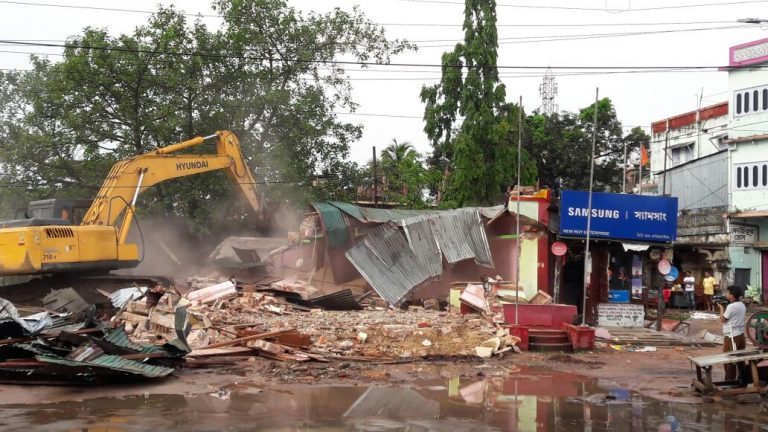
Earlier we had reported how the Tripura government had identified 78 illegal buildings, including political party offices, to be demolished on a major clean up drive. Today morning, the government started the demolition process for the buildings built on government land across the stage.


The west district administration conducted a detection drive and found that 78 illegal buildings including offices of political parties and trade unions, were on government land. Claimants of these offices have been told to move out by May 6, or face razing, said district magistrate Dr Milind Ramteke. “If the offices are not removed by due time, the administration, with the help of police, security forces, and if required, paramilitary forces would demolish those offices from May 7.” Dr. Ramteke had said.

Chief Minister Biplab Kumar Deb, during the assembly session in March, had said his government would not allow the construction of offices of political parties and its affiliated bodies on government land and had warned of stern action.

“If offices of any political party, including BJP, are found illegally on public land, action would be taken,” Deb said.