Home Blog Page 7273

‘The Print’ must answer why it’s spinning sensational stories about Chinese aggression in Doklam

0

For some in the English mainstream media, Doklam is a gift which keeps on giving. Various articles and analysis offered on the subject have ranged from few balanced pieces to many which have been sensationalist.

Latest in this series, comes an article from ‘The Print’ which claims that Chinese have found a new route to South Doklam.

The article relies on satellite imagery (purchased by the news organization) to claim and I quote :

“China has worked through the winter to bypass India’s aggressive blockade at Doklam, making a new road that can give its troops access to the southern part of the plateau – a move that has serious strategic implications for New Delhi”

It further states :

“However, latest satellite imagery from the area suggests that while road construction at the point of contention has stopped, China has been working through the winter to create an alternate route that will give it access to the southern part of the plateau. Unlike the June standoff, where Indian troops had to climb down about 100 meters from their posts to block construction, the new Chinese alignment is deep into Bhutanese territory and over 4 km away from the Indian border, leaving narrow choices for an intervention”

There is an inherent contradiction in the above assertion. Google search of the meaning of the word bypass gives the following, “a road passing around a town or its centre to provide an alternative route for through traffic”

Now, if as per the analysis given in the article itself, the road being constructed by the Chinese is at a distance of 4 km from the point of the stand-off, and is an ALTERNATE route along a different alignment, how have the Chinese bypassed the point of Indian blockade?

Interestingly, while the article provides two separate satellite images which show the original point of conflict opposite Indian positions along Doka La and the point from where a new road is supposed to start towards Jampheri ridge, it does not provide them together on a SINGLE satellite image; something which would’ve have shown the relative position of the two locations.  Yes, there is an illustration which shows the original stand-off point and direction of a new road under construction but it oversimplifies the ground situation.

To put things in perspective, let’s look at the satellite image of the plateau. But before we do so, here is a word of caution – the article claims to have obtained satellite images as of February 2018. And since I’m but an armchair general with no such organizational backing, I’ll be using the Google Earth (GE) satellite images. As per time stamp on GE, the satellite image of the area was updated on 10th December 2018.

Here is the satellite image of the Doklam plateau along with major features:
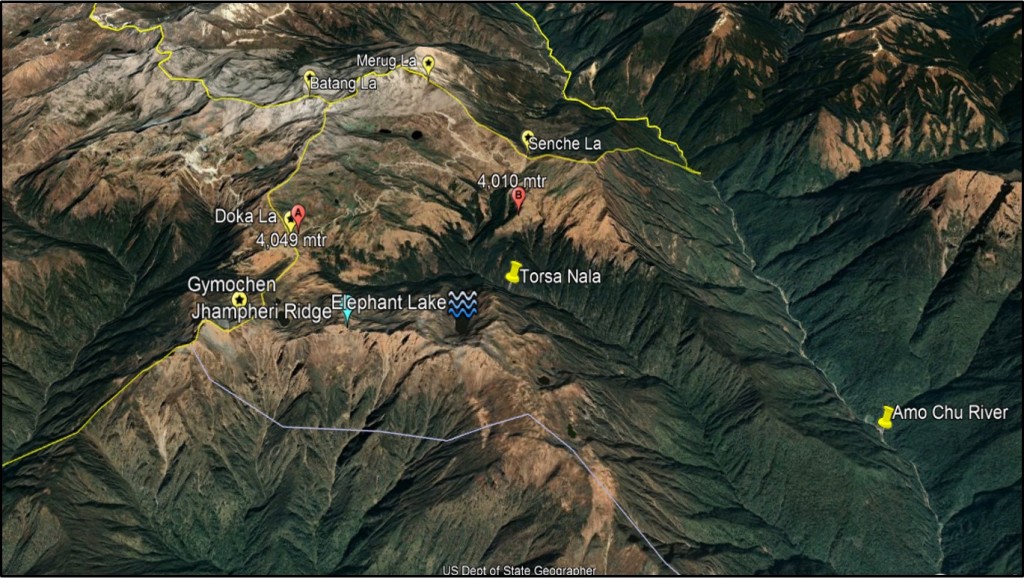
Satellite Image_1 (Google Earth)

A quick summary of the places mentioned on the map (La means mountain pass):

  1. Senche La: The main access point for the Chinese. A major road from Chumbi Valley comes to Doklam across this pass.
  2. Merug La: Another mountain pass on the ridgeline. Also leads into Chumbi Valley and other sectors north of Doklam opposite India-Tibet border in Sikkim.
  3. Batang La – The tri-junction as per India and Bhutan where Indian, Tibetan and Bhutanese boundaries meet.
  4. Doka La – On India-Bhutan border where Indian Army maintains a strong presence. Indian troops had moved from this position to block the road construction activity by the Chinese towards Jampheri Ridge.
  5. Mount Gymochen/Mount Gipmoche – Tri-junction of Indian, Tibet and Bhutanese boundaries as per the Chinese. If this point is accepted as boundary tri-junction, it will place entire Doklam plateau in Chinese control.
  6. Torsa Nala – Water body which drains into the Amo Chu river. This V-shaped depression with steep walls divides the Doklam Plateau into two segment – north and south. As will be explained later, the presence of this steep depression has a major impact on the ground situation.
  7. Point A – the approximate location where the stand-off between India and Chinese troops happened
  8. Point B – the last point in eastern part of the Doklam Plateau from where a road/track is supposedly being built by the Chinese towards Jampheri Ridge

So, where is the bypass?

There is none. With India showing the resolve to block construction work from Point A towards Jampheri Ridge, the Chinese seem to be trying to build an ALTERNATE, and much more difficult and challenging road towards the ridge. That is if they’re trying to build a road in the first place.

So, if the Chinese are super clever and can build a road towards the ridge from Point B (as claimed in the analysis in ‘The Print’), why did they not do it earlier?

There are two main reasons why Chinese wanted to construct a road/track from opposite to Indian positions on Doka La towards the Jampheri Ridge. These are as follows:

  1. It is in-line with Chinese claim that the tri-junction of Tibetan-Indian-Bhutanese boundaries lies on Mount Gymochen/Gipmoche. Over last many years, Chinese have slowly, but surely, build infrastructure on the plateau and extended their hold on it. They’d already reached a point opposite Indian position on Doka La. The road building exercise towards Jampheri ridge was an extension of their creeping occupation of the plateau.
  2. Geography of the plateau!
    1. The area along and in front of the Indo-Bhutanese border on the plateau is the most conducive to build a road/track connecting northern and southern parts of the plateau.
    2. As explained earlier, the Torsa Nala is a deep V-shaped depression on the plateau which divides it into the northern and southern half. This depression runs in the west to east direction with the depth of the depression increasing sharply as we move from east. This becomes evident when you compare the altitude of various points along the Nala. For example, in the GE satellite map below, the difference in altitude of Point D [3,999 meters (13,120 feet)], which is close to Indian position along Doka La and Point E [3,417 meters (11,210 feet)] is evident.
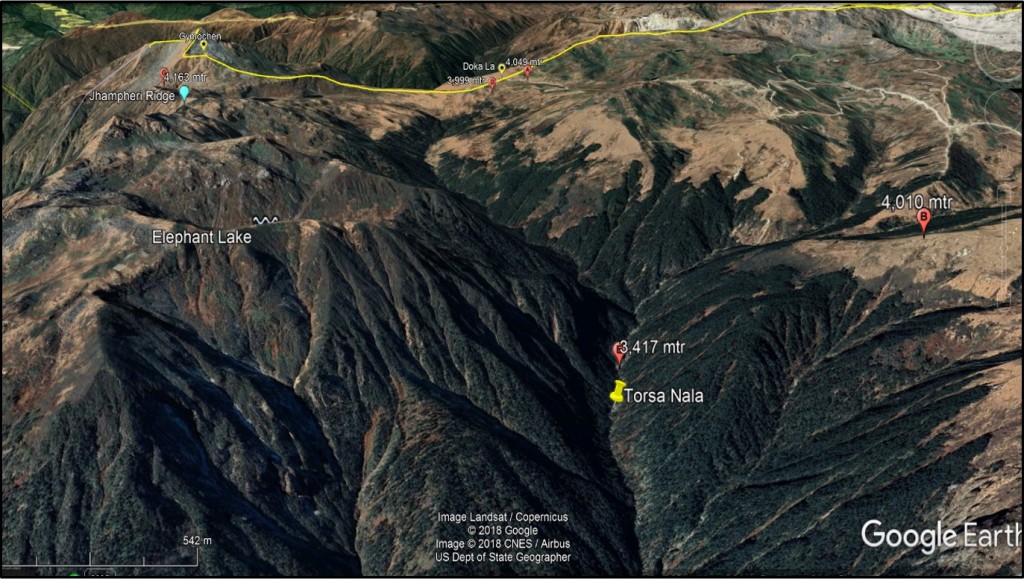
Satellite Image_2 (Google Earth)

While there is no denying the fact that Chinese access and control of Jampheri Ridge poses threat to Indian security, what is also true is that had the Chinese wanted to build a road towards it through the eastern part of the plateau, they would’ve attempted to do so in the past. While not insurmountable, building a road along this direction requires much more engineering effort as compared to building a road/track from the area opposite Indian positions on Doka La.

The challenge of building a road from Point B towards the Jampheri Ridge (or Point H marked on the map) is demonstrated in GE satellite image below. The map shows a direct route between Point B and Point H. Also given towards the bottom part of the satellite image is the elevation profile of this direct route. Please note that right corner of this elevation profile corresponds to Point H and left corner to Point B.
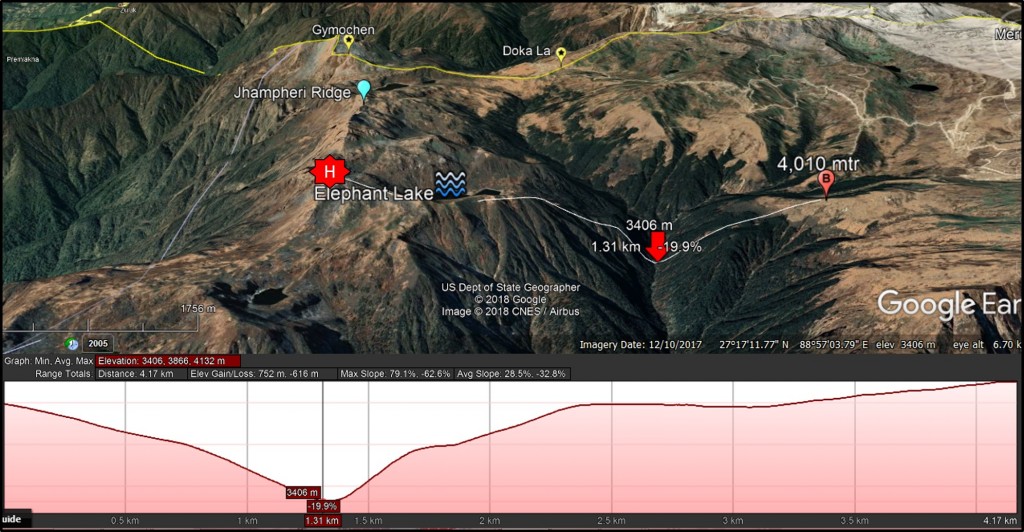
Satellite Image_3 (Google Earth)

While both Point B and Point H are at an elevation in excess of 4,000 meters (13,123 feet), the deepest point along the direct route between Point B & H is at 3,406 meters (11,175 feet). A difference in elevation of more than 1,900 feet from either point! Another important thing is the slope or gradient; there is a steep decline from Point B to the deepest point and a steep climb/incline from this point towards Point H.

What this means is that Chinese will have to be build winding roads with multiple loops while going down towards the Torsa Nala and then while going-up from it towards the ridge. Something similar to the famous ‘gata-loops’ along the Srinagar-Leh highway.

And this will take time.

That is if they actually are building a road or decide to build such a road in future.
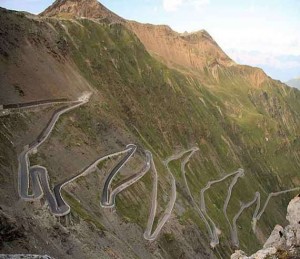
Source: Daily Bhaskar

In comparison, consider the elevation profile of the road/track planned earlier from Point A towards Point G. It is much gentler. The path starts at Point A [4.049 meter (13,284 feet)] and ends at the place below Point G on the ridge. This endpoint is at an altitude of 4,087 meters (13,408 feet). The lowest point on this route is at about 3,961 meters (12,995 feet).
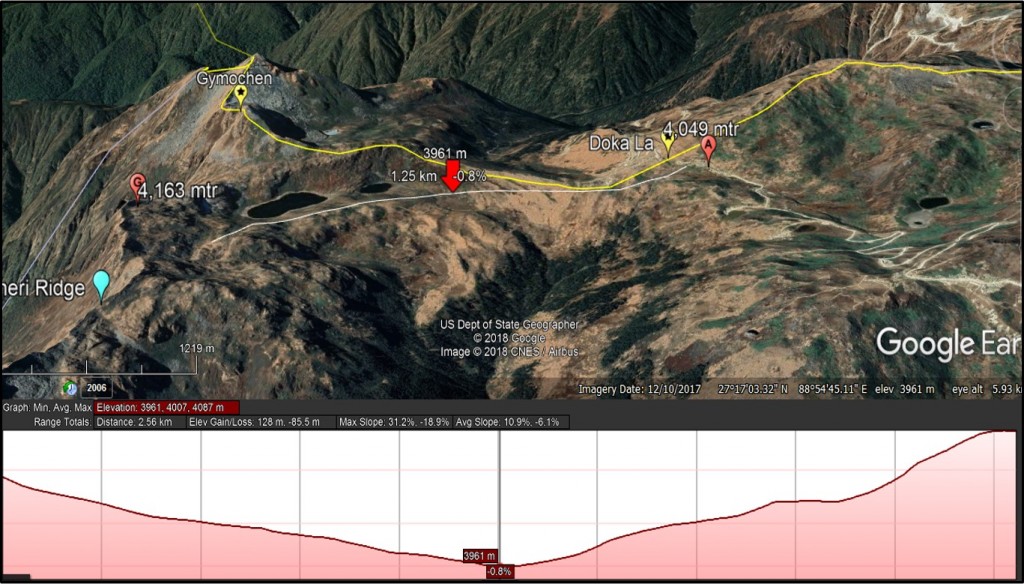
Satellite Image_4 (Google Earth)

It was the Indian action of blocking their original effort last year whereby they will have to opt for an alternate and much more difficult alignment.

And in doing so, Chinese are not being clever by half. Indian analysts tend to suffer from ‘7-foot China-man syndrome’ where anything & everything which the Chinese do is supposed to have deep profound wisdom behind it.

In this case, a forced necessity is being described as an example of Chinese cleverness!

The Chinese claim line in Doklam

The final paragraph of the article consists of the following:

The construction seems to be targeted at providing access to the ridge connecting Mt Gipmochi with Mt Gyamochen. The ridgeline is a possible claim line, although the real claims of China have not been made public till date.

First, as far as I understand, Mount Gipmoche and Mount Gyamochen are the same; old topographic maps of this region mention either of the two names. So, the ridgeline runs from Mount Gipmoche/Gymochen towards the east and then curves in south-eastward direction. It runs parallel to Amo Chu River and losses altitude as it moves south-east.

Coming to the Chinese claim lines, the Chinese claims in this region are much larger than Doklam. And the claim line does run along the Jampheri Ridge.

I reproduce two maps below. First is a Chinese map which highlights the disputed areas between Bhutan and China, as per the Chinese. The second map was shared by the Chinese foreign ministry official when explaining the Indian ‘aggression’ after India blocked their construction activity.
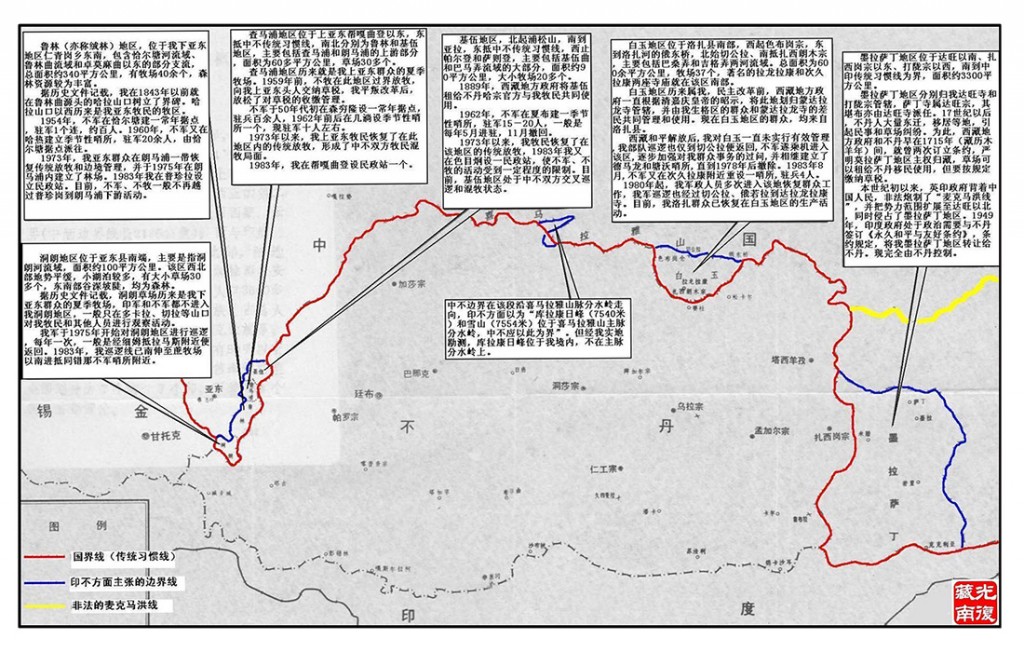
Map_1 (Source: www.bhutannewsservice.org)

The blow of above map which highlights the boundary issue in the present area:
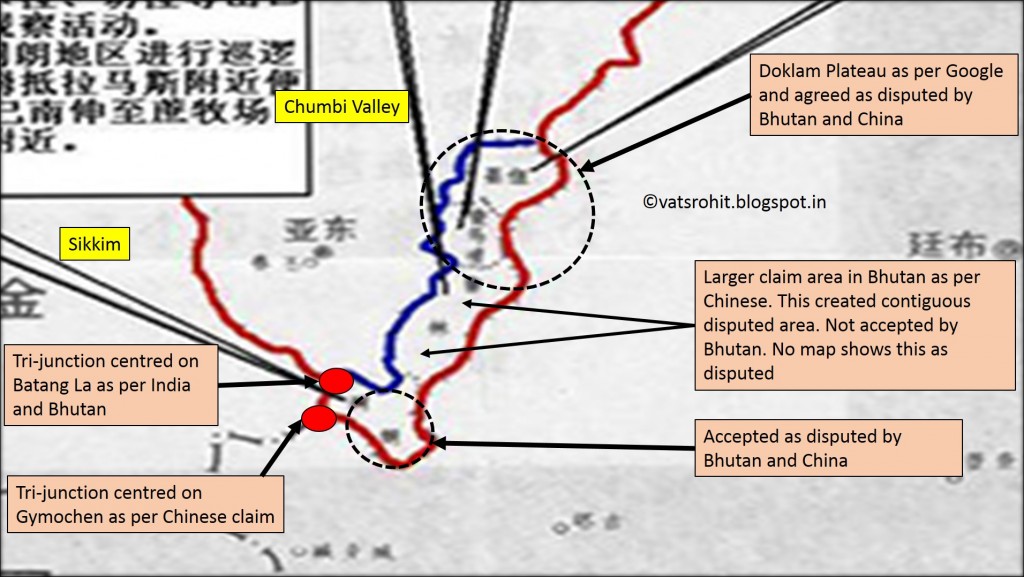
Map_1.1

Below map was released by Chinese Foreign Ministry during one of their briefings to explain Indian ‘aggression’
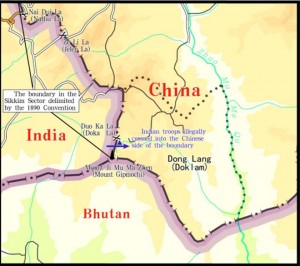
MAP_2 (Source: financial express)

The alignment of the boundary along the Jampheri ridge-line, east of Mount Gipmoche/Gymochen can be made out in both the maps. And follows the alignment along the ridge towards the Amo Chu river.

I’ve tried to create the Chinese claim line on a Google Earth map by using features I could identify. These features correspond to those mentioned in Chinese claims as per the two maps attached earlier.
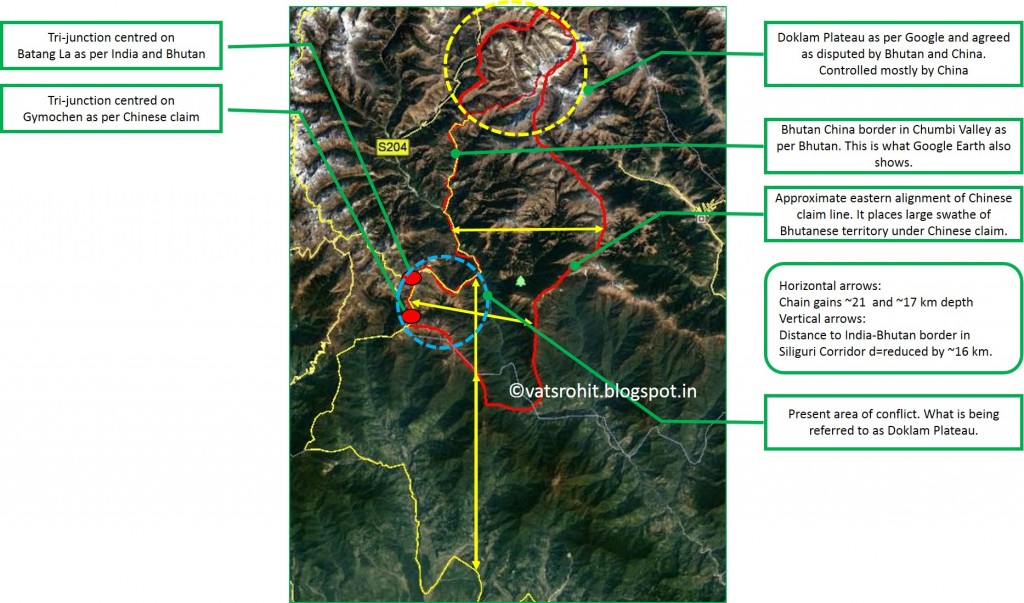
Satellite Image_5 (Google Earth)

The reason Chinese are doing this is because it gives depth to Chinese positions in the Chumbi Valley. As has been widely reported, Chumbi Valley is extremely narrow with steep mountainsides on either side. This gives very less real estate to PLA to station troops and provisions. Further, this puts them at disadvantage vis-à-vis India position on ridges to the west along Sikkim-Tibet border.

The importance of this area to the Chinese can be gauged from the fact that Chinese have in past tried to get Bhutan to exchange 495 sq.km area of disputed area in the north for the total area of 269 sq.km in western Bhutan. This covers the Doklam Plateau as well as larger area towards its east and north-east.

Final Word – Need for balanced analysis

The use of open source, high-resolution satellite images, backed with professional military analysis, is a welcome addition to the media world. The images and analysis give common people a peep into events or aspects which are generally not available outside the security establishment.

However, what is also required is that such analysis is balanced and provides a holistic picture of the ground situation. Along with professional military analysis which covers all the aspect. What we’re witnessing of late is the use of information – satellite images – to present only a part of the picture. And too in a sensational manner. The unbiased and complete military appreciation of the situation is also missing.

Till we get more balanced analysis, keyboard commandos and arm-chair generals like me will have to rely on free Google Earth satellite images and do our own analysis!
Why are regional parties paying tributes to Sonia Gandhi in Rajya Sabha polls?

0

In the old days, we would wait with much excitement for the special afternoon movie that Doordarshan would choose to show on Independence Day. I remember that one time the movie chosen for the occasion was Krantiveer, with Nana Patekar playing the lead role. In the climax of the movie, he delivers a rousing speech to a crowd of people moments before he is scheduled to be hanged, in a manner only Nana Patekar could have.

I still remember some of the lines from that speech (rough paraphrase): “When God looks at all of us from the sky, what does he think? He remembers that he had made human beings to be wonderful and intelligent creatures. But what does he see? He sees all of us on our knees, crawling like insects. Have some shame.”

Somehow the latest round of Rajya Sabha polls happened to remind me of these lines from Krantiveer. In a democracy, the people are supreme, they occupy the position of God. People elected their representatives to stand up for them. But what do the people see? They see a political class that is on its knees, crawling before the power of the Congress establishment.

Indeed, from Bengal to Jharkhand, why are regional parties rushing to offer Rajya Sabha seats to the Congress Party? The Rajya Sabha is the Council of States. A Rajya Sabha berth is a great honour, an expression of trust on part of the states in our federal system.

Today when Congress is at its lowest ebb and when people from almost every state have rejected Congress, have you thought why there are tributes still pouring in from all corners for Queen Sonia Gandhi?

No, this is hardly a case of the losing parties ganging up against the BJP because it happens to be the front-runner. The BJP spent long years in the opposition. Do you remember parties lining up to offer free rides to the BJP?

No, of course not. Because these Rajya Sabha seats are tributes from the political class to Queen Sonia Gandhi. Because our entire system, from netas to bureaucrats and from patrakars to intellectuals, is beholden to the Congress Party. And yes, the … is beholden to the Congress as well; I can’t name them for fear of being in contempt.

The Congress may not have a lot of seats right now, but it has the immense power to lease out its ecosystem to anyone who pays the tribute.  The Congress Party’s lawyers will defend in court every single land grab, every dodgy coal or spectrum allocation that you have ever indulged in. Its media Pidis will wash your stains in the court of public opinion.

Do you have a political pitch that benefits from turning community X against community Y and based on Breaking India in general? The Congress can give you it’s party historians who will prove beyond all reasonable doubt that the feud between the two communities goes back several thousand years. Want to be a ‘free speech activist’ and/or a ‘youth icon?’ Do you fancy yourself going to corporate ‘Thinkfests’ and rubbing shoulders with the high and mighty of society? The Congress can get you in the door in no time.

This is why they always crawl before Congress establishment.

If you are a BJP supporter, congratulations. You are one of the few with a backbone to stand up and speak against this establishment. The BJP is basically the only party across the length and breadth of this vast nation with the gall to take the Congress Party head-on.

They say that you BJP supporters are on the backfoot, they say that Narendra Modi is now on the “backfoot.”

Yeah, maybe you are on the backfoot. But at least you are standing on your own two feet. Stand up and be counted. Do not take a step back.

Rajya Sabha elections: Victory for all 9 candidates of BJP from Uttar Pradesh, opposition loses out

0

Elections for 25 Rajya Sabha seats took place on Friday. The elections were held in total six states including Uttar Pradesh. The other states where polls were held are West Bengal, Karnataka, Jharkhand, Chhattisgarh and Telangana.

On March 15, 33 Rajya Sabha members were elected uncontested. Union ministers Ravi Shankar Prasad and Prakash Javedkar were among those elected.

Of the remaining 25 seats UP had the most numbers at 10. Finance Minister Arun Jaitley was also contesting from the state. The BJP registered a massive victory in UP where it won all of the 9 seats it contested for. In an interesting series of events where many assembly members cross-voted, the BSP candidate was defeated and Samajwadi Party won only 1 seat. BSP leader Anil Singh had declared that he voted for BJP


SP leader Jaya Bachchan was the sole non-BJP Rajya Sabha seat winner in Uttar Pradesh.

In Karnataka where 4 seats were up for grabs, BJP MP Rajeev Chandrashekhar won while Congress got 3 seats. Congress L. Hanumanthaiah, Syaed Nasser Hussain and GC Chandrasekhar were the winners.


In Telangana, all three seats were won by TRS candidates. TRS candidates B. Prakash, J. Santhosh Kumar and B L Yadav secured Rajya Sabha seats.


In West Bengal where 5 seats were being contested TMC won 4 while Congress’s Abhishek Manu Singhvi won too.


In Chhattisgarh BJP’s national General Secretary Saroj Pandey won the sole seat. While in Jharkhand BJP’s Sandeep Oraon and Congress’s Dheeraj Sahu won 1 seat each.

The Election results of Friday are a glimpse of a major power shuffle happening in the 245 member Rajya Sabha. Yesterday’s gains took BJP to 69 seats from its previous tally of 58 seats in the house. Though BJP does not have a majority yet, Congress has made significant losses.

14 of Congress’ members are retiring next week and with that, its tally will come down to 50. The BJP suffered a setback when TDP pulled out of the coalition recently but the party has been slowly gaining territory in the Rajya Sabha.

Due to lack of a majority in the RS, many of the NDA governments policy bills have faced hinderances in the past. Though the NDA is still below the majority mark of 126 seats, by expanding its foray into the house the BJP expects faster clearances of its bills. Its winning march in state assembly polls is helping it to steadily increase its presence in the Rajya Sabha.

‘I don’t know the details of NCC training and that type of stuff’ says Rahul Gandhi while answering a student

0

Rahul Gandhi has positioned himself as a youth leader even as he enters his late forties. Today he was interacting with students at Maharani’s Art college for women in Mysuru. He spoke on Nirav Modi, GST, demonetisation and jobless growth in his interaction.


When asked about benefits he would offer to NCC cadets who have passed C certificate examination he was unable to answer the question. The Congress President made no attempts to understand about the C certificate examination before answering the question on stage.


He went on to add – “As a young Indian person I would like to give you an opportunity where you can have a future, where you can have successful education and where you can thrive in this country. Details of NCC, I don’t know exactly, training and what you go through.”

Social media reacted in a sarcastic manner to Rahul Gandhi’s answer.


One of the Twitter users felt that the lack of nationalism in the Congress party had led to a situation where its president doesn’t know anything about the NCC.


The lack of connection between Rahul Gandhi and life of India was the reason for the Congress president’s failure to answer the question as per another user.


Some could not resist the Chhota Bheem reference.


The youth and general public will probably find it hard to support a leader who gives vague and casual answers to questions thrown at him.

JNU protester inflicts serious head injuries on police officer while violently agitating in Delhi

0

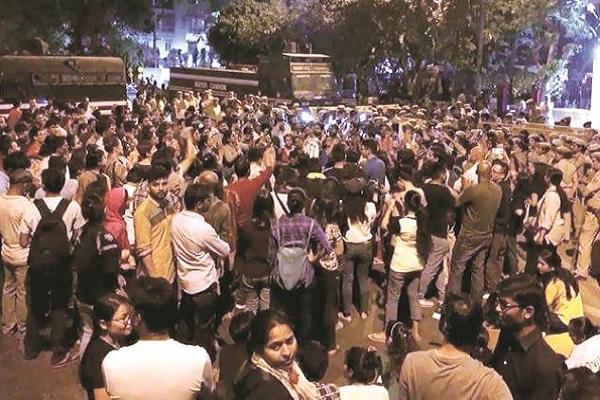
The station house officer (SHO) of Haus Khas police station suffered critical head injuries on Friday, after being allegedly assaulted by JNU protesters who along with fellow students and teachers, had taken out a protest march in Delhi. As a result of this attack, the SHO had to be admitted to the hospital.

Since the assault, the Deputy Commissioner of Police (New Delhi district) Madhur Verma issued a video of the incident, to seek people’s help in identifying the attacker:


One Twitter user closely observed the video and highlighted the alleged assailant:


He also put out a couple of other videos, one of which he claims shows the JNU protesters throwing barricades and assaulting the police personnel on duty:


The protest apparently involved about 1000 JNU students and teachers who attempted to march from their campus towards the parliament street. Some of the issues they were protesting against included, “decision to make attendance compulsory”, “JNU getting autonomy” and “alleged lack of administrative action against JNU Professor Atul Johri, accused of molesting eight girl students”.

This march though saw stiff resistance from the police at the city’s Laxmi Bai Nagar area, where the authorities used means like water cannons and lathi charge to try and disperse the crowd. Post the clashes, about 23 protesters were detained. Since then both sides have made conflicting claims. On one hand, the students claimed that they had permission to march all the way towards the parliament street, the Delhi police’s chief spokesperson alternatively claimed that it was mutually agreed that the march would culminate at the INA market.

In total reports have claimed that about 41 policemen and 35 students suffered injuries in the clashes. It has also been alleged that journalists were manhandled by the police and their equipment was confiscated.

Veershaiva Mahasabha rejects minority tag for the Lingayat community, calls decision “height of injustice”

0

The Veershaiva Mahasabha, a representative body of the Veershaiva and Lingayat community, has rejected the minority tag recommended for the Lingayat community by the Siddaramaiah government in Karnataka.


The Mahasabha also accused the Karnataka government of taking the decision in view of the upcoming Assembly elections.


Mahasabha President Shamanur Shivashankarappa, who is also a Congress MLA, had on Tuesday called the decision of the cabinet “height of injustice”. He had said, “We have called a meeting of Veerashaiva Mahasabha on March 23; prima facie itself this (decision of the cabinet) makes it clear that it is the height of injustice.” The meeting has been called to discuss the future course of action.

The Siddaramaiah government had earlier accepted the suggestions of a panel that had been constituted to look into the issue and recommended a minority tag for the Lingayat community. The move was seen as an appeasement tactic ahead of the upcoming polls to divide the votes of the community which has traditionally been a BJP vote base.

Radical Islamist organisation supports Kerala professor who made sexist remarks against women: Times Now

0

As per a report carried by Times Now, Popular Front of India (PFI) – a radical Islamist organisation has protested against Kerala professor getting booked for making sexist remarks against women.

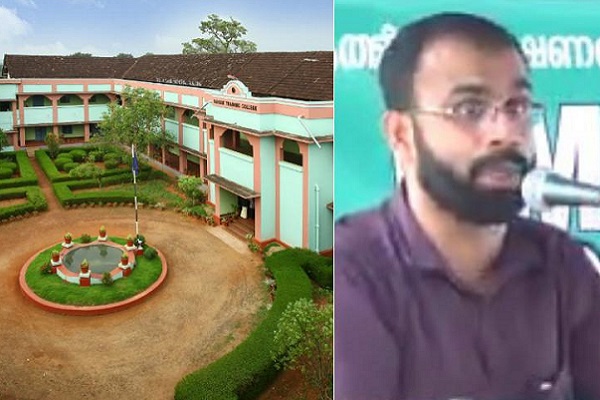
It was reported that Koduvally Police had registered a non-bailable case against Jouhar Munavvir, a teacher at Farook College in Kozhikode for making sexually coloured remarks while speaking at a gathering of Muslim families at Vattoli, Kerala.

He was quoted as saying that, “I am a teacher of a college where 80 percent of the students are girls and of that, the majority are Muslims. These girls are not wearing a dress as per the religious tradition. They are not covering their chests with hijab. But showing part of it is like a slice of red watermelon being displayed”.

He also slammed women for wearing leggings, saying that girl students hold the purdah up deliberately to show off the leggings. He warned the women wearing such ‘immoral’ dresses that this will result in them losing both physical and spiritual worlds.

Following widespread protest and condemnation against his statement, he was booked under sections 354 A (IV) and 509 (word, gesture or act intended to insult the modesty of a woman) of the IPC.

This, as per the Times Now report, has resulted in him finding an ally in form of the PFI. The report claims that various organisations had taken part in this protest which was led by PFI and its political arm SDPI. They have alleged a wider conspiracy in this matter thereby demanding that it be investigated. They also slammed the government’s decision to frame charges against the professor.

PFI in the past has been accused of carrying out various violent activities. This includes chopping off hands of a Kerala Professor for allegedly insulting Islamic Prophet Mohammed in Kerala.

It has also been accused by the National Investigative Agency (NIA) of being involved in the controversial ‘love jihad’ cases in Kerala. In recent days, activists of its political arm SDPI were arrested in connection with an ABVP worker’s brutal murder in Kerala’s Kannur.

No, Dear Sir, Rahul Gandhi forgiving the killers of his father does not make him a great leader

0

In a recent column on Livemint, the author argued for the virtues of unconditional forgiveness and how, by forgiving the murderers of his late father, Rahul Gandhi was treading a noble path forged by other legendary figures from the past. The views expressed in the column were in my opinion utterly misplaced and there was even a certain shred of arrogance in the manner in which his views were expressed. In the column, the author betrayed his biases and it became evident that his opinions were shaped more by a morbid hatred of particular political stances rather than a genuine approval for Rahul Gandhi’s words.

The virtues of forgiveness are often quite exaggerated. Our actions must be guided by justice and not by an overwhelming desire to forgive those who offend our sensibilities. And forgiveness cannot be universally applied to all situations without due consideration for the uniqueness of the matter at hand. For instance, one can be forgiven initially for a minor transgression on one particular occasion. However, if the transgression is oft repeated, then forgiveness every time after the affront is committed makes one complicit in the matter.

The overarching principle of the universe is Justice. Fulfilment of our duties and upholding Justice must be the primary objective of our actions and if Justice mandates that we inflict the harshest of punishment on the sinner, then forgiveness of the crimes itself becomes a sin.

Will the author implore us to forgive the priests who rape children in churches? Will the author implore us to forgive Churchill who was responsible for the death of millions of Indians? Will the author implore us to forgive the Nazis who committed a genocide of Jews? Surely not, if there’s a shred of humanity left in him.

The author admires the fact that Rahul Gandhi has forgiven the killers of his father and showers him with laurels. I agree that Rahul Gandhi’s sentiments on the matter could be sympathized with but to glorify his sentiments as something noble and worth emulating reeks of a certain obnoxiousness on the part of the author.

If forgiveness is what helped Rahul Gandhi cope with the death of his father, then good for him, but to assert that it’s the one true noble path that all great men tread is sheer arrogance. On the contrary, legends and folklore all across the world are littered with tales of heroes who avenged the death of his beloved or his family by inflicting the most terrible of vengeance upon the offenders.

Forgiveness is desirable under certain circumstances. For others, revenge is a worthy pursuit. And the actions are or will be judged on the merit of the individual cases. We could forgive the Congress party for the massive corruption they wreaked upon this country.

We could forgive them for the slew of sectarian laws they embedded in our Constitution. We could even forgive them for their constant efforts towards diving Hindus along caste, regional and sectarian lines while going overboard in appeasing one particular minority community. We could forgive them for compromising our national interests as well and denigrating our Gods and snatching our Temples away from us. But are we adhering to the principles of Justice if we forgive the Nehru-Gandhi family for all the seeds of the division they have sown in this country? More importantly, will the generations to come ever forgive us if we forgive the Nehru-Gandhi family and absolve them of all sins?

The author exalts Mohandas Karamchand Gandhi for his ability to forgive and says, “Gandhi in Noakhali put aside his own pain because he wanted to stop the fires in India.” But did Gandhi really want to stop the fires in India? He did say at a prayer meeting in New Delhi, “Hindus should not harbour anger in their hearts against Muslims even if the latter wanted to destroy them. Even if the Muslims want to kill us all we should face death bravely. If they established their rule after killing Hindus we would be ushering in a new world by sacrificing our lives.” Therefore, when the author says that Rahul Gandhi is following his path, it might be a terrible thing for Indians.

As much as the author wants us to believe Rahul Gandhi is some visionary leader because he forgave the killers of his father but really, it does not mean that. If forgiveness brought solace to a grieving son, then we should be happy for him if it brought him peace. But it does not change the fact that Rahul Gandhi lacks the political acumen or the conviction necessary to lead the country. How does an act of forgiveness for a personal tragedy change the fact that his party has been the den of corruption for a decade? And that he personally comes across as lacking the wit and intelligence expected of a national leader.

The author uses Rahul Gandhi’s admission of forgiveness as just another stick to beat the RSS and the BJP with. One would have expected people to have the decency to not politicize such a matter sometimes, when one has a hammer, everything appears to be a nail. The author says in an ending note, “Rahul Gandhi, by forgiving his father’s killers, is following that path. That’s where he differs from those obsessed with rewriting our past because they’re swallowed by ancient hatreds.” One has to say here if secular historians had not shamelessly distorted our past, there wouldn’t have been a necessity of rewriting it.

And as for ‘ancient hatred’, the entirety of Nehruvian politics revolves around a morbid hatred of the Rashtriya Swayamsevak Sangh and hardly a day goes by when Hindutvavadis are not accused of being ‘Godse bhakts’. Therefore, the efforts of the author come across as another desperate attempt at exalting Rahul Gandhi and denigrating the RSS. And if the author does treasure forgiveness so much, maybe he should first forgive the RSS and the BJP for whatever affront he believes they have caused him before pontificating others on the ‘noble’ path of forgiveness.

The headline of the column, however, is extremely appropriate. Unconditional forgiveness is liberating indeed. It liberates us from the necessity to fulfil our duties, to uphold the principles of Justice and Order and do what needs to be done despite our personal antipathy towards. Therefore, yes, unconditional forgiveness can be liberating but on certain occasions, it is the least honourable path to pursue.

Is Siddaramaiah planning to divide the Karnataka police force on caste basis?

The Siddaramiah led Congress government in Karnataka has taken yet another step towards dividing the society in the state. Recently, the government had sought to separate Lingayats from Hinduism. This time it has picked the police force.

In a hurriedly conducted survey based on a circular issued on March 17, the state’s policemen were asked to provide their caste details. The move has attracted the criticism of the BJP


This move is strikingly similar to the larger insidious plan of the Congress-led government at the centre when it had tried to divide the army by asking for the religious composition of armed forces in 2006.

The home minister Ramalinga Reddy in his response to a Kannada channel Suvarna News has said that it was a part of ‘2-year-old routine survey by backward class [commission] and the new circular was sent as previous ones were not answered’. He added that this survey was not restricted to police force but all government departments. The minister further added that the move was not related to elections when questioned by the channel.

Caste/religion census may adversely affect the morale of the security/police forces. Divisions in important institutions like the police force and the army are dangerous for any society as they are expected to ensure security for all the citizens impartially.  It remains to be seen whether divisive agenda of Congress will stop or continue further in Karnataka before the assembly polls.

JNU student claims harassment from professor for helping another student who was allegedly sexually harassed

0

The Delhi High Court on Tuesday issued a notice to Jawaharlal Nehru University and three professors on a petition filed a student who has alleged that the professor has deliberately tried to stop his PhD registration on frivolous grounds because he helped a student who was allegedly sexually harassed by one of the professors at JNU. The notice has been issued to the university; professor Mahendra P Lama of the Centre for South Asian Studies; Rajesh Kharat, former chairperson of the Centre for South Asian Studies; and Ajay Patnaik, former Dean at the School of International Studies (SIS).

In his petition, filed a week ago, the student had alleged that the sexual harassment incident took place in October last year and the petitioner, also a student, helped the victim escape. Once the accused professors got to know, the professors at first didn’t clear his synopsis, following which the student wrote to the vice-chancellor, the petitioner claims. Once his synopsis was cleared, the student claims his PhD registration was stopped. He claims that while he made a representation in January, nothing happened till now and hence he has moved court.

On Thursday, some students at JNU had held protests against the said professors, demanding an investigation in all 31 pending cases of sexual harassment against the professors.


However, shockingly, the champions of women’s rights and the paragon of liberal feminism, Kavita Krishnan and Shehla Rashid as well as Professor Ayesha Kidwai, President of Jawaharlal Nehru University Teachers’ Association (JNUTA) have not uttered a single word against Professor Lama who is accused of sexual harassment. Earlier this week, the same people had taken social media by storm and held up traffic even as an injured child bled profusely while protesting against Delhi Police demanding action being taken against Professor Atul Johri, who is also accused of sexual harassment by a number of students.

According to reports, the incident came to light when the contents of the email allegedly sent by the woman scholar to the Vice-Chancellor went viral. In her email, the woman had claimed she has registered a complaint of sexual harassment against Prof. Mahendra P Lama and Prof. Rajesh Kharat with the Internal Complaints Committee (ICC) of the university on 8 January. Prof. Lama had outrightly refuted the allegations made against him.

The double standards of these self-proclaimed feminists are shocking. The accused professors, Prof. Lama and Prof. Kharat are believed to be Leftists. Surprisingly, as soon as the news of High Court order issued against the accused professors came out, the protests and prime-time debates demanding Professor Atul Johri’s arrest, who is also accused of sexual harassment, have died down. Rashid and Krishnan have not tweeted in over 24 hours demanding Johri’s arrest.

This is not the first time the so-called feminists have come together to defend one of their own against accusations of sexual harassment. Similarly, one Raya Sarkar put up a list of academics accusing them of sexual misconduct towards women, especially students, a list of 14 ‘feminists’ had written a post that they are against the idea of ‘name and shame’ the sexual predators. These ‘feminists’ who insisted on following a ‘due process’ include Kavita Krishnan, who, ironically, is the Secretary at All India Progressive Women’s Association and till two days back very, very vocal about arresting Professor Johri, and Ayesha Kidwai, President, JNUTA who has also earlier allegedly threatened students and tried to protect Ashraf Alam, a JNU professor accused and found guilty of sexual molestation of a student in JNU, by indulging in victim shaming.

This makes one wonder are they trying to hide something? Are they trying to save one of their own through their silence?