Home Blog Page 7433

Hardik Patel’s treatment of the Congress shows how low the party has fallen

0

Once upon a time, Zail Singh declared that he was ready to pick up a broom and sweep the floor if Indira Gandhi so commanded him. He was made President of India.

How… O how the mighty have fallen.

This is how Rahul Gandhi and the Congress treat Hardik Patel.

Untitled.png

This is how Hardik Patel treats the Congress party.

Untitled.png

They laid out an invitation for him at a press conference held in their party HQ. He called them common thieves.

Again, Hardik Patel is an absolute nobody. He will disappear from the news the day after the Gujarat elections. That Rahul Gandhi and the Congress would let themselves be treated thus by Hardik Patel says a lot about the condition of the Congress Party.

They say Hardik Patel might have actually met Rahul Gandhi. We see some sort of an evidence of that via a hotel CCTV footage. From what I hear, Hardik denies this and he actually might sue the hotel for releasing CCTV footage that damaged his reputation.

There you go: A tiny leader like Hardik Patel feels that his reputation (what reputation?) would be damaged by meeting Rahul. That is the amount of stigma attached to the Congress today. No matter how much they try to polish it, the taint of lakh crore corruption scams won’t wash off easily.

Meanwhile, the media is generally busy fooling itself with stories of the three musketeers (Hardik, Alpesh, Jignesh) joining hands to propel Rahul into beating the BJP in Gujarat.

Only a few sensible ones, have seen the writing on the wall and have devoted themselves to the imminent need to console Rahul baba after defeat in Gujarat. See this:

Untitled.png

Excellent work, Javed Ansari. You have blazed a trail for other flatterers to follow. Instead of bothering with the election, focus on consoling Rahul baba that he’s done well.

On counting day, don’t focus so much on the data coming from the election results. Focus instead on creating a “mahaul” in TV studios that Rahul baba has won. 

These type of journalists may soon even come out with stories like: Even if Hardik Patel calls him a thief, Rahul Gandhi has still earned Hardik’s respect.

Gujarat ATS arrests 2 ISIS terrorists suspected of planning an attack during Gujarat Assembly elections

0

On Wednesday the Election Commission announced that Gujarat’s assembly election would be held on 9th, 14th December and the results will be declared on 18th of the month.

Soon after the dates were announced, it was reported that Gujarat’s Anti-terror squad had successfully nullified a potential terror threat which was looming over the assembly elections.

As per reports, Gujarat ATS arrested two suspected ISIS operatives who were planning a terror attack in the state during the assembly elections. These two operatives were believed to have been in touch with the terror group via social media.

The two arrested have been identified as Kasim Stimberwala and Ubaid Baig Mirza. Kasim a resident of Surat used to work as a laboratory technician in a private hospital and Ubaid is a lawyer who also owned a hotel. The reports also claimed that these operatives were planning a lone wolf attack on a Jewish synagogue situated in Ahmedabad’s Khadia area. As per the police they were either planning a blast or planned to indiscriminately fire at the religious shrine.

Both these operatives are believed to have been in contact with Shafi Armar alias Zahed-al-Hindi, an Indian ISIS handler based in Afghanistan. As per the ATS officials, after the arrests, they also managed to recover cell phones, pen drive, laptops from the duo which will now be sent to a forensic laboratory to acquire details about their handlers and contacts.

Similarly on Wednesday, three men were arrested from North Kerala for suspected ISIS links. These men identified as Mithilaj KC, Abdul Razak KV and Rasheed MV were stopped from going to Syria four months back.

As per the Kannur police, they failed to reach Syria as they deported back to India from Turkey. As a result, the police closely started tracking their online activities which included being active on ISIS related websites. They have now been booked under the anti-terror law, Unlawful Activities (Prevention) Act.

We had reported a few months back how ISIS and its ideology was gaining a foothold in India, which included operatives planning attacks in various parts of the country and travelling to ISIS controlled territories to fight for the terror group.

How Leftists come together to save one of their own accused of sexual harassment

0

Earlier this week, Raya Sarkar, a law student with Indian roots based in the US put out a list of Indian academics who have been accused of sexual harassment. She had posted it on Facebook account and the post soon went viral with many people reaching out to her speaking about their own experiences with abusive professors in prominent Indian universities.

Meanwhile, champion of naming and shaming sexual harassers, the Leftists cabal have taken it upon themselves to prove how this naming and shaming is ‘blackening faces’ and was uneasy with the name and shame list. In a statement, the Leftist cabal has come out in open to support one of their own.

The statement reads,

As feminists, we have been part of a long struggle to make visible sexual harassment at the workplace, and have worked with the movement to put in place systems of transparent and just procedures of accountability. We are dismayed by the initiative on Facebook, in which men are being listed and named as sexual harassers with no context or explanation. One or two names of men who have been already found guilty of sexual harassment by due process, are placed on par with unsubstantiated accusations. It worries us that anybody can be named anonymously, with lack of answerability. Where there are genuine complaints, there are institutions and procedures, which we should utilize. We too know the process is harsh and often tilted against the complainant. We remain committed to strengthening these processes. At the same time, abiding by the principles of natural justice, we remain committed to due process, which is fair and just.
This manner of naming can delegitimize the long struggle against sexual harassment, and make our task as feminists more difficult.
We appeal to those who are behind this initiative to withdraw it, and if they wish to pursue complaints, to follow due process, and to be assured that they will be supported by the larger feminist community in their fight for justice.

The statement is singed by 12 self proclaimed feminists including Ayesha Kidwai, the Leftist professor from JNU, who believes she is a parallel judiciary by leading a public inquiry against the Vice Chancellor of JNU, Nivedita Menon, who believes Kashmir is not an integral part of India, Vrinda Grover, the advocate who rallied to save Yakub Memon and Kavita Krishnan, pro-Naxal ideologue activist who tried to pass off Diwali as a non-religious festival.

While it is ironical that Ayesha Kidwai, the one leading a kangaroo court against sitting JNU VC wants to push for legal and due process, Kavita’s hypocrisy got called out since she has in the past very vocally advocated naming and shaming the perpetrators of sexual harassment. She argues that we cannot afford to throw away due process and adopt vigilantism.


Of course, Twitter was quick to point out her hypocrisy.


She also thought naming and shaming is one of the ways to make Internet a safe space for women.


One is forced to ask – Why keep quiet now? Why did JNU Teachers Association rally behind Arshad Alam, a professor at JNU who was found guilty of sexually molesting a student?

Perhaps one of the reasons could be what this Twitter user pointed out.


This may not be farfetched since most in the original list put up by Raya Sarkar, whose Facebook account is now restored after being blocked by Facebook, are Leftist professors. The left ecosystem does indeed look out for one of their own, even if it goes against everything they pretend to stand for.

Chhattisgarh govt helps provide citizenship to 60 Pakistani Hindus, will further aid 600-700 such Hindus

0

Raman Singh the current chief minister of Chhattisgarh on Wednesday announced that his government had given clearance for 60 Pakistani Hindu migrants to get Indian citizenship. He also asserted that the remaining 600-700 such Hindu migrants too would soon be provided citizenship.

As per Raman Singh, it was possible as for the 1st time the Central government had given the state government authority to take such actions. Raman Singh also sympathised with the plight of the migrants by stating that these people who ran away from Sindh after having suffered and getting treated badly (by the locals. He added that they finally received Indian citizenship 30-40 years later. He further pointed out that the people who were oppressed in Pakistan have now got due respect.

The Raman Singh government had reportedly sent the applications of about 600 such Hindus for registration out of which 60-70 have now been cleared.

This isn’t the only time Pakistani Hindus have been provided such a citizenship. We had reported in July that as many as 114 people from Pakistan, most of them Hindus, had received Indian citizenship in Gujarat. This was considered possible as a result of the Modi government simplifying rules for Pakistani Hindus in exile to get Indian citizenship.

These simplification of rules include:

  • Collector’s office being given powers to process applications seeking citizenship which earlier needed pleas to be made to the Home Ministry. A renunciation certificate too was compulsory from the home country for getting citizenship, all of which has now been doe away with.
  • The registration fee to apply for Indian citizenship has been reduced to as low as Rs 100 from the earlier amount of Rs 15,000.

Even though the rules have been simplified, it hasn’t meant that Hindu migrants have started to enjoy safe haven in this country. In August it was reported that 9 Hindu families were deported back to Pakistan even though the Rajasthan High Court had given clear orders against their deportation.

Sexual harassment allegations against Mahesh Murthy: Did we have our own ‘Weinstein’ moment too?

0

Even as people are raising their voices against the sexual harassment they had faced in their lives with the #MeToo campaign, more and more skeletons are tumbling out of Indian corporate cupboards. Twitter user Pankaj Mishra, founder of technology website FactorDaily, in a series of tweets accused venture capitalist Mahesh Murthy who is also an investor in the Left leaning self-proclaimed ‘media watchdog’, Newslaundry.

In a series of tweets, Mishra accuses Murthy of sexual misconduct for years.


He cites a FactorDaily investigative piece which talks about alleged sexual misconduct of Murthy. Amongst others, author Rashmi Bansal and a woman journalist have accused Murthy of inappropriate behaviour, ranging from inappropriate electronic messages to verbal advances to physical grabbing. Murthy had also allegedly sent an inappropriate message, “Hey babe, one’s supposed to celebrate Diwali by blowing a pataka. So can I go down on you please. :-)” to a woman government officer in Delhi.

Pankaj then talks about a journalist, who was only 19 when she was allegedly harassed by Murthy.


He further says that many people know of Murthy’s alleged misbehaviour, but no one has taken a stand against him except an IT giant.


A woman executive was allegedly asked “are you a virgin” by Murthy back in 2006, and then the company blacklisted Murthy’s digital media company, Pinstorm.

Whoever wrote on Murthy’s alleged misconduct, Murthy sought to implead them in defamation case.


On his part, Murthy rejects all these charges as “absolute and complete lies” and a planned movement to discredit him. He is also reported to have been planning to take legal recourse, but details are not available about whom he suspects to be behind this movement to discredit him.

Interestingly, Newslaundry has never reported on Murthy’s alleged misconduct and hasn’t even carried his denials. The portal had infamously tried to defend even Tarun Tejpal by questioning the woman who had made the charges, but has kept mum on allegations against Murthy. In case the portal carries any views in support of their investor, we will update this article in spirit of fairness.

Manish Mundra the man behind Newton and Masaan speaks to OpIndia

Manish Mundra [1][2], is a trendsetter in many ways when it comes to Hindi Cinema. Manish, a well established movie producer, has produced acclaimed movies like Ankhon Dekhi, Masaan and most recently Newton which became India’s official entry to the Oscars this year.

His journey into movie production too is nothing short of a movie script. A person with humble beginnings, while growing up he used to sell soft drinks after school to support his family. All this while movies always remained close to his heart and getting into the film industry was always a childhood dream for him. After completing his education he decided to climb the corporate ladder and is currently the CEO, MD Africa of Indorama Eleme Petrochemicals.

His entry into Indian Cinema was a result of a tweet sent out by film-maker Rajat Kapoor, lamenting the fact that he wasn’t getting a financier his upcoming movie. Manish replied affirming that he would help produce the movie and this marked his entry in the world of story telling. In 2014 he founded his production house Drishyam Films had has since then never looked back.

He agreed to give OpIndia an interview and spoke about a wide variety of topics like content driven movies, the changing face of Indian cinema and also shared his thoughts on India’s economic and political scenario.

Following is the transcript of the interview:

Hi Mr Manish Mundra thank you so much for agreeing to the interview. What is your family and the movie fraternity’s reaction to Newton becoming India’s official entry into the Oscars:

Manish Mundra: Everyone was happy and excited, we have been pursuing this type of cinema for the last 3-4 years, I am proud of all the films and I was elated when Newton was recognised. Soon my family, friends came to know about it and they too were happy and celebrated as if we had won the Oscars (laughs). So we had to calm them down and explained that we need to do a lot of hard work to enter the final top 5 nominations.

You have been trend setter in Bollywood by making content driven films or those films where script is the most important aspect. So what was your thought process behind choosing this kind of an outlook and are you surprised that Bollywood has somewhat overlooked this aspect:

Manish Mundra: First of all I would want to to call it Hindi cinema and not Bollywood, we have our own identity. I think Hindi cinema had a big stage in 70’s and 80’s equivalent to its counterparts in Europe and America. But from the 90’s we faltered and stuck to the easy way like making formula films without working hard on scripting and technicalities, which resulted in average films. That’s where I felt that we need to focus on this segment of smaller films and on relationship stories than grandeur.

Apart from these content driven stories, another trendsetter of sorts has been you giving chances to newcomers who are trying to get a foothold into the industry. So what would you say are the advantages of having them in movies:

Manish Mundra: I, being a newcomer in the film industry, I felt that newcomers have that drive, courage to go the extra mile, listen and learn which is a requirement for the kind of cinema we are making. Also if you are a newcomer and want to prove a point you would really want to experiment.

So do you think that it is an advantage to not have a big cinematic star so that the focus ultimately remains on the content:

Manish Mundra: Yeah. I firmly believe that the whole idea of star driven films is wrong, it should be the story which drives the movie and actors should come second. In India though the trend is that you create a star and follow whatever he/she is comfortable playing. So audience whether they are aware or not, are being cheated. My idea was that let the story be the star and it should drive and attract the actors.

I guess you are one of the few production houses in India who are trying out such experiments:

Manish Mundra: Yes. Like Ankhon Dekhi was based out of Delhi, Masan was based out of Banaras, Newton based out of Chhattisgarh and my upcoming film Rukh you can paste it in any part of the country and still be able to relate to it. So we go to various places of India to see what the place talks about and it character.

Another very important aspect of you life has been your humble beginnings so by shooting in such diverse locations of India do you try to portray these in your movies as well:

Manish Mundra: Yes. We should remember where we have come from and there are a lot of untold stories India which need to be explored. So there is definitely a connect that those stories which have that humility.

Another possibly erroneous perception attached with the type of movies you make is, people wonder what would be the commercial viability of those ventures. So would you like to set the record straight regarding that:

Manish Mundra: I am a commercial guy myself. The films which are generally called commercial are more speculative in the sense that 95-97% of the so called commercial films fail in terms of making money. So any business which has such a high probability of losing money is a speculation. Also, out of the movies which do make money, almost half of them are star driven. What we are making is true commercial cinema in the sense we are careful about not going over budget and have a very rational production, marketing and advertising expenses. Hence apart from a couple of movies, we have been able to either break even or make money.

Another question which arises with regards to your movies is the Audience. So is the audience responding with regards to them and would such movies overtake the star driven movies in the future:

Manish Mundra: I strongly feel so. With the advent of digital media the audience has a larger access to the starts hence there isn’t a huge euphoria attached, which was the case 10-15 years back. So people will wait for the content and we have seen in a few instances that stars on their own cannot drive the film unless there is a story at the base of things. Second aspect is that the Indian audience also has a lot of exposure to International cinema and content so they now realise the superiority of that content. It is also true in the digital space the word of mouth spreads very fast so the news about a good film spreads like wildfire.

So the audience too has a voice now. Another aspect digitisation has brought forth are various live streaming platforms like Netflix, so are you planning for focusing on such content. That is you won’t be dependent on a cinema hall per say:

Manish Mundra: I agree that the life of cinema is going to be very difficult as people are getting good electronic gadgets to watch content at home. This poses a challenge that one needs to make good movies to pull people to cinema halls and competition always gives a better output in terms of good cinema. Also to directly answer your question, rightly I am focusing on making films and there would be a time when we can focus on making such live streaming content.

Another trend which you seem to have set is that you released Newton on a Monday and not a Friday:

Manish Mundra: I feel when you make a movie, you should be courageous enough to open it up for the reviewers hence they get a chance to judge the movie out way ahead of Friday which gives enough time for the audience to make their minds up by reading the reviews before the weekend. So its more of a strategic decision and we are also showing confidence that we are open to scrutiny.

To diversify things a bit, you obviously have been very successful in the corporate world, so what is your outlook on the current economic and political scenario of India:

Manish Mundra: I am very bullish about the economic and political scenario of India as after years we have got a stable government, which has a visionary leader. I feel we are moving in the right direction with strategic and structural changes in place as far as the economy is concerned and we are poised for a boost. I feel that the parallel economy of the country is demolished and most people have moved towards digitisation. Due to the change in the taxation structure and the widening of the tax net, the government should work on reducing tax percentages. All this added with the lower global fuel prices, puts a lot of funds at the government’s disposal to focus on social and infrastructural reforms. So I feel that the tough times are behind us and the next 3-4 years would be effective in terms of economic growth.

Do have any expectation from the government when it comes to cinema:

Manish Mundra: The government should try and focus on increasing the number of screens, providing enough investment avenues for international investors and increase FDI in cinema halls, establish more world class film making institutes. The entertainment businesses have a huge scope when it comes to foreign exchange, talent development and youth empowerment.

What do you think the future holds for Hindi cinema in the next 5-10 years 

Manish Mundra: Hindi cinema has ample scope (to grow) as almost 80% of the Indian population understands Hindi which translates to about 80 crore people. But less number of cinema screens pose a problem. So I feel the government should focus and deregulate the screen licensing laws so that we can reach a larger audience.

So moving towards a bit of a lighter content, movies have always been close to your heart so do you have any other passions apart from movies:

Manish Mundra: Yes, I love painting, writing poems, I love photography which I have been learning

So, what would you say is the favourite cinematic memory of your childhood:

Manish Mundra: All Amitabh Bachchan movies attracted me to follow cinema

Before parting, would you like to give any other message for our viewers:

Manish Mundra: We want the audience to go and watch Rukh which is releasing on 27th October. Its an poetic experiment film and is directed by Atanu Mukherjee so we need a lot of love from the people.

I hope that Rukh is a huge success, I wish you all the best and thank you for speaking to OpIndia


Political ‘Sholay’: political parties get filmier as election campaigns get more dramatic

0

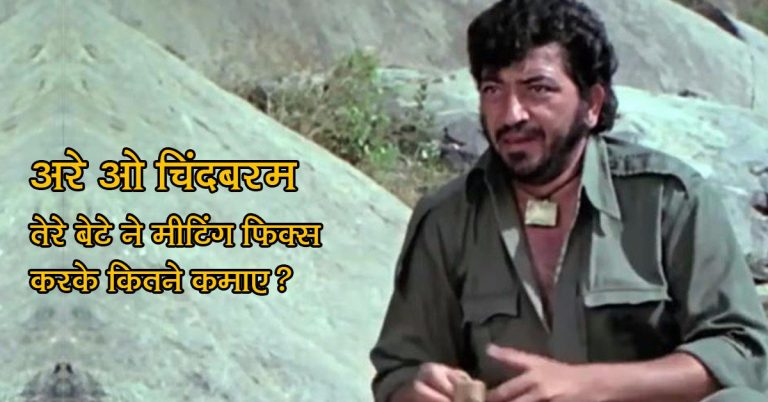
On Monday, during his drama-filled visit to Gujarat, Rahul Gandhi had referred to Goods and Service Tax (GST), introduced by Prime Minister Modi with effective from 1st July, as ‘Gabbar Singh Tax’.


Gabbar Singh is a popular fictional dacoit from the film Sholay, played by Amjad Khan. The film also starred Amitabh Bachchan, Jaya Bachchan, Dharmendra, Hema Malini and Sanjeev Kumar. Of course, this little jibe of Gandhi amused a lot of people.


Soon, a lot of “Gabbar” memes and jokes started flooding in.


Some accounts paying tributes to slain journalist Gauri Lankesh, too joined in the fun.


A day later, Bharatiya Janata Party (BJP)’s youth wing, Bharatiya Janata Yuva Morcha (BJYM), retorted with their own set of Gabbar memes.


Whether we believe GST is Gabbar Singh Tax or Gabbar is back, one thing is for sure, the meme wars have just started.

Just kidding! We don’t promote violence of any kind.

Bank Recapitalization – sorting the myths from the facts

0

BIG BUSINESS BAILOUT!! TAX PAYER MONEY!! ADANI AMBANI, NPAs!! Etc etc etc screamed the Twitter liberal circle. On the other hand a section of dolts kept saying “we need reforms”. This is not enough. Need to do more. A golden chance to correct errors is being missed. Etc etc etc..

Its not quite clear what these people intend to say. Anyway I shall keep that for some other day. Let us focus on the Bank Recapitalization part for now. I shall try and explain the whole activity in as many simple terms as possible.

What is Capital Adequacy Ratio (CAR)/(CRAR):

A bank cannot keep on lending. There are certain limits to it. These limits are set to protect depositors like you and me and to promote a stable and efficient financial system. Thus the capital “adequacy” ratio, as the name suggests, is a measure of a “bank’s capital.” It is expressed as a percentage of a bank’s risk weighted credit exposures or in simpler terms its “loans”. CAR is also known as Capital to Risk (Weighted) Assets Ratio (CRAR)

So What was the problem with CRAR?

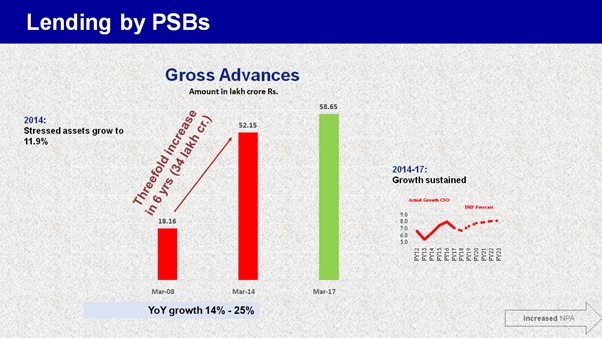
Indiscriminate Lending under UPA government!!

This chart explains how loan portfolio of banks increased manifold. There were certainly few allegations that loans were issued on phone calls and under influence from top politicians. Some of the practices from then are captured in Vijay Mallya’s saga. Anyway, this lending led to an increase in NPA’s. If you lend to an unviable project, it cannot service the debt! This is precisely what happened. As on today the total banking NPAs have crossed Rs 8 lakh crore in the quarter ended June 2017, 90% of which are from public sector banks.

When an account is declared “NPA” banks have to mandatorily make “provisions” for bad loans in their books which leaves them with even lesser money to lend further and very badly affects their profitability and capital adequacy.

So tell me who is to be blamed for this situation? The people under who’s tenure the loans were given or the people who are trying to fix the rot?

This indiscriminate lending has resulted in six banks having been put under the “prompt corrective action” category by the Reserve Bank of India. This means that their activities like announcing dividend, opening branches, hiring and giving further loans to below investment grade rated entities are restricted. In fact the headlines should read how UPA nearly collapsed the banking system.

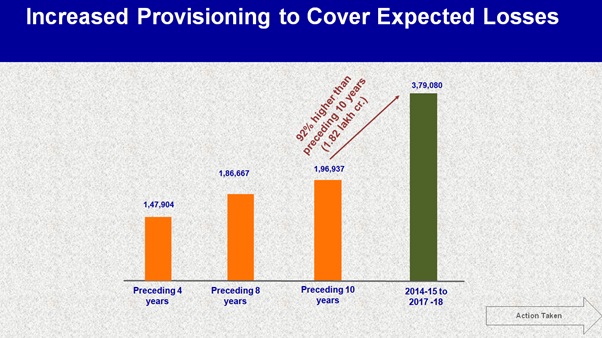
Banks had to cushion in a lot of provisions to cover up these loans. A graph issued by the Finance Ministry covers this aspect:

All in all, poor oversight by the UPA government over functioning of the Public Sector Banks, nearly collapsed our economy. The provisioning has eroded the capital adequacy ratio thereby hampering the ability of banks to lend fresh loans.

So why this “Capitalisation of Banks”

Capitalisation simply means infusing fresh capital with the banks. This time the government is planning to issue “Capitalisation bonds” to raise funds. Here is one of the ways it can be done:

Government issues bonds. Banks subscribe to bonds. Government gets funds. Government uses same funds to infuse into banks and thereby expanding their capital base. Thus improving CRAR. This allows banks to lend fresh loans and even allows them to raise even more funds from outsiders at cheaper rate.

These fresh loans generate productive assets, jobs and create demand. Demand drives the economy. The exact mechanism of these bonds has not been announced yet but it will come out in due course of time.

Who shall benefit out of this?

Anybody who is willing and eligible for a commercial loan from a bank shall benefit out of this. Banks, which are currently stressed and cannot lend much, will be freer to lend. They need eligible and good borrowers to keep the cycle running. The Finance Minstry highlighted that special focus shall be given on Mudra and Standup India loans once fresh capital is infused.

Are Tax Payers Bailing Out Banks?

The technical versions may say NO, but to put it bluntly: Yes. But we have to remember there is no other option. We are in a tight spot, and this could be the best out of bad options. Let anyone tell you otherwise, we cannot let our banks die.

Are Tax Payers bailing out the NPA accounts or big defaulters?

No. The proceedings under various laws are going on. The recovery proceedings against defaulters will not stop. There is a difference between bailing out a bank and an individual borrower. So no, you aren’t paying Vijay Mallya’s loan off.

What is the guarantee that future loans will not go bad?

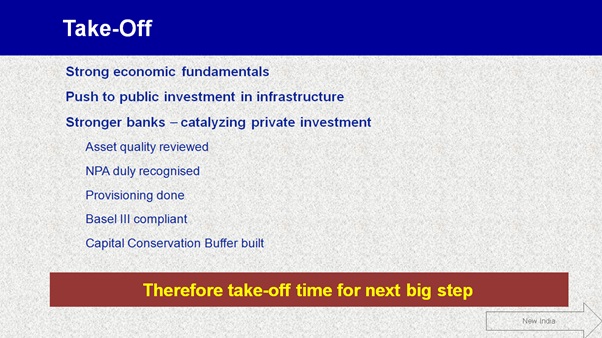
True. There is no guarantee. They may also go the same way. For that systemic reforms have been taken by this government. Here is a glimpse of the same.

Lending based on sound principles will ensure lesser NPA’s. Bank Boards and credit appraisal system have been revamped. Insolvency and Bankruptcy code has been enacted. State Bank Group has been consolidated. MOUs with 11 Public Sector Banks have been signed to ensure a turnaround. None of this was done by the UPA. It was done under the Modi Government.

Conclusion

Instead of following views of some policy wonks and copy-paste “economists” on twitter, listen to what experts have to say. There is no denying that Banks today are not in the best of shape. There is also no denying that most of the loans which are causing troubles, were extended during the UPA regime. The current Government is essentially cleaning up the mess of the previous Government, and as you know, in any clean-up, hands will get dirty. The public at large needs to only ensure that even after this clean up, Banks do not go back to their old ways of lending. Stricter norms for loan appraisal need to be enforced and the Government must ensure that we do not see a repeat of the crisis.

Post Script

If you are a Raghuram Rajan fan and are wondering “what would he have done”, read this:

“I think it’s important to recognize that banks do need capital and you need to put it aside and if it means that there are other resources allocations that should be reduced, so be it. I mean, that’s the cost of staying within the budget. This is not painless,”

“A Brahmin is always a rapist”: Has the Indian left lost control of its loons?

0

Like fire, you could say that, fanaticism is a good servant but a bad master. It has a way of spinning out of control and coming back to burn the hand that lit the fuse.

A similar thing seems to be happening with the bitter harvest of left wing extremism that our campuses and intellectual circles have been cultivating for years, with a booster shot being administered after Narendra Modi became Prime Minister.

The Kanhaiyyas of the world may have realised that it is more profitable to ask for “Bharat mein Azaadi” instead of “Bharat se Azaadi“, but how will the left wing worthies stop Kanhaiyya’s Kanhaiyya?

Untitled.png

These names have been compiled in a Facebook post by a radical leftist lawyer by the name of Raya Sarkar based in Davis, California. A cursory glance at the list shows a preponderance of names from India’s “Institutions of Higher Dissent” such as Jadavpur University, JNU, FTII and arts departments of Delhi University.

What is noteworthy is that the poster has not presented any evidence whatsoever in support of these accusations. While it is impossible not to feel for innocent people who may be facing public character assassination, it is also impossible not to relish how liberal circles are being singed by the fire of irresponsible, radical leftism that they lighted themselves.

The panic in liberal circles has set in swiftly. Far left propaganda blog Kafila has released a statement by several strident radical feminists who are “dismayed by the initiative on Facebook, in which men are being listed and named as sexual harassers with no context or explanation.” The more suave left wing website Scroll has had to step in to publicise the statement on Kafila.

Untitled.png

In a delicious irony, radical leftists have appealed to other radical leftists to utilise “institutions and procedures”. From “revolution” and “Azaadi” to appealing for respect towards established institutions and procedures … that’s the plight of leftists caught on the wrong side of their own fanatic tide.

This was also acknowledged on the Facebook post naming alleged sexual harassers, which clearly exposed the fault lines in the left:

But who can stop the tide of fanaticism? Like I said, they can manage Kanhaiyya, but who will manage Kanhaiyya’s Kanhaiyyas? The loose cannons of the left are going rogue : here is just a sample of the hatred they are spewing below Raya Sarkar’s Facebook post.

Untitled.png

A Brahmin is always a rapist? The radical left’s mask is slipping. Their hatred is showing. They have been done in by their own loons.

What has happened to Hindustan Times’ database ‘hate-tracker’?

0

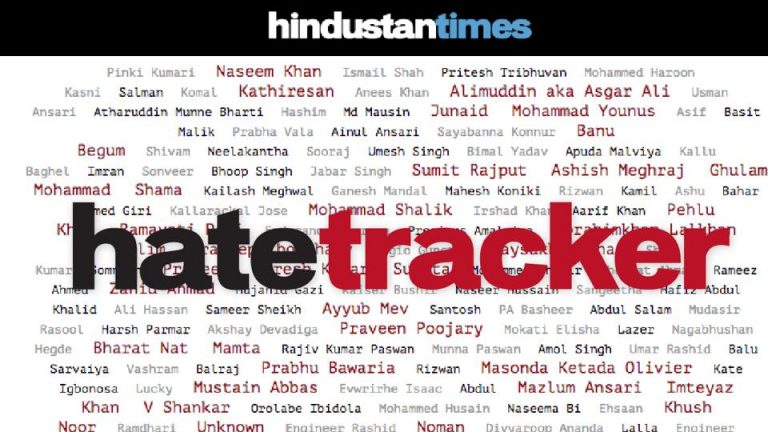
On 28th July, 2017, Hindustan Times had introduced a “Hate Tracker” which it claimed was “a national database on crimes in the name of religion, caste, race”. They even had an option where you could “submit” a hate “incident” which would be added to their database only if it meets their “editorial criteria”.

Ever since, the Hate Tracker has come for severe criticism for its obvious bias. Rather than being a common database of crimes against all communities, castes and people, it had warped into a repository where majority of the victims were Muslims and Dalits. Hate crimes against people belonging to certain political or religious inclination were conveniently ignored, and so were crimes perpetrated by people belonging to certain political or religious ideology.

Scientist and columnist Anand Ranganathan was one of the first one to spot and point out this obvious bias. We had covered how he had debunked the Hate Tracker, one tweet after another.

Today, Ranganathan discovered to his suprise, that the link to the Hate Tracker no longer went to the original page:


This is what it looked like, on 24/10/2017:

The bias of the tool is evident from just a glance at the most recent “hate” crimes tracked by it (as on 24/10/2017):

Today,  when Ranganathan visited the site, he was welcomed with this screen:

Is it really the end of this contrived, one-sided tool of bigotry? Some would assume so because even the editor, Bobby Ghosh,  who oversaw the introduction of this Hate Tracker, quit the publication just 14 months into his job. During  his time, as many as four editions and three bureaus, including the business bureau in Delhi and Mumbai were shut down, laying off an unknown number of journalists.

Is it the beginning of a course-correction by Hindustan Times or is the Hate Tracker down for “technical reasons”? A questionnaire was sent to the Editor at the Hindustan Times, reply to which is awaited and will be appended to this post.