Home Blog Page 7432

Pakistani website claims Muslim population in India has grown to 22% thanks to beef consumption

0

A Pakistani news website named Tribune has carried a blog titled, Fudging the population: The missing 90 million Indian Muslims.

The author named Shakir Lakhani seems to have a problem with the number of Muslims which are reported to be there in India. He claims that the few rich Indian Muslims are adamant that the number of Muslims in India is much more than what’s officially reported.

After “smartly” detailing the census numbers, he claimed that the Indian governments have deliberately suppressed the Muslim numbers so as to keep “Hindutva Extremists” calm, who otherwise would resort to outright violence and murder.

He then claimed that he had done a lot of research in the past few months to come up with his theory. He then promised, he would try and explain that to us in simple terms. This explanation involved quoting Jana Sangh website and doing a lot of mathematical “wizardry”. After throwing a lot of numbers he concluded that there are a total 22% Muslims in India as opposed to the 14.23 % reported in the 2011 census.

Things didn’t stop at that and the article questioned why Indian Muslims didn’t speak up against this misinterpretation. It saved the best for the last and elucidated that “Hindu extremists” should ask themselves why Muslims are growing so rapidly, while Hindus are declining in India.

But before the “Hindu Extremists” could ask themselves this question, the article proceeded to provide a theory that perhaps Muslims are growing rapidly because a high protein diet (including beef) increases fertility.

It was certainly commendable that the author attempted to use concepts of both mathematics and biology in a single article to provide proof of gossip. We rarely get to see that. Perhaps he can also do further research to try and ascertain if concepts like birth control and family planning (which are normally associated with keeping a check on reproduction) are a Zionist conspiracies?

This article predictably has generated a lot of buzz online. Already it has been reproduced by another Pakistani news website named “Pakistan Herald”. The original article also has about 92 comments which might be sufficient to conclude that he has managed to rile a lot of people up.

Unsurprisingly, this isn’t the only time Pakistani websites and media houses have managed to conjure up some crazy news stories with wild insinuations :

  • A Pakistani TV channel named Dunya News had sensationally claimed that a recent stand-off between India and China had escalated to a full blown war. They later proceeded to reveal exclusive information about the attack. Things became so crazy that not only India, but even China, who goes out of its way sometimes to cater to Pakistani eccentricities, termed the news as fake.
  • In 2010 Pakistani newspapers published fake Wikileaks cable in order to try and attack India. Using these fake cables, Pakistani media tried to claim that Indian spies were supporting Islamist militants in Balochistan and Pakistan’s tribal belt.

The Pakistani media has also displayed high aptitude and a supremely wild imagination when it comes to concocting conspiracy theories out of thin air :

  • Soon after the death of veteran actor Om Puri, a Pakistani TV channel named Bol TV had amusingly claimed that he was murdered on the orders of Narendra Modi and Ajit Doval. Things progressed from being just amusing to hysterically amusing when the same TV channel claimed that Om Puri’s ghost was caught on camera looking for Ajit Doval to avenge his death (Can’t make this stuff up!).
  • Another conspiracy theory was spread by a certain Neo News which claimed that Donald Trump was born in Pakistan’s lawless North Waziristan region. Named as Dawood Ibrahim Khan, he apparently studied at a madrasa until 1954 when a car accident killed his parents. We wonder if “Dawood Ibrahim Khan” chuckled when he finally, thanks to Neo News, discovered his true ancestry and said “This is ridiculous. RIDICULOUS! This is Fake news!”

We suspect Pakistan, in their little bubble of ridonculous fantasies, have already weaved tales of how they rode blindfolded on one eyed leprechauns to defeat to Indians in wars. Can’t put it past them now, can we?

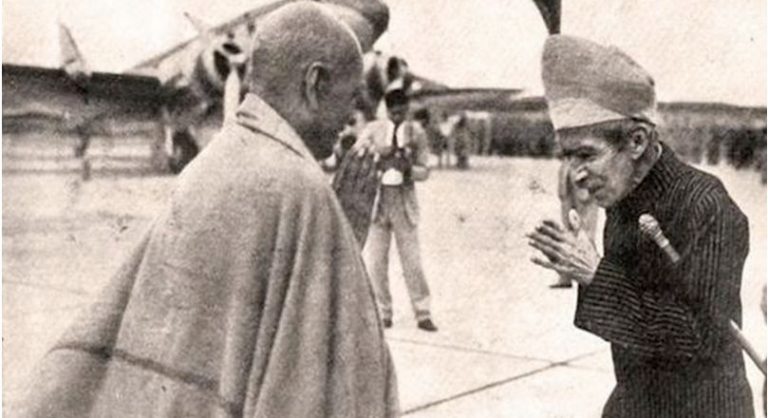
How Sardar Patel ensured Hyderabad’s inclusion in India

When India got independence in 1947, Lord Mountbatten, the last viceroy of India, was appointed to supervise the freedom process & smooth transition of power. British offered all the 565 princely states the choice of becoming part of either India or Pakistan. Most of the 565 princely states found it reasonable to become part of either India or Pakistan based on their geographical location and went about signing Instrument of Accession. Some of them saw this as an opportunity of regaining their bygone glory. Nizam of Hyderabad was adamant on remaining as an independent state ruled by own Government.

While other princely states were small in size and not self-sufficient, hence it made sense for them to become part of India (or Pakistan), Hyderabad was already very prosperous and was recognized as the richest state. The state was actually self-reliant, had its own currency (Hyderabadi Rupee), its own army, railway network, radio network, postal system etc. The Nizam Osman Ali Khan was the richest man in the world, regularly being featured in international magazines like TIME.

Hyderabad of that time consisted of parts of today’s Andhra Pradesh, Telangana, Karnataka, Maharashtra, Madhya Pradesh and Chattisgarh. But it was completely land locked (It was surrounded by Indian land from all sides).

Tasked with the integration of Indian states and kingdoms, Patel made his stand clear that Hyderabad has to merge in India. But Nizam refused to sign treaty of accession. After much intervention by Lord Mountbatten a standstill agreement was signed between India and Hyderabad according to which status quo will maintain for 1 year. According to the agreement, Hyderabad will keep functioning as it was earlier. India cannot interfere in its matters unless there is a state of internal emergency. But Patel was relentless in his pursuit of making Hyderabad part of India and he kept pushing from his side. Patel very clearly told Laik Ali (Nizam’s representative in Delhi) that Hyderabad has to be part of India like all other kingdoms. He sternly said that India will never agree for an independent Hyderabad. When Laik tried to disagree, Patel plainly told him there is no point in discussing this any further. Patel had realized that polite requests would not bear fruit in this case.

Meanwhile, other 2 princely states (Junagarh and Bhopal) which initially wanted to be part of Pakistan, had succumbed to Sardar Patel’s diplomacy and agreed to become part of India. Majority population in Junagarh wanted to be part of India, while ruler wanted to join Pakistan. India sent its army and surrounded Junagarh. The ruler panicked and left India in a jiffy.

Nizam of Hyderabad realized that India can try similar tactic with Hyderabad. But Nizam was assured by his advisors that Indian forces were occupied in Kashmir and cannot come down to Hyderabad for any military action. So he kept playing the hard ball. During a meeting with Patel, Nizam’s representative Kasim Razvi in his arrogance threatened that he will wipe 1.2 Cr Hindus in Hyderabad if Government of India tried to interfere with Hyderabad’s functioning. The threat was dangerously real since Razvi commanded an army of 2 lakh Razakar’s (who were guerrilla militants) could run havoc in Hyderabad on his one signal.

There seemed to be no way out of this deadlock other than using force. Patel was not willing to let an 82,000 Sq. Km. area right in the middle of India remain a separate state. Allowing this would make it a permanent internal security threat for India. He termed it an ulcer in India’s belly. But Nehru and many other political leaders were not in favor of using force to include Hyderabad. Nehru even wanted to take this to UN to avoid direct confrontation. Patel wanted to avoid taking any direct military action because this could force Hyderabad to go with Pakistan or take the matter to UN. He was firm with his opinion that Hyderabad has to merge with India eventually.

By September 1948, reports of atrocities on civilians started coming from Hyderabad. It was also found that Hyderabad gave a loan of Rs 20 crore to Pakistan (which was against the “Standstill Agreement”). Since Pakistan was already fueling unrest in Kashmir, it was clear that money sent by Nizam will be used for funding the war against India in Kashmir.

India didn’t need any another reason to act. Patel, who was not well at that time immediately wrote to Nehru requesting him to send the army to Hyderabad. A quick and fast action was required so that Nizam doesn’t get time to involve UN or Pakistan. And India did exactly that. In the early hours of 13th September 1948, under the code-named “Operation Polo”, Indian troops started marching into Hyderabad. It was a two-pronged advance, with the main force along the Sholapur-Hyderabad road, and a smaller diversion along the Bezwada-Hyderabad road. Hyderabad did not anticipate this and was clearly not prepared for a war with India.

With “state of the art” military equipment (of the 1940s), the Indian Army was generations ahead of Hyderabad Army and the Razakars. Within 100 hours, “it was all over”.  On 17th September 1948, the Nizam went on air & announced ceasefire. On 18th September 1948, the formal surrender ceremony was held at 4 pm in which the Hyderabad Army, led by Major General El-Edroos, surrendered to General Chaudhari leading the Indian Army. This was followed by a high level meeting between Sardar Patel & Nizam Osman Ali Khan, in which the Nizam assured that in spite of all that happened in the past, he shall now be loyal to the Indian Union and work in the closest collaboration with the Government of India for the benefit of his people.

And that’s how within span of 4 days, Sardar Patel forced Hyderabad to becomes part of India while completely avoiding the issue being dragged in UN. Had he not acted with urgency, Hyderabad could have gone Kashmir’s way.

Building a sustainable ‘Right Wing’ ecosystem

0

I am reminded of the story of a man called Antony Fisher. Antony came from a family of migrants – mine owners, military men, and politicians. As those of his time with a robust pedigree, he joined Eton and later graduated from Cambridge University. After graduation he joined the Royal Air Force, where he was grounded, following a flying accident.

Antony’s weakness was his love of the periodical – The Reader’s Digest. Every copy was read (and re-read) cover to cover, underlined, notes made thereon and many a times read out aloud to his family and friends. He had created a library of decades worth of the digest. In the April 1945 issue, The Reader’s Digest had published a condensed version of Austrian Economist Fredrich Hayek’s masterpiece, “The Road to Serfdom”. The Book was hugely popular and despite war-time paper shortages had gone for several re-prints. Still, it was incredibly difficult to get a copy of the book then. Fisher was alarmed by the victory of the Labour Party in the elections held just months after the Victory Day (day on which the Allies accepted the surrender of Nazi Germany), and the nationalization of industry, central planning etc. that followed.  Fisher, deeply influenced by the ideas expressed by Hayek in his book, became set on meeting him.

As the story goes in late spring, early summer of the same year, Fisher took the ten minute stroll from the War Office (where he was then posted) to the London School of Economics were Hayek taught. Neither men being much for small talk, Fisher straightaway told Hayek that he agreed with what was written in his book and that he intended to join politics to set his country right. Fisher had already been politically active for some time and this seemed like a logical progression for him in his quest to “set his country right”. Hayek replied, “No you are not!”. Hayek’s stand was that society’s course would be changed only with a change in ideas. For this, one must first reach the intellectuals, the teachers, the writers, the journalists and opinion makers with reasoned argument. It will be their influence on society which will prevail and compel the politicians to follow. Fisher considers this as one of the most important days of his life and instead of going into politics, he continued to make an intellectual case for his worldview. About a decade later he founded the Institute of Economic Affairs (IEA), which is an influential right wing think tank and has been described as the most influential think tank in British history.

This is what the Indian right wing must aspire for.

Hayek’s views as far as the influence of ‘intellectuals’ on society is concerned, seems agreeable. Indeed, as Keynes so succinctly said, “The ideas of economists and political philosophers, both when they are right and when they are wrong, are more powerful than is commonly understood. Indeed the world is ruled by little else. Practical men, who believe themselves quite exempt from any intellectual influences, are usually slaves of some defunct economist.”

A practical demonstration of the power of intellectuals can be seen in India as well. Despite doing stellar social work since the 1920s, RSS did not manage to get political influence till as late as 2013. Contrast this with what the left ideology led ecosystem has achieved. Despite its focus on negatives, cultivating a defeatist mindset, at times even alleged support to an enemy country during times of war, a naxal terrorist movement, creating obstacles to several developmental works etc, the left has managed a strong hold on political power and the ‘establishment’ which is in play whether they are in power or not. Remember, eventually the politician will do what people want. It is the job of an ecosystem to convince people to want the right things. The Left understood this and the Right did not. As a result, despite 50-60 lakh members, a nearly 100 year pedigree, about 60,000 shakhas and decades upon decades of selfless service, RSS finds itself struggling as hard today as it did perhaps a quarter century ago to defeat the leftist narrative. So much so that even a powerful and influential swayamsewak like Ram Madhav is constrained to admit that “RSS is difficult to understand and easy to misunderstand.”

If this isn’t a scathing indictment of what a lack of a strong intellectual ecosystem can do to pulverize a social ecosystem (RSS) and a political ecosystem (BJP) however strong they may be, then I don’t know what is. In fact, unless there is a strong intellectual foundation for a political and social movement, their combined might will come to naught given enough time. Indeed it can be described as being on a treadmill, running to stay in the same place. At best, we can slow the outflow of our brothers and sisters from the Hindu fold, but we cannot reverse the movement till such time their hearts are not accessed via their minds. This is a losing battle unless the right wing opens on the intellectual front. Creation of an intellectual ecosystem is no longer optional, if India’s Hindu or Indic identity is to survive this century.

It is thus essential to look evaluate the path etched by AdiShankaracharya to devise an intellectual ecosystem. AdiShankara lived in a time when the country was again at similar ideological crossroads. He used the path of reasoned debate, to firmly re-establish the Dharmic identity of India by taking what is best from other philosophies and showing its compatibility to Vedantic thought. In fact, he is the Proof of Concept (if one was ever needed) that societal changes are the result of a strong intellectual ecosystem. AdiShankara concentrated on creating bhashyas on three principal Dharmic texts: The Upanishads, The Brahmasutras, and The Bhagwad Gita.

The Upanishads are the epitome of Vedantic thought and outline the crux of Indic philosophy. Through a commentary on the principal Upanishads, AdiShankara first created a strong intellectual base. This is called Shruti. The Brahmasutras are a text that reconciles apparent disagreements between various Upanishads and Shankara’s commentary on it was necessary to create a strong rational, argumentative, and logical basis to the lofty ideas developed by the Shruti. This commentary is called Yukti. Now that philosophy is clear, and it has been given a strong rational basis, how does one experience the highest truth? For this, we have the Bhagwad Gita, the commentary on which is called anubhuti.

The RW ecosystem will also only be created by following this structured path of Shruti, Yukti and Anubhuti. The RW will need a friendly, well funded policy research arm that will first decode and crystallize what an Indic identity is. A lack of unified identity among Hindus is a key reason why our customs, festivals and culture can be easily meddled with and appropriated by outsiders.

It is a safe bet to assume that the idea of what it means to be a Muslim or a Christian across the world will have many similarities, unlike the vagueness in our Indic family. But there is a simple, direct, common denominator within all Indic identities that this intellectual system must identify. There is something that binds me to a Kashmiri Pandit, to a Buddhist Bhikshu, to a Jain monk, to a Sikh granthi, to a Namboodri priest, to caste leaders across castes, to an East Indian, to a South Indian. What is that? That needs to be defined clearly.

Shruti :

When a Jallikattu is banned, I feel the same pain as I am sure my Tamil family feels when Dahi Handi was regulated in inches and feet. When Durga Pooja is banned, I felt the same pangs as I am sure my Bengali family felt when Diwali was banned. My eyes well up when I read of the atrocities meted out to Sikh gurus, as I am sure my Sikh family feels when the torture meted out to Chhatrapati Sambhaji is narrated to them. It is this common thread that this proposed Policy Institute must first identify and define.

Yukti :

The next step will be to make a logical and rational case for the Indic worldview in all matters of policy, where foreign, monetary or fiscal. ‘Why is our way the better way’ will be the crux of all research within the boundaries outlined in the Shruti. There will be regular papers, books, presentations, studies, surveys conducted by fellows of the Institute. The work would be subject to peer review, criticism, blind refereeing, etc as is required of serious, independent intellectual publications. The Fellows will ensure that only the most critically defend-able argument for our world view is put out for public consumption and debate.

Anubhuti :

Finally, the goal of the Institute will be to conduct policy research scholar programmes where subject specialists are cultivated. The idea would be to flood the market for ‘talking heads’, with those of the Indic worldview. Create students, who will become teachers and influence the public at large. A large enough contingent of public intellectuals will be needed to digest the Indic worldview for easy public and journalistic consumption.

This three pronged strategy will have to be carried out with deliberate intent and well financed backers. No more will the adage “as much as one can, as much as possible” be enough in the face of the sustained, well financed and incredibly well organized opposition India faces today. The Institute will do a great job of bringing people with disparate views on specific issues but common goal of an Indic renaissance together. A unified Indic intellectual resistance will be impossible to beat and we can be absolutely confident that it will take no longer than 15 years at best to reverse a great deal of brain washing that has been inflicted upon us. India is a young country and what we need to do to harness the power of our youth is to facilitate and help our  youth to think for themselves and grow up with the pride of belonging to the best culture and a glorious heritage.

In conclusion as Keynes so famously explained that people are going to be influenced by some defunct economist. I humbly submit, that if people are going to get influenced by defunct economists anyway, let that economist be ours.

Time is running out.

Amid rising radical Sikh violence, Congress drops idea to install Indira’s statue in Punjab

0

The Punjab district Congress committee has, as per reports, abandoned the idea to install Indira Gandhi’s statue at the Congress Bhawan in Ludhiana.

As per Vijay Agnihotri, the secretary of Punjab Youth Congress, this statue was scheduled to be installed on her death anniversary, which is today. Agnihotri had announced this plan at a press conference on Chandigarh.

The reason being given for shelving the plan is that the Congress wished to avoid a possible confrontation with Sikh radicals. The report too recorded that several Sikh organisations had started to oppose this plan and issued open warnings to the tune of their supporters resisting such an attempt.

The President of the District Congress Committee, Gurpreet Bassi Gogi, called the plan as the individual sentiment of Vijay Agnihotri. Agnihotri too has now claimed the same and asserted that he had even sent invited to MLAs and senior leaders to attend the statue installation. He had also taken the pains to travel to Delhi for inviting prominent individuals.

He said nobody had raised any objections at the time, but he was informed on Monday that the installation won’t take place.

Bassi Gogi on the other hand has said that he took the decision to not install the statue after being notified of the plan. He also claimed that information regarding the plan wasn’t conveyed to party superiors.

The report has insinuated that the party seniors were advised by the police administration that the move might add to the prevailing tension.

In recent days, radical elements have started to make a bit of noise in Punjab.

These radical voices prominently found mention during AAP’s campaign leading up to the Punjab assembly elections. Back then we had carried a report about pro-Khalistani outfits infiltrating the party. There was also speculation about Gurmehar Kaur receiving support from certain fringe Sikh elements during her free speech episode.

Punjab has also become riddled with instances of Hindu leaders getting murdered. This includes the daylight murder of Ravindra Gosai the chief of one of RSS’s shakhas in Ludhiana, which took place on 17th October.

Just yesterday, Vipan Sharma the president of a Hindu outfit named Hindu Sangharsh Sena, too was shot dead by unknown assailants in Amritsar. He, as per accounts, was shot 7 times at about 2 PM by two unidentified men.

This murder means that a total 5 murders of Hindu leaders in the state have taken place in the last 2 years.

The case of Ravindra Gosai has been transferred to the NIA and it remains to be seen if all these are disjoint events or whether there is a larger conspiracy that is fueling rising tensions in Punjab.

AIB deletes out of context video demeaning PM Modi after getting called out on Twitter

0

A few years back, a phrase called “shoot and scoot politics” was made famous by current AAP supreme Arvind Kejriwal. This brand of political activism involved hurling allegations against prominent public figures, but doing nothing to try and prove them.

Now it seems that the controversial comedy troupe, All India Bakchod (AIB) has developed a form of “shoot and scoot” brand of comedy where they put up controversial comic sketches on social media and soon delete them as soon as people start calling them out.

We saw an example of this brand of comedy when AIB had uploaded a meme about a “privileged cow” which was stereotypical of the narrative peddled by the left. They soon deleted the meme from Instagram, Facebook and didn’t even share it on twitter.

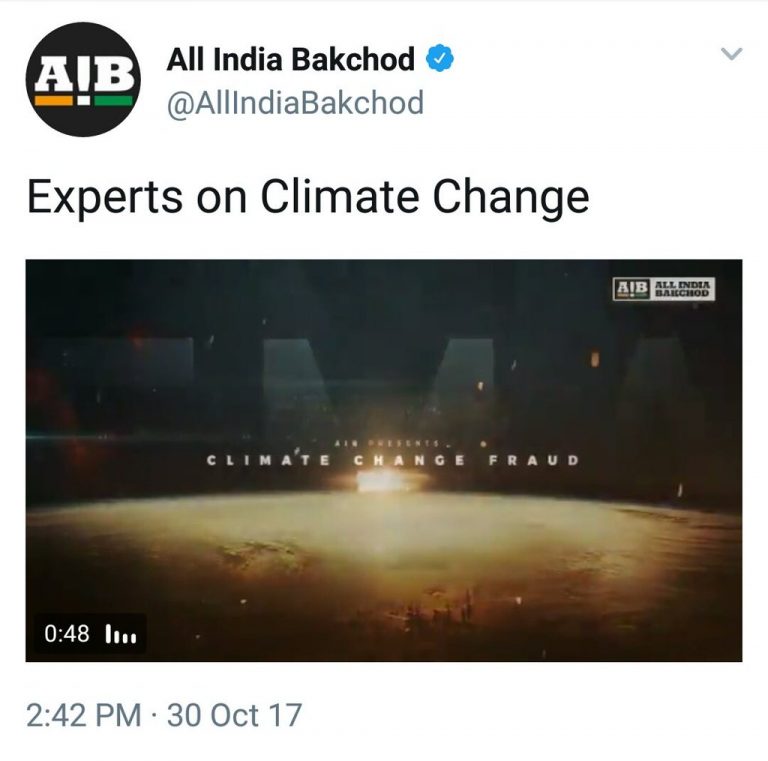
AIB were at at again when they uploaded a video titled “Climate Change Fraud” on Monday:


This deleted video, whose copy was retained by Twitter user @moronhumor, depicted famous personalities like, Barack Obama, Hillary Clinton, Elon Musk among others asserting that climate change is real and extremely dangerous. Later the video abruptly cuts to a clip of PM Modi addressing schoolchildren where he is seen saying (translated to English), Actually the cold hasn’t increased, their resistance to it has reduced. Climate hasn’t changed, we have changed. The final moment of the video ends with the audio of Donald Trump approving the message.

The video clearly tried to insinuate that unlike other world leaders, PM Modi was ignorant about climate change and didn’t take this very important threat seriously.

Naturally people didn’t take AIB’s claim on face value and the Twitter user @moronhumor decided to get to the bottom of things:


He as promised put out the whole video of PM Modi’s event:


The whole 2.20 minute video (out of which AIB borrowed a 4-5 seconds clip), shows PM Modi sharing an anecdote with school kids about elderly people often using the phrase that the “weather this year is colder as compared to last year”. This Modi explains is because their resistance to cold has reduced. Thus he claimed, Climate hasn’t changed but we (humans) have changed.

What AIB failed to incorporate in its video was, what Modi said after this. He had stated how the bad habits of humans have resulted in us harming the environment. He then gave points of advice to the schoolkids that humans should love and not struggle with nature.

So clearly from the video, not only PM Modi wasn’t refuting climate change, he actually was telling the school kids how the changing habits of humans has resulted in the degradation of the environment.

In order to further drill home his point, @moronhumor put out video clips which showed Modi’s love for the climate, including the clip of him addressing the Paris summit where he is clearly heard stating that “Climate change is a major global challenge”.

Soon after his expose, AIB deleted the tweet, which might insinuate that the intention of the video merely was mischief making and not actually trying to make people laugh.

Other twitter users too as a result were miffed at AIB:


Popular spoof video makers decided to create a parody:


Even though AIB has now deleted the post, the video continues to flourish in the form of Congress spokespersons and its supporters sharing it to attack Modi.

Perhaps that was the idea to begin with? To seed a political propaganda video, then delete it to keep your own backyard clean, while the propaganda keeps spreading?

On Indira’s death anniversary, don’t fall for this lie about Vajpayee

0

Today is the death anniversary of former Prime Minister Indira Gandhi, best known for the 19 month long Emergency declared by her. Of course, like previous years, media houses have started circulating the fiction where former Prime Minister Atal Bihari Vajpayee had referred to Indira Gandhi as “Durga”.


The headline says that the Opposition, referring to former Prime Minister Vajpayee, referred to Indira first as a doll and then as goddess Durga. This is absolutely incorrect.

Listen to Vajpayee himself vehemently deny referring to Indira as Durga.


Even ABP News in its 10 facts about Indira, repeated this fake news.


This is not the first time media houses have spread lies about former Prime Minister Vajpayee. Earlier, The Hindu had also spread lies about Vajpayee.

Many others, too, kept referring to Indira as goddess Durga.


While many Twitter users called out the media houses for spreading this fake news, the fact that it comes up periodically shows how lies spread faster than truth.


They say repeat a lie a thousand times and it becomes the truth. Vajpayee referring to Gandhi as Durga is one such lie.

Now West Bengal Government says NO to celebrating Sardar Vallabhai Patel’s birth anniversary

0

According to a notice on the UGC website, Ministry of Human Resource Development has issued a directive to all higher educational institutes in the country to observe and celebrate 31st of October as “Nation salutes Sardar Vallabhai Patel”.

The directive asks the institutes to organise programmes and events based on the theme of unity to showcase how Sardar Patel maintained unity even in a diverse country like India and create a single political, socio-economic and administrative entity for governance under independent India.

The institutes have been asked to conduct a ‘unity run’ and send pictures and videos of the events organised to UGC.

Unsurprisingly, the Mamata Banerjee led West Bengal Government has asked the varsities to ignore the Central Government directive and celebrate the occasion as they deem fit.

The Education Minister of West Bengal, Mr. Partha Chaterjee said,“The Union government has no right to enforce anything on us. Paying tribute or respect cannot be on the basis of any directive from anyone. We specially take objection to the directive on video-recording the event and sending the same to the UGC.”

However, this controversy does seem like a forced one, in a bid to oppose the central government since the directive to celebrate ‘unity run’ or ‘Rashtriya Ekta Divas’ on 31st October is not new.

Even in 2014, a UGC directive read,“We are all aware of Sardar Patel’s contributions to India’s unity, safety and security. As a mark of honour… you are requested to organise different events on October 31 on the campus.”

In fact, the Ministry of Human Resource Development in 2014 had even uploaded photograph of “Run for Unity” being organised at Visva-Bharati, Santiniketan, West Bengal.

Shantiniketan

This is not the first time that the Mamata Banerjee led West Bengal government has opposed nationalist and positive directives of the Central Government in a terrible syndrome of cutting the nose to spite the face.

In May, 2017, West Bengal became the only state that refused to participate in Modi Government’s cleanliness survey.

In September, 2017, Mamata Banerjee and her Government asked its colleges to ignore the UGC directive to telecast PM Narendra Modi’s speech commemorating the 125th anniversary of Swami Vivekananda’s address to the World Parliament of Religions in Chicago.

And in August 2017, Mamata Banerjee’s government asked schools to ignore the ministry of human resource development’s circular, asking schools to organise a set of programmes revolving around Independence Day.

It would seem like Mamata Banerjee is deliberately issuing bizarre diktats against following the central government’s instructions in an attempt to oppose every move of the Modi Government. Perhaps it would bode well if the West Bengal Government started thinking of the betterment of it’s people rather than opposing every central government move simply for the optics of it.

Tehseen Poonawalla threatens to sue OpIndia for a Mumbai Mirror report after-effects

0

Earlier in the day, we had published a report titled ‘Billionaire Cyrus Poonawalla clarifies ‘motormouth’ Poonawalla of Congress is not his relative’, which was based on an article that had appeared in Mumbai Mirror and Ahmedabad Mirror newspapers.

As per the report in the Times Group newspapers, billionaire businessman Cyrus Poonawalla’s PR firm had issued a statement, where it was clarified who all were the members of the family linked with their business, further asking the press not to assume any other “Poonawalla” as part of their family.

The Mirror report wondered why the business family had to issue such a clarification and hinted that perhaps the business family had a ‘motormouth politician’ with the same surname “Poonawalla” in their mind while issuing the statement. Very soon, social media users knew that the hint was too obvious, and Congress supporter and brother-in-law of Robert Vadra, Tehseen Poonawalla was being referred to in the Mirror report.

The OpIndia report documented the same, and further pointed out the earlier deeds of Tehseen Poonawalla, which includes provoking people in the name of caste, spreading lies about lynching and tweeting obscene tweets to Minister Smriti Irani.

Once the report went viral, Tehseen claimed that he had spoken to Adar and Cyrus Poonawalla regarding this report. Later, he put up a copy of an email, which he claimed was sent to him by Adar Poonawalla, the son of Cyrus Poonawalla:

This email, whose original message was sent by a certain Melvin Bob to Melvin Bob himself as per the image posted by Tehseen, claimed that Tehseen Poonawalla is an old friend of Adar Poonawalla. It called the recent news sad and unfortunate. The email further claimed that Adar isn’t involved in politics and his and Tehseen’s business interests are separate.

Based on this letter, Tehseen threatened OpIndia with a defamation case if we didn’t apologise and take down the “fake”  article:

So do we owe an apology to Tehseen? Was our report “fake”?

First of all, the letter by Adar Poonawalla doesn’t deny that a PR firm, on behalf of his family, had issued a clarification asking the press to not assume any other Poonawalla as their relatives. The letter also doesn’t say that the family was not hinting at Tehseen in their statement, or Tehseen’s actions were not the reason why such clarification was issued.

Please remember that something that is “sad and unfortunate” — how the purported letter by Adar describes the situation — is not necessarily “fake”. Even realities are sad, unfortunate, and embarrassing on occasions.

Even though the letter doesn’t explicitly deny either a clarification being issued or Tehseen being the ‘other Poonawalla’, let Tehseen or Adar give an example of another Poonawalla, who is relevant to the press for some reason (i.e. a public figure), whom the business family doesn’t want to associate with as relatives; we will update the report even in that case.

And lastly, why is Tehseen not taking up the issue with Times Group that publishes Ahmedabad Mirror and Mumbai Mirror?

Finally, we are carrying the letter in fairness, and we leave it upon our readers to conclude the facts around the development. We are also updating our earlier report and adding this information about the letter in the original article, so that people don’t miss the other side of the story.

In a historic first, India sends a wheat shipment to Afghanistan via Iran’s Chabahar port

In a historic landmark when it comes to Indo-Afghan trade relations, India on Sunday flagged off its first wheat shipment to Afghanistan via Iran’s Chabahar port. The shipment after reaching Chabahar, would then reach Kabul by road.

This would mean that both the countries have established a trade route which doesn’t involve Pakistan as an intermediary. Earlier trade between India and Afghanistan was a major hassle as Afghanistan being a land locked country, was totally dependent on Pakistan for sea access. Pakistan also predictably used to create hassles by not allowing India land access to Afghanistan and merely allowing Afghan truck to enter India via the Wagah border.

This historic shipment was flagged off by External Affairs Minister Sushma Swaraj and also prompted a tweet by current chief executive of Afghanistan Dr Abdullah Abdullah. This tweet also included a map of the new trade route:


The usage of Chabahar as a port would not only help India connect to Afghanistan, it would also mean that it can now access other resource-rich countries in central Asia. Chabahar is also meant to be a counter to the China-Pakistan economic corridor whose Gwadar sea port is already being used for China’s trade activities.

Even though this port was such a key feature in India foreign strategy, it almost went into a cold storage during the UPA period, after former Prime Minister Atal Bihari Vajpayee had entered an agreement to develop it in 2003. Negotiations intensified after Nuclear Deal between P5 + 1 (The UN Security Council’s 5 permanent member and Germany) and Iran. It was finally brought on track by PM Modi during his 2016 Iran visit, where the two countries signed the Chabahar port agreement. Moments later, a trilateral transit agreement was signed between India, Iran and Afghanistan, which now seems to have started to bear fruits.

Things unfortunately might have again hit a potential roadblock after it was reported that pressure was being exerted against this project by US officials, who questioned if India was as a result of the agreement, violating the international sanctions against Iran.

India’s plan to develop the Chabahar includes $500 million investment and a construction of a railway line between Chabahar and Zahedan which will connect the port to the mainstream Iranian railway system. Japan too has offered a hand in developing this whole project.

In the next few months India is expected to send 6 more wheat shipments which (including the current shipment) comprise of a 1.1 million tonnes wheat grant for the Afghan people. Such a grant, one hopes would not not only increase the relations between the two countries but might also make India a major player in Central Asia.

Billionaire Cyrus Poonawalla clarifies ‘motormouth’ Poonawalla of Congress is not his relative

0

In what can be termed as a major embarrassment to Congress supporting Poonawalla brothers, as per a report in Ahmedabad Mirror and Mumbai Mirror, Pune based business family, Cyrus Poonawalla has issued a clarification listing out the members of their family that owns the business. The clarification further asked the press not to assume that any other “Poonawalla” was part of this family.

Cyrus Poonawalla founded the Serum Institute of India in 1966, which is one of the world’s largest vaccine makers.

So why did he issue the clarification and which other “Poonawalla” was he hinting at?

Pretty soon, some social media users guessed that it was Tehseen Poonawalla, brother-in-law of Congress Vice President Rahul Gandhi’s brother-in-law Robert Vadra.


Tehseen Poonawalla, a regular on TV and in press, has regularly spread misinformation on Twitter. In the past, he has tried to provoke people in the name of caste, and spread lies about lynching. He has also tweeted obscene tweets on Minister Smriti Irani, which he deleted after she showed them on a TV channel.

Recently, after son of a Congress leader Moti Irani, who was under CBI scanner for the CWG scam, Khodu Irani, was accused of sexual harassment by number of women and men on Twitter, Tehseen came to his rescue and even defended him by saying that he personally knows Khodu ‘who is a great guy’.

Could this be the reason the ‘original’ Poonawalla had to issue a clarification?

The clarification from Cyrus Poonawalla comes at a time when a Twitter user by the name Prafful Sarda has been tagging authorities on Twitter, like Pune Police and Chief Minister of Maharashtra, Devendra Fadnavis, vocally clarifying that Tehseen and Shehzad are not related to Cyrus Poonawalla and referring to the former as ‘cons’.


He has repeatedly referred to him as “uncle” implying that he may be somehow related to the Poonawallas.


He has also suggested that Cyrus Poonawalla as his uncle and hoped for free stay at a hotel they acquire.


Nowhere has he clarified that he is not related to Cyrus Poonawalla.


No wonder the Pune based family had to clarify that no other Poonawalla was part of their family. Considering that the other “Poonawalla” appears to have implied so on many occasions by using the helpful term “Uncle”.

UPDATE: Tehseen Poonawalla feels that the above OpIndia report is “fake” and has produced a letter in support of his assertion. You can read that letter here. We leave it upon the readers to conclude if our report is fake as claimed by Tehseen.