Thursday, April 2, 2026
Home Blog Page 7505

The nation wants to know where the buck has stopped on: RSS Shorts

0

The RSS has just decided to change its uniform from khaki shorts to brown trousers after a good 91 years. Surely there are much better things to talk about than uniform an organisation ports, but then for that Indian media needs to work hard. Here is an excerpt of some possible news-room deliberations on this issue:

Editor-in-Cheap of a leading news channel – To arrest our sliding TRP ratings, today, we are discussing a topic that is of great national interest. It is socially relevant, has tremendous intellectual potential and has the capacity to impact the lives of every citizen of this country! Yes, we are discussing one and ONLY burning issue before the nation today, ‘The increasing length of the RSS uniform.’

rss shorts

Our guests today are, a psychologist who will discuss how this decision is a result of a subliminal, puritanical desire to cover one’s leg.

Our second guest today is Ms. Loud Mouth from ‪#‎JNU‬ who will explain, how this subliminal desire stems from thousands of years of Manuwadi, patriarchal, misogynist thoughts and how it is actually a devious plot to keep the women under covers.

We will visit the #JNU campus with a measuring tape and measure the length of women’s skirts to prove her point!

Our third guest is a Pakistani journalist now settled in London who will talk about how absolutely liberal Pakistan is, in comparison to the RSS, how no one measures the length of the Burkha.

Our fourth guest today is Madam Big Bindi Communist. She will talk about how this is all a crony capitalist controversy to increase sales figures of big cloth mills?

Our fifth guest is an AAP spokesperson who will call Modi ‘an Ambani-Adani-Tata-Birla-CIA-Mossad-LIC agent’ and ask for his resignation. He will link the increased length of pants to additional cloth requirement by thousands of pracharaks to increased demand for cloth from Ambani owned Vimal, thus proving that Modi is doing all he can to help Ambani.

Our last guest for today’s show is someone we all know and love! The uber glamorous Surmewali Budhiya. She will give her expert, simpering opinion on how RBI governor Raghuram Rajan will look ‘smoking hot’ in the new RSS uniform.

And that’s not all. We have a phone-in with that big film star from Mumbai, where he talks with great anguish in his voice about how his Begum read about the changed RSS uniform in the morning newspapers and felt so despondent at this intolerance against shorts!!

Did Ghulam Nabi Azad understand his own condemnation of Religious fundamentalism?

0

Congress leader Ghulam Nabi Azad tweeted this, after he equated Rashtriya Swayamsewak Sangh (RSS) with Islamic State of Iraq and Syria (ISIS).


Let us visit United States of America, a hundred years ago. According to this Wikipedia article, the term Fundamentalism was coined by Baptist editor Curtis Lee Laws in 1920 to designate Christians who were ready “to do battle royal for the fundamentals”. Lee Laws had actually borrowed this term from a collection of articles published under the name “The Fundamentals“. The book which housed a collection of articles demanding return to the fundamentals of Christianity was published by Bible Institute of Los Angeles between 1910 to 1915. Various streams of Christianity, Princeton theology in particular, urged adherents of Christianity, especially Protestants to get back to the old and original forms of Christianity. In short, the Fundamentalist movement was floated to save Christianity from its critics, liberalism and modernism. Slowly, there was a clash between the Fundamentalists (aka the ones who wanted to get back to the roots of Christianity) and ones who opposed the Fundamentalists. The war is still going on for a century, in the form of Creationism vs Evolution at school. In short, Christian Fundamentalism means ‘getting back to how Christianity was when it originated’.

The term Fundamentalism came to Islam very much later. The prime reason being, there was no need for Muslims to return back to their roots until the collapse of Caliphate in 1920s, because they were very much attached to the core Islam all along. There was a strong Wahhabi presence in the land of Arabs, which was a more stricter interpretation of Islam. But with the modernism appearing slowly in Iran, Afghanistan and several other Islamic countries due to Western influence, calls for returning back to fundamentalism grew shrill. Cold war happened. America did all in its might to prevent Russia from exerting its muscle in Middle East. Funds and Weapon flew to the Islamic mujahideens, who later used it to propel forward the calls for getting back to the Islamic roots. Establishment of Islamic Republic of Iran and Pakistan were just the beginning point of this. The term Fundamentalism seeped into the world news rooms at this juncture. It became more strong as Taliban grew more strong in Afghanistan. Many fundamentalist groups started appearing on the scene, with ISIS re-establishing a Caliphate, giving the dream of Islamic fundamentalism a reality. In short, Islamic fundamentalism means ‘getting back to how Islam was when it originated’. The word Fundamentalism took a violent connotation because the Islamic fundamentalists were using bombs to achieve their dream.

The conception of Israel which too had its own share of violence by Zionist extremist groups also shaped the Jewish fundamentalism. As per Jewish fundamentalists, creation of Israel brought them back to their fundamentals.

So, the Abrahamic religions, namely, Judaism, Christianity and Islam, can bear the name of fundamentalism because it has fundamentals. The fundamentals of Judaism lies in Torah. The fundamentals of Christianity lies in Bible. The fundamental of Islam lies in Quran, Hadiths and Sunnah. Only when a religion has a defined fundamental, it can call for fundamentalism, that is living the life as how their god had revealed via the respective holy books. If a Jew or Christian or Muslim is not shaping their life based on their Holy books viz their fundamentals, how can they be considered adherents of their respective religion? A fundamentalist is someone who lives as per the fundamentals of his religion. Simply put, if you are not a fundamentalist in Abrahamic religion, you are not following your religion properly. And, by not following your holy book properly, you might be on your way to your hell (as per the same book). So, if you are not a religious fundamentalist, you better re-read your whole holy book and think twice before saying that you are either a moderate or liberal and not a fundamentalist.

If you are not going to believe me, you are free to look upon the meaning of the term ‘fundamentalism’ in dictionaries. Fundamentalists are not just violent or extremist religious members. Fundamentalists constitute the religion in its real form. Like Secularism has a separate meaning in India, fundamentalism also acquired a separate meaning in world media.

Islamic or Christian or Judaic fundamentalists must act as per the fundamentals of their religion and that is why they are called fundamentalists in the first place. Being moderate and liberal are not the other side of spectrum of religious fundamentalism, but it forms the other end of extremism. An extremism in ideology occurs when you take extreme steps to enforce it. So, a religious fundamentalist who takes extreme steps to enforce the fundamentals of his religion is called a religious extremist. A religious fundamentalist who takes liberal steps to enforce the fundamentals of his religion is called a liberal Muslim or Christian. What if taking liberal steps are not suggested in your fundamental? What if the fundamental was written by people who had taken extreme steps and you had to follow the fundamentals ‘by hook or crook’? So, you cannot cherry pick a portion of verse and sell your fundamentals, when you are supposed to implement it with the help of your sword.

Let us now construct the fundamentals of  Hinduism. What can you call as the fundamental book of Hinduism? Vedas? Upanishad? Puranas? Bhagavad Gita? Ramayana? Mahabharata? Do all Hindus exactly follow the central tenets of Hinduism? What can be the fundamentals of a religion that has so many gods, unlike the single god of Abrahamic religion? What about Hindus who worship local gods and do not follow any of the above mentioned Hindu texts? Muslims, Christians or Jews praying a local saint or god are considered apostates, but is not considered so in Hinduism. This just conveys the point that Hinduism does not have defined set of fundamentals. Anybody is free to create their own god, own rituals and own texts but still remain under the umbrella of Hinduism. During the Islamic invasion, anyone who was not a Muslim got the term Hindu. And that name got stuck until now. With no fundamentals recognizing what makes one a Hindu and with no single central text authorizing duties of every other Hindu, how can there be a Hindu Fundamentalist in the first place? There can only be a Hindu extremist, Hindu moderate and Hindu liberal, but a Hindu fundamentalist is impossible to exist.

In 1920s, V.D. Savarkar introduced the term Hindutva which called for creation of Hindu nation encompassing anyone who considers himself Hindu. RSS and later BJP adopted Hindutva for its political expansion. The works of Savarkar, Golwalkar and Hegdewar serves as the fundamentals of Hindutva. Thus, Hindutva has fundamentals, but Hinduism doesn’t. So, going forward, a Hindu calling for Hindu nation must be labeled a Hindutva fundamentalist and not Hindu fundamentalist. RSS, BJP, VHP, Shiv Sena and any other Hindutva groups are Hindutva fundamentalist and not Hindu fundamentalist. Hope, the International media stops labeling anyone as Hindu fundamentalist.

I had painted a clear picture about the term fundamentalism, which just means ‘following the religion and its central book properly’. Being religious can only be synonymous with being fundamentalist, condemning fundamentalism is equal to condemning religion.

Getting back to the tweet of Ghulam Nabi Azad wherein he has condemned Fundamentalism of any religion, did he just condemn Islam along with Christianity and Judaism? Does he not know that condemning those religions amounts to blasphemy and even apostasy? Or, is Azad an atheist? Because, only atheists condemn fundamentalism of any religion.

In the same tweet, Azad had said ‘Fundamentalism cannot bring peace to society’. Does he imply that the three Abrahamic religions do not bring peace to society?

Also, the first step towards fighting fundamentalism of any religion in India is by implementing Uniform Civil Code. Will Congress and Left which had opposed it by tooth and nail in the past, allow it to be implemented now to fight religious fundamentalism? If no, do they have the right to talk about fighting fundamentalism ?

Bhak Stops Here: The news that made news – February 2016

0

After a good response to Bhak Stops Here: The news that made news – January 2016, here is the Bhak Stops Here for February. Some news stories of February are analyzed under “Criticality of News” and its “Amplification on Media and the Social Media”. 

Bhak Stops

1. Ishrat Jahan Exposure:

After David Headley revealed that Ishrat Jahan was a member of LeT, the story caught the attention of many.  After that, a former Intelligence Bureau (IB) special director, Rajinder Kumar revealed that some greedy officials in the CBI tried to frame Modi for the murder of Ishrat Jahan. He also said that he was offered allurements by a very senior Congress leader to produce false evidence for implicating Narendra Modi in the Ishrat Jahan encounter case. Later, another explosive revelation by RVS Mani, who was under-secretary in the Chidambaram-led Home Ministry, stunned people. He revealed that he was tortured by CBI officer Satish Verma. He claims that he was not only harassed, hounded, chased and stalked by some CBI officers, but burnt by cigarette butts too. Apart from that, GK Pillai, Home Secretary at the time, has also alleged that Chidambaram bypassed him and “totally rewrote” the Ishrat affidavit.

Ishrat Jahan encounter case is one of the biggest political stories of the decade. It was massively pursued by politicians, journalists, bureaucrats and common people. The multiple layers of religion, terrorism, BJP, women, encounter, etc gave importance to the case. Interestingly, even after series of exposures done by Times Now, many news channels have downplayed the story. The reactions on social media have also been very mixed. Many Ishrat activists have stayed away from the recent exposures.

2. Jat Agitation:

Between 12th to 24th February 2016, Haryana experienced one of the most disgraceful social agitations of the year. In less than 15 days, the state suffered losses of crores. The Jat community of Haryana, who were violently protesting for reservation, damaged railway stations, roads, police stations and many public and private properties. The collateral damage incurred by trade and other economic activities amplified to an estimated worth of Rs 18,000-Rs 20,000 crore. As reported by DNA, the mayhem also ended up taking 12 lives.

The Jat agitation news caught eyes of media and social media. The story, however, attenuated due to the JNU and Kanhaiya story. Many obfuscated political theories behind the agitation further digressed political supporters and media houses from the happenings.

An incident which should have been dealt and discussed very seriously was soon forgotten.

3. Slogans at JNU:

On 9th Feb 2016, a group of people organized an event in JNU to, which was supposed to be a “cultural” event, but culminated in slogans for Afzal Guru and destruction of India. Someone captured the videos and the posted it on social media. No one would have imagined the repercussions. That one video led to many videos — some real, some doctored and some yet to be validated. These videos resulted into series of political controversies. The versions of narratives behind JNU slogans have changed from debates on Freedom of Expression to Modi using police and IB to terrorize students, from innocent JNSU President Kanhaiya, a victim of politics to a brave and bold Kanhaiya who is the new face of politics, from Laal Salaam to Jai Kanhiaya Laal ki.

JNU is one of the best universities in India. It has produced numerous administrators, bureaucrats, economists, leaders and philosophers. JNU plays a pivotal role in shaping the politics of India. Many students and professors have admitted that some students of JNU do get involved in objectionable and antisocial events. JNU, which boasts about Freedom of Expression and scope of alternative studies, has suppressed students who pursue contrary viewpoints.

While some sections of the media went berserk against JNU as a whole, some other sections went to the other extreme, with senior journalists calling themselves “anti-nationals”. The need of the hour was a balanced, nuanced debate, which was sadly missing.

 4. Arrest of Kanhaiya:

On 12 February 2016, Kanhaiya Kumar was arrested by the Delhi police under the charges of Indian Penal Code Sections 124-A (sedition) and 120-B (criminal conspiracy). Since that day, he has grabbed top slots of media and social media. Kanhiaya was charged for helping some students who organized pro-Afzal Guru sloganeering at the JNU campus. Within a few hours of his arrest,  Kanhiaya Kumar became the most loved and hated student of India. Regional, national and international media houses covered his each and every movements. Social media ran several anti-Kanhaiya and several pro-Kanhaiya campaigns after his arrest.

The JNU episode has opened Pandora’s box of politics practiced in Indian universities and colleges. Behind anti-establishment slogans, doctored videos, glorification, and mudslinging, there are questions which need to be discussed, argued, debated and solved.

5. Raids on Karti Chidambaram:

February 2016 was not a month which P. Chidambaram will like to remember. If Ishrat Jahan exposure was not enough, IT raids on his son added more problems to his life. Sometime during the last days of February,  the Enforcement Directorate of India and the investigation wing of the Income Tax Department exposed huge wealth acquired by P Chidambaram’s son Karti Chidambaram.

As reported by The Pioneer, investigation agencies found that Karti made investments in real estate assets and other businesses in many countries, including England, United Arab Emirates, South Africa, Philippines, Thailand, Singapore, Malaysia, Sri Lanka, British Virgin Island, France, USA, Switzerland, Greece and Spain. The report also claims that recent raids exposed massive wealth acquired by Karti during 2006 to 2014 when his father was Finance Minister and Home Minister at the Centre.

The news, even when important, was completely neglected by most of the media houses. The news didn’t gather much attention of the media of the social media. In fact, some big media houses covered it as a political vendetta. The silence of some politicians whose USP has been their “anti-corruption” stance, was also baffling.

Corruption is a big challenge in India. Any news of such magnitude should have been covered more aggressively than how it was done.

6. Union Budget:

Our journalists, politicians and thinkers keep talking about poverty and plight of farmers. We have heard them discussing how Government has neglected farmers and focused on businessmen. The Union Budget is a decent snapshot of the government’s financial vision for a year and more. With respect to the latest budget, I have hardly heard any intense TV/ Social Media discussion on possible budget impacts on farmers. Everyone, who was talking about the rights and plights of farmers, has shifted to Kanhaiya. My friends who shared articles on drought in Maharashtra and Karnataka and questioned “what is the government doing” are busy analyzing Kanhaiya’s speech.

For a democratic setup, both the discussions (Kanhaiya and Farmers) are important, but then there is another reality which we tend to ignore — we are not living in a Utopian resourceful nation in which all the demands can be instantly served. For a nation — as big as India — future of people is decided by policies and not by romantic dialogues of equality. Policies determine the path of growth. We can’t create a welfare system with paralyzed policies. If we really wanted to know what government is doing about farmers, if we really wanted to know how things could have improved, if we really cared about the rural India, we would have read budget policies and debated on it. Did we do it?

Many of my friends who are projecting Kanhaiya as the Che Guevara of Indian social revolution will not be able to tell even 2 steps taken by the government for farmers/peasants this time. TV reporters, who should have called economists and policy makers to discuss what else could be done, are busy in the glorification of Kanhaiya. They will return with anger and questions; not now, but at the time when media will report suicide of farmers.

7. Government fixes ceiling of essential medicines:

Drug regulator National Pharmaceutical Pricing Authority (NPPA) fixed ceiling price of 530 essential medicines. This move by the government translated into price reduction of over 40% in case of 126 drugs. This is expected to provide substantial savings in treatment costs.

After a huge outrage on the removal of subsidies from drugs, this news should have gathered more eyeballs. Surprisingly, this could neither get an attention on media, nor on the social media.

8. Case against Lord Ram:

An advocate in Bihar filed a case against Lord Ram and his brother Laxman for exiling his wife Sita in Ramayana. The absurd news which should have been neglected as a futile story was discussed in media and social media with high attention.

Why is “Nation-State” Important?

One of the recent probes in the 21st century is the question of centrality of the concept called ‘Nation-State’ in the debates of nationalism, self-determination and the resultant anarchical violence. The rhetoric seems unending and un-resolving; sometimes academic debates themselves end in ferocity. We (the authors) are very much sceptical about the outcome of the ideas presented in the write-up; however, let us start with a cautionary note.

‘Nation-State’ isn’t merely the territorial or cultural identity but it represents many socio-political values revered by all – all of humanity. Therefore, the minority who condemn the usage of Nation-State is requested to see the idea of Nation-State in spirit and in content – its standing for those socio-political values related to the freedom of the individual. Now those who romanticise it in the name of patriotism may do so with precaution as Nation-State is just another political instrument to serve the human needs of peace, stability and progress built in the fortitude of a geographical territory. Ironically, this romanticised Nation-State is so fragile that the moment it discards these needs, its instrumentality is lost. We find this differentiation not because we intend to, but because the debate, unfortunately, seems so divided.

Now let us ask some preliminary but primary questions – How did the ‘Nation-State’ survive the social evolution till date? Why did not a ‘religious-state’, ‘ethnic-state’ or ‘laissez-faire market-state’ or any other form of State? How intentional and deliberate was the process of installation of the concept of Nation-State? Social philosophers and political theorists have taken turns on this question and presented innumerable logic of political battles, suppressions, oppressions, race for resources and have come up with great theories of war and peace with identifiable heroes and villains. These theories may have some truth, but on a matured level of thinking one can see that all such heroes and villains are, in fact, inimical constructs of the human mind which is obsessed with heroism of the ‘self’ and villain in the ‘other’.

We must remember that we have all been brought up in an atmosphere of storytelling – fictional or historic – both presented to us in the form of hero-villain dialogues. The stories of the million hundred common people living between these two characters are not even heard once, though the ‘non-heroic’ commonness was all pervasive. The resultant make up of human thought process tends to constantly search for a hero and villain in every space of reality to which man is presented. If we remove the lens of imagination, one will see the actual fallibility of not just heroes but also of ‘oneself’. In other words, the political institution of ‘Nation-state’ is not an intentional invention but, a natural unconscious discovery in the course of experiments of the human polity – a distilled concept evolved out of the turbulent political waters of Europe during the medieval period. Nobody planned it and nobody has been forced to accept it.

The rise of nation-states over feudal states and papal-states in Europe was an output of super-class (identity) thinking triggered by the violent wars and resultant human sufferings. They (super-class) identified it against other puritan identities that a European carried. This super-class thinking has contributed to evolution of a radicalised socio-political consciousness which could accommodate a diluted form of every other identity in a restricted fashion giving certain spheres of autonomy for each of them in every individual’s life. It is this socio-political consciousness what we call a ‘nation-state’.

Similar thinking can even be traced in the monistic ideology of Prophet Mohammed, i.e. creating a homogenous identity of Islam and an associated institutionalised political organ called Islamic State or even in the ideas of Karl Marx though he tried to induce a dualist form namely bourgeois and proletarians. But, none of these ideas (including any other monistic and dualist philosophies) could stand the test of man’s social evolution, the simple reason being force of nature is disintegrative and centrifugal in character and the above ideas try to induce an opposite current. For the very same reason, these concepts couldn’t satisfy the innate thirst of man for infinite freedom, people rather suppressed their yearnings and feelings, and it was only a matter of time before they agitated.

Sadly, the cherished dream of a global cosmopolitanism – considered by some as the most achievable form of secular society (a society not identifiable with any form of identity cultural, geographical or ethnic) with infinite freedom – seemed a far-fetched idea, owing to the geographical endowment of natural resources that man relished (natural cause) and his love for heritage and legacy (man-made reasoning based on the former natural cause).

Naturally, the need for peaceful “maximum freedom” pushed the forces of competing cultural identities apart and created the space of a socio-political institution (state) which could habitually accommodate multiple identities and at the same time, endorse maximum freedom of conscience of the individuals within a specified geographical territory (nation). This was made possible by entrusting powers with secular forces. The parting with power to a secular force was easily acceptable to all identity groups as their positions and acceptance was never questioned; further, man was tired of scourge of conflicts, wars and violence. Thus, the rise of nation states reached its peak in Europe during the first half of the 20th century. Post United Nations, the idea spilled-over to the Middle Eastern, African and Asian, Far Eastern territories, resulting in the 1960 Declaration Granting Independence to Colonial Countries and Peoples.

Therefore, essentially – a Nation-State is a socio-political construct of heterogeneous society (nation) in terms of religion, race, ethnicity, colour, sex, or language, etc., with a single secular source of law and power (state). A political authority in any other form of identity simply meant restrain of human freedom and progress. In other words, any other form of state built on the basis of any other source of commonness would hinder man’s yearnings, better say a religious state would never be tolerant to a man’s personal fancy (for instance, inter-caste or inter-religious marriage), so wouldn’t a Communist state be tolerant towards profiteering. But laws of a secular nation-state will have no problem in allowing such personal freedom; they are neutral as long as the man stays in his individual (private) sphere and in public sphere too as long as it wouldn’t question the consciousness called nation-state and the pre-sets of peaceful living.

Again for the very same reason of its association with individual freedom and secular nature, any trace of non-secular elements, even minimal, if found within the ‘nation’ or in the ‘state’, is highly intolerable. It doesn’t matter if the identity pertains to a minority or the majority.  The intolerance is simply huge, i.e. for the sole reason that such an identity is discernible in state, may transform a trivial law and order issue in a small part of its territory, to a highly destructive nation-wide civil war. Unfortunately, the newly-formed nation-states, including India, which boast of highly democratic regime, had only a hearsay experience of European and Western Wars ruins. The people of these nations never comprehended the significance of the socio-political consciousness named ‘nation-state’. They often mistake fundamental freedom of conscience, which is greatly individualistic, with pluralism and cultural autonomy, which are far collective rights. Article 25 of the Indian Constitution and its varied interpretations is a lucid example of this misunderstanding.

It is more so often, the people of such nations try to align democratic agents (political organisations) on the lines of several other identities they represent. Initial success of these organisations in mobilising people induced an identity-based socio-political consciousness, antithetic to the concept of nation-state. Even the organisations, otherwise ideologically secular, started appeasement politics. It challenges the state of law and order in these nations simply because the trend endorses multiple sources of law and power. It raises voices of disintegration among many of these nations. Therefore, the result of losing a ‘nation-state’ consciousness not only endangers human freedom, but also undermines human security.

A change of circumstances is nearly impossible, as this revived puritan consciousness among peoples is highly ignorant of universal principles like democracy, freedom of speech, freedom of conscience, socialism and sometimes even human rights and humanitarian considerations. They see these principles through a sceptical lens – as a part of European hegemony in international politics. There is even a reason for this antagonism – look at the elements ‘Holy See’ and the ‘Pope’ remaining in modern political institutions like UN and other international-secular bodies.

The wretched part of the contemporary political scenario is that these partisan groups challenge the most celebrated concept of democratic society by way of asserting the very same concepts which they see through the above sceptical lens. For example, freedom of expression, they confuse people about the application of these rights using uniquely developed theories of morality and divine origin. The Anglophone media, among this quagmire, seldom is able to capture the righteous sentiments and able to characterise the true spirit of a democratic nation-state. Even the proponents of deliberative democracy are not able to provide a solution as the participants comes obviously (not just often) with an identity consciousness other than that of a nation-state.

The cancellation of the legal authorization of such partisan political groups may seem a solution, but this shall result in outbreak of hostilities. Given these circumstances, the only peaceful solution ahead is nurturing a nation-state consciousness which shall in future subdue all other identity consciousness. Peoples should be encouraged to disassociate themselves from any form of identity consciousness, even for humanitarian purposes. Institutions like the United Nations and nation-state governments may have to undergo fire testing to remove even possible minimal elements of identity from them; sometimes even the elements they had so dearly held on for many years and decades. It may sound crude, but sometimes it is better to learn from history than to learn from experience. We may neither shed blood nor burn flesh–

This article is co-authored by Nithin Ramakrishnan and Sreenath Namboodiri

Authors work as fellows for Centre for Economy Development and Law (CED&L), an academic think – tank based in Kerala. Nithin Ramakrishnan pursues Masters in International Law and Organisations from Tamil Nadu Dr. Ambedkar Law University. He is a Scholarship Fellow, The Hague Academy of International Law. Sreenath Namboodiri, a law graduate, is Editor to Elenchus Law Review a bi-annual interdisciplinary law journal of CED&L.

Twitter abuzz with speculations over Vijay Mallya’s connection with Aakar Patel

0

Amidst news that Vijay Mallya had refused to come back to India claiming that “time was not right” for him to return, Twitterverse was abuzz with speculations over what makes Mallya so well connected, enabling him to almost act with impunity.

While Mallya’s closeness with the political class is well known with him having friends in almost all political parties, many people on Twitter discovered yet another link of Mallya that makes the Bangalore based business tycoon “well connected”.

And this time the connection goes to the “civil society” and the journalists – who are supposed to be the “conscience keepers” of the society.

Mallya was found to be connected with Amnesty India’s Aakar Patel – who is also well known for writing casteist and anti-Modi articles, and thus is a celebrated writer among the “liberal” journalists – by virtue of Aakar Patel’s wife being Mallya’s political secretary.

Interestingly, the woman in question – Tushita Aakar Patel – has not explicitly mentioned that she was a secretary to Mallya. Instead, her twitter bio reads “personal assistant to a big businessman”. She is however followed by many journalists on Twitter with whom she regularly interacts.

Intrigued by this lack of disclosure, many Twitter users decided to dig further and they found the following pieces of information that once again confirm how well connected is the “ecosystem”:


Having someone as a personal or political secretary is not a crime, but what Twitter users found is that Aakar Patel was economical with disclosures when he wrote about Vijay Mallya e.g.


and a riddle 🙂


Hatred for Sri Sri grows. Political parties and journalists are editing videos to spread rumors

0

There seems to be no stopping the rumor-mongering and hate-mongering spread by media and social media teams of political parties. The World Cultural Festival organized by the Art of Living team was under the attack since the announcement of the event. One of the reasons which many journalists and anti-BJP groups, directly or indirectly, hinted for their extreme hatred towards Sri Sri is his inclination towards the Modi government. Initial campaigns against WCF spanned from concerns around environment, Yamuna saving, farmers, traffic, ecology to the deployment of Indian army for construction works in WCF. It was only after people learned that AAP minister Kapil Mishra wrote to Parrikar for Army’s help in Sri Sri Ravi Shankar’s event, and Arvind Kejriwal posted tweets in favor of WCF, the outrage toned down.


These tweets by Arvind Kejriwal disappointed, frustrated and pained his supporters, which was visible in their tweets.

The hatred level is so much that many of those who were opposing WCF for the conservation of environment, expressed their glee at seeing rain on the inaugural day of WCF.


This was not enough. Now, the social media team of Congress along with many journalists are trying to give a Pakistan angle to the event. Few days back, The Economic Times published an article which mentioned that the parody account of Vinod Mehta, under the handle name of @DrunkVinodMehta is run by a Congress social media team member. Today, this handle posted an inflammatory tweet intended to provoke people against Sri Sri. The tweet and attached screenshot are created by cropping selective parts of his speech. 

In the actual video, Sri Sri appeals that Jai Hind and Pakistan Zindabad should move together in harmony. The guest from Pakistan benignly says Pakistan Zindabad, to which Sri Sri replies Jai Hind. Sri Sri further adds that it is possible to create an environment of victory for all instead of creating a defeat for some for the victory of other. The Congress social media handle posted the full video only after Tajinder Bagga questioned him. That too without an iota of guilt.

Another case of similar hate-mongering and provocation can be seen in the tweet posted by Talveen Singh Aroor.


As claimed by AOL, The World Cultural Festival is attended by 155 nations and 3.5 million people. To say that, Pakistani nationals participating in a global festival of peace and harmony should not be allowed to wave their flags is fascism, hatred and extreme evil. In fact, most of the haters of Sri Sri are busy spreading the same.

Explained – the Marital Rape law debate for the rest of us

Marital Rape or ‘Rape inside of marriage committed by a husband on his wife’ has been a subject of recurring debate in India.

Every government has had to deal with the matter in some form, either because of NGOs filing PILs or MPs bringing it up for discussion. For one reason or the other, all governments – be it NDA or UPA – have avoided venturing too much into this territory.

Bit of background first:

For better part of the last century, the concept of marital rape has been missing in narratives of most nations including the west. Some commentators in India try to pin the blame for lack of marital rape law in India on the usual “Indian regressive culture”, however most nations criminalized Martial Rape only after UN’s “Declaration on the Elimination of Violence Against Women” in 1993.

It was actually Sir Matthew Hale, Chief Justice of England, who in his book ‘History of the Pleas of the Crown (1736)’ proclaimed – “But the husband cannot be guilty of a rape committed by himself upon his lawful wife, for by their mutual matrimonial consent and contract the wife hath given up herself in this kind unto her husband which she cannot retract” – thus negating the concept of marital rape altogether. Perhaps he was directly borrowing from traditional Catholic preaching that doesn’t accept this concept. His thoughts on the subject continued to form the basis of English law till 1993.

India, having borrowed heavily form British Era laws, of course, also inherits the flaws; one of them being the case of Marital Rape law.

So why are we talking about it?

On Thursday, Union Minister for Women and Child Development Maneka Gandhi told Rajya Sabha that the concept of marital rape could not be applied in India. She was responding to a question and her response was verbatim to an earlier response in April 2015 by Minister of State for Home, Haribhai Parthibhai Chaudhary, who had said:

“It is considered that the concept of marital rape, as understood internationally, cannot be suitably applied in the Indian context due to various factors, including level of education, illiteracy, poverty, myriad social customs and values, religious beliefs, mindset of the society to treat the marriage as a sacrament.”

Back then, the question was raised by DMK MP Kanimozhi, who had moved a private member’s bill and asked the government if it planned to bring in a new law or remove exemption of “rape inside of marriage” from the section 375 of the Indian Penal Code (IPC), which deals with Rapes.

Kanimozhi had based her question on a survey by UNPFA that proclaimed “75% of women in India are victims of rape”, which is incorrect. The survey (pdf link) had only surveyed 6 states with a very small sample size, and only UP showed 75% of “intimate partner violence”. But it does not mention if that “intimate partner violence” is “rape”.

Irrespective of whether the stats are insufficient or exaggerated, there is enough evidence out there to believe that a large number of rapes are committed by someone the victim knows, and among those rapes, marital rapes count for a good percentage. An NFHS survey, which seems to be the most reliable indicator of this, pegged marital rapes faced by women at 8.5%.

That leaves us with no other option but to finally face and deal with it. And with a government at the center that made its grand march to power fueled by votes from women too, all the more reason to not push it under the carpet.

What do the current laws say?

The section 375 of the IPC deals with rape and it criminalizes the act, but it makes an “exception”. The exception says “Sexual intercourse by a man with his own wife, the wife not being under fifteen years of age, is not rape.”

You might wonder why the law says the wife being under 15 years of age, while the legal age of marriage is 18 years. It is because under the Muslim personal law, a woman can marry when she reaches 15 years of age.

This exception in the IPC section 375 is the reason why the concept of marital rape is not applicable in criminal cases.

Justice Verma report, which was presented after the infamous Delhi gang-rape case (the Nirbhaya case), had suggested to delete this “exception”, but the then UPA government skipped the suggestion. And now, the current NDA government also appears to be in no mood to delete the exception.

Is there any logic for not removing this exception?

Many argue that such issues related to married couples are covered in the “Protection of Women from Domestic Violence Act 2005” and thus there is no need for a special law to cover marital rapes or to delete that exception part in IPC section 375.

The Domestic Violence Act can be argued to cover the offense of marital rape because “sexual abuse” is defined as one of the act or conducts that constitutes “domestic violence”.

However, there are two problems with this act, due to which it is considered inadequate to deal with cases of marital rapes:

1. While the term “sexual abuse” is mentioned, the act doesn’t explicitly define “rape” as is defined in the section 375 of the IPC.

2. The Domestic Violence act has been deemed as a “civil law” by the courts and thus the accused can get away without any jail term.

So as it stands, there is no recourse for a woman who has faced the horror of rape in the hands of husband if she wishes to file a criminal case against him.

What are the arguments for not criminalizing marital rape?

1. Misuse of law like IPC section 498A: according to some activists, as huge as 85% of dowry cases turn out to be false and India cannot deal with another failed catastrophic law that will amount to “legal terrorism”. Many men’s rights activists are especially wary of criminalizing marital rape, as they feel that it will be misused even more than the anti-dowry law.

2. Burden of proof: it is going to be hugely challenging to prove lack of consent when a husband and wife are involved. In conservative societies, marriage itself is considered as that consent between a man and a woman. So the burden of proof is going to be huge and legally complex.

3. Religious obstacles: if marital rape is criminalized, it could interfere with the civil laws of many communities e.g. many orthodox Christian or Muslim communities don’t believe in the concept of marital rape. A conflict between civil and criminal laws could give rise to constitutional challenges.

4. Slippery slope: there are some who argue that if the concept of consent is so strictly going to be implemented in the institution of marriage, where does one stop? Could it be applied next to the crime of stalking or voyeurism? That will make marriages almost unworkable as many acts could be wrongly interpreted.

5. Gender neutrality: arguments to make the definition of ‘rape’ gender neutral has been put forward on many occasions, and the same argument is put forward in case of marital rapes too. Even if the exception of IPC section 375 is removed or criminal provisions are added to the Domestic Violence act, husbands will not be able to use those, many argue.

Some of the above issues could have easy solutions and some could indeed be complex e.g. perhaps, in the absence of clear proof of rape, the law can give one benefit of doubt to a husband who has never been previously reported for any cases of violence or abuse to not turn a rapist suddenly.

However, it’s imperative that the above issues are also discussed when marital rape is discussed.

So what is the way forward?

Much like every other civilized nation that swallowed the bitter pill, India too will have to criminalize marital rape. So the question really is of “when” and “how” and in “what form”. The way forward is to hold more public consultation, get more hard data and create a road-map for criminalization of marital rape.

The solution is not to sweep it under the carpet but to wake up to the fact that the concept of marital rape in itself is not totally outlandish. Unfortunately, the current attempts by the political class – as is evident by the acts of both the UPA and NDA governments – appear to be ignoring the issue rather than taking it heads on.

Vijay Mallya: Bad Loans Bail-out and how Air India was bled to death

0

(This post was first published in 2011 on this site, written by @thekaipullai. All references to time are as of that date.)


Vijay Mallya wanted the Indian Government to save his airline.

When Vijay Mallya, the self anointed King Of Good Times, maker of India’s most expensive calender, asks the Government of India to bail him/his airline out it will be the headlines. For, after removing all the marketing gas and gloss, effectively meant the king was broke.


So the inevitable arguments followed with Arnab Goswami taking the lead on prime time TV and Suhel Seth vehemently playing the devils advocate, to save his friend. And after sometime, the man himself came on TV, speaking Oxfordian English, telling us that

1. Kingfisher Airlines is hale and hearty.

2. What he asked for is not a Bail Out, and how he is not Air India and will never ask the poor tax payer for his hard earned money to save his private airline.

And some more Mumbo Jumbo, basically selling us a load of nonsense that weighed as much as his yacht. But in reality, Kingfisher airlines is not in trouble. Saying Kingfisher airlines is in trouble is like saying Ra-One is just a bad movie. Kingfisher is right now at a stage, where being ‘in trouble’ would have actually been a good thing. It is actually having an existential crisis.

Figure this out

1. It has a total debt of Rs 7000 Crores, even after about Rs 1400 crores was kind of written off last year.

2. On top of this seriously large debt, the airline made an operational loss of Rs  1027 Crore over the last year. And the loss since its inception in 2003, a small matter of Rs 5690 Crores.

3. It owes a sum total of approximately Rs 890 crores to all its fuel suppliers. The situation with the fuel is so bad that Indian Oil has put a Kingfisher on a Cash and Carry basis. This means, they have to pay Indian Oil for every drop of fuel, before it actually goes into their planes and not afterwards, as is the norm. BPCL and HPCL, the other two suppliers, have stopped supplying fuel completely. BPCL has even filed a court case against Kingfisher Airlines for recovery on unpaid dues of over Rs 250 Crores.

4. It owes the Airports Authority of India, undisclosed landing charges. Their cheque of Rs 151 crores to clear their past dues, apparently bounced. And in a harbinger of further trouble, both the Bangalore and the Hyderabad airports have decided to ask Kingfisher for landing charges before they allow the KF planes to land. And if they do not clear their dues by the end of this week….

5. It has absolutely no assets that it can sell or mortgage. All its aircraft are currently leased, speaking of which

6. Kingfisher had to return its 5 ATR aircraft, the mainstay of its short haul flights, to its lessors as it could not afford the lease amount. With that, the sum total of aircraft returns since 2009 due to non payment of rent, increased to a total of 19. Also further aircraft recalls by lessors were on the way due to rental defaults. 

The inevitable had to happen. Kingfisher, owing to lack of fuel, pilots, landing space or all the three, arbitrarily cancelled over 200 Flights (And the list is growing by the  millisecond) without as much as a sorry, inconveniencing thousands of Indian air travelers, dealing a mortal blow to its image of a 5 star airline.

For anyone who says (Read the media and the man) this was due to the unfavourable combination of a hostile economic climate and high aviation fuel prices, please punch him/her in their faces. For Kingfisher is not down in the dumps because of those reasons. It has been pretty much in the dumps all this while. Kingfisher has been a loss making entity, since the day Mallya announced its launch in 2003. To put it in perspective, all his competitors, including the much maligned national carrier,Air India, were actually making profits, till as late as 2005-2006, while he sustained continuous losses.

So in one line, Kingfisher is an airline that is badly managed, has no assets to speak of (all their current Aircraft are leased and the ones they own are in an assembly line in Toulouse) and whose debts are mounting with every flight that either takes off or is cancelled.

And the man claims ‘all is well’ and as an ‘honest industrialist’ he will never ask for tax payers money. Why should he ask, when he in collusion with a particular minister with whom you will be introduced later in the post,  surreptitiously has taken a lot of it anyway?

In fact he has not only gone after tax payer’s money, but also he has grabbed the money of the predominantly middle-class depositors who invested their savings in trusted public sector banks.
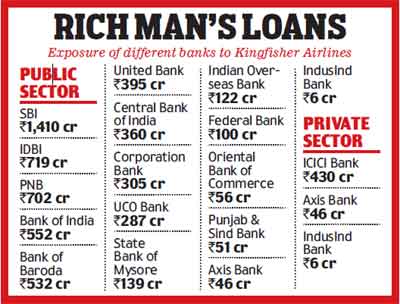
How did he pull it off? Read on

For this you, have to go back to 2010. As usual Mr Mallya was neck deep in trouble, with the banks circling around like vultures asking for the money that Kingfisher borrowed but could not or did not repay.  So our man, decided to sit with the bankers, to ‘restructure’/reduce/waive off his debt. And the bankers obliged.

Kingfisher’s debt was reduced to Rs 6000 Crores,(type ‘debt recast’ in the find box) from the previous debt of Rs 8414 crores, when some of the debt was converted to equity. Banks took up a 23 percent stake in the Airline, with each Kingfisher Airline share being valued by the banks at Rs 64.48. The banks determined that 23 percent of the airline, at the above share price, was about Rs 1400 crores. This price was knocked off from the original debt. After that, both the bankers and Mallya went home happy and probably had a big party.

However, there was one small problem. Share price of Kingfisher Airlines, that day was, Rs 39.90.

This meant that, Mr Mallya was given an incredible premium of 61 percent premium per share in his failing company. I am not particularly strong in Maths, but then a quick back of the envelope calculation shows that,

According to banks, Rs 1400 crores of Kingfisher Airlines, represents 23.32 percent of the company when valued at Rs 64.48 per share. In reality however, a simple multiplication shows that, 23 percent of the company at that value is closer to around Rs 1000 crores, with the 400 crores being touted as the haircut taken by the banks. So the banks, which are under the control of the government of India, literally wrote off Rs 400 Crores, even after their generous calculation.

But, when you account for the real stock price at that time, which was Rs 39.90, 23 percent of the company was not Rs 1400 crores or Rs 1000 crores as determined by the banks.

It was, actually, somewhere close to Rs 461 Crores. The day the deal was signed, banks had decided to literally hand over Rs 1000 crores of depositor’s money to Vijay Mallya and his floundering airline. While Vijay Mallya claimed he had reduced his debt, which in essence was true, he had actually deprived the depositors and the banks of more than Rs 1000 crores.

The banks, to their defence, will say that as it is the price of a share and considering India’s potential in aviation, Rs 39 is a minor blip and the price will rise to its true value, which they determined as Rs 64, sooner rather than later.

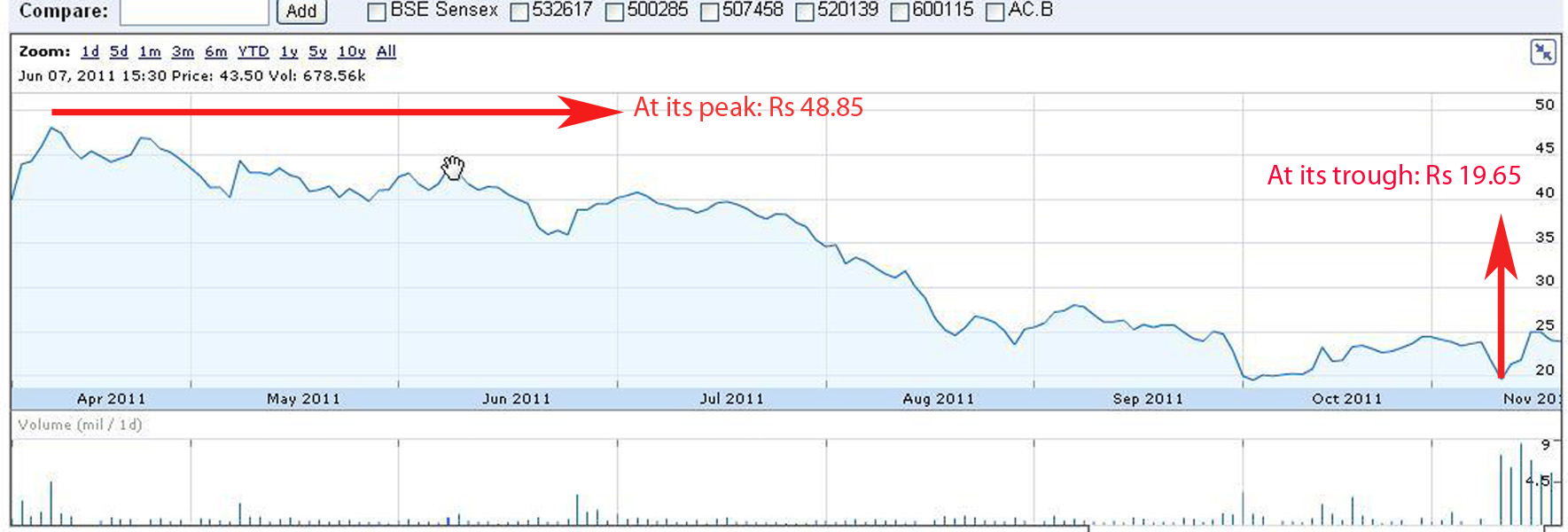
It has been eight months since the deal was announced, and the highest stock price of Kingfisher in that period…Rs 48.85. Not once did it cross, the bank determined value. Not once.

As of today Kingfisher stock price has nosedived to Rs 23, rendering the value of the Kingfisher stocks that the banks have, to Rs 276 crores or so.

Vijay Mallya has swallowed, as of 21-Nov-2011, at least Rs 1200 crores of depositor’s money from various banks.  


Add to the above straight up loss of Rs 1200 crores, the banks also reduced the interest rate of his left-over debt of about 7200 crores so that he could repay, as and when his lordship is willing. The exact figures of the reduction, I could not find, but when 1 percent of the amount represents 72 crores, it has to be pretty substantial.

And all this is depositor money, which translates to your money, my money and the money of pretty much anyone you will meet on the street.

And Vijay Mallya says, he has not taken and will never take tax-payers money.

However the fundamental question is, didn’t the banks realize that this is an almost insolvent if not a totally insolvent company they are dealing with? The facts were on the table, here was a company that has not made a profit since the day it was established. It has substantial unpaid bills in almost every sphere of its operations. Its debt was rising every day. And the global outlook on the aviation sector in general has been negative for the last few years.

So how could the bankers not only give Kingfisher Airlines a breather in its debts, but give it at an unheard of 60 percent premium guarenteed to cause them huge losses in both short and long term? Didn’t they realize it was not their ‘baap ka maal’ they were playing with?

At this point I can only speculate, but I am sure the decision was not Bank’s alone. I guess some higher power had to do with their largesse. Something akin to the

I give an order that you cannot refuse

I can only point you in the general direction of the man. He is a politician and before joining Indian politics, made his living by manufacturing Beedis. He is in fact India’s largest beedi maker, by a distance.

Just to give you a heads up on the man, let me quote one instance

Beedi’s are the considered the AK-47’s of the tobacco world.  Though everyone assumes nuclear missiles are the weapons of mass destruction, it is the humble AK -47 assault rifle that is the real WMD. It is inconspicuous, easily available, very cheap and has killed more people in more countries than nuclear weapons ever can.

Similarly, a beedi is ten times cheaper, and going by the World Health Organization and Voluntary Health Association of India, it is smoked by eight times as many people who smoke cigarettes. Also according to them, the deaths caused due to beedis are more than the deaths caused due to the other tobacco products combined.

But when in 2010, Health Ministry decided to put pictorial warnings on tobacco products to warn people of their dangers, Beedi’s were miraculously exempted from necessary rule.

You don’t need to guess why that happened.

But what has this got to do with Vijay Mallya? Well turns out a lot

When Vijay Mallya’s Kingfisher Airlines flew its first flight on 9th May 2005,  Kingfisher was ranked at number six in the pantheon of Indian Aviation, while Indian Airlines was in the second position, with Jet Airways at number one. Instead of concentrating on making his airline better, Mallya decided to push others out of the way in his quest for glory.

And he had a lot of help in doing that.

First obstacle, Capt C.R Gopinath, pioneer of low cost aviation and e-commerce in India and the guy responsible for the maximum number of first time fliers in India. Formidable force. Ensure that

1. He does not get landing space and hangar facilities in major airports.

2. Further permits to fly on profitable routes are denied.

All on orders from his guardian angel.

For added effect, Mallya unleashed a media barrage, targeting his airline labelling it a “Flying Udupi Restaurant” even when Air Deccan was making more money and carrying more passengers than Kingfisher. Capt Gopinath saw the writing on the wall and sold out to Vijay Mallya.

Obstacle 1, obliterated.

While this was happening, Subroto Roy Sahara, owner of Air Sahara, then the fourth largest operator also wanted to sell out. So, Vijay Mallya got into a bidding war for that heavily loss making and debt ridden airline, and using the Parthiban-Vadivelu auction strategy inflated the price for his competitor, the no 1 airline at that time. They fell for it and bought the airline at a price unanimously considered as too much.

Obstacle 2 dispatched, or that is what he thought.

And what happened to Vijay Mallya and Subroto Roy Sahara

Six Years later

However the most difficult competitor still remained Indian Airlines and Air India.

In 2007, Indian Airlines had a pittance of a loss of Rs 280 Crores. I say pittance because at the same time Mallya was seeing losses of Rs 480 Crores or so. And also, Indian Airlines had achieved profitability of over 90 percent of its routes and remaining 10 percent of the routes were on its way to green. So it was well on its way towards overall profitability. And Air India, was a actually a profitable airline.

And then the intervention happened

Completely disregarding the existing systems, policies and patterns of both the airlines, the powers that be, decided to merge IA and AI, ostensibly to increase their efficiency and allow it to enter the global Star Alliance. This according to them was the panacea for the non-existent ills of the national carriers. Why Star alliance only and why couldn’t Indian Airlines and Air India be members of that damned alliance on their own terms were trivialities that were not answered.

So suddenly, one loss making airline on its way to profitability and one just about profitable airline suddenly became one huge loss making airline. And this in spite of vehement opposition from the management of both the constituent airlines.

And to deliver the coup-de-grace to the shaken airline, the powers ordered a MIND BOGGLING 111 AIRCRAFT IN ONE GO. Yes a total of 111, that too at a mind boggling cost of Rs 32,000 crores. For apparently enhancing its operational capability. This when the management of Air India and Indian Airlines, the ultimate end users of the aircraft, had requested a sum total of 67 aircraft.

The inevitable had to happen. When your annual turnover is about Rs 7000 crore, how do you pay for aircraft worth Rs 32,000 Crores? You take a big loan, for which there is a big interest, Rs 6000 crore a year big.

What started as a loss of Rs 180 crore with a negligible debt, the new company suddenly had debts worth Rs 40,000 crores for which interest was mounting every day.

Main competitor taken care of.

It did not stop with that. Indian Airlines had specifically requested for Airbus A 340 planes, which were wide bodied and had a reliable delivery schedule. This was specifically mentioned in their requestion for new aircraft.

‘Indian Airlines, need 43 A 340-300 aircraft for their operations’ was the statement by their management. Unfortunately the statement was so unclear and complicated, that the powers to be just “read between the lines” and without any prior intimation or consultation, straight up changed the Request for Proposal (RFP).

So, the original requirement mandated that the new aircraft should seat six abreast which rendered both Boeing and Airbus eligible. This inexplicably was tweaked, with the new guidelines mandating the aircraft to seat nine abreast. As a result, Airbus was ruled out and Boeing suddenly was the only one in the race.

Also perhaps, in the RFP was a clause, that the aircraft should take as much time as possible for delivery. For the date on which I am writing, not one of the new aircraft from Boeing has been delivered, three years since the planes were ordered. All this while the debt incurred to buy them keeps accumulating day after day for Air India.

Air India was not being killed. It was being simultaneously poisoned, strangulated and stabbed. What more could one do to kill, what was once considered the national pride? Turns out, a lot more.

The powers now started meddling with Air India’s routes, to explicitly benefit Mallya and Kingfisher.

What the hastily arranged merger of the airlines, achieved was it had a direct effect on the agreements that the Indian Government has with foreign countries. For example, the agreement with Singapore allows a maximum of two Indian Carriers to fly at most 32 flights. The roles were being fulfilled by Air India and Indian Airlines, each flying 16 routes at about 90 percent capacity.

With both of them now being merged as one, it suddenly became one airline, opening the space for another airline to start flying to Singapore. And to enable that airline, the powers cut down 16 routes of the 32 flown by national carriers, so that the new airline join this highly profitable routes party immediately. You don’t need to be Einstein to figure out who filled in. In all, 16 profitable routes were lost to Kingfisher.

And while Air India continued to fly to Singapore, some domestic routes of Air India were cancelled outright, without as much as an explanation apart from ‘we need to cut loss making routes’ rigmarole.. And mind you, many of these routes had over 90 percent occupancies.

And exactly one week after these ‘loss making’ routes were cancelled, Kingfisher started operations on the same freaking routes.

Like the Mumbai-Vadodara: 90 percent load factor. Cancelled by Air India, patronized by Kingfisher

Kolkata- Bangkok- 90 percent load factor. Cancelled by Air India, Patronized again by Kingfisher

And also why does Air India, most of the times, have the most expensive tickets for peak flight timings,

Like hereherehere and here as well.

So to summarize

Excess Aircraft: Loss of Public money

Unnecessary Debt and resultant interest: Loss of Public money

Loss of Revenue because of arbitrary route cancellations and excessive pricing: Loss of Public money

All this was done to favour Mallya.

And Mallya claims he has not touched a paisa from the public.

In fact at the Air India inquisition, this was what a ruling cabinet minister had to say and I quote. “Reasons for going ahead with huge purchases by the civil aviation ministry despite Air India and Indian Airlines not having the capacity to support it, remain unknown to the Committee. It, therefore, recommends that this aspect needs to be further probed to fix the responsibility for taking such an ambitious decision that has become a big financial liability.”

When the Congress government starts pointing at you for corruption, you must have done something wrong.

It was Vijay Mallya’s strategy to drive everybody else to the ground, so that he could have a monopoly over air transport in India. And he had a faithful and willing ally at the peak of the aviation power pyramid, who did his bidding. It was as if, there was a grand plan to drive Air India to the ground, put it up for distress sale so that the leading bid could come from. You guessed it, Vijay Mallya.

What they did not account for was Mallya going belly up before that happens.

The systematic destruction of Air India and the Kingfisher bailout, should not be viewed in isolation. Both are closely related to each other. Mallya entered aviation, knowing fully well he had his friends in the seat of power. While they meddled with the Air India so that Mallya benefits, he grossly mis-managed his airline knowing fully well, come what may, he will somehow be saved in the end. With the Government ‘considering’ the bail out/loan/capital infusion application of Kingfisher, he might well be vindicated in his belief.

Scam Flowchart : For Future Reference


Truth be told, Mallya does not need a bail out. It will be a travesty if he is ever given one. Forget a bail out, all his debts should now be recovered on a priority basis, lest he pulls a Houdini and runs off somewhere. If he cannot pay, which I am sure he cannot,  the government has to

1. Sell every asset of Kingfisher, or whatever is left (Whatever it has in terms of landing rights, Parking spaces etc etc)

if that does not suffice

2. They should confiscate his expensive collection of vintage cars

and if that does not suffice

3. Sell off his prime properties that he owns in UB City in Bangalore.

If that happens, no other tycoon will then take the Indian public or the government for granted and dare to mismanage their business with the belief that the government, with some inside help, will bail them out.

As of today, the total debt of Kingfisher, including pending fuel bills, landing charges, lease rentals totals to around Rs 10,000 crore and its total Market Capitalization is around Rs 1,220 crores.

Kingfisher’s debt, today is approximately 1000 percent of Kingfisher’s market capitalization. Which means, Even If I sell, all of Kingfisher’s shares,  I will still have to about Rs 9000 crores of its debt left to be reclaimed.

9000 Crores

Do the banks still think Kingfisher will get their money back?

I will go on a cruise liner, sharing the president’s suite with Scarlett Johansson and Jessica Alba before that happens.

1. The weakening of Air India, also benefited other private airlines and some foreign carriers. No word is said about them because they did not go to the government with a begging bowl. 

2. The financial calculations are approximate. 

For some fascinating insights on the Air India scam, i redirect you to this amazingly informative piece.

And here are the entire transcripts of the Radia Tapes on the systematic destruction of Air India.


Meet the journalism student who almost lost his career for shouting anti-Barkha Dutt slogans

Recently Barkha Dutt went on an overdrive to interview JNU Student Union’s President Kanhaiya Kumar, who was arrested and later released on conditional bail on charges of sedition after anti-India slogans were shouted on the campus. After coming out on bail, Kanhaiya gave an anti-government and anti-Modi speech, after which he has become the darling of some political parties and some sections of the media, especially of Barkha Dutt, who’s tweeting about him almost as much as she tweeted about her book a while back – basically making a strong sales pitch.

There is nothing wrong in interviewing someone, especially a student, who protested against the Prime Minister, but perhaps Barkha Dutt forgot how she reacted when a student protested against her.

It was back in 2011, when Anna Hazare led anti-corruption movement was at its peak and Radia tapes were leaked. Barkha Dutt was one of the journalists whose conversations with lobbyist Niira Radia were leaked and it was alleged as a proof of moral corruption and ethical wrongdoing, even if no proof of quid-pro-quo appeared to be there.

Many felt that journalists like Barkha Dutt had no moral rights to lecture about corruption when their own record was blemished. One of those who felt this was a journalism student at IIMC (Indian Institute of Mass Communication), which incidentally is situated in the JNU campus.

On the evening of 9th April 2011, this student, Yogesh Kumar Sheetal, was present at an anti-corruption gathering at India Gate in New Delhi. He saw Barkha Dutt present there, and he couldn’t control his anguish. He shouted a few slogans against Barkha and soon many joined him. Barkha had to leave the spot.

But it appears that she decided not to leave Yogesh so easily. A complaint against Yogesh was made to the Course Director at IIMC, and he was served a show cause notice. And that was just the beginning.

OpIndia.com decided to talk to Yogesh about what he had to experience after his expression of dissent. Following are the highlights of the interview.

Q: Did it all start with a complaint to your course director at IIMC, or were you warned of the consequences even before that? You have previously said you were intimidated…

Ans: No. Things came into action immediately after Barkha Dutt left the venue. People were getting extremely aggressive following physical assault by NDTV crews on protesters including women. I was not warned, I was directly targeted, but it misfired because of bad preparation by NDTV as they didn’t have the time to hatch a foolproof conspiracy. In less than half an hour, NDTV could only plan to file an assault case against me. NDTV’s Ruby Dhingra was planted as a victim and other crew members were presented as eye witnesses. It all started when a girl appeared out of the blue and started leveling number of serious allegations against me. I was stunned. Many people who gathered against Barkha Dutt had gone back to their work, but some of them were still walking around by that time.

Yogesh Kumar Sheetal
Yogesh Kumar Sheetal (pic courtesy his Twitter profile)

NDTV did first mistake when Ruby appeared before me along with her crew, expecting me to be alone and easy to be targeted. I was caught by NDTV’s crew and dragged to police. She told police that I assaulted her and put other allegations too. Her allegations were promptly reinforced by her crew members. Neither Ruby nor any of her crew members informed the police that they’re from NDTV. They were trying to portray that they had come for Anna’s movement.

During the same time, a lady and some protesters reached out to me to understand the situation. I didn’t notice that some protesters were still there. They knew what had happened and so they started shouting slogans again, and one of them exposed Ruby Dhingra. They explained to the police that I was innocent and the complainant has manufactured a story to malign me. After a short interrogation I was asked to go.

This was the starting point. The very next day I received a call from an unknown number. I was threatened that I would have to eat 22 Salfas tablets if I do not shut my mouth against Barkha Dutt. Perhaps the same day I was handed over a notice from IIMC, where I was a student of Hindi Journalism.

Q: When you were given a show cause notice by your institute, were you scared about your career prospects?

Ans: I was disturbed because of back to back threatening calls, but I was not scared. I had nothing to lose, so I had no reason to be scared. But, let me confess that I turned pessimistic about my career. This should not be read as “scared”.

Q: How did you survive and manage to get a diploma from IIMC? Did that incident haunt you and you feared that you could be failed?

Ans: There’s a saying in English, “Fear of danger is worse than the danger itself”. I was psychologically under pressure. That episode didn’t haunt me in IIMC since IIMC is not a Private Company like NDTV. Had I failed, I would have filed an RTI. I was prepared for that.

Q: How tough was it to get a job after getting the diploma? Were you told in clear terms that your slogan shouting against Barkha Dutt was something that was working against you?

Ans: One can understand it very easily. I don’t wish to recall those unpleasant days anymore but I do wish to recall one thing again and again. Due to this entire incident, I could meet A S Raghunath Sir, Anil Kohli Sir and many people. Twitter made everything possible for me. Raghunath Sir arranged my internship in a Hindi Tabloid Newspaper and till now I’m blessed with the guidance of Raghunath Sir and Anil Kohli Sir.

Q: What is your family background? Could you have afforded not getting a job due to such vindictive attitude of a celebrity journalist?

Ans: I belong to an average middle class family based in Begusarai, Bihar. It’s tough for me to imagine what I would have done had I not been helped by A S Raghunath Sir. I think I could have moved back to Bihar and started preparations for a competitive examination after ditching my dream to be a journalist. I always remember a couplet of famous Hindi poet Pash “Sabse khatarnak hota hai sapno ka mar jana“. I’m fortunate that my dream still survives and I want to be known as a journalist till my life.

Q: Did you ever try to get in touch with Barkha Dutt or someone in the NDTV to apologize or to “settle” the matter so that your career progresses smoothly?

Ans: I dismissed this idea with the contempt it deserved. I was residing in New Ashok Nagar, Delhi and getting Rs 6788/- as salary. It was a very difficult situation for me. For 2 years, I have had the worst phase of my life. There were days when I didn’t even have money to recharge my cellphone or to fulfil my daily basic needs like newspaper and magazines. There were days when I could only manage to make missed calls to people and get frustrated when people didn’t give a call back. However, every time I thought of settling things, I felt like I was betraying my well wishers.

Credibility is everything. If you don’t have integrity, credibility, character, discipline, manner, self confidence or determination or commitment, you can never get a sound life. Today, I don’t have money, I don’t have bank balance, I’m earning only Rs 31,000 in Mumbai and facing serious difficulties in my livelihood, but I’m happy because I’m not compromised. I have a lot to learn and I’m learning in Mumbai. I have my parents and they are my assets. I’m confident to speak to Raghunath Sir and Kohli Sir, that’s enough for me! I don’t need to shy away or run away from anything or anywhere. I’m happy.

Q: When and where did you finally get a job?

Ans: DLA, a tabloid newspaper, which is based in Agra, was the first newspaper where I got a chance to work as a sub editor in its Noida Edition in June, 2011. I always remember my DLA days where I learnt so many things from Shri Virendra Sengar and my colleagues.

Q: In retrospect, do you think you should not have taken the initiative and shouted slogans against Barkha? It doesn’t seem to have helped you a bit?

Ans: There’s a quote in English, “I don’t regret what I did but I regret what I didn’t do when I had time”. Same thing with me. I don’t think I should not have taken the initiative, in fact I think I should have taken this initiative more effectively. I have no regrets.

Q: Recently entire media lauded a Zee News reporter when he quit the organization accusing it of bias. Do you think the media will ever laud, or even report fairly, if someone quits an organization like NDTV accusing someone like Barkha?

Ans: I don’t know how to respond this question because I’ve least interest in News Channels’ internal politics.

Q: Has anyone, say your batchmates from IIMC who might be employed at NDTV or any other organization, confided in you about such inherent bias that they can’t talk about or revolt against? You are free not to reveal someone’s name and organization for obvious reasons.

Ans: To be very honest, I came to IIMC for getting a certificate not for learning journalism. IIMC is a good place for learning politics, not journalism. All students, who cracked entrance and interview, are already journalists. I’m still surviving in news industry because I know politics and I would like to extend my deep thanks and gratitude to my IIMC teachers for teaching me politics directly or indirectly. IIMC and NDTV seem to be locked in a relationship and both oblige each other in different ways.

Q: When you see Barkha Dutt supporting free speech and eulogizing someone like Kanhaiya for daring to take on the government, how do you feel?

Ans: Now, I have no time to feel anything. I have a lot many better thing to think and do in life. I search good stories and work on that and try to bring something worth watching for my audience. Barkha Dutt supporting free speech is like a CEO of a tobacco company campaigning for Cancer awareness.

Top Lies spread by Indian Media in February 2016

0

Big Lies:

1. Zee News: “Pakistan Zindabad” slogans were raised in JNU

We had done a post and a video on this. What was actually a group of students, presumably from ABVP, shouting “Bhartiya Court Zindabad”, was shown by Zee News as if they were saying “Pakistan Zindabad”. The police report abut JNU did not mention “Pakistan Zindabad” as a slogan but had many other slogans such as “Bharat ki barbaadi”, “Bharat tere Tukde honge” etc. The Delhi District Magistrate, in his report, also stated that the slogan can neither be “clearly heard” in the video, “nor in the transcripts of the JNU videos shot by the security staff”. This he says, showed that even the cops had doubts about this slogan. Even the ABVP students we spoke to confirmed that the slogans were “Bharatiya Court Zindabad” i.e. long live Indian Courts as a counter to the claims of “judicial killing” of Afzal Guru.

2. News X and India News: Portraying a doctored video of Kanhaiya as seditious.

By now it is pretty well known that these 2 channels played the doctored tape from 11th February. What Kanhaiya actually said was “Azadi” from social evils such as casteism etc. But the above 2 media houses showed this video by cutting the social evils part and showing Kanhaiya shouting only Azadi. Times Now too, in a way, did telecast the video, when Arnab egged Sambit Patra to show the video from his tablet, during a newshour debate.

3. Multiple media houses: BJP-AIMIM alliance will wipe out Congress says Owaisi

We had written a separate post on this here. Zee News,  CNN IBN, Aaj Tak and DNA reported the above news, based on a speech given by Owaisi in Hyderabad. As we had explained in our post, all these media houses heard only a part of his speech. Secondly, they completely misquoted Owaisi. In the video, Owaisi can be seen attacking Modi, BJP and Congress throughout. The key sentence which has been grossly misquoted by the media is when he says “Along with BJP, I will carry the corpse of Congress too”. This has been reported by media as “With BJP, I will carry the corpse of Congress”. To anyone seeing the full video it is clear that a man constantly attacking BJP and Modi and Congress cannot say in the same breath that he will combine with BJP to finish the Congress

4. NDTV / Firstpost: Martyr Captain Pawan Kumar was from and had studied at JNU

In an attempt to paint JNU as a place which also hosts students who go on to become patriotic army men, NDTV and Firstpost decided to use a martyred Jawan and claimed he was from JNU and had studied at JNU. He did have a JNU degree, but it was awarded to him because all military officers who graduate from the National Defence Academy (NDA) have under a special arrangement with JNU for this honorary degree. While NDTV changed the story, Firstpost continues to claim he had studied at JNU.

5. Multiple media sources: Delhi Police grab a woman by hair, punch and drag her

Multiple news outlets like ABP News, Huffington Post and Indian Express claimed in their reports that Delhi police acted violently with a woman in the protests against death of Rohith Vemula infront of RSS office. This news was based on a video released by AAP which showed a long haired individual get beaten up by cops. On closer observation though it was clear the long haired person was a man and not a woman. This does not justify any police brutality. We had written a separate post on this.

6. The Telegraph- “Fact Check” on Smriti Irani’s speech in Parliament

We had written a separate post on this. In their attempt to attack HRD Minister Smriti Irani, The Telegraph used all sorts of tricks. One such trick was when they claimed that the JNU administration is “facing charges/criticism”, hence the Minister’s claim that the JNU administration was independent and free from Government control was wrong. They even went as far to say that the security guards of a private company, recruited by the JNU administration cannot be called as free from Government control! There were a few more such arguments which we debunked in our above piece.

7. Times of India – Why not cut off traitors’ tongues? asks BJP general secretary Kailash Vijayvargiya

Times of India in the above report claimed that BJP general secretary Kailash Vijayvargiya wondered why the tongues of those who hail Pakistan and terrorists should not be “chopped off”. The headline and the opening paragraph made it clear that Times of India considered that this statement was of Kailash Vijayvargiya. But, the following paragraphs showed something different. Times of India in these paragraphs said: “Referring to his conversation with the former soldier who suggested chopping off of the tongues of those hailing Pakistan, Vijayvargiya said ‘It seemed to me he was voicing the thought of all patriotic Indians'”.  So now, Times of India is saying the “chopping off tongue” suggestion was made by a soldier. So what is the truth? The story was based on Vijayvargiya’s tweets, and if we see the tweets, the story is clear. Vijayvargiya was in fact narrating an incident, spread out in 6 tweets

1

Times of India had indeed mentioned the correct version in the latter portion of the article. Why then the utterly misleading headline and opening paragraph?

8. CNBC TV 18 – UAE offers two thirds of its oil to India for free

As can be seen from this tweet, CNBC TV 18 claimed that UAE had offered two-thirds of its Oil to India for free. Of course, this sounded to good 1to be true but a fair number of people fell for it. The truth however was much more realistic. UAE wanted to use some of India’s Strategic Petroleum Reserves to store its oil. Instead of paying rent to India to use these storage facilities, it offered India the right to use two-thirds of the oil stored in these reserves  in emergencies. Eventually CNBC deleted the tweet.

9. All media – Aamir Khan to be made ambassador of Maharashtra Scheme. 

Almost all news outlets reported that Aamir Khan was chosen as the ambassador for a Maharashtra scheme called ‘drought-free Maharahtra’. This was met with resentment due to his sensationalist statements on Intolerance. Eventually Maharashtra CM Fadnavis cleared the air and denied any such plans. As it turned out later, Aamir Khan’s non-profit organization, Paani Foundation had started a scheme in association with the Maharashtra Government, aimed at solving the state’s water crisis. Aamir was to also join hands with other actors such as Nana Patekar, to take forward his initiative. From no angle, had the Maharashtra Government appointed him a  brand ambassador.

10. ABP News: Kumar Vishwas may soon join BJP

Based on the fact that some BJP leaders were seen wishing Kumar Vishwas on his birthday, ABP News ran a story which claimed Vishwas had now become close to BJP and would be soon joining the party. Vishwas immediately took to twitter to trash the story saying people across party lines wished him. ABP News then deleted the story.

11. Aaj Tak – Nitish does U-Turn from his statement, says he never called Ishrat “Bihar ki Beti”

The misleading portion in this news is Aaj Tak claiming that Nitish Kumar had done a “U-Turn” from his “Bihar ki beti statement”. This implies Nitish had indeed said such a statement. The fact though is, he never said such a statement and it was in fact made by another JDU leader, Ali Anwar. Arguments can be made whether or not Nitish supported such statement by never condemning them, but fact remains, he personally never said it, and hence it doesn’t constitute a U Turn.

12. All media: BJP leader Gopal Shetty trivialises farmer’s suicide, claims suicide ‘a fashion now’

We had explained this lie via a video:

Media fabricates lies to attack BJP MPBJP MP never said that it is fashionable for farmers to commit suicide. Most of the media houses published reports on it.

Posted by OpIndia.com on Thursday, February 18, 2016


Miscellaneous lies:

1. ET Now: TRAI fails Netizens, Blow to Net Neutrality

Last month, TRAI had given a fairly pro-net neutrality decision on differential pricing of data services by telecom companies. This was hailed by most net neutrality activists. ET Now however completely misread the situation and instead gave the below captions, which showed a completely opposite and inaccurate picture:

1

2 The Hindu: Ishrat Jahan was an LeT suicide bomber says David Headley (later The Hindu denies this)

Initially The Hindu reported that David Headley, in his video deposition, claimed that Ishrat Jahan was an LeT suicide bomber. Soon, The Hindu issued a correction saying “Headley had not called Ishrat Jahan a suicide bomber for LeT during the deposition”. So what was the truth? The truth was in between both the versions. Headley had said that Ishrat worked for LeT i.e. she was an operative. There is a bit of difference in being a suicide bomber and an operative and in both the original story and the correction, The Hindu failed to bring this out.

3. Navbharat Times: BJP IT cell founder Prodyut Bora quits party attacks PM Modi and Amit Shah’s style

Yes Prodyut Bora had indeed left the BJP’s IT cell. Then what is the lie here? He had quit on February 19 2015. But extremely weirdly, Navbharat Times reported this as a fresh story exactly one year after it happened, on 19 February 2016. The story had no mention that the actual event took place a year ago. Obviously people felt this was a new happening.

4. ANI News: SFI activists protest in support of #JNU in Kolkata

Initially ANI news reported the above that SFI activists were agitating in Kolkata in support of JNU students. Later, they issued a correction saying the SFI activists were protesting in Kolkata against students lathi charged in Burdwan University. Even though the correction was tweeted, the original erroneous tweet exists till date and has much more Retweets than the correction.

5. India Today: Spiritualism and Materialism cannot co-exist says Sri Sri Ravi Shankar

India Today tweeted the below that Sri Sri Ravi shankar had said spiritualism  and materialism cannot co-exist. But if one actually sees his interview with Rajdeep Sardesai, at around the 27 mins mark, he clearly contradicts this statement and says the 2 are not all on a collision course and both can co-exist.

6. The Hindu – Slogans heard in JNU were ““Kashmir ki azadi tak bharat ki azadi tak, jang rahegi jari”

Small error or deliberate? This The Hindu report stated that the slogans raised at JNU, as per the video evidence, included “Bharat ki Azadi tak, jung rahegi”. Of course everyone know tht it actually was “Bharat ki Barbaadi tak”, but for some reason The Hindu posted the opposite. This was pointed out to The Hindu my many people but till the time of writing this, no change was made.

7. Firstpost/India TodayNSUI members protesting in Bhopal over JNU row

While Firstpost, India Today and a few more media houses reported that NSUI students were protesting in Bhopal over the JNU row, Local Media in Madhya Pradesh and even ANI news, reported that the NSUI protests were in fact for student union elections. This was declared even by NSUI Bhopal on their Facebook page.

8. The Hindu: Inaccurate and illogical graph

They say pictures speak louder than words, and indeed this graph by The Hindu speaks for it self. This “bar graph” is wrong in so many aspects its hard to figure out where one should begin. Firstly see 12-13 q which has 5.6. The bar is shown to be very small, and then see 14-15 which has “5.7.2” (how can a number have 2 decimal points), and the bar size is almost 10 times more than the 12-13 bar inspite of being just marginally more.  Next, 13-14 is 6.6,, which is more than 14-15’s “5.7.2”, yet 14-15 bar is bigger than 13-14!

9. The Indian Express: Anurag Thakur says slogans raised in JNU were “Bharat ki Azadi tak jung rahegi”

Like The Hindu, did The Indian Express also make the same “mistake”? While the slogans were unmistakably about “Bharat ki barbaadi”, The Indian Express to reported them as “Bharat ki Azadi” and even worse, attributed this statement to BJP MP Anurag Thakur. Just like Th Hindu, no correction was made by The Indian Express even after people pointed out the obvious error.

10. IBN Khabar: Hafiz Saeed comes out in support of JNU students 

As in many cases in the past, this time too Indian media did not disappoint. They took a tweet from a fake twitter handle (which was soon deleted) and claimed that it was the handle of Hafiz Saeed and he had just extended his support to JNU students.


January 2016: 20 lies