Home Blog Page 7584

Aeroplane hovers due to traffic congestion, TMC claims conspiracy to kill Mamata Banerjee

0

A new controversy has erupted regarding how West Bengal Chief Minister Mamata Bannerjee’s plane was low on fuel and was not allowed to land for 30 min. This issue could date back to her making a statement in New Delhi on 28th November that whether she dies or lives, she would remove PM Modi from Indian politics.

Just four days after this, her party the TMC cried that the conspiracy to eliminate the CM was already underway after it alleged that her flight from Patna back to Kolkata was made to circle around 30 minutes over Kolkata airspace even though it was precariously low on fuel. State Urban Development Minister Firhad Hakim who was the co-passenger in that flight was quoted by TOI as,

“This is nothing but a conspiracy to kill our chief minister as she has raised voice against demonetization and is touring the country to organize a mass movement against the anti-people decision.”

He further alleged that even though the pilot kept asking for permission to land he was repeatedly put on hold by the ATC officials.

Indigo today came out with a statement that Mamata Banerjee’s flight had more than the minimum fuel requirement and that it did a perfectly normal landing. Also the low fuel report emerged after the Kolkata ATC misunderstood the pilot. Indigo’s whole statement read as,

‘IndiGo flight 6E 342 from Patna and Kolkata made a normal landing at the Kolkata airport on Wednesday (November 30). The flight was kept on hold for landing due air traffic congestion at Kolkata. The pilot operating 6E-342 had advised the ATC that he has 8 minutes of extra holding fuel over Kolkata (destination) before commencing diversion to the planned alternate. However, this information was misunderstood by the air traffic controller who assumed that the aircraft had only 8 minutes of total fuel left. The misinterpretation of the information by ATC controller led ATC to instruct fire engines and ambulances to be stationed at Kolkata airport. We would like to clarify – IndiGo captain at no stage declared a fuel priority or an emergency. Subsequently, the airplane made a normal landing at Kolkata airport 8.40 pm (Delayed by an hour due to congestion). The fuel on arrival was more than the minimum diversion fuel. There has been no violation or breech of any regulatory requirement in the above mentioned scenario.’

However the controversy looked far from being over after the TMC refusing to back down caused an uproar in the Rajya Sabha.


As a response to all this, Aviation Minister Jayant Sinha today told the parliament that a probe by the DGCA was underway to as to how not one but three flights, Mamata’s, Spice Jet’s and Air India’s were reported to have been running on low fuel, while stressing that at no point the lives of passengers in those planes in any danger.

Also as put out in this article, the main reason the flight was made to circle in the first place was because of congestion issues and TMC in what may be a blatant case of VVIPism demanded that because the Bengal CM was on the Indigo flight, it should have received a priority landing.

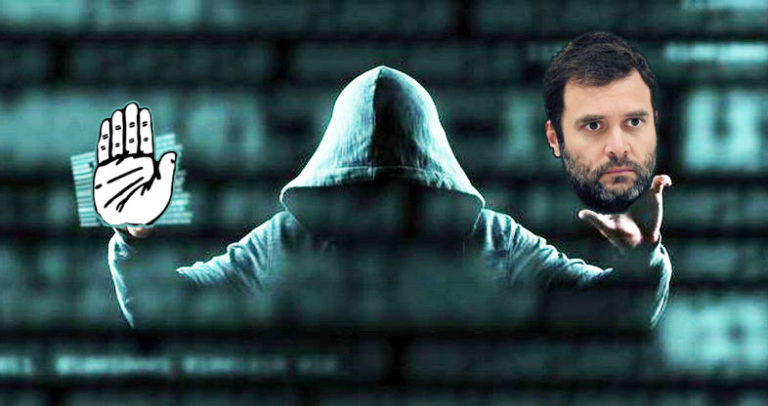
Who hacked Twitter accounts of Congress and Rahul Gandhi? Options are…

Lasts night Rahul Gandhi’s Twitter account was allegedly hacked and some obscene comments were posted from the account. Congress leaders and their friendly journalists immediately linked it to the cashless economy and Digital India. The issue was even raised in the Parliament today.

Even as the Congress support system was coming up with rather ludicrous arguments over why this incident was an indictment of digital transactions, the official Twitter account of the Party also appeared hacked as it started sending out weird tweets for around half an hour this morning.

These two hacking incidents one after the other left people guessing about the identity of the hacker(s). As of now, there are three options widely being considered:

1. Disgruntled Member: Since both Rahul Gandhi’s and the Party’s official accounts were compromised, people are guessing that it could be someone from the team that had access to both the accounts i.e. some employee in the IT cell or social media team of Congress, entrusted with managing both the Twitter accounts.

The fact that all is not well with the social media strategy of Congress came to light in May this year when one of the most influential Congress supporting Twitter handles revealed that he/she was ill-treated by the party and kicked out despite being loyal:

Congress volunteer abused by the party
Congress – a divided house?

The fact that party doesn’t secure its digital assets well was also evident last year when its Delhi unit’s official website went offline because the member having access to it was reportedly denied ticket by the party:


So if this was another case of some party member or volunteer going rogue, the party needs to set its house in order. It would be very juvenile to raise the issue in parliament or to question cashless transactions – both of which they did – just because they are not smart enough to secure their digital assets.

2. External Hacker: If it was not done by someone who is part of the Congress party, maybe it was done by a professional hacker or a group of hackers such as Anonymous?

Although hacks by Anonymous usually don’t follow the path of sending out abusive and obscene tweets, some tweets during the period when Congress party’s account was compromised, hinted at the involvement of a group that was similar to Anonymous. For example this tweet:


Other reason to suspect a professional hacker or a group’s involvement was a tweet sent out from the compromised Congress handle, where the hacker threatened to dump all official emails of the party in public. This is similar to what hackers like Anonymous do:

Congress email dump
Bigger controversy to come?

If India Today journalist Rahul Kanwal is to be believed, Twitter has virtually denied that their systems were compromised and they appear to be blaming the Congress email system for the security breach i.e. the hacker had access to official emails of Congress, which is why he was able to reset the passwords and log into these official accounts:


If this is indeed true, we are to set witness a desi controversy similar to John Podesta’s email leaks that we saw during the US Presidential elections. The hacker has claimed that it would be released around Christmas. Let’s see if there indeed was an external hacker.

3. Planned Drama by Congress: Then there is the final theory that this was all done by the Congress party to manufacture controversy around the government’s push for the cashless economy and Digital India.

The theory, captured in the image contained in the tweet below, claims that the theory of “disgruntled employee” was spread by friendly journalists of Congress to hide the fact that it was all planned by the party:


The theory has some credence because if it indeed was a malicious hack, as the party claims, they should have approached Twitter and asked them to temporarily take the accounts off or at least take away the “verified” badges (blue ticks) off till the party got control of the accounts back.

But the party appeared more interested in bashing the cashless economy and Digital India than getting control of the accounts back. And interestingly, they got control of their party’s official account back just in time today:


So what is the truth? We will know after the investigations are over, as the party reportedly has filed a police complaint. Meanwhile, you can take your pick among the above options, or add more options in the comments section below.

Rahul Gandhi’s Twitter account hacked, Congress uses it to attack Digital India

On Wednesday night, the official Twitter account of Congress Vice President Rahul Gandhi started sending out weird tweets, many of them abusive and obscene.


It is not for the first time that some high profile Twitter account was hacked, the most notorious being the account of news agency Associated Press being hacked, which falsely tweeted about an attack on the White House. That even caused brief panic in the markets.

Recently in the run up to the US Presidential elections, Twitter account of Hillary Clinton’s campaign chief John Podesta was hacked. There have been many such instances when celebrities or organisations have been targeted by hackers.

Back in India, Rajdeep Sardesai had, in all probability, falsely claimed about his Twitter account being hacked in April this year when he sent out obscene abuses to many users, while recently government’s Chief Economic Adviser’s Twitter account was reportedly hacked, which again we think was more of a case of some malware than hacking.

Basically, hacking of Twitter accounts or emails is not a rare phenomenon. Most of the times it happens due to a user not being alert and aware enough to secure his or her account. Apart from using a strong password, people should use mobile authentication to login and avoid clicking suspicious links. There are many other things you can do such as these to secure yourself online.

One can blame a particular platform if there is mass hacking and credentials of users are leaked in bulk, as has happened on occasions with different websites, but hacking of a single user’s account is more an indictment of that particular user rather than of the platform or the system.

Therefore, if everyone’s Twitter account is safe, but Rahul Gandhi’s account gets hacked, people have to ask the team handling Rahul Gandhi’s online presence rather than attacking Twitter or by extension attacking the digital world.

However, this simple fact was lost, or deliberately missed, by supporters and leaders of the Congress party, who tried to attack everyone and everything for the hacking, except Rahul Gandhi’s office.

These leaders and supporters blamed BJP, Digital India, cashless economy, and even demonetisation because Rahul Gandhi’s Twitter account was not secure enough. Look at some of such tweets:


So where these tweets out of political naivety knavery or digital illiteracy?

Or was it all planned? You decide.


//platform.twitter.com/widgets.js

Compulsory National Anthem verdict by SC: it started with Kabhi Khushi Kabhi Gham!

0

Sometime in early 2002, Mr. Shyam Narayan Chouksey, a retired engineer in Bhopal went to watch the movie Kabhi Khushi Kabhie Gham, which starred big names like Amitabh Bachchan, Shahrukh Khan, and Hrithik Roshan.

There is a scene in the movie where Shahrukh Khan’s son, at his school function in London, sings the National Anthem. As soon as the national anthem was sung by Sharukhs’ son (the character in the movie), Mr. Chouksey stood up in respect.

But he was shocked to see that no one else was joining him. In fact, people around him objected to him standing up as he was blocking their view and interrupting their movie watching experience. Some even mocked him. Chouksey was crestfallen at this “insult” meted out to the national anthem.

Shocked and saddened that fellow Indians were not respecting the anthem, he went to the Manager of the theatre, Jyoti Theatre, and complained to him about the incident, but the manager couldn’t have punished the people. So he staged a ‘satyagrah’ outside the theatre to create awareness among people.

He put banners and posters and registered his protest, but people were still not willing to stand for the national anthem during the movie. So went to the local administration, state police, and finally to the Madhya Pradesh High Court.

And guess what. The High Court banned Kabhi Khushi Kabhie Gham and ordered its producers – Yash Johar and Karan Johar – to delete the national anthem scene as people were unknowingly disrespecting the nation anthem due to not standing up during the movie. Court even asked producers to pay for Chouksey’s legal expenses.

The producers ran to the Supreme Court, which set aside the High Court’s order citing the rule that it was not mandatory for viewers to stand up for the national anthem if it was played as part of a film or documentary being screened.

This judgment didn’t impress Mr. Shyam Narayan Chouksey, who decided that he will keep fighting to make people aware of their duties and make them respect the national anthem. He filed a review petition claiming that the issue of national anthem being commercially exploited by film producers remained open.

Mr. Chouksey has been knocking at the doors of justice ever since. Not just movies, he went on to include in his petition, television shows, events, and other possible cases where there could be disrespect to the national anthem.

Last month, he could get the Supreme Court to issue notice to the union government regarding the same. In his Public Interest Litigation, he had sought the apex court to direct the government to take appropriate steps to stop disrespect and abuse of the national anthem.

And today, he could get the Supreme Court to declare that playing national anthem before every movie was mandatory and people will have to stand up in respect.

Not only that, the court agreed with him and declared that national anthem cannot be introduced or used as part of any entertainment program or variety show. So looks like if Karan Johar decides to remake Kabhi Khushi Kabhie Gham, he will have to do away with that scene that started it all.

Rajasthan govt signs MOU with NGO having hidden agenda of spreading Christianity.

0

As you visit the website of the NGO World Vision India, you are welcomed with full page photographs of underprivileged kids smiling, one wearing a school uniform and other having a plate full of food in his hand. Both these images include a passionate message to sponsor a kid for making his life better. Plus there are options of crowdfunding various survival needs of the poor kids and grown ups alike, programs to rescue a child, fight HIV and AIDS, sending kids to school and more.

While all these paint a very rosy picture of an organisation making it look like the one which genuinely cares about making the lives of those struggling everyday to survive in the harsh realities of the world easier, the Rajasthan government came under attack online after people were irked at the fact that the government choose to sign an MOU with World Vision. The critics of this alleged, under all this compassion and save the children message, Wold Vision has a hidden evangelist agenda mainly funded by various church groups from around the world. Before we go into this aspect of World vision lets look at some of the reactions critical of the government’s move:


The MOU was specifically signed between the Integrated Child Development Services (ICDS) department of the State Government’s Women and Child Development Ministry and World Vision India in order to curb severe acute malnutrition among kids. Before going ahead, lets look at the exact role the NGO is expected to fulfill. The NGO is expected to assign a nutrition expert to every 5-10 Anganwadi centers who will provide support to the existing Anganwadi helpers, furthermore the NGO will provide infrastructure like salter scales, bathroom scales and IEC materials. Looking at the support required to be provided, as putout by Shefali Vaidya, it does’t seem to look like a job which an Indian NGO would not have been able to do.

Finally coming to the NGO itself. This is how the NGO describes itself at various places:

The controversies in world vision global include, sending funds intended for developmental works in Gaza to Hamas, grass root level corruption and more. The extent of influence Christian organisations have on World Vision can be gauged by the fact that back in 2014 they came out with a policy to hire Gay-Christians in same-sex marriages and just two days later retracted ‘under immense financial pressure and criticism from gatekeepers on the evangelical right” as reported here.

Coming to India, World Vision’s Chennai office received the maximum amount of foreign funding among all NGO’s amounting to about 239 crores in 2015. Plus coming to it having an Evangelist agenda, as written here in this Huffpost article, the writer an evangelist student then, who once sponsored a kid in India so that he/she could go to a ‘Christian school’ and talks about the influence religion has in its functioning.

While there haven’t been outright incidents of the organisation engaging in outright proselytizing, they also categorically deny about engaging in the same. But looking at above instances the fact that there would be a Christian influence on the Rajasthan kids which in the long run might resemble mental conversion to a different set of ideas might not be very inaccurate. The matter becomes complicated even further when one finds out that a BJP government which is dubbed as having conservative views when it comes to such issues is openly collaborating with NGO even when its own central government is cracking down on foreign backed NGO’s  having dubious funding.

Railways can help the poor learn cashless transactions if it makes the UTS app better

0

“Government of India encourages people to move towards a Cashless Economy” reads the opening sentence of a flash message that you can encounter these days on almost all of the websites related to the Indian Railways, including the hugely popular IRCTC e-ticketing portal.

IRCTC is special. Not only because it has improved itself so much that all “slower than IRCTC server” jokes have vanished, it is a big success story of technology adoption in India.

Consider this: according to estimates, not more than 10% of all transactions in India are cashless or digital, which proves that there is a long way to go before India becomes a cashless or less-cash economy. However, if you look at train ticket reservations, almost 60% of ticketing happens through IRCTC i.e. cashless transactions!

It will not be unreasonable to assume that Indian Railways – a mammoth on which almost 20 million people daily depend for their travelling needs – would have introduced many citizens to the convenience and effectiveness of cashless transactions through IRCTC. They would have gained confidence in this concept of digital transaction and would have tried the same on other e-commerce websites.

Now when the government is trying for a major push towards cashless economy – latest being the demonetisation move – Indian Railways can play a crucial role again, and this time through another ticketing offering – of unreserved tickets.

A considerable proportion of those travelling in trains using unreserved tickets happen to come from that socioeconomic class which the government is trying to include in banking system and educate about cashless transactions.

In such a scenario, a drive among this class telling them to adopt UTS (Unreserved Ticketing System) mobile apps can go a long way in educating them about cashless transactions and making them comfortable about digital economy.

However, before that step is taken, Indian Railways have to make sure that the UTS app is revamped and upgraded to make it easier and more efficient.

For those who don’t know, this article provides a walk around the Android app of UTS. It also lists some issues I could find that. I hope the Railways takes note of these – and other issues that readers or users point out – and comes up with an improved app that can prove to be crucial in realising the dream of a cashless economy:

The UTS mobile application was introduced in 2015, which enabled users to book ordinary unreserved tickets online and platform tickets. Currently it is available only for Android and Window users. There is also a UTS website but it can’t be used to book tickets.

You can download the app and register using your mobile number, which it verifies, and once the profile is ready, you get this screen:

The interface of UTS App

Now the first problem is that the app is not fore entire India. It is mostly for suburban railways in major Indian cities, and that needs to change.

The poor people whom this government is targeting to be included in the cashless economy, travel long distances in unreserved coaches. It will be a good start for them if they start using this facility to book their tickets, and for that inter-city unreserved travel routes have to be introduced:

Services not available in many cities

The app has the e-wallet concept (R-Wallet as you can see in the home screen), which you have to recharge in order to book tickets. There comes the second problem.

To recharge or topup the e-wallet, you either need to go to counter (which is not cashless) or do it via Paytm’s gateway with an extra Rs 10 charge. Good for this government that Arvind Kejriwal has not yet noticed it, else he would have claimed it as another proof of “deal” between Paytm and Narendra Modi!

Payment options for credit cards or government’s own initiative of UPI needs to be incorporated:

Payment options on UTS app
Not many options available for payments

There is another issue of the app compulsorily requiring a GPS enabled smartphone. GPS is required to ensure one is at least 4 meters away from a railway line so as to prevent people from booking tickets at a platform or in a train to avoid a fine as soon as they see a TTE (Train Ticket Examiner) approaching.

Perhaps the TTE can ascertain the same by looking at the time of booking the ticket? Doing away with the GPS check will save some time as sometimes people are not able to book tickets when GPS signal is weak (even though data connectivity is there). My mother sometimes has to go to the terrace to book the tickets!

Nonetheless, despite current shortcomings, the app works:

Sample ticket
Sample ticket

Overall as it stands, the UTS app isn’t the easiest to use with its high security features, limited payments options, and low available routes. It can also appear daunting to someone less inclined to technology.

But as they saw you need to start from somewhere. Right now it might appear a bit too fantastical that poor people will use smartphones and UPI or bank cards to book unreserved tickets. But who knows, with Jan Dhan accounts getting Rupay cards and smartphone penetrations destined to grow, UTS app could indeed be the major catalyst in changing the consumer behaviour, which is needed to move towards a cashless economy.

Aam Aadmi Party and the demise of hope

0

Aam Aadmi Party was born of hope. The Lokpal movement of 2011, led by Anna Hazare, was a watershed event in India’s recent history. A diminutive mild mannered 70 something former soldier and social worker, Anna caught the nation’s imagination and inspired following like only Mahatma Gandhi had before him.

It was half-way into the second tenure of UPA government, and each new day brought with it news of another scam, each bigger than the last. Amounting to digits so big that an ordinary citizen had trouble figuring out the number of zeroes in it. Things came to such a ridiculous level that one union minister while refuting allegations of corruption against another argued that the amount involved (71 Lakhs) was too small for a minister.

To add to people’s despair, there didn’t seem to be any viable alternative in sight. Leadership of the principle opposition party BJP was ageing and ineffectual, apparently incapable of providing strongly taking on the government even when issues were handed to it on a platter every day.

So when Anna began a fast undo death in Delhi against the rampant corruption, people came out and joined him in thousands in a groundswell of active support. These were ordinary people – office goers, teachers, lawyers, students. People who had probably never actively participated in politics beyond casting their votes, if even that.

India Against corruption
Team Anna – genesis of hope

When Arvind Kejriwal, who was seen as one of the primary lieutenants of Anna, announced the formation of a political party for the Aam Aadmi, or the common man, he got instantaneous support of Anna’s huge follower base. This, even though Anna himself was not in favour of formation of a political party, preferring to keep his movement away from electoral politics. Maybe this was because he had the wisdom to foresee what would eventually happen.

Aam Aadmi party emerged as a symbol of hope amidst the depths of despair. The ideals and principles that Kejriwal lay down for the party seemed to be just what the country needed. He promised politics with a difference – away from the trappings that the people have come to associate with it. He promised clean, transparent governance delivered by ordinary people who wanted to make a difference.

So when AAP decided to contest Delhi assembly elections, people across the country, imaginations fired by a vision of change, came forward to offer support, resources, money and even their time towards furthering the cause. This phenomenon led to victory in the polls. Numbers didn’t allow AAP to form a stable government, and despite several U-turns by Kejriwal, the people of Delhi returned them with a mind boggling majority in the consequent re-elections.

Crowd at Jantar Mantar during Anna Days
The common man – the aam aadmi – was optimistic

But almost two years down the line, there is an overwhelming sense of disappointment amongst the people who had believed in the vision shown to them by Kejriwal. Although it’s still early days to conclusively evaluate the government on results, the sense people are getting are that the government has been delivering excuses instead of performance, passing on the blame to interference from the central government.

What’s worse is that the promised ‘politics with a difference’ is not visible. Party leaders have been quick in adopting the trappings of power despite prior promises of remaining as ‘Aam Aadmi’. High personal expenses (as per an RTI reply, the expenditure by the six cabinet ministers on tea and snacks has been Rs 1 Crore in 18 months, with Rs 47.29 Crores being spent at the CM’s office and residence alone), nepotism and frequent foreign jaunts.

What is even more disappointing is the way the party and government resources are being used to build the personality cult of Kejriwal himself. Till a crackdown by the courts, the Delhi government was regularly placing advertisements in regional newspapers across the country, particularly in states where the party is in the fray for the upcoming assembly elections. The arbitrary announcement of a monetary grant of Rs 1 Crore to the kin of Subedar Garewal who committed suicide recently in protest against OROP, despite the fact that he wasn’t even a resident of Delhi, is another example of the ‘outward’ focus of the Delhi government.

What shocked people even more was the vehemence with which Kejriwal has opposed the demonetisation move by the government. Since he has come to power on the primary plank of anti-corruption and clean politics, he and his party should have been the first to welcome some definitive action on this for the first time. However his opposition to it raises suspicion whether it has affected the party’s plans in the forthcoming elections in Punjab. Another reason for his pique could be the huge political advantage that BJP and the PM personally has got from this resolute action.

It’s becoming increasingly clear that all the actions and resources of the party and the Delhi government seem to be geared towards fulfilling the Prime Ministerial ambitions of Kejriwal. While ambition in itself isn’t bad, but the manner in which the hopes of millions of voters who elected him as CM are being trodden upon for its sake is. If the people of Punjab and Goa cast their votes for AAP, they must be clear that they’re doing so to just another political party, and the only difference it has to offer is the lack of administrative experience and acumen that the Delhi experience has shown. However, if the inputs from the ground in Punjab are to be believed, AAP has lost the edge it had over the other two parties/coalitions it had just a few months ago.

It would be a pity if this hope dies a premature death with the AAP joining the ranks of other political parties instead of being the party with a difference it started out to be. And that is on its way towards happening, primarily because of Arvind Kejriwal and a handful of key members – while the party still has a large base of professionals and common people who still believe in that dream.

Ideally, there should be an internal cleansing in the party, with this second rung who still believe in the core ideology, purging the party of people like Arvind Kejriwal and keeping the hope alive.

Full Disclosure – the author was a founder member of AAP, having joined the party at its launch at Jantar Mantar on 26 Nov 2012. The photographs in this post are from that event. He parted ways from the party when Arvind Kejriwal resigned as Delhi CM and decided to fight parliamentary elections. This was first posted on my blog.

Why amendment in taxation laws was brought in the middle of demonetisation

0

Demonetisation was a blow which struck at the heart of decades of planning by the corrupt. All those sacks of cash worthless within a few hours. The only way to redeem them was to deposit them in the banks and thus declare them as your income. The hardest part of this was gauging the taxation cost of this exercise. Each deposit would obviously catch the eye of the Income Tax Department and hence some tax would be payable on this.

And this is when the rumours began. Many social media messages portrayed that one would have to pay anywhere between 200% to 90% of the deposits as tax. This news created panic among the crooks, and they began looking at alternate “jugaad” to convert their cash into legal tender or other assets. This was partly debunked by us here.

The legal position though was worth studying and understanding. The penalty laws as per Income Tax Act, were amended in the latest budget, and some draconian provisions which gave undue power in the hands of the taxmen were withdrawn.

Simply put, the new laws stated as below:

  1. A penalty of 50% of tax amount for “under-reporting”
  2. A penalty of 200% of tax amount for “mis-reporting” as a consequence of “under-reporting”

Before we proceed, we need to understand these two new concepts which were brought in.

“Under reporting” meant that the income disclosed by the person, was lower than his actual income. In the context of demonetisation, “under-reporting” would be triggered if: A person deposits Rs 10 lacs as cash, but shows his income as only Rs 6 lacs, and cannot prove that the balance Rs 4 lacs was not his income.

“Mis-reporting” on the other hand referred to malafide “misrepresentation or suppression of facts” and similar actions. The new laws put the onus on the tax officer to prove that “mis-reporting” had taken place, thus it was not as straight forward a provision as the “under-reporting” clause.

What further complicate things was that the way the law was worded, it meant that the stringent 200% penalty of “mis-reporting” could be invoked ONLY if there was “under-reporting”.

To understand the consequence of this, let us take an example:

Mr A has Rs 50 lacs of black money. He deposits all of it in the bank and declares the entire amount as income. He pays 30% thereof as tax, under the regular provisions. Thus, Mr A, by declaring the total deposits and not hiding anything, has avoided the “under-reporting” clause. Thus he avoids the 50% penalty.

Now, as per the law, he could even avoid the 200% penalty for “mis-reporting” since, this could be triggered ONLY in the case of “under-reporting”. Further, the way the law was worded, there was a chance that the 200% penalty would be applied only on the income which was under-reported, and not on the total deposits. So there was a view in professional circles that one could get away with paying just 30% as tax!

This rate (excluding other consequences such as indirect tax laws etc.) was lower than the 45% offered to the Income Declaration Scheme applicants, and hence was not desirable. Mr A could appeal against any decision at multiple levels. He could appeal to the Commissioner (Appeals), the Income Tax Tribunal and even the Courts. Some of the legal means of avoiding penalty are given here.

Thus as per the old law, a crook caught in demonetisation had very good chances of paying just 30% Income tax.

To avoid this anomaly, where an IDS applicant faced a tax rate of 45% and a crook caught in the demonetisation scheme pays just 30% tax, a new scheme of Pradhan Mantri Garib Kalyan Yojana was brought in. It was done through the introduction of Taxation Laws (Second Amendment) Bill, 2016 in Lok Sabha yesterday.

This scheme primarily serves two purposes:

  1. It doesn’t allow people to use the possible loophole of getting away with just 30% tax as explained above.
  2. It clears the air on all kinds of tax and penalty numbers doing the rounds on the social media.
Taxation amendment during demonetisation
Details of the amendment brought in by the government. Source.

It should be noted that while 30% appeared the likely amount of tax to be paid, which could have “inspired” people to deposit their unaccounted cash, WhatsApp messages and many other considerations had also created the fear and confusion by circulating numbers like 200%. This turned off people from demonetisation, who then began looking for illegitimate means. This could have defeated the purpose of the drive.

Secondly, a gross tax rate of 50% with immunity from certain laws, but not from FEMA, PMLA, Narcotics, and Black Money Act, meant that the people caught after IDS, were not at any advantage over the people who had come clean during the IDS.

Thirdly, although the tax rate is 50%, the effective loss to the depositor is around 57%-60%, considering that he would lose interest on 25% of the money deposited in the Pradhan Mantri Garib Kalyan Yojana for 4 years.

Fourth, the scheme has not just given a 50% rate, but has also warned that if anyone did not go for this, and tried to hoodwink the department by paying just 30% tax, and if caught, he would have to pay tax in excess of 85%.

So in effect, this scheme is a carrot and stick approach. The stick landed hard on November 8th, and now a small carrot has been dangled so that the intention of the demonetisation scheme is achieved.

Now the question arises if this is another Voluntary Income Disclosure Scheme? Not exactly because after the scrapping of old notes, it is not exactly “voluntary”, and the old IDS granted much greater immunity from further prosecution, as compared to this new scheme.

The Pradhan Mantri Garib Kalyan Yojana will most likely ensure better legal compliance from those who have stacks of black money or unaccounted cash, and discourage them from using illegal means to trick the department.

They can buy peace of mind (to an extent) buy parting away with 50%-60% of their money, and the Government also gets a substantial tax revenue, as compared to the old provisions where they could have been sitting with just 30% tax.

What BJP’s win in Phase 1 of Maharashtra municipal council polls signifies

0

The first phase of the Municipal Council polls were held in Maharashtra on Sunday, 27th November 2016. The counting was done on Monday, 28th November 2016. This is a four phase election that will run till February 2017. These elections cover the semi urban areas of Maharashtra. Many of these towns have just been upgraded from gram panchayat to municipal council.

Media publicized these polls as litmus tests for the Devendra Fadnavis government and later also made it a referendum of rural and small town Maharashtra on demonetization.

BJP has always been an urban party in Maharashtra, with some pockets of influence in rural Maharashtra. These municipal council polls are a great indicator towards BJP’s future growth as these towns represent the future of a rapidly urbanizing Maharashtra (roughly 40% population is urban).

To set the context for these polls, following was the party wise strength (measured in number of corporators) in these areas in 2011:

2011 Maharashtra Results
Results of 2011 election

Thus we can see that BJP historically does not have a strong grass root party organization in rural and semi urban Maharashtra. These elections were a test of whether BJP has leveraged the 2014 Vidhan Sabha results and struck roots in these areas.

Another masterstroke by CM Devendra Fadnavis was introduction of direct election of nagar adkhyashkas (equivalent to mayors and henceforth referred to as council head). The voters would vote for their corporators (or nagarsewak) as well as for their council head separately. This system is an interesting experiment and seems to be on the lines of direct election of mayors in major countries of Europe and US.

When the counting started, BJP was trailing the other three main parties. Marathi news channels and journalists like Rajdeep Sardesai were quick to link this to a negative vote on the demonetization initiative of the Modi government. However, contrary to the initial trend, BJP started taking lead in the council head elections.

There were many towns in which the BJP did not have majority in the council but got their council head elected. For example in Karad (ex-CM Prithviraj Chavan’s stronghold) Congress won 16 councilor seats, NCP 6 councilors and BJP just 3 councilors. However, BJP’s candidate won the council head post.

Congress and NCP were gaining in Marathwada region where Dhananjay Munde (NCP) won the battle of the cousins by beating Pankaja Munde (late Gopinath Munde’s daughter) in Parli municipal council. It was a big loss for Pankaja who has made it a fight for her prestige. This also sets her back in the popular perception of being a challenger to CM Devendra Fadnavis.

BJP and Sena have gained in North Maharashtra (Khandesh) at the expense of Cong and NCP. BJP took a runaway lead in Vidarbha (from where Fadnavis, Nitin Gadkari and state finance minister Sudhir Mungantiwar hail) by winning 25/44 of the council head elections, including 6/6 in Wardha district.

In what could come as a 440 volt shock to Congress and especially Sharad Pawar, BJP won more council heads in Western Maharashtra, an area they were largely non-existent till that historic May of 2014. BJP gains were in Sangli, Solapur and Kolhapur. They are expected to gain in Pune district too in the second phase of elections in mid-December 2016.

Konkan was evenly shared by all parties with ex CM Narayan Rane coming back from the dead to win majority for Congress in Sawantwadi, Vengurla and Devgad municipal councils. However it was not to be a big win for him as BJP and Sena denied him the council head positions in Vengurla (BJP), Sawantwadi (Sena). This prompted the Marathi media to use the famous words of Chhatrapati Shivaji ‘Gad aala, paan Sinha gela’ (We won the fort but lost our lion) when his army won the impregnable Kondana fort in Pune from the mughals, but lost his childhood friend and warrior Tanaji Malusare. In the context of these elections, Rane had won the majority in the councils but lost the council head posts.

Number of Council Head posts won

Council Heads

Number of Councilor Posts won (comparison with 2011)

Councilor Post

The conclusion that can be drawn from these results is the following,

  1. These results are a thumbs up given to CM Devendra Fadnavis who has taken up many welfare measures and infrastructure projects. This can also be taken as an indirect endorsement of the success of the #JalYuktShivar (a micro irrigation scheme). Many of these municipal councils are recently converted from gram panchayats and some would have experienced the benefits of this programme.
  2. BJP’s strength in semi urban Maharashtra is here to stay and BJP seems to have dug some roots here. Critics who said that BJP win was due to Modi wave of 2014 should now do more analysis.
  3. There is no flash anger against the Modi government for demonetization. Though it may be early to know if demonetization has added new voters but it has definitely not angered most of the voters. PM Modi can be reassured by this verdict and keep getting bolder in his anti-black money mission. Though people want to see tangible benefits of the scheme but they are ready to cut slack and give him much more than 50 days.
  4. Voters have rejected entrenched political families in their bastions. Days of dynasty seem to be coming to an end rather soon.
  5. CM Devendra Fadnavis is now the tallest BJP leader in Maharashtra and has absolutely no challenge from his local adversaries. Upstarts like Pankaja Munde have been dealt with a rude lesson by the electorate.
  6. The results portend well for BJP in the remaining three phases of municipal council polls as well as the municipality polls in February 2017. The big prizes on stake are Mumbai, Thane, Nashik, Nagpur, Pune and Aurangabad municipalities.

Narendra Modi has forgotten the 2014 elections, and this is why he has done that

0

In May 2014, Narendra Modi recorded an unprecedented victory in the history of contemporary India. I have deliberately called it a Modi victory rather than a BJP or NDA victory, because it indeed was victory of a personality called Narendra Modi.

While hardly anyone gave Congress any chance of it returning to power, and some people talked about Modi wave, no one knew about this Modi tsunami that would eventually strike the motley of pollsters, “intellectuals”, and of course, the Congress party.

People just couldn’t stop talking about 2014 after the results were out. Well, even otherwise it was a hotly debated election, but the results made it burning hot. How it happened, why it happened, does this change India forever, and all kinds of things were discussed.

Whether Modi haters or his ‘bhakts’ – both love to go back to the last general elections, and remind or warn each other that it will repeat or it will not repeat in 2019. Books were written and are still being written about the 2014 elections.

It’s been around 30 months now, but it appears that most people can’t get over the 2014 verdict yet.

Except one man – Narendra Modi himself.

He came, he saw, he conquered. And he has moved on.

He doesn’t open YouTube to watch the dejected faces of NDTV anchors or of likes of Rajdeep Sardesai discussing the 2014 mandate and feel good about it.

Okay, that sounds a bit too childish for a Prime Minister to do, but what if I told you that he has almost forgotten 2014? That he is not making policies based on the 2014 mandate. And that he is not looking to repeat 2014 at all.

Because of the simple reason that he will not be a challenger in 2019. He will be the incumbent. 2014 factors will not repeat in 2019.

But there is another election that he has in mind – that of 2004. When BJP government led by Vajpayee lost after everyone thought Atal Wave was intact.

If there is any election and it’s repeat that Modi is thinking about, it’s the 2004 general elections and he is thinking about stopping its repeat.

It’s rather surprising that 2004 election results didn’t see as many books or debates germinating out of it as 2014 could. Perhaps those who like to write books were busy celebrating BJP’s defeat. In fact, Arundahti Roy literally said that darkness had passed and it was time for celebration.

Journalists might have got too busy with celebratory parties or with getting a new union cabinet formed – a hitherto unknown journalistic role that people discovered thanks to Niira Radia – so 2004 didn’t see the kind of microscopic analysis 2014 has seen.

Nonetheless, there were some analyses and conclusions that are largely accepted by all:

  • Vajpayee’s pro-market policies didn’t have immediate short term positive impacts that could be felt by the masses, especially in the rural India or by the urban poor. A booming Sensex didn’t make sense to them.
  • BJP’s over emphasis on “India Shining” and technology didn’t cut ice with the aforementioned section. They could connect with Congress’ campaign of “aam aadmi ko kya mila?” (What did the common man get in all this India shining business?)
  • Vajpayee kept a moderate outlook and BJP actively tried to woo minorities, especially Muslims, due to which the core Hindutva group was not energised enough to actively campaign and vote.

And these are the factors that Narendra Modi will be keeping in mind when he thinks 2019, rather than getting stuck on to what happened in 2014. So while the 2014 mandate might look like a directive for Modi to go aggressively after Gandhis and to make more and more free-market policies, his policies will be decided by what happened in 2004.

The political incidents in 2014 and 2015 would have only strengthened this belief that the challenge before Modi is not to repeat 2014 but to stop the repeat of 2004. Because the usual suspects are repeating, purposely or pavlovianly, what they did to Vajpayee.

There were cries of “rising intolerance” during Vajpayee too, when “fringe groups” disturbed shooting of a movie Water, incidentally with screenplay by Anurag Kashyap of “btw, Bharat Mata Ki Jai” fame, and HRD Minister Murli Manohar Joshi was accused of interfering with educational institutes just like now they are accusing the Modi govt of stifling universities.

While the above two criticisms are good for TV debates and op-eds in New York Times, in 2015, BJP did face defeats first in Delhi and then in Bihar. The defeat in Bihar would have especially hurt Modi because he was the chief campaigner there.

Apart from a formidable opposition that had allied as ‘mahagathbandhan’, what hurt BJP was the constant messaging by the Janta Parivar that Modi was working only for the rich, for Ambani-Adani (something I had touched upon in my article after Bihar assembly results). Basically the same “aam aadmi ko kya mila” taunt that brought down BJP in 2004.

And which is why Modi is now on a mission that the poor don’t believe this again. The demonetisation announcement is a part of that, where the poor believe that the rich with ill-gotten money are being forced to burn their wealth, while their own money is safe (the demonetisation ads released by the government actually plays up this “my money is safe” part).

Today, the government announced that the there will be surcharge on tax and penalty on unaccounted deposits, exclusively to be spent on welfare schemes for the poor. Not only that, 25% of such deposits will be locked in for government’s anti-poverty scheme.

If the government can achieve what it is aiming for in shape of these welfare spends – which is not exactly right-wing free-markets economics that 2014 supposedly voted for – Modi will be able to do what Vajpayee couldn’t do i.e. to convince the poor that the government is working for them.

And this is why the opposition is rattled the most. They too understand that Modi is trying to stop the repeat of 2004.

In 2004, there was stampede in Uttar Pradesh when poor women rushed to collect free saares distributed by BJP. That was not India Shining. Modi is working to stop repeat of such errors. As of now, such images have been seen only in Rahul Gandhi’s rallies, where fortunately there has been no stampede but poor people can be seen rushing to collect free cots (khaat). That’s indictment of Congress’ rule of decades, where the poor have to fight for cots.

The theory that Modi has gotten over 2014 can also be verified from the fact that he disbanded the tech-savvy team of Prashant Kishore soon after the victory. People wondered why did he do that, and after the Bihar defeat, they thought it was a blunder. But that was another signal that Modi had decided to start afresh after the victory. 2014 was history.

That leaves the last point – the core Hindutva voters. How does Modi make sure that they don’t lose the steam as is argued to have happened in 2004?

Well, here Modi’s job will perhaps be done by his haters. Even in 2014, he didn’t need to make any communal or divisive statements, but the Hindutva core was all geared up. Because his haters called him all names – a fascist who must be resisted if India has to be stopped from becoming a Hindu Rashtra. The elections were polarised for this group by the secularists, not by Modi.

Even now the Hindutva core group is not exactly happy – as the government has not freed temples, or removed RTE that exempts minority run schools, or acted on any other pet projects like Ram Temple. But they will be energised and polarised by the hyperactive secularists of this country, who simply can’t change.

Just see the latest example of Triple Talaq or Uniform Civil Code. It is not BJP, but Modi haters who are making it a Hindu vs Muslim issue. In fact forget these issues, even demonetisation has been made into Hindu vs Muslim issue!


Well, they say that history repeats itself, and Modi’s challenge is to make sure it doesn’t. As of now, he appears to have a plan to stop that, and create history again.

Update, on May 24, 2019: He has done it!