

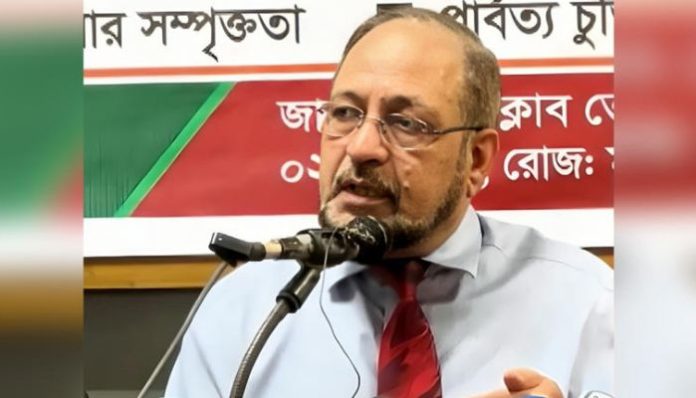
A former Bangladeshi army officer has sparked a major controversy by claiming that Bangladesh will not experience “complete peace” unless India “breaks into pieces.” The comment was made by Brigadier General (retd) Abdullahil Amaan Azmi, the son of former Jamaat-e-Islami leader and convicted war criminal Ghulam Azam. Azmi made the remarks at an event held at the National Press Club in Dhaka, triggering strong reactions in India.
Azmi accused India of deliberately keeping Bangladesh unstable. “Bangladesh will not see full peace as long as India does not break into pieces,” he said, because New Delhi always keeps unrest alive inside the country. His father, Ghulam Azam, was one of the most notorious figures of the 1971 Liberation War, held responsible for the killing of Hindus and pro-liberation Bengalis.
?????Bangladesh will not see full peace as long as India does not break into pieces, said Bangladesh Brigadier General Retd, Abdullahil Amaan Azmi.
— warmonitor73 (@war_737) December 2, 2025
Well well well look ?? who said that ?.
That's peak level comedy. pic.twitter.com/5XMiKIw6j1
Azmi also blamed India for unrest in the Chittagong Hill Tracts (CHT), a region close to the Indian border. He claimed that India supported armed groups in the area during the 1970s and 1990s. According to him, India trained and armed the Shanti Bahini, the militant wing of the Parbatya Chattogram Jana Samhati Samiti (PCJSS), which was involved in violent conflict from 1975 to 1996.
Commenting on the Chittagong Hill Tracts Peace Accord of 1997, Azmi said the disarmament of Shanti Bahini was “only for show.” The accord was signed to end decades of fighting in the area, but Azmi claimed the peace process was never fully implemented.
Jamaat-e-Islami is a worrying sign for India
Defence analyst and retired Indian Army officer Colonel Mayank Chaubey reacted sharply, saying such statements reflect a dangerous ideology. He wrote that this was not an isolated comment but a “mindset” that exists within certain parts of Bangladesh’s political space. “India must remain alert and fully aware of such forces that openly dream of our breakup while pretending to maintain friendly ties,” he warned.
???? “Bangladesh will not see full peace as long as India does not break into pieces.”
— Colonel Mayank Chaubey (@col_chaubey) December 2, 2025
– Brigadier General (Retd) Abdullahil Amaan Azmi, Bangladesh Army????
A retired senior military officer openly wishing for the disintegration of a neighbouring, friendly nation. This is not a… pic.twitter.com/M9rEs6vyi0
The resurgence of Jamaat-e-Islami is also a worrying sign for New Delhi. Once banned for terror-related activities by the Hasina government, the party is now regaining strength. Opinion polls suggest that while Khaleda Zia’s BNP may win most seats in the upcoming elections, Jamaat is not far behind. Its recent victory in the Dhaka University student elections has further boosted its confidence and visibility.
Yunus’s controversial remarks about India’s Northeast
This controversy comes soon after another provocative statement by Muhammad Yunus, the Chief Advisor of Bangladesh’s interim government. During an event on 28th March this year, Yunus suggested to China that the Northeastern states could serve as an “extension” of the Chinese economy.
“Seven states of India…the eastern part of India called the Seven Sisters. They are landlocked country, a landlocked region of India. They have no way to reach out to the ocean. We are the only guardians of the ocean for all this region,” Yunus was heard saying.
Yunus said Bangladesh could become a gateway for China’s expansion into this region. He described the Northeast as a “production house” for China, encouraging Beijing to use the area to build and export goods. His remarks were widely criticised in India as they implied China could extend its economic influence into Indian territory with Bangladesh’s support.
This was not the first time Yunus had made such comments. In August 2024, shortly after Sheikh Hasina’s ouster, he claimed that any instability in Bangladesh would “spill over” into the Northeastern states and parts of West Bengal. These comments were seen as attempts to exaggerate Bangladesh’s leverage over India’s internal security.
