

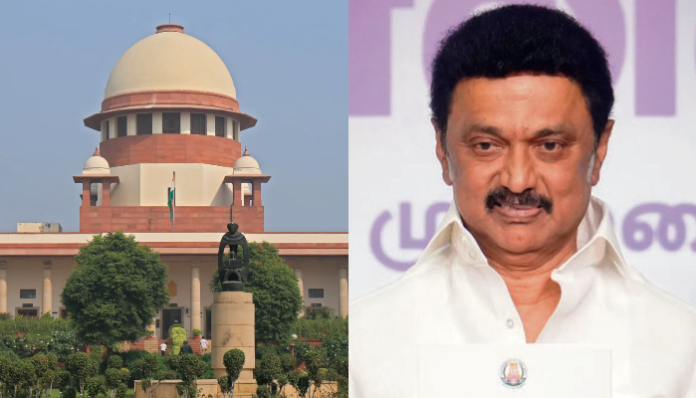
On 15th December (Monday), the Supreme Court revised an eight-year-old order and asked the Dravida Munnetra Kazhagam (DMK) government to determine the land needed for Jawahar Navodaya Vidyalayas (JNVs) to be established in each district. The court reprimanded the state and instructed it to view the Navodaya Vidyalayas program as an opportunity rather than an obstacle to the two-language formula. The decision was pronounced by a bench of Justices BV Nagarathna and R Mahadevan.
Justice Nagarathna reminded the state of its constitutional position within the union in response to Tamil Nadu government’s complaint about central “imposition” of schemes. She inquired whether the southern state was included in the country or not and told the government not to “make it into a language issue” as well as drop “the ‘my-state-my-state’ attitude.” The judge conveyed, “This is a federal country. Don’t lose this opportunity. It’s an opportunity for your students.”
“There must be a federal discussion. You come one step they will also come one step. They may come two steps. After the bifurcation of Andhra Pradesh, Tamil Nadu has gotten all the glory. It is the largest industrialised state in South India. Everything first. You grab this opportunity. Don’t take it as imposition, it is an opportunity for your students. You can say this is our language policy. They will look into it. They cannot also discredit your policy. Bring to the notice of the secretaries of the central government about your act and how you are going about it. Please have a positive attitude,” she stated.
Supreme Court dismisses “Hindi imposition” allegations
The plan, claimed senior attorney P Wilson, is a “backdoor entry” by the central to force Hindi on Tamil Nadu. However, the court countered that the exercise was exploratory and mentioned, “We are only making an exercise. We are not asking you to put a foundation stone today.”
Justice Nagarathna suggested that the state might set requirements including having a two-language policy rather than the three-language policy that JNVs follow. She further noted, “If you have a language policy, you say so, we will modify the scheme accordingly. But don’t suppress an opportunity for rural students.”
The bench also explicitly outlined in its directives that it was acting in the best interests of the kids. According to Justice Nagarathna, the court was more concerned with impoverished and rural children receiving an education than it was with Hindi. She criticised, “Why this mental block? If economically backward students are given the opportunity, why are you preventing that?”
Wilson argued that the Navodaya model mandated that the state maintain the schools for three years and supply thirty acres of land in each district. However, the court challenged, “There is nothing wrong in the central government wanting to invest in education. Only meritorious students are admitted there. Why do you resist schools? Education is in the concurrent list. This is enhancing standards.”
“I (state) can build my own schools. We have the highest gross enrolment ratio. Never, ever will any other state match ours. They want 30 acres of land to be given in every district. I have to shell out the money. I had spent ₹3,548 crore on Samagra Shiksha scheme. They still owe us. This is not the way to treat the state,” Wilson alleged.
Nevertheless, Justice Nagarathna chastised, “You (state) cannot come in the way if they want to study the central syllabus. How can you deprive them?” She also questioned, “Are you not a part of this Republic,” and stressed that “we live in a federalist society” where dialogue is important between state and centre. “We have said nothing on the language. There can’t be such an adversarial attitude. This is in the interest of the students,” the court mentioned.
Supreme Court unmoved by state’s arguments
Wilson added that the Tamil Nadu Tamil Learning Act of 2006 conflicts with the Navodaya Vidyalaya scheme’s three-language formula. However, Justice Nagarathna warned, “Don’t bring in politics into this. You are coming in the way of providing education to meritorious students. What is wrong in having more schools?”
Wilson retorted that Tamil Nadu’s current standards were superior to those of Navodaya Vidyalayas and the initiative offered states the choice to accept or reject participation. However, the court was not persuaded.
The court even conveyed that 650 Navodaya schools had previously been approved nationwide by the union government and only Tamil Nadu refused to comply. “We modify the interim order of stay granted by this court on 11th December 2017 by directing the petitioner-state to identify the requisite extent of land necessary for establishing a Navodaya Vidyalaya in each district. The said exercise shall be carried out within a period of six weeks and a status report shall be placed before this court,” the bench announced.
After requesting consultations on the scheme’s implementation from representatives of the Union Ministry of Education and the Tamil Nadu government, the apex court posted the matter six weeks later. The bench stated, “Please don’t talk through press or through the media. Go face to face and go on talk to them. Everybody is issuing statements and there is no talking between the actual persons.”
Background of the matter
On 11th September 2017, the Madurai Bench of Madras High Court ordered the state to provide temporary housing for 240 students in each district within two months and added that that Jawahar Navodaya Vidyalayas do not breach the Tamil Nadu Tamil Learning Act, 2006.
The court concluded that the state’s general rejection violated the Right of Children to Free and Compulsory Education Act and restricted the freedom of children to select educational institutions. The Kumari Maha Sabha’s public interest litigation suit served as the foundation for the verdict. The court also ordered that the state needed to supply land with the centre bearing the entire expense.
Tamil Nadu insisted in its Special Leave Petition that its two-language program under the 2006 Act was incompatible with the three-language formula of JNVs and education policy is within its exclusive purview. However, the court observed that Navodaya Vidyalayas in Tamil-speaking regions employ Tamil as the first language in Classes IX and X. Tamil was also utilised as an optional subject in Classes XI and XII and as the medium of instruction up to Class VIII. Hence, the state’s argument was rejected.
