

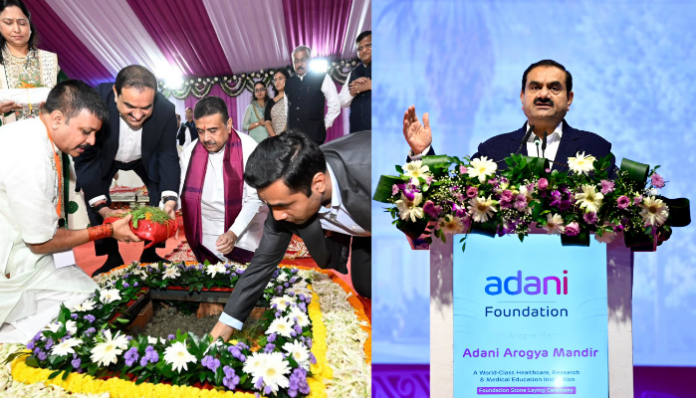
On 24th September (Thursday), industrialist Gautam Adani unveiled a plan to spend more than Rs 1 lakh crore in West Bengal by 2035 in a number of areas, including ports, logistics, renewable energy, power generation, power transmission and distribution, roads and bridges, green cement, hyperscale data centres and heritage preservation.
The development transpired when he laid the foundation stone for a 2,000-bed Adani Arogya Mandir alongside Chief Minister Suvendu Adhikari in the Bengal Silicon Valley Tech Hub in New Town, Kolkata. “We, at Adani, want to help build that chapter alongside the people of Bengal. And today, our commitment begins with the Adani Arogya Mandir,” the businessman declared.
A very special day for me in Kolkata.
— Gautam Adani (@gautam_adani) September 24, 2026
Grateful to Hon’ble Chief Minister @SuvenduWB for gracing the occasion as we mark the beginning of the Adani Arogya Mandir.
This 2,000-bed, not-for-profit hospital, will be built around a modern medical college, advanced research and care… pic.twitter.com/tC0avucDrd
The Adani Group informed, “Closely aligned with West Bengal’s 2026 Healthcare Vision, the project, to be executed by the Adani Foundation, will cater to over 200,000 inpatients and more than 2 million outpatients annually and generate about 10,000 jobs. Envisioned as a world-class Academic Medical Centre and a comprehensive healthcare ecosystem for Eastern India and beyond, the project will entail an investment of over Rs 4,000 crore,” in an official release.
The 51.75-acre Adani Arogya Mandir will house step-down and transitional care facilities in addition to a multispecialty hospital. Additionally, a Meditel and Vishram Gruh will be part of the full ecosystem, offering lodging to family members of hospitalised patients.
CM Adhikari stated, “Mr Adani, we look forward to your presence to rebuild Bengal. The final vision is not just a hospital campus, it will be a fully integrated healthcare city. Nowhere in India is there a hospital of this high standard. The hospital will give a big boost to medical tourism. This is a historic, meaningful and auspicious day for us. Viksit Bharat 2047 can happen only if Bengal develops,” during the occasion.
The entrepreneur likewise conveyed, “The Adani Arogya Mandir will be a world-class, not-for-profit medical institution that will have 2,000 beds – with a thousand beds catering to economically weaker sections of society, eligible under State and Central health insurance schemes.”
“The Adani Arogya Mandir campus will feature a medical college, with an annual intake of 150 undergraduates, 100+ postgraduates and 40+ super-specialists. It will also include a College of Nursing and an institution for allied healthcare and paramedical education, creating a multidisciplinary ecosystem for the next generation of doctors, nurses, technicians and allied healthcare professionals. The broader campus ecosystem will also provide residential facilities for the healthcare professionals and their families,” the Adani Group stated.
Adani further mentioned, “At the heart of this institution will be a medical college supported by advanced research and care facilities. This will lay the foundation for a highly skilled healthcare workforce for Bengal.”
Focus on infrastructure push, power sector, heritage preservation and more
Adani explained the reasoning for the infrastructure drive, asserting that ports improve logistics, logistics draws industry, industry drives manufacturing, manufacturing requires electricity, and energy makes digital infrastructure possible. He added that “jobs multiply” as the chain expands.
This is the first official reference to the Adani Group’s intention to enter power distribution, which has up till now been the exclusive domain of the R P Sanjiv Goenka Group in Kolkata and Howrah through its flagship company, CESC Limited.
On the other hand, Adani pointed out that West Bengal is the nation’s natural marine and logistical link between Southeast Asia and Northeast India. According to him, the state might develop into “one of Asia’s greatest integrated industrial and economic platforms.”
He reiterated, “Bengal is the natural maritime and logistics bridge connecting India’s vast industrial heartland and the Northeast with the Bay of Bengal.” He then added, “This gives Bengal a structural advantage few regions can match and the potential to become not just a gateway.”
The Adani Group announced their support for the renovation of Kolkata’s historic Writers’ Building. The West Bengal government’s offices were later housed in the structure, which was initially used as an administrative office by the East India Company. Adani will also endorse efforts to promote the city’s Durga Puja artwork internationally and the revitalisation of Kumartuli Ghat.
He remarked, “Progress cannot be measured only in kilometres of roads, megawatts of power or rupees invested. A society must also care for its people and protect the culture, memories and institutions that give it identity.”
Meanwhile, Adani lauded CM Adhikari, calling him a “Bhoomiputra” and outlining that people had high expectations for his government in terms of employment, infrastructure, healthcare, education and opportunities. He also emphasised that Bengal was at a moment of possibility. He even cited Rabindranath Tagore, Swami Vivekananda, Netaji Subhas Chandra Bose, and Jagadish Chandra Bose as examples of the state’s contributions to Indian history and culture. “Bengal will awake, Bengal will progress; Bengal’s strength is India’s momentum,” he stressed.
Adani referred to Bengal as his group’s “karmabhoomi in the East,” drawing a comparison with Mundra in Gujarat, which served as its basis for massive projects. “Because, for me, Bengal is not simply an investment destination. It is a place where I want to build, to serve and most importantly, to belong,” he pronounced. The industrialist also visited the renowned Kalighat Kali temple to pray for “Shakti”, “Ichhashakti” and “Kriyashakti.”
