

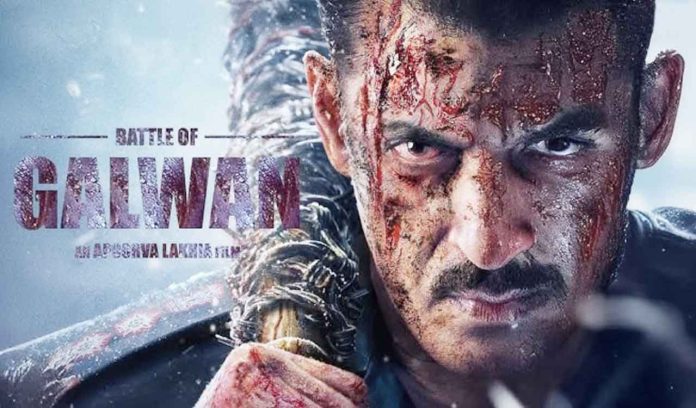
India on Tuesday issued a firm rebuttal to criticism from China’s state-run daily Global Times over the upcoming Bollywood film Battle of Galwan, asserting that creative freedom is intrinsic to Indian cinema and cannot be dictated by foreign political sensitivities.
Government sources said films based on India–China military confrontations are not unprecedented, citing Haqeeqat on the 1962 war and 121: Battle of Rezang La as earlier examples of Indian cinema engaging with sensitive military history. Storytellers, the sources emphasised, are free to choose narratives they consider important, and such expression should not be politicised.
The response followed a Global Times article attacking the teaser of Battle of Galwan, alleging it distorts the events of the June 2020 clash in eastern Ladakh’s Galwan Valley. The report dismissed the role of Indian Army officer Bikkumalla Santosh Babu, who was killed in the clash, and claimed Chinese social media users viewed the film as exaggerated. It reiterated Beijing’s position that India triggered the confrontation by crossing the Line of Actual Control, accused New Delhi of inflating casualty figures, and alleged an attempt to malign the People’s Liberation Army, despite China acknowledging its own fatalities much later.
Indian sources rejected these claims, reiterating that the government has no role in the making of the film and fully respects freedom of expression. Those seeking factual clarity, they said, may approach the Ministry of Defence.
Battle of Galwan is based on the real-life confrontation involving the Indian Army’s 16 Bihar Regiment and draws from India’s Most Fearless 3 by Shiv Aroor and Rahul Singh. Salman Khan portrays Colonel Santosh Babu.
India’s stance, officials underlined, is unequivocal: cinema is an artistic medium, not a diplomatic instrument, and creative freedom will not be curtailed to suit external narratives.
