

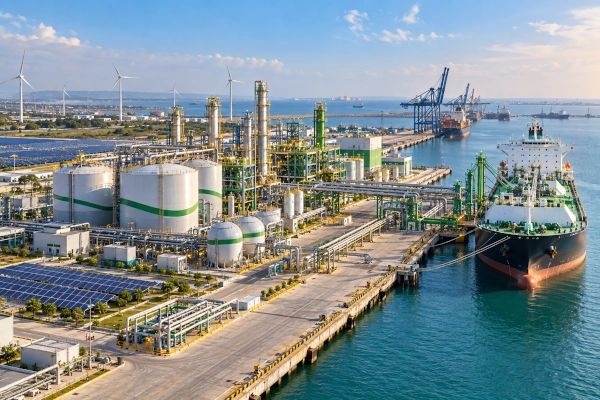
India is taking a major step towards becoming a supplier of low-carbon marine fuels with the foundation stone laid for the country’s first port-based e-methanol plant at Deendayal Port in Kandla, Gujarat. The ₹2,300-crore project is a joint initiative of the Deendayal Port Authority (DPA) and Assam Petro-Chemicals Ltd (APCL), bringing together Gujarat’s port and renewable-energy infrastructure with Assam’s industrial capabilities.
Gujarat Chief Minister Bhupendra Patel, Union Minister for Ports, Shipping and Waterways Sarbananda Sonowal and Assam Chief Minister Himanta Biswa Sarma laid the foundation stone on September 26.
The plant will have a total capacity of 150 tonnes of e-methanol per day and will use renewable power, water and biogenic CO₂ to produce the green fuel. Its location at Kandla is strategically important: production, storage and marine-fuel supply can be integrated directly with port operations, allowing e-methanol to be supplied to vessels operating on major international trade routes, including the Asia-Europe corridor.
The project will be built in two phases. Phase I, involving 50 tonnes per day of capacity, will cost ₹1,200 crore and is targeted for completion by January 2027. Phase II, adding another 100 tonnes per day, will require ₹1,100 crore and is targeted for March 2027.
DPA and APCL will contribute in a 76:24 ratio. DPA’s contribution includes ₹567.32 crore in equity, 75 acres of land, desalinated water and renewable-energy infrastructure, including green hydrogen. The project is expected to create more than 3,500 direct and indirect jobs and stimulate allied activities such as transportation, storage, fuel handling and other green-energy services around Kandla.
The project also represents an unusual inter-state industrial partnership. APCL, based in Namrup, Assam, is taking its petrochemical expertise to Kandla, linking the Northeast with Gujarat’s growing green-energy and maritime ecosystem. Sarma has highlighted the project as an example of Assam participating in India’s emerging clean-energy economy.
The economics could be equally significant. The project targets green methanol production at around US$750 per tonne, compared with a cited global cost of approximately US$1,300. If achieved at scale, this could strengthen India’s position in the emerging market for alternative marine fuels.
Kandla’s e-methanol plant is also part of a larger maritime expansion. India plans to add 100 ships to its merchant fleet over the next five years and aims to become one of the world’s five largest ship-owning nations by 2047. DPA is simultaneously pursuing a ₹1,520-crore shipbuilding project with Cochin Shipyard at Vadinar, alongside plans for a shipbuilding and repair cluster at Porbandar.
From green methanol to synthetic petrol
Methanol’s significance extends beyond shipping. It can also serve as a feedstock for Methanol-to-Gasoline (MTG)technology, which converts methanol into gasoline-range hydrocarbons using a ZSM-5 zeolite catalyst.
The process begins by converting methanol into dimethyl ether:
2 CH₃OH → CH₃OCH₃ + H₂O
Further reactions over the zeolite catalyst produce gasoline-range hydrocarbons, water and a small LPG stream. MTG was commercialised by Mobil in New Zealand in 1985, while subsequent plants have been developed in China.
One technical challenge is the formation of durene, a high-melting-point aromatic compound that can require additional treatment before the gasoline meets specifications. Modern MTG technology has nevertheless evolved, with applications now extending towards renewable gasoline.
India’s emerging green-methanol capacity could therefore have implications well beyond maritime fuel. If production becomes economical at scale, methanol could become a platform for marine fuels, synthetic gasoline and other industrial applications.
The Kandla project is thus an important step towards building an integrated ecosystem for producing, handling and exporting green molecules from India.
Read the detailed explainer on Methanol-to-Gasoline (MTG) and the evolution of synthetic fuels in Chapter 1 Magazine.
