

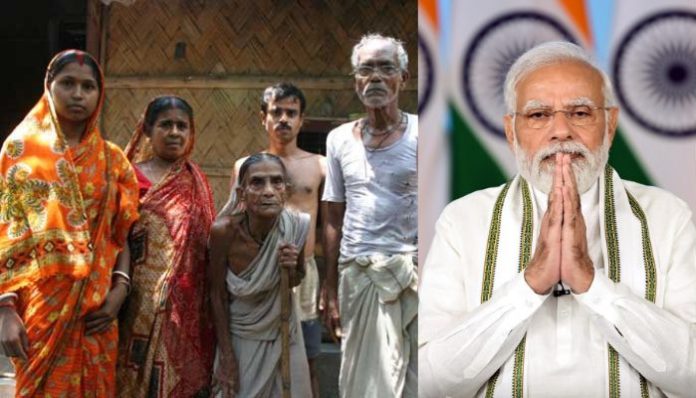
The Modi government recently granted Indian citizenship to 12 Hindu refugees from Bangladesh who fled their homes years ago to escape religious persecution and violence. These families, who crossed the border with almost nothing, received their citizenship certificates in West Bengal under the Citizenship Amendment Act (CAA). For them, this marks the end of decades of uncertainty and the beginning of a safer, more stable future in the country they have always considered their motherland.
A long journey from fear to dignity
The journey has been long and painful for these Hindu families. Many of them left East Bengal with only the clothes they were wearing, driven out because of their religion, culture and identity. They arrived in West Bengal with no home, no land and no documents, just the belief that India would protect them.
Nadia, West Bengal: A resident of Palpara in Chakdaha Municipality has been granted Indian citizenship.
— IANS (@ians_india) November 29, 2025
The individual is extremely happy to receive the citizenship certificate and expressed gratitude to the Government of India pic.twitter.com/1zwYN1m75g
But even after settling in India, they were forced to live like stateless people. Without citizenship, they could not apply for regular jobs, get passports, or access basic services. Every time they needed a document, they were asked to produce papers from before 1971, an impossible task for families who had fled violence with nothing in hand.
This struggle continued for decades as political disagreements in West Bengal delayed their citizenship. There were leaders of the TMC, CPM, and Congress opposing giving them the necessary documents. Consequently, thousands of Hindu refugees in this country lived in fear day and night: the fear of being told to leave, the fear of losing work, and the fear of separation from the country they saw as their only home.
CAA brings relief to refugee families
Their situation began to change after the central government notified the CAA rules and started processing applications. This week’s development in West Bengal is seen as a major milestone, especially for communities like the Matuas and other Hindu groups who migrated during and after Partition.
The Matuas, one of the largest refugee communities in the state, have welcomed the decision with immense relief. For decades, many families in Thakurbari and nearby areas lived without papers, always worried they might be removed from the country. Now, with citizenship certificates finally in their hands, they say they can live freely without fear.
A big part of this progress comes from the help desks and camps that the BJP has opened across border districts in the past two months. Camps in Nadia, Cooch Behar and other regions have assisted thousands of refugees in filling out CAA forms, verifying details, and completing paperwork. Many applicants who once feared they would never be recognised as legal citizens now see a clear path forward.
Politics and Fear-Mongering Around CAA
The citizenship update comes at a crucial time, especially in West Bengal, where political battles over CAA have been intense. Last week, Chief Minister Mamata Banerjee visited Thakurbari and assured Matuas of support, even warning she could “shake the entire country” if needed.
But the timing of the new citizenship certificates has changed the mood on the ground. Members of the Matua community say they had spent years caught between political promises and fear, unsure which party would actually deliver on their concerns.
With the certificates now issued, many in the community say their doubts have reduced, and their trust in the central government has strengthened. They no longer need to hide or fear being labelled as illegal residents. Instead, they can openly identify themselves as Indian citizens, show their papers proudly, and access opportunities that were once out of reach.
A reality check for Anti-CAA lobby
BJP IT cell chief, Amit Malviya, shared a long post on his X account and said the long battle for justice had finally reached its rightful conclusion. According to him, these Hindu refugees were denied citizenship for decades due to political reasons in West Bengal. He pointed out that while the BJP worked to give citizenship to persecuted minorities, other political parties were “trying to legalise illegal migrants for vote-bank politics.”
The long battle for justice, fought by those who crossed the border with nothing but the clothes on their backs, has finally reached its rightful conclusion.
— Amit Malviya (@amitmalviya) November 29, 2025
Those who were persecuted in East Bengal for their religion, culture and identity were driven out of their homeland with… pic.twitter.com/zcogIGmWms
BJP leaders also contrasted the situation at the border, where illegal entrants were allegedly sheltered by TMC, with the plight of genuine Hindu refugees who had fled atrocities in Bangladesh. They said the CAA provides justice for people who lost their homes, identity and hope, while also ensuring that illegal immigration is not legitimised.
A new beginning for the refugee families
For the 12 Hindu families who received their documents this week, the struggle has finally come to an end. They say their tears of sorrow have now turned into tears of joy. With citizenship in hand, they can plan their future with confidence, whether it is applying for a job, building a home, or educating their children.
Nadia, West Bengal: A resident of West Bengal has been granted Indian citizenship
— IANS (@ians_india) November 29, 2025
A Nadia resident is extremely happy to receive the citizenship certificate and expressed gratitude to the Government of India pic.twitter.com/AS7TVbfzDd
After 75 years of displacement, uncertainty and political battles, these families now say they truly feel part of India. For them, the grant of citizenship is not just a document, it is dignity, safety and a long-awaited sense of belonging.
North 24 Parganas, West Bengal: A resident of West Bengal has been granted Indian citizenship
— IANS (@ians_india) November 29, 2025
He says, "…Minority people, including Hindus, came from Bangladesh, Pakistan, and Afghanistan after facing persecution. From my experience, upon arriving in India, we were detained by… pic.twitter.com/QyzbHLbA5S
Expressing his gratitude to the Modi government, a resident of North 24 Parganas who has been granted citizenship says, “Minority people, including Hindus, came from Bangladesh, Pakistan, and Afghanistan after facing persecution. From my experience, when we arrived in India, we were detained by the GRP at the railway station and taken to Barasat and Sealdah, which caused immense fear. Visiting the passport office was another experience of harassment, and our children had to submit numerous documents for exams or admissions. Now, with citizenship granted under the government’s enacted law, refugees have greatly benefited. On behalf of the refugees, we express our gratitude to Prime Minister Narendra Modi and Union Home Minister Amit Shah.”
