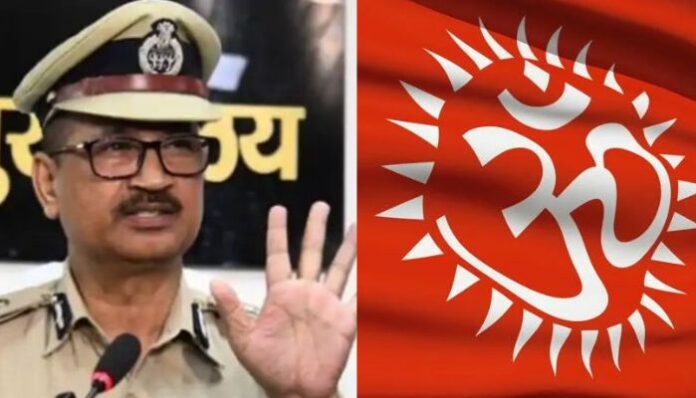
In an alarming assertion of ‘uniformity’ reeking of selective secularism, Bihar DGP Vinay Kumar has directed police personnel to erase visible markers of their Hindu faith while in uniform. On 26th April, Bihar’s Director General of Police issued a directive barring officers from wearing or displaying Hindu religious symbols like Tilak, Chandan, Mangalsutra when they don the Khaki.
Media reports say that this move is a part of the police’s efforts to improve ‘discipline’ within the police force. As per the directive, police personnel are not allowed to display religious symbols such as a chandan tilak while on duty. Similarly, female constables are barred frm from wearing visible jewellery or make-up while in uniform. According to the order, women personnel must refrain from wearing churis, kangans, mangalsutras, nose rings, or jhumkas that are visible over their uniforms.
The Bihar DGP’s directive has stirred outrage, with people questioning the rationale behind linking Hindu religious symbols with discipline and forcing officials to suppress their religiosity, while no such explicit bars are imposed on police personnel belonging to other religions. Many local Hindu rights groups have registered a protest and called the move unnecessary, unfair and discriminatory.
This, however, is not the first case of blatant overreach imposing restrictions on Hindu religious symbols in police and government offices. Over the years, many such incidents have been reported.
While restricting excessive jewellery and heavy makeup is understandable,
Bihar Agriculture Department was suspended for refusing to remove Tilak in 2007
Back in September 2007, a senior Bihar Agriculture Department official, Lakshman Mishra, faced suspension proceedings for refusing to remove his Tilak. The Hindu Brahmin official had worn the Tilak to work for around three decades. However, a new dress code was cited as justification behind enforcing a ban on Tilak at the workplace. Mishra was reported to have been threatened by department secretary CK Anil with suspension for not complying with the anti-Hindu diktat.
Several Agriculture Department Tilak-wearing employees had staged a protest outside the IAS officer’s office and condemned the ban as a blatant assault on the Hindu religious beliefs.
Bihar DGP Anand Shankar faced protests from police association in 2009 for wearing Tilak to office
In 2009, then Bihar DGP Anand Shankar had faced protests by the Bihar Police Men’s Association, an organisation of constables, for wearing a Tilak on his forehead while on duty in uniform. The Association had accused him of violating the rules of the police manual. The protesting constables targeted DGP Kumar, a devotee of Lord Krishna for his Tilak and religiosity, after he directed all association office-bearers, who otherwise mostly wore Kurta-pyjama, to wear police uniform and report on duty like regular policemen. While DGP Kumar reprimanded the constables for violating the discipline by shirking their duty and not wearing proper uniform, the Association played the same card against him but by targeting his practice of wearing a conspicuous Tilak.
Bihar ADG issued circular banning police personnel from wearing Bindi, Mangalsutra, Tilak in 2025
In July 2025, Additional Director General (Law and Order) Pankaj Darad had issued a circular imposing restrictions on wearing churis, kangans, Mangalsutras, nose rings, or jhumkas that are visible over their uniforms. The order cited discipline, simplicity, and dignity in the police force’s appearance as the reason behind banning the use of Hindu religious symbols for police personnel. It further stated that violation of these guidelines would attract disciplinary action.
Does Tilak or Mangalsutra impair duty? Banning Hindu religious symbols at government and private workspaces is not grooming or discipline, but Hinduphobia
The Bihar Police DGP’s reported diktat banning Hindu religious symbols for police personnel, while imposing no such restrictions on Hijab or religious symbols of other faiths, is appalling. In addition to the above-discussed instances of government departments targeting Hindu religiosity in the guise of ‘grooming’ and maintaining ‘professional image’, there have been cases wherein Hindu candidates have been forced to remove their Kalava and Janeu before appearing for government recruitment exams, while Muslim Hijabs, Muslim beards (without moustache) and Sikh Turbans, etc, are left untouched.
In fact, in 2024, the Madras High Court allowed Muslim police officials to keep beards in Islamic style, citing religious freedom. If Muslim cops can be allowed to sport beards according to their religious beliefs, why can’t Hindu officials wear a Tilak or other religious symbols?
This pattern of small and non-obstructive Hindu markers like Tilak, Mangalsutra, Kalava, etc, while the religious markers of other faiths are conveniently accommodated, is not confined to government institutions; it is rampant in the private sector as well.
Are Hindu sentiments and religiosity not as significant and constitutionally protected as those of other religions?
Recently, a major eyewear company, Lenskart, courted controversy after its employee grooming policy document, which restricted staff from wearing Hindu religious symbols, went viral online. The document stated that Lenskart employees are prohibited from wearing sacred threads (kalava) and bindis (bindis), while they may wear hijabs and Sikh turbans. The document also stated that if someone applies vermilion, they should apply it sparingly and should not spread it across the forehead.
Air India has also recently faced a backlash over a similar alleged grooming policy bias against Hindus.
Government office or private company, Hindu employees do not cease to be human beings while on duty, so they are expected to forget their faith and conceal their religious identity to appear proper professionals. Hindus have the right to express their religiosity, and no Tilak, no Mangalsutra, no Sindoor, or Kalava obstructs the discharge of duty. Hindu religious symbols are not optional adornments that can be scrubbed away or banned for ‘discipline’. If turban or Kada-wearing Sikh employees do not become unprofessional or undisciplined merely by wearing their religious symbol, how does this logic not apply to Hindus?
The Bihar DGP’s directive targeting Hindu symbols demonstrates that the corporate over-caution and bias have gradually metastasised into state policy for ‘secularism’, ‘professionalism’, ‘neutrality’ and whatnot. Secularism, however, does not mean erasure of Hindu religiosity. A Tilak or Sindoor or Mangalsutra or Kalava does not impair duty, and yet, time and again, Hindus have been made to feel that their religious expressions are inherently less legitimate.