

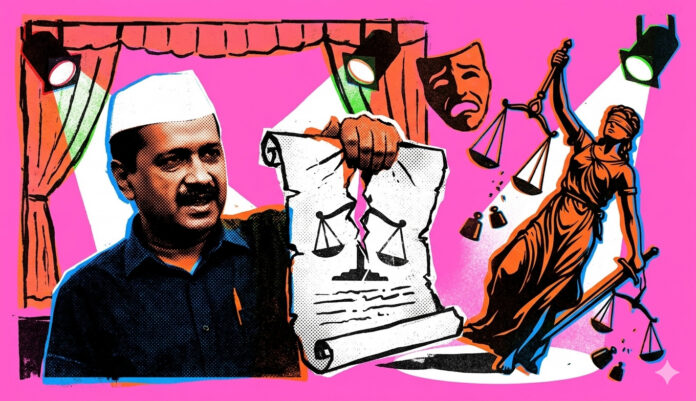
Arvind Kejriwal shared what he described as a letter of conscience this morning on X. He said that he would not appear before Justice Swarana Kanta Sharma in the Delhi excise policy case, either in person or through counsel, citing the ‘Gandhian concept of satyagraha’. The letter, addressed directly to the judge, was both theatrical in its fake humility and bizarre in its implication. ‘Justice Sharma’s court cannot give justice to him’, this is a remarkable claim. And it’s almost entirely inaccurate.
In all humility and with complete respect for judiciary, I have written the following letter to Justice Swarna Kanta Sharma, informing her that pursuing Gandhian principles of Satyagraha, it won’t be possible for me to pursue this case in her court, either in person or through a… pic.twitter.com/HmyOyNYug8
— Arvind Kejriwal (@ArvindKejriwal) April 27, 2026
What had Justice Swarana Kanta Sharma said
One must first comprehend what the court did in order to comprehend what Kejriwal is doing. A trial court order that had acquitted Kejriwal and his co-accused in the liquor policy case was being challenged by the CBI at the Delhi High Court. Kejriwal filed a recusal plea against Justice Sharma, accusing her of bias on three grounds, that her children were appointed as Central Government counsel, that she had attended events connected to organisations he believed to be ideologically opposed to his party, and that her impartiality had been compromised by earlier judicial observations in related matters.
The court rejected the accusations of bias, stressing that unsupported charges cannot compromise judicial independence. The plea was based on ‘conjectures and insinuations’ and did not reach the legal threshold for recusal, according to Justice Sharma, who maintained that accusations of bias must be substantiated by tangible material rather than just perception. She firmly declared, A judge cannot recuse to satisfy unfounded suspicions or manufactured allegations made by a litigant, and added, I will not recuse. I’ll listen to the case.
The court went one step further, issuing what might be the episode’s harshest criticism that ‘the courtroom cannot become a theatre of perception,’ and warning that even influential politicians cannot level accusations against judges in the absence of proof. Kejriwal’s reaction to this rational, legally sound decision? To post on Twitter that his hopes for justice had been shattered and that he would not take part in the court proceedings that would ultimately decide his fate.
What the law says about the stunts Kejriwal is trying to pull
Kejriwal’s Gandhian analogy completely breaks out at this point. The objective of Mahatma Gandhi’s Satyagraha was to overthrow a colonising power that lacked democratic legitimacy and against an unfair colonial law. What Kejriwal is opposing is the jurisdiction of an independent Indian constitutional court, which he willingly invoked when filing the recusal plea in the first place. A court cannot be declared illegitimate after you have petitioned it and lost. That is forum shopping wrapped in a khadi shawl, not civil disobedience.
Wilfully refusing to appear in court has established and severe legal repercussions. Contempt of court is defined by Indian law as either disobeying a court order (civil contempt) or saying or doing anything that scandalises, prejudices, or interferes with legal proceedings and the administration of justice (criminal contempt). Before the merits of a case are even heard, writing a public letter to a sitting judge that is shared on social media and accuses her of being incapable of delivering justice falls dangerously close to the second category.
The Supreme Court has said unequivocally that scandalising the court refers to attacks on individual judges by making unjustified and defamatory remarks about their abilities or character. It would be criminal contempt to write or draft statements that make defamatory accusations against a judge. This is exactly what Kejriwal’s letter, which was released publicly and written to garner the maximum amount of political sympathy, does.
What happens when an accused wilfully refuses to appear?
Kejriwal’s chosen stance is likely to fall apart on its own terms once the law becomes both fair and firm. The Supreme Court established the guiding principle for criminal appeals and revisions in cases where the accused or his counsel is not present in K.S. Panduranga v. State of Karnataka. The court is free to proceed and make a decision on the merits of the case, but it must make sure that natural justice is upheld, usually by designating an amicus curiae to support the court in the accused’s absence. When the accused’s freedom is in jeopardy, the court cannot simply dismiss the case for lack of prosecution or leave him completely unrepresented.
It was never intended to act as a shield for an accused who has been duly served, is free, has the means to retain the best legal expertise in the country, and declares on social media that he has intentionally chosen not to appear. Kejriwal has already been served. He isn’t in jail. He is not without advice. Natural justice principles are not being violated against him; rather, he is attempting to use them as a political weapon. Applying Panduranga, the court will be well within its rights to proceed, appoint an amicus, and consider the case on its merits.
Kejriwal’s absurd drama: A pattern, not a principle
Kejriwal’s in-person appearance before the bench, where he personally argued the recusal plea, was sharply referred to by the Indian Solicitor General as theatrics. That evaluation holds weight when compared to Kejriwal’s well-documented history of turning legal issues into political theatre. After just 49 days in office, he resigned as Delhi’s chief minister in 2014, portraying his surrender to political pressure as a moral stance. Then, in 2020, he came back to power after discreetly giving up on the very matter for which he had resigned. Kejriwal was arrested in 2024 after failing to show up for interrogation by the Enforcement Directorate despite receiving nine summons.
Each of these was characterised at the time as Kejriwal standing up to a compromised system. Despite being slower, quieter, and far more patient each time, the system continued. The pattern is consistent, the formalities of law itself are targeted when it fails to produce the desired result. When the courts decided against him on recusal, they became suspect. When the ED summoned him several times, it became a tool of political retribution. The grievance is usually legitimate in its framing, but the evidence is always noticeably lacking.
What lies ahead
Justice Sharma’s court is open to the choice of hearing the CBI’s appeal against the discharge judgement, which would address the actual merits of the liquor policy case. The court will hear the case with the prosecution’s arguments on record and render a decision if Kejriwal fails to show up and refrains from sending a legal counsel. When that verdict is issued, it will most likely be challenged in the Supreme Court, at the course of which Kejriwal will reemerge in the judicial system he claims to have abandoned.
When that happens, there will almost certainly be another letter, a press conference, an invocation to Gandhi, Bhagat Singh, or the Constitution. The language will differ. The drama won’t change.
The Delhi High Court dismissed the recusal plea, stating that ‘justice cannot be managed through perception.’ It’s a sentence that rings especially true given what happened this morning. Kejriwal’s letter is a master class in perception management, it is sympathetic in tone, vague in content, and only intended to win in the court of public opinion as the case moves forward.
The judiciary has witnessed this before. The Supreme Court was faced with the exact argument that a person should be shielded from the repercussions of scandalising judicial authority by principled dissent in the contempt case against Prashant Bhushan. Advertised willingness to be a martyr does not equate to righteousness.
Conclusion
Arvind Kejriwal is aware that a letter to a judge posted on Twitter receives significantly more column inches than a court judgement in the current Indian media landscape. He is aware that the phrase ‘recusal plea dismissed’ lacks the emotional impact that ‘Satyagraha’ conveys. He is not presenting a legal argument. He is performing a political stunt to entertain his supporters. The law will wait, just as it always has. There will be another hearing. The sequence shall be followed. And whatever it’ll be, it would have been decided without Arvind Kejriwal’s perspective because he chose social media over the courtroom.


