

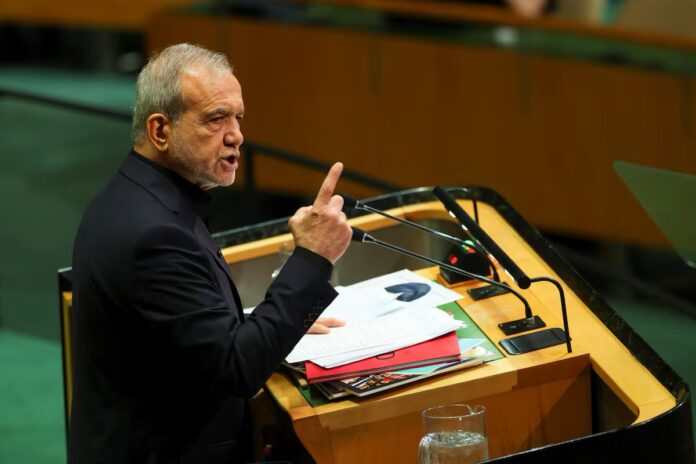
Iranian President Masoud Pezeshkian delivered a defiant message to US President Donald Trump at the United Nations General Assembly on Wednesday, declaring that increased sanctions, pressure and what he described as “bullying” would only strengthen resistance among the Iranian people.
Addressing world leaders in New York, Pezeshkian said Tehran remained willing to pursue dialogue and diplomacy but would not negotiate under coercion or accept what he called the “language of force.” His remarks came a day after Trump warned at the same forum that he could “annihilate” Iran if a deal was not reached.
Pezeshkian’s address was his first at the UN General Assembly since the latest US-Israel war with Iran. He sought to portray Tehran as having resisted military pressure while simultaneously keeping the door open to negotiations.
“He must know that the resistance of the Iranian people will only increase in the face of sanctions, increased pressure, increased bullying. We will never bow our head or bend the knee,” Pezeshkian said, directly addressing Trump.
Pezeshkian accuses US, Israel of Terrorism
The Iranian president also rejected Trump’s characterisation of Iran as a terrorist state, arguing instead that his country had been the victim of attacks.
“The President of the United States called us terrorists. We have been the victims of terrorism,” Pezeshkian said.
He held up photographs of Iran’s former Supreme Leader Ayatollah Ali Khamenei and more than 150 schoolchildren who, according to Iranian authorities, were killed during the opening days of the conflict. Pezeshkian accused the US and Israel of attacking Iranian targets and said Tehran had responded in self-defence.
“We have only defended ourselves. We are not terrorists,” he said, adding that Iran had defended itself “with utmost strength.”
Pezeshkian further argued that the international order should be based on international law, justice and human dignity, saying that peace could not be achieved through coercion.
‘Ready for dialogue, but not under pressure’
Despite his criticism of Washington, Pezeshkian said Iran was prepared to engage in negotiations.
“Iran must be understood by Mr Trump and those who seek to bully us that we are ready for dialogue and diplomacy and negotiations without accepting the language of force,” he said.
His remarks came as the Trump administration continued to signal that diplomacy with Tehran remained possible. Trump said Tuesday that US and Iranian officials had held discussions on the sidelines of the UN gathering and described the meeting as “very good,” although he acknowledged that the Iranian representatives were not the country’s highest-level officials.
Iran, meanwhile, has maintained that any negotiations would require Washington to change its approach, including its military and economic pressure on Tehran.
Trump had offered Iran a stark choice
Pezeshkian’s speech followed Trump’s address to the UN General Assembly on Tuesday, in which the US president presented what he described as a choice between reaching a deal with Tehran and destroying the Islamic Republic.
Trump said he faced a decision over whether Iran would reach an agreement that would allow it to rebuild or whether the United States would “annihilate” the Islamic Republic.
“Do I drive them into hell with no chance of survival and no hope of future greatness or generations?” Trump said.
At the same time, Trump said he believed a diplomatic agreement remained possible and suggested that negotiations could progress after the US midterm elections in November.
The contrasting speeches underscored the sharp divide between Washington and Tehran: Trump emphasised military and economic pressure as leverage, while Pezeshkian insisted that pressure would not force Iran to capitulate.
US delegation walks out during Pezeshkian’s address
The confrontation extended beyond rhetoric inside the UN chamber. The US delegation left the General Assembly while Pezeshkian was delivering his address, according to reports from the session.
Pezeshkian’s appearance came against the backdrop of a conflict that has disrupted regional security and energy markets, with the Strait of Hormuz remaining a central flashpoint. Washington and Tehran have continued to signal sharply different positions even as indirect diplomatic contacts have taken place.
