

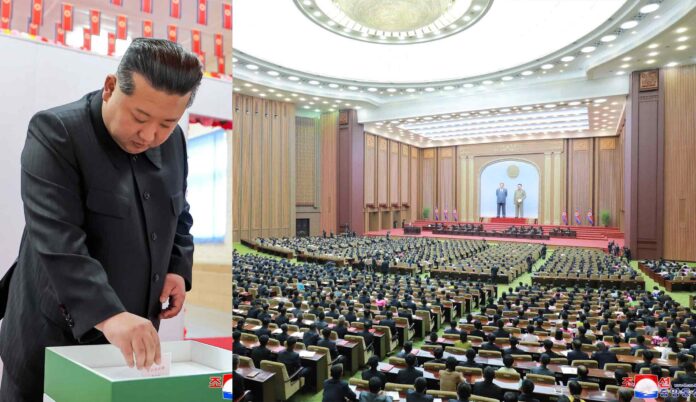
In the recently concluded elections in North Korea, candidates backed by Supreme Leader Kim Jong-un’s Workers’ Party of Korea and its allies have secured almost 100% votes. According to North Korean media, the ruling alliance received 99.93% of the vote amid a voter turnout of 99.99%.
The polls, held on 15 March to elect 687 deputies to the 15th Supreme People’s Assembly (SPA), mark the first national legislative vote in seven years. According to the Korean Central News Agency (KCNA), only 0.07% of voters cast ballots against the approved candidates – a rare public acknowledgement of any dissent in North Korean elections.
Kim Jong-un was not a candidate in the elections; he cast his vote at a polling station in a youth-run coal mine near Sunchon, where he endorsed the local manager as the constituency’s representative.
The Supreme People’s Assembly is North Korea’s rubber-stamp legislature, which formally approves state policy and appoints senior officials but wields no independent power. All seats were won by the ruling coalition, reinforcing the regime’s total control.
How North Korean elections are conducted
North Korea’s electoral system is designed to project an image of democratic participation while ensuring the outcome is never in doubt. There is only one approved candidate per constituency, selected in advance by the Democratic Front for the Reunification of Korea, the ruling coalition dominated by the Workers’ Party. Candidates undergo “voter meetings” at workplaces or neighbourhoods where their suitability is discussed under close party supervision.
On election day, voters are handed a ballot paper bearing the single candidate’s name. The process is nominally a secret ballot, but in practice, it offers little genuine secrecy. To vote in favour, citizens simply deposit the unaltered ballot into the ballot box. To reject the candidate, they must cross out the name, an act traditionally performed with a red pen in full view of election officials or in a separate area adjacent to the ballot box.
Recent minor reforms to the electoral law have introduced elements such as separate “yes” and “no” ballot boxes in some contexts, but the core structure remains unchanged for the national SPA vote, a single pre-approved name per seat and with only yes and no votes. The process makes sure that officials know and record who voted yes and who voted no. Dissent in the form of a no vote is extremely risky, with reports of surveillance and potential repercussions for those who openly oppose the nominee.
Voting is effectively compulsory, with local officials maintaining detailed voter rolls that double as a population census. Those unable to vote, for example, sailors at sea or citizens abroad, are explicitly accounted for in official figures, which this year showed just 0.0037% of registered voters fell into this category, and only 0.00003% of the voters actually abstained.
The 99.93% approval rate, while headline-grabbing, is typical of North Korean elections. Similar results were recorded in 2019, when turnout was also reported at 99.99%. The process is a carefully choreographed display of unity without any genuine contest, as no opposition parties are permitted, and independent monitoring of the polls is impossible.
The newly elected assembly is expected to convene shortly to rubber-stamp the leadership’s policies, including Kim’s ongoing five-year economic plan and nuclear programme. Kim’s younger sister, Kim Yo-jong, has been widely tipped for a more prominent role following the vote. The Supreme Leader has been spotted with his daughter in several public events in recent times, which has been seen as a clear sign of grooming her to become his eventual successor.
