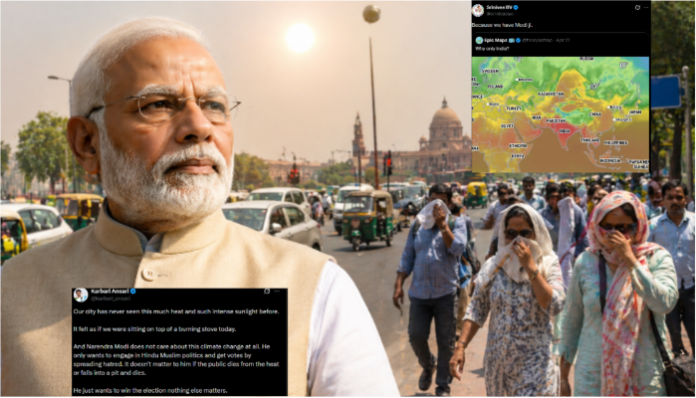
India is accustomed to a scorching sun, and several cities are already witnessing the onset of a blistering summer. The India Meteorological Department (IMD) has declared heatwave conditions in 11 states and union territories, including Punjab, Haryana, Delhi, Rajasthan and Uttar Pradesh.
Nonetheless, this phenomenon is not limited to India as the opposition and its ecosystem are attempting to suggest because thermometers have shown spikes across the globe at the same time. The extreme conditions have been related to a number of factors, some human-driven and a lot more of natural phenomena.
The situation is further aggravated by an evolving Super El Nino, which releases additional heat from the ocean into the atmosphere, as scientists look into events in the Pacific Ocean that might spike global temperatures and shatter records in the next year. More importantly, the intense heat currently gripping the Indian plains is a component of a broader pattern that began 6 weeks ago in North Asia, Siberia.
Meanwhile, a number of stakeholders convened in early April to establish a new platform, South Asia Hub of the Global Heat Health Information Network (GHHIN), to promote cooperation and creativity to confront the massive challenge as mercury levels soar not only in India but throughout the subcontinent. It will partner with the Indian Institute of Tropical Meteorology (IITM) and the India Meteorological Department. The goal is to devise a common regional framework for converting climate data into health interventions.
The world is battling with these changes and is in search of solutions. On the other hand, the Indian opposition and left liberals are actively engaged in their usual tactic of blaming the Modi government using nonsensical arguments.
The detractors invent creatively ridiculous excuses to blame the Modi government
‘Epic Maps’ uploaded a weather map illustrating the climbing temperature in India, framing it as an unusual occurrence confined to India, while conveniently excluding that the country and its neighbour Pakistan, as well as Yemen and other nations in the Indian Ocean Region, like Thailand, Myanmar, etc., showed a spike in temperature
Congress leader Srinivas BV took advantage of the half-truth and, in a clear demonstration of both unfettered hatred and stupidity, alleged that Prime Minister Narendra Modi was responsible for it.
Because we have Modi ji. https://t.co/SC4pPnQV3U
— Srinivas BV (@srinivasiyc) April 27, 2026
Full-time mutton biryani connoisseur and part-time PETA (People for the Ethical Treatment of Animals) activist Diya Mirza amplified a post charging PM Modi with snatching tribal territories and accelerating the destruction of forests through the Forest Conservation Amendment Act of 2023.
This thread matters more than most things being discussed in our country right now.
— Dia Mirza (@deespeak) April 27, 2026
Must read. https://t.co/VeebFI4Kfb
Karbari Ansari declared that PM Modi is indifferent to the burning heat and the climate change. “He only wants to engage in Hindu Muslim politics and get votes by spreading hatred. It doesn’t matter to him if the public dies from the heat or falls into a pit and dies. He just wants to win the election nothing else matters,” the Congress party man alleged.
The centre headed by the Bharatiya Janata Party has addressed this issue through various pivotal measures, including a substantial increase in the dense forest cover, a commitment to achieving net-zero emissions by 2070 and a strong promotion of renewable energy. Nevertheless, the true pioneers of communal politics do not depend on facts.
Our city has never seen this much heat and such intense sunlight before.
— Karbari Ansari (@karbari_ansari) April 27, 2026
It felt as if we were sitting on top of a burning stove today.
And Narendra Modi does not care about this climate change at all. He only wants to engage in Hindu Muslim politics and get votes by… pic.twitter.com/eG7FA7TjnH
According to Gaurav Pandhi, secretary of the All-India Congress Committee (AICC), PM Modi is primarily concerned with winning elections by instigating divisions in the society, which is his only focus. He stressed that the situation was considerably better under the Congress government as it actively tried to deal with these problems. Pandhi added that the saffron party has failed in this regard, and their poll promises, such as 100 smart cities, were merely intended to gain votes but never meant to be honoured.
❌ 100 Smart Cities
— Gaurav Pandhi (@GauravPandhi) April 27, 2026
✅ 100 Most Polluted Cities
✅ 100 Warmest Cities
Modi ji kaam bantaa,
bhaad mein jaaye janta! pic.twitter.com/S8MFlCUbny
“Educator” Dinesh Wadera asserted that this is a consequence of PM Modi’s “concrete” initiatives, insinuating that infrastructure growth and drives to ensure that the poor have proper houses is somehow a grave mistake the Modi government committed.
This heatwave in india is a result of “Concrete” efforts of Modi Sarkar. pic.twitter.com/8EpSa5rROF
— Dinesh Wadera (@dineshwadera) April 27, 2026
Sudhir Yadav claimed that the government has taken over tribal lands, waters and forests, transferring them to businessman Gautam Adani. Consequently, millions of trees have been cut, contributing to India becoming one of the hottest countries globally, with 95 out of 100 cities enduring extreme heatwaves. He remarked, “This model of destruction in the name of development is Modi’s biggest achievement.”
पिछले 12 सालों में आदिवासियों,
— Sudhir yadav (@sudhiryadav9421) April 26, 2026
किसानों से जल, जंगल और जमीन छीनी गई लाखों-करोड़ों पेड़ काट दिए गए।
और अडानी को दे दिए गए।
नतीजा भारत आज दुनिया के सबसे गर्म देशों में जहां 100 में से 95 शहर भीषण गर्मी की चपेट में।
विकास के नाम पर विनाश का ये मॉडल मोदी की सबसे बड़ी "उपलब्धि" है। pic.twitter.com/0u3j5mGKl7
What is the truth behind the charges
India is undoubtedly prone to hot weather, which is triggered by a multitude of interrelated determinants. Heat is trapped close to the surface by meteorological elements, including low winds, high-pressure systems and a shortage of cloud cover. A “heat dome” that has confined hot air over the Indo-Gangetic plains and eastern India is also a critical cause. This year, the western disturbances that bring rain to plains and snow to slopes have also become less frequent and weaker.
However, the left-liberal lobby is preoccupied with rumour mongering and attacking PM Modi instead of discussing the actual explanations for the present condition. Likewise, it is equally false to contend that India is warming faster than the globe. The nation’s average surface temperature has risen slowly relative to the global figures owing to many factors. It was reiterated in research conducted by Harvard University’s Salata Institute.
Pollution produces aerosols, which scatter sunlight and lower solar surface radiation. They serve as the atmosphere above South Asia’s reflective shield. The Indo-Gangetic plain’s over-agriculture is another major contributor. The area is mostly utilised for agriculture because of the fertility of the plain. Large-scale irrigation has resulted from this, which boosts evapotranspiration and acts as a form of cooling blanket over the plains.
The elevation has been particularly marked at higher latitudes, especially near the poles, because of heat transfer from the tropics via atmospheric circulation systems and the pre-existing lower temperatures at these latitudes. India is situated closer to the equator in the tropical zone, where such geographical events do not occur.
The landmass of India is not homogeneous, with prominent regional differences in temperature modification. Due to local climate and terrain, some regions incur greater warming, but the national average spike in temperature continues to be low.
Moreover, the pre-monsoon season, which runs from March to May, is the hottest time of year in nearly all of South Asia. Heat waves and other extreme weather conditions are frequent at this time.
Which region of the world is seeing the most significant increase
The Copernicus Climate Change Service’s ERA5 dataset showed that since the mid-1990s, Europe has warmed by about 0.53°C per ten years, making it the fastest-rising continent. The Arctic is warming even more swiftly, by about 0.69°C every ten years.
The notion that India is warming faster than the global average is a misconception; the data presents a different narrative.
— 🔴All India Weather (@allindiaweather) April 27, 2026
Recent headlines often claim that India is warming at an alarming, unprecedented rate compared to the rest of the world, but long-term observational data… pic.twitter.com/6JoC285ann
On the contrary, large portions of the Indian subcontinent have a far more stable trend, commonly between 0 and 0.2°C each decade, while the Arctic, Europe and portions of the Middle East exhibit warming rates as high as 0.6°C to 1.5°C per decade. X handle @allindiaweather has explained the phenomenon in a viral thread. It also discussed how the claims of India’s declining green cover are false, because data over the years has shown an increasing trend of green cover in the country.
Global warming has been traditionally linked to the growing frequency of extreme heatwaves in recent decades. Blocking over the North Atlantic is linked to the first kind of heatwave over north-central India. “The blocking over North Atlantic results in a cyclonic anomaly west of North Africa at upper levels. The stretching of vorticity generates a Rossby wave source of anomalous Rossby waves near the entrance of the African Jet. The resulting quasi-stationary Rossby wave-train along the Jet has a positive phase over Indian subcontinent, causing anomalous sinking motion and thereby heatwave conditions over India,” highlighted “Anatomy of Indian heatwaves”, a research article in Nature.
The abnormal Matsuno-Gill response to the anomalous cooling in the Pacific is responsible for the second type of heatwave across coastal eastern India. Heatwaves are prompted by the Matsuno-Gill response, which reduces the land-sea breeze by producing northwesterly anomalies over the continent.
Conclusion
India is tackling with a serious problem that is raising concerns and needs a consistent and dedicated approach. However, the responses of the opposition and its supporters are politically inclined and are devoid of any genuine recommendation or critiques. They are simply attempting to unjustly attack PM Modi and the current government to score political points instead of focusing on the underlying issues. This is the manner in which they have behaved each time the nation faced a major event, and this time is no exception.
The climate realities of the world are not going to change with changing governments.