

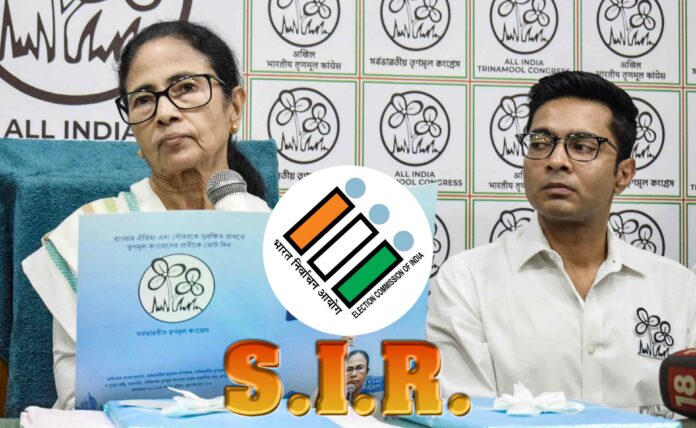
In the wake of the BJP’s decisive victory in the 2026 West Bengal Assembly elections, which ended the Trinamool Congress (TMC)’s 15-year rule, the TMC continues to allege that the party lost the elections due to ‘large-scale deletion’ from the electoral roll during the Election Commission’s Special Intensive Revision (SIR).
Senior TMC leader and MP Abhishek Banerjee repeated the claims today, after Suvendu Adhikari took oath as the new chief minister of the state. In a detailed post on X on 9 May 2026, Banerjee stated: “We have fought an extremely difficult election where nearly 30 lakh genuine voters were allegedly disenfranchised from the electoral rolls.”
We have fought an extremely difficult election where nearly 30 lakh genuine voters were allegedly disenfranchised from the electoral rolls. Throughout this entire process, we witnessed what we believe was deeply partisan conduct by several government agencies as well as the…
— Abhishek Banerjee (@abhishekaitc) May 9, 2026
He accused several government agencies and the Election Commission of India (ECI) of “deeply partisan conduct,” claiming compromised democratic institutions, irregularities in EVM handling, and mismatches in control units. Banerjee also raised concerns over post-poll violence against TMC workers and demanded the release of CCTV footage from counting centres along with transparent VVPAT slip counting to restore public trust.
The TMC has repeatedly called the SIR process, under which over 90 lakh names were deleted in the state, a targeted effort to suppress its voter base, particularly in Muslim-dominated areas. Similar allegations have been echoed by opposition voices in other states too, but TMC has been the most vocal critic of the process to remove the names of dead, migrated and duplicate voters from the voter lists.
However, constituency-level data from the ECI directly contradicts the narrative that SIR deletions caused the TMC’s rout. In fact, the party won the seats where there were high deletions and high additions of voters under SIR. As per ECI data analysed by the BJP, the top five assembly constituencies with the highest net deletions of ineligible electors were all swept by the TMC. These included Sujapur (1,50,410 deletions), Raghunathganj (1,30,982), Samserganj (1,25,337), Ratua (1,23,885), and Suti (1,20,690). TMC won in all five of these seats.
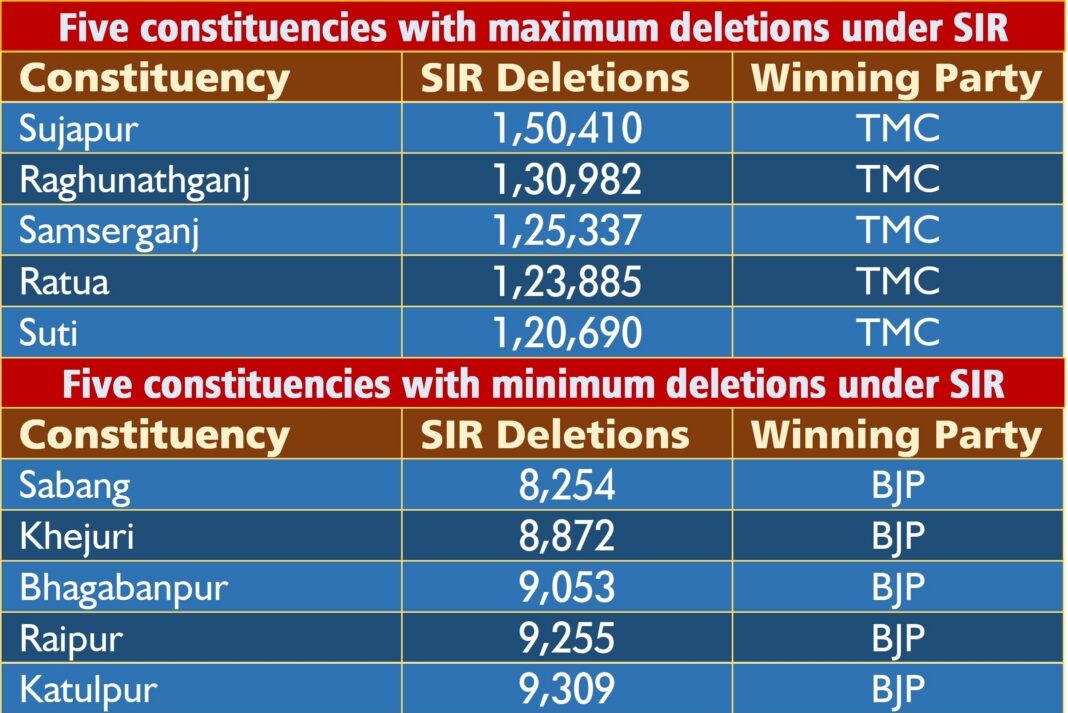
Out of the 20 seats with the highest deletions of voters under SIR, as many as 13 were won by the TMC.
On the other have, BJP won in places where deletions were less. Data shows that the five ACs with the lowest net deletions were won by the BJP: Sabang (8,254 deletions), Khejuri (SC) (8,872), Bhagabanpur (9,053), Raipur (ST) (9,255), and Katulpur (SC) (9,309).
It is notable that while TMC is focusing only on deletions, a significant number of voters were also added to the voter lists during the SIR before the assembly elections. And in those seats too, TMC did well compared to the BJP.
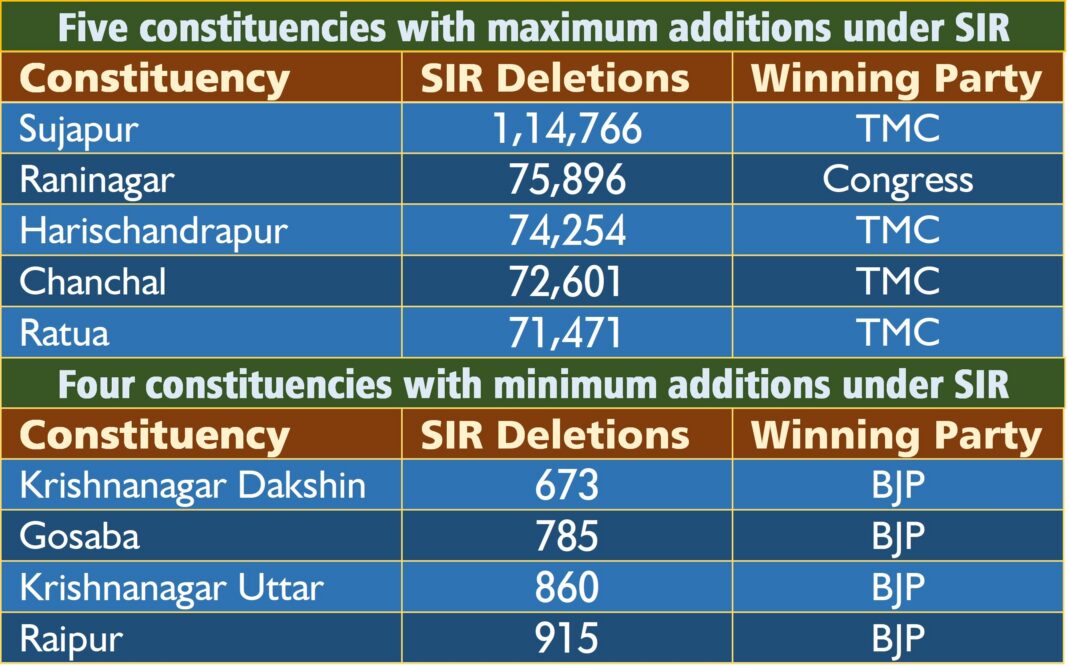
The top five ACs with maximum net additions of eligible electors under SIR were won by the INDI Alliance parties, four by TMC (Sujapur, Harischandrapur, Chanchal, Ratua) and one by Congress (Raninagar). On the other hand, the seats with the lowest additions, including Krishnanagar Dakshin, Gosaba, Krishnanagar Uttar, Raipur and Narayangarh, were won by the BJP.
These numbers make it clear that the SIR didn’t hamper the TMC, as alleged by the party.
Posting the analysis on X, BJP leader Amit Malviya further noted that even in a hypothetical scenario where all 27 lakh adjudication cases were added back and every single vote went to the TMC, seat-wise analysis shows the BJP would still lead comfortably in 181 constituencies, well above the majority mark of 148 in the 294-seat Assembly.
TMC made two major allegations after the BJP’s historic victory in West Bengal:
— Amit Malviya (@amitmalviya) May 9, 2026
1Deletion of voters through SIR
2Wrongful addition of voters from UP & Bihar
But a single set of data demolishes every lie 👇
• The top five seats with the maximum deletion of ineligible electors… https://t.co/3Wk6IMzDps pic.twitter.com/pKD2jnqjTk
The SIR exercise, conducted across several states, aimed to remove duplicates, deceased, shifted, and ineligible voters from rolls that had ballooned pre-revision. While opposition parties and some left-liberal media reports have raised concerns over opacity, errors, and alleged disproportionate impact on minorities, the empirical correlation between deletion intensity and electoral outcomes does not support the TMC’s core claim of losing because of the SIR.
Therefore, while the scale of deletions sparked debate on process and inclusivity, available voting data indicate that the TMC’s defeat was not engineered by voter deletions. The people of West Bengal delivered a clear mandate, and the numbers show the party retained strongholds even in the most affected seats.
