

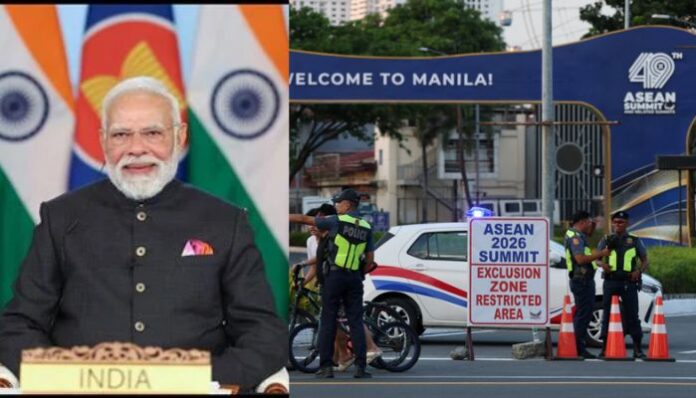
On Monday, 16th November Prime Minister Narendra Modi departed for Manila, Philippines, for a two-day visit to attend the 23rd ASEAN-India Summit and the 21st East Asia Summit. The meetings, scheduled for 17th November, will focus on strengthening maritime security, expanding economic cooperation and deepening India’s development partnership with Southeast Asian countries.
PM @narendramodi has departed for the Republic of the Philippines, to attend the 23rd ASEAN- India and 21st East Asia Summit. 🎥 A look at the highlights of the multifaceted India-ASEAN partnership. https://t.co/znKR3Q9VuI
— Randhir Jaiswal (@MEAIndia) November 16, 2026
During his visit, Modi will attend a dinner hosted by Philippine President Ferdinand R. Marcos Jr. on Monday for visiting leaders. On Tuesday, 17th November, he will participate in the ASEAN-India Summit and the East Asia Summit. His schedule will also include bilateral meetings with other participating leaders. The Indian government is also trying to arrange an interaction between the Prime Minister and members of the Indian community in the Philippines.
A meeting of Quad leaders is also being planned on the sidelines of the ASEAN Summit. US President Donald Trump, Japanese Prime Minister Sanae Takaichi, Australian Prime Minister Anthony Albanese and Modi are expected to participate.
What the Ministry of External Affairs said about Modi’s visit
According to a press release issued by the Press Information Bureau (PIB) on Thursday, 12th November, PM Modi will visit Manila from 16th to 17th November at the invitation of Philippine President Ferdinand Marcos Jr. The Philippines is hosting the two summits as the ASEAN Chair for 2026.
The release said that India-ASEAN relations are a central pillar of India’s Act East Policy and its vision for the Indo-Pacific region. The visit comes as India and ASEAN are observing 2026 as the ASEAN-India Year of Maritime Cooperation. The two sides will also mark 35 years of their Dialogue Relations and five years of their Comprehensive Strategic Partnership in 2027.
The ASEAN-India Summit will review the progress made in implementing the Comprehensive Strategic Partnership, including the ASEAN-India Plan of Action for 2026-2030. It will also provide an opportunity to discuss the future direction of cooperation between India and the regional grouping.
Maritime security, trade and development partnership among key priorities
According to Rudrendra Tandon, Secretary (East) in the Ministry of External Affairs, strengthening maritime security cooperation will be one of the main priorities during Modi’s engagements in Manila. India is expected to underline the need for closer cooperation among like-minded countries to maintain peace, stability and security in the Indo-Pacific region.
Economic cooperation is another major area of focus. Indian officials said that both sides are working to strengthen trade and investment ties, improve connectivity and build resilient and diversified supply chains.
“Economic cooperation” remains an important pillar of the India-ASEAN relationship, officials said, adding that the two sides are looking to expand their economic engagement.
Development partnership and capacity building will also feature in the discussions. India supports efforts to reduce the development gap among ASEAN countries through the Initiative for ASEAN Integration (IAI). “Through our support to Initiative for ASEAN Integration (IAI), India supports capacity building efforts to narrow the development gap in Cambodia, Laos, Myanmar and Timor Leste,” officials said.
The visit will also provide an opportunity to review the overall progress of the India-ASEAN partnership, discuss regional and international developments and identify new areas of cooperation.
Modi’s 13th participation in ASEAN-India Summit
This will be PM Modi’s 13th participation in the ASEAN-India Summit since 2014, underlining the importance India attaches to its relationship with the regional grouping.
The year 2027 will be an important milestone in India-ASEAN relations, as it will mark 35 years of their Dialogue Relations and five years of the Comprehensive Strategic Partnership. ASEAN will also complete 60 years since its establishment.
India and ASEAN have expanded their engagement in recent years, with growing cooperation in areas such as trade, investment, connectivity and defence. New Delhi considers stronger ties with ASEAN important for advancing its Act East Policy and strengthening its position in the Indo-Pacific.
Myanmar situation likely to feature in wider regional discussions
The situation in Myanmar is also expected to remain an important issue during the broader ASEAN discussions. India has maintained that isolating Myanmar would be counterproductive and could create space for other external powers to increase their influence in the country.
MEA Secretary (East) Rudrendra Tandon said India continues to support ASEAN-led initiatives to engage with Myanmar. He stressed that the country’s complex historical and social circumstances need to be taken into account.
Tandon said there was no alternative to engagement and cautioned against an approach that could create a diplomatic vacuum.
ASEAN has restricted Myanmar’s military leadership from attending its high-level meetings following the 2021 military coup that removed the democratically elected government of Aung San Suu Kyi and the conflict that followed.
India started its ASEAN journey by becoming a Sectoral Dialogue Partner in 1992, becoming a full Dialogue Partner in 1996, holding annual summits starting in 2002, and most significantly, joining the Treaty of Amity and Cooperation (TAC) in October 2003, which firmly established New Delhi’s adherence to ASEAN’s principles of peaceful dispute resolution and non-coercion.
The ASEAN grouping, which has 11 member countries, is among the most influential regional organisations in the Indo-Pacific. The East Asia Summit, established in 2005, serves as a key platform for discussions on strategic, security, defence and economic issues. Its participants include ASEAN members as well as India, China, Japan, South Korea, Australia, New Zealand, the United States and Russia.
Modi’s visit is expected to further strengthen India’s engagement with Southeast Asia at a time when maritime security, economic ties and regional geopolitical developments are becoming increasingly important.
