

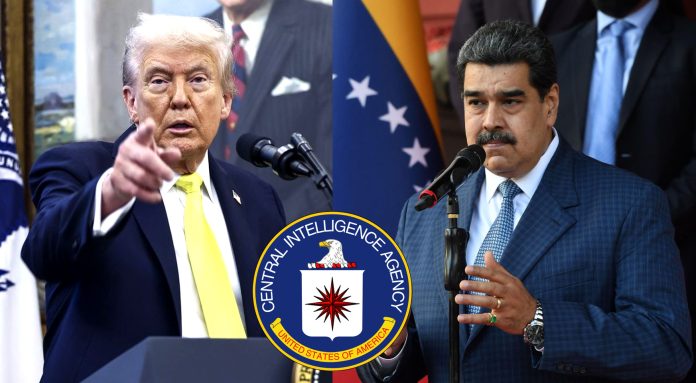
U.S. President Donald Trump has confirmed that he has authorised the Central Intelligence Agency (CIA) to conduct covert operations inside Venezuela, marking a significant escalation in the United States’ long-standing campaign to oust Venezuelan President Nicolás Maduro from power. This move comes as part of broader efforts to combat alleged drug trafficking and criminal activities linked to the Maduro regime, with U.S. forces already engaging in military strikes in the region.
In a statement to reporters in the Oval Office on Wednesday, alongside FBI Director Kash Patel and Attorney General Pam Bondi, Trump explained his rationale for the authorization. “I authorised for two reasons really. Number one, they [Venezuela] have emptied their prisons into the United States of America. They came in through the, well, they came in through the border. And the other thing are drugs, we have a lot of drugs coming in from Venezuela, and a lot of the Venezuelan drugs come in through the sea. So, you get to see that, but we’re going to stop them by land also,” Trump said.
He further indicated that the U.S. is considering land-based strikes for further actions in the region, saying, “we are certainly looking at land now, because we’ve got the sea very well under control.”
When pressed on whether the CIA’s new authority could be used to directly unseat Maduro, for whom the U.S. has offered a $50 million bounty on charges of narcoterrorism, Trump called it a “ridiculous” question for him to answer. “Wouldn’t it be a ridiculous question for me to answer?” he replied, avoiding specifics on the scope of the operations.
“But I think Venezuela is feeling heat. But I think a lot of other countries are feeling heat too. We’re not going to let this country, our country, be ruined because other people want to drop, as you say, their worst,” Trump further said.
The authorization, detailed in a presidential finding, empowers the CIA to undertake a range of activities, including potentially lethal operations, either independently or in support of larger military efforts. U.S. officials have privately stated that the ultimate objective is to remove Maduro from power, amid accusations that he leads a criminal network involved in drug trafficking, including the so-called Cartel of the Suns and the Venezuelan gang Tren de Aragua. Maduro has repeatedly denied these allegations, and some U.S. intelligence assessments have contradicted claims of Venezuela as a major drug producer.
This latest development builds on Trump’s ongoing attempts to dismantle the Maduro government, which the U.S. does not recognize as legitimate following disputed elections. Recent actions include halting diplomatic talks with Caracas due to Maduro’s refusal to step down, deploying approximately 10,000 U.S. troops to the region, primarily in Puerto Rico, and positioning naval assets, including eight surface warships and a submarine, in the Caribbean.
In the past few weeks alone, U.S. forces have carried out at least five strikes on suspected drug-carrying vessels off Venezuela’s coast, resulting in 27 deaths. These operations have been criticized by UN human rights experts as potential “extrajudicial executions.”
A leaked congressional memo has framed these efforts as part of a “non-international armed conflict” with drug-trafficking organizations, labelling them as “nonstate armed groups” that pose a direct threat to the United States. CIA Director John Ratcliffe, known for advocating a more aggressive agency stance, has expanded counternarcotics operations in Latin America, including drone surveillance for fentanyl labs in Mexico.
Secretary of State Marco Rubio, who also serves as national security adviser, has been instrumental in shaping this strategy, publicly branding Maduro a “narcoterrorist” and pushing for his ouster. The administration’s approach echoes historical CIA involvement in Latin America, from the 1954 coup in Guatemala to operations against Fidel Castro in Cuba, causing prolonged instability in several nations.
Venezuelan officials have condemned the U.S. actions, with Maduro warning against “CIA coups” and heightening fears of an imminent invasion in Caracas. A statement issued by the govt said, “The Bolivarian Republic of Venezuela rejects the extravagant statements of the President of the United States, in which he publicly admits having authorized operations in order to act against the peace and stability of Venezuela.”
The foreign ministry of the Venezuela govt said it would raise this complaint to the security council and the secretary general of the United Nations.
