

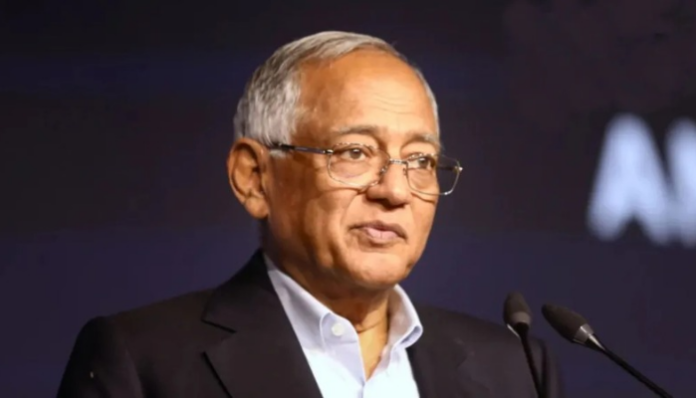
The succession battle within the Venu Srinivasan branch of the TVS family has moved from boardroom manoeuvring and court caveats to a formal demand for partition, with Lakshmi Venu seeking an equal share in the joint family assets controlled by her father.
In a partition notice addressed to Venu Srinivasan, chairman emeritus of TVS Motor Company, Lakshmi has asked him to discharge his fiduciary duties as head of the family and give effect to a “fair and lawful partition.” The notice, confirmed by a statement from her office, covers family interests held through the VS Trust and other holding structures, including stakes in TVS Holdings, TVS Motor Company, TVS Credit Services and Sundaram-Clayton businesses and assets allotted to the Venu Srinivasan branch under the wider TVS family arrangement of 2020.
Lakshmi, managing director of Sundaram-Clayton and vice-chairman of TAFE, has invoked Section 6 of the Hindu Succession Act, 1956, as amended in 2005, which recognises daughters as coparceners with rights equal to sons in qualifying joint family property. Her position is that the 2020 division of the larger TVS Group did not amount to a partition within her immediate family, and that no settlement or division of assets within Venu Srinivasan’s family was ever initiated, let alone completed.
Her mother, Mallika Srinivasan, chairman and managing director of Tractors and Farm Equipment, has publicly backed the claim. “As a mother, to me, a son and daughter are equal in every respect. I do believe that Lakshmi has a legitimate share of the family assets, not unequal to that of Sudarshan’s,” she said, while calling for a settlement through transparent dialogue.
The move sharpens a dispute that surfaced publicly in October after TVS Holdings disclosed that Sudarshan Venu, Lakshmi’s brother and the person who leads TVS Motor, had been identified as a significant beneficial owner through trust structures. Lakshmi and Mallika questioned those arrangements, and all four family members Venu Srinivasan, Mallika, Lakshmi and Sudarshan filed caveats in Chennai courts, signalling preparations for possible litigation even as both sides publicly favoured an amicable resolution. The four represent the third and fourth generations of T.V. Sundaram Iyengar, founder of the TVS Group.
What the whole dispute is about
At its core, the fight is over whether the Srinivasan family’s economic interests have actually been divided and, if not, whether Lakshmi is entitled to an equal share of assets that she says are joint family property.
Venu Srinivasan and Sudarshan maintain that a separation has already been carried out. They point to a memorandum of understanding signed by all four family members in March 2024, and to the broader 2020 TVS family arrangement, as evidence that the economic split is complete. Venu Srinivasan has said the businesses and assets were his, that he had the liberty to deal with them as he thought best, and that the separation gave Lakshmi the Sundaram-Clayton business while Sudarshan got the motors business. “The separation was always about ownership and control,” he has said, adding that both children were given a fair share on which to build.
Lakshmi and Mallika reject that characterisation. They argue that the March 2024 MoU was primarily a limited-term agreement on the use of the TVS brand and trademarks, along with non-compete obligations, and cannot be treated as an economic settlement. They say no transparent valuation, discussion or mutual consent took place to divide the family’s economic interests, and that management or control of a business does not confer exclusive ownership or extinguish the legal rights of other family members.
Lakshmi has alleged that beneficial interest in the family assets has been concentrated in favour of Sudarshan at the expense of her own lawful rights, describing it as both a breach of law and a breach of trust. Her statement put the broader argument bluntly: “Patriarchy has no place in law or in a progressive India.”
The legal question is not simply whether a daughter can inherit. The 2005 amendment to the Hindu Succession Act made daughters coparceners in joint family property, and Lakshmi’s case rests on that right. But the dispute will turn on whether the assets in question are indeed joint family or coparcenary property, whether the 2024 MoU operated as a partition, and how the trust structures that hold the family’s stakes in listed and unlisted companies are treated. Because the VS Trust holds a 66.55% stake in TVS Holdings, which in turn owns a majority stake in TVS Motor, any partition or reallocation could have consequences for ownership and control of one of India’s best-known automakers.
For now, the notice is a legal escalation rather than a filed suit. Lakshmi has said she prefers an amicable and equitable resolution, and the family has publicly maintained that dialogue is the preferred route. But with a partition notice on the table and caveats already filed in Chennai courts, the TVS family feud has entered a phase where the next move may well be judicial.
