

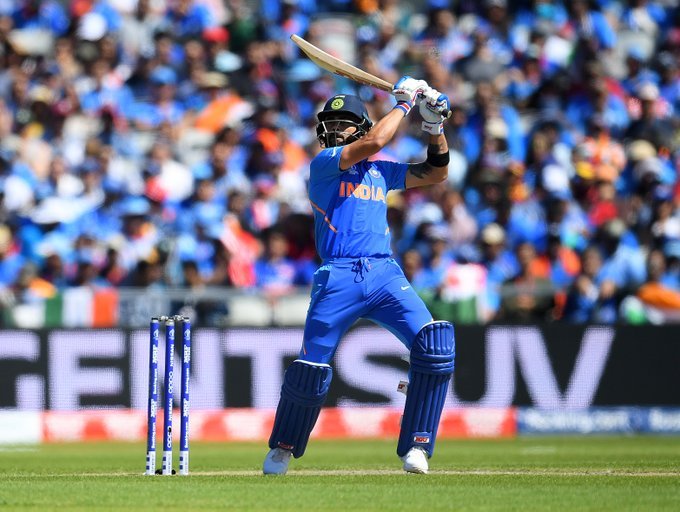
An easy win for India put them on the second position of the World Cup’s points table. India needs to win just one game from the remaining three matches to reserve the seat for the semi-final. West Indies has now officially out of the Cricket World Cup.
On a sunny and dry day, India opted to bat first after winning the toss. Rohit and Rahul started the innings cautiously before Rohit was given out by the third umpire. The original decision was not out, but the third umpire overturned it even though there was not conclusive evidence of Rohit hitting the ball with his bat.
Rahul and Kohli added 69 runs for the first wicket, and it looked like India will cross 300 plus score, but then Rahul lost his wicket. This is not the first time he has thrown away his wicket after a great start; any top order batsman in these conditions would love to score big hundreds. The Indian middle failed again, Shankar and Jadhav fell cheaply.
Kohli at the other kept scoring runs and in the process becomes the 3rd Indian to score four consecutive 50 plus score in the World Cup and becomes the quickest to reach 20,000 International runs. When trying to accelerate the innings, Kohli fell at the score of 180 in the 30th over.
Dhoni who crawled to 18 runs off 38, shifted gears in the last few overs along with Pandya and made sure India reaches a decent score to defend against the hard-hitting West Indians. Dhoni scored 56 not out while Hardik fell 4 short of his first world cup half-century.
For West Indies, their captain Jason Holder bowled an excellent spell of 10 overs in which he took two wickets for just 33 runs. Kemar Roach too had a great day on the field and gave full support to his captain; he took three wickets for only 36 runs.
West Indies had a terrible start when they lost Gayle in the fifth over with just ten runs on the board. They never get off, losing wickets at regular intervals as Indian bowlers were in top form. All five regular bowlers got a wicket, and West Indies was bowled out for just 143 runs. Shami and Bumrah were once again terrific, taking 6 out of 10 wickets which fell in the innings. Shami once again took four wickets, and he is now the leading wicket-taker for India in ODIs in 2019.
Watch the highlights
STATS
- Virat Kohli becomes the quickest to reach 20,000 runs in International cricket. He reached the milestone in just 417 innings while previously Lara and Tendulkar scored these many runs in 453 innings.
- Virat Kohli scored a fourth consecutive half-century in this World Cup. He is the third Indian to score four successive 50 plus score in World Cup after Sidhu (1987) and Tendulkar (1996 & 2003).
- Mohammad Shami took his 27th ODI wicket in the year 2019, the most by any Indian.
- Chahal becomes the first Indian bowler to take ten wickets in this World Cup.


