

The atrocities against minorities in Pakistan continues unabated as violence was unleashed against Hindus in Ghotki, Pakistan, after a school principal, who is a Hindu had made an alleged blasphemous remark.
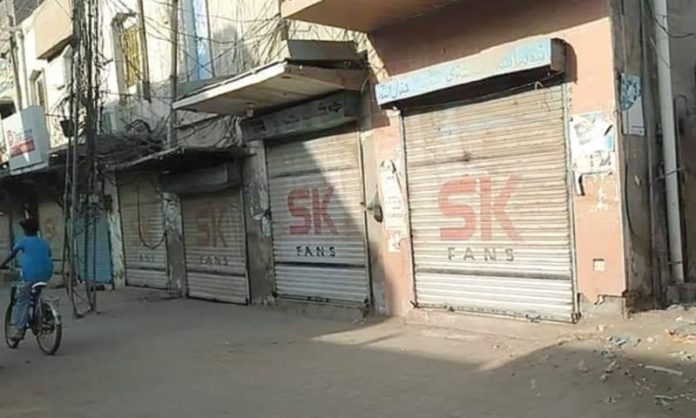
The angry mob attacked the SSD Dhaam Mandir and broke open shops in Jillani Market belonging to Suresh Kumar, Gopi Chand, Gurmukh Das and others in broad daylight.
A #Hindu teacher was attacked by a mob and a temple was vandalised in #Pakistan's Sindh province over allegations of blasphemy. The incident took place in #Ghotki in #Sindh on Sunday. pic.twitter.com/yM4hYAmh4a
— NooriBadat (@NooriBadat) September 16, 2019
Properties worth millions of rupees were attacked and several shops belonging to the Hindu community looted on Sunday by an enraged Muslim mob in Ghotki town after the owner of a school was accused of committing blasphemy.
A Hindu principal in Ghotki, Sindh has purportedly been accused of committing blasphemy by extremists, who have vandalised his school. Hindu community in the area is in danger. They must be provided with protection immediately! Video & report via Shankar Meghwar pic.twitter.com/Xctf04brli
— Bilal Farooqi (@bilalfqi) September 15, 2019
Reportedly, an enraged mob led by local Muslim leaders attacked properties belonging to Hindus and looted their shops, taking away goods worth millions.
Later, the angry mob blocked the National Highway in protest against the alleged blasphemous remarks. They raised slogans and demanded of the authorities to arrest Prof Lal for making the blasphemous remark. The violence also occurred in towns like Mirpur Mathelo and Adilpur, apart from Ghotki.
The Human Rights Commission of Pakistan has taken cognisance of the matter and raised concerns over the “outbreak of mob violence”.
Alarming reports of accusations of blasphemy in #Ghotki and the outbreak of mob violence. https://t.co/PEc15iBsJi
— Human Rights Commission of Pakistan (@HRCP87) September 15, 2019
Following the incident, the World Sindhi Congress has also expressed concerns over reports of violence, urging other countries to pressure Pakistan “to ensure safety” of religious majorities in the neighbouring country.
Alarming: Hindu community in #Ghotki Sindh under attack after student accused a #Hindu school principal of #blasphemy. Principal’s school, Hindu temples, shops & homes ransacked by mobs. The world must pressurize #Pakistan to ensure safety of religion #minorities in the country.
— WorldSindhiCongress (@sindhicongress) September 15, 2019
The human rights advocacy group urged the other countries to pressurise Pakistan to ensure safety of religious minorities in the country.
Pakistan is notoriously known for its persecution of not only religious minorities but also ethnic minorities within their own country. The forceful conversion programmes have often been unleashed against the minorities especially Christians, Sikhs and Hindus living in Pakistan with utmost brutality. This violence against Hindus in Pakistan’s Ghotki comes months after a series of abductions and forceful conversions of minority Hindu and Sikh girls. In March, two underage Hindu girls Raveena (13) and Reena (15) were abducted from the Ghotki in Pakistan’s Sindh on the eve of Holi. The girls were later forcefully converted and married off to older Muslim men.
Earlier, Jagjit Kaur, a Sikh girl was abducted and forcibly converted to Islam in Nankana Sahib which has caused a huge uproar. It has attracted widespread criticism and a massive protest by Sikhs in India in front of the Pakistani Embassy in New Delhi. The MEA, too, issued a strong statement and demanded immediate remedial action from Pakistan.
In another horrific incident, a 13-year-old Pooja Sotahar Kumari, daughter of Fatan Rathore, resident of village Bakhsho Laghari in Hyderabad district’s Hosri Taluka, was kidnapped, forcefully converted and subsequently married off to a man identified as Syed Irshad Shah.
Recently, a report released by the Members of the European Parliament (MEP) threw light on the plight of religious minorities in Pakistan. The report claims that around 1000 girls from religious minorities are forcibly converted to Islam every year. The numbers might be higher as many cases are not even reported.


