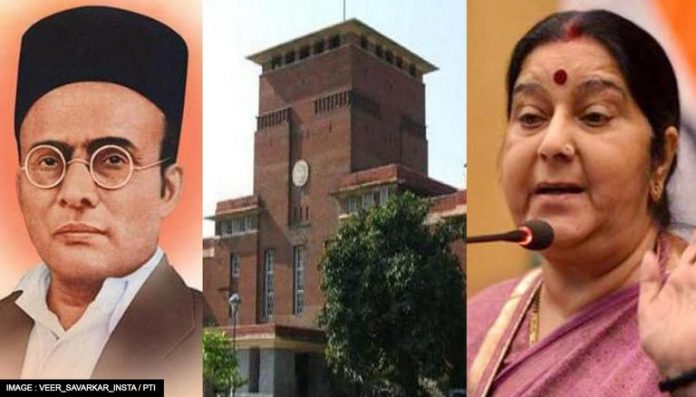
Delhi University has decided to name upcoming colleges after Hindutva stalwart Veer Savarkar and the late BJP leader and Union Minister Sushma Swaraj. The Delhi University vice-chancellor Yogesh Singh informed during the meeting of the executive council held on Friday that two future colleges of Delhi University will be named after them.
The DU administration has also allotted two chunks of land at Najafgarh and Fatehpur Beri for the establishment of the two colleges. DU wanted to set up new colleges in the Delhi dehat area since in the last 25 years, no new colleges fully funded by the Central Government came up in the NCT Delhi.
Seema Das, an executive council member told the media members of the executive council were informed that in the previous meeting a pool of names was suggested for the new college. “During the meeting on Friday, when a member sought an update on the development, we were told that these two names were finalised,” Das said.
The idea to set up new colleges and name them after noted Indian personalities were taken during the academic council meeting of the university held on August 22 this year. During the further discussion, some names that were proposed for the college included Veer Savarkar, Sushma Swaraj, Swami Vivekananda, Sardar Vallabhbhai Patel, Atal Bihari Vajpayee, Savitri Bai Phule, Arun Jaitley, Choudhary Brahm Prakash and CD Deshmukh. The council authorised the VC to select the name.
However, some like Rajpal Singh Pawar in the DU executive council who have known political association, opposed the decision to name the colleges Veer Savarkar and Sushma Swaraj. He objected saying that the shortlisted people are associated with a ‘particular ideology’.
BA K Bhagi, President of National Democratic Teachers Front and former member of the executive council, welcomed the decision if the new colleges are set up in name of great historical luminaries, unsung heroes.
“It will be a good decision to name or construct new colleges in name of great historical luminaries, unsung heroes. I welcome the proposal of the DU and when it finally comes up it will be a great contribution towards the enhancement of the new education policy which comes after 1986. A women college in the name of a greatly respected leader Sushma Swaraj will keep motivating country to realise the goal of Beti Bachao, Beti Bachao,” Bhagi stated.
Kunal Sehrawat, president of Delhi NSUI, the student wing of the Congress party, had threatened to further insult and resort to vandalism if a college is named after Veer Savarkar.