

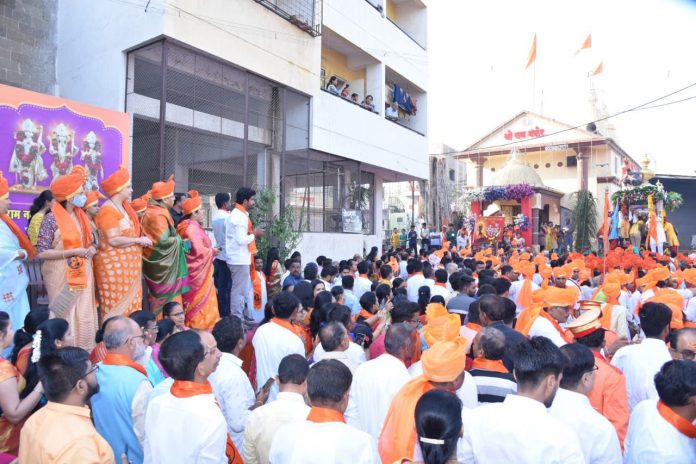
The year was 1929, freedom struggle in the entire nation was at its peak. In the small town of Sangamner in Maharashtra, nationalist sentiments were high as Hanuman Jayanti, the traditional Rath yatra Utsav of the town was approaching and the British police had decided not to allow the Rathayatra.
On the day of Hanuman Jayanti, people across the town gathered in the early morning, at Chandrashekhar Chowk from where the Rathayatra was supposed to begin. The police had already arrived and were determined to not allow this yatra. Thousands of people gathering in one place, in one spirit, to worship the god of strength and power was not something the British would take quietly. And so, the police declared that they will shoot and beat up anybody who tries to move the Rath and march on. The people, though furious, could not step forward because of the fear of a Jallianwala-Baugh-like massacre that could take place.
Suddenly from nowhere two-three saree-clad women came forward, took the string of the Rath in their hands and started pulling the Rath forward will all the strength they could gather. This stunned everybody. Another two-three woman joined and started taking the huge Rath forward will every bit of strength in their body. The police could not understand what had just happened. The extremely heavy Rath was being taken forward by five women in front of their eyes, in spite of their warning. And mind you, these were not some affluent, activist, educated women; they were common, illiterate but brave Indian women who decided to stand up to the British police for their traditions, for their revered Hanuman, for their nation, their pride and their dignity.
After realising what had just unfolded, the police decided to take control. But till then, hundreds of women, little girls and men too had joined their brave sisters in pulling Hanuman Ji’s Rath. After reaching the next chowk, a reserved force arrived and stopped the procession. The women did not budge. They took a decision to let the Rath stay there until the police let them carry it forward. For two months, the entire town was on Satyagraha.
Finally, the British govt had to kneel and allow the Rathayatra. This was the victory of those five women, of the girls, women who joined them and of the entire town that decided to stand tall and fight the British. The Rathayatra concluded with immense joy, pride and an even stronger spirit of unity and patriotism.
The tradition still continues. The small town of Sangamner in Maharashtra, every year celebrates Hanuman Jayanti by remembering this struggle and by honouring the women-power. Every year since 1929, the Rathayatra begins with women pulling the Rath first.
Earlier today, Chitra Kishor Wagh, VP BJP Maharashtra, took to Twitter to share details of the tradition and how it still continues to date. In a Twitter thread, she also expressed her gratitude for the honour of getting the opportunity to pull the Rath this year.
हनुमान जयंती उत्सव हा संगमनेरच्या इतिहासातील महत्वाचा पैलू..
— Chitra Kishor Wagh (@ChitraKWagh) April 16, 2022
स्वातंत्र्यपूर्व काळात संगमनेरात ब्रिटिशांविरुद्ध वातावरण तापले होते
२२ एप्रिल १९२९ रोजी सब डिव्हिजनल मॅजिस्ट्रेट यांनी मिरवणुकीवर बंदी घालन्याचे जाहीर केले..संगमनेरला छावनीचे स्वरुप आले होते..(१/४)#हनुमानजन्मोत्सव pic.twitter.com/lEHYTo3BUR
We often are told through our history books or our media that a few leaders, one party won us our independence. But events in our history like this one, remind us that it was, truly, we the people of India, who struggled, sacrificed and won the war of independence.


