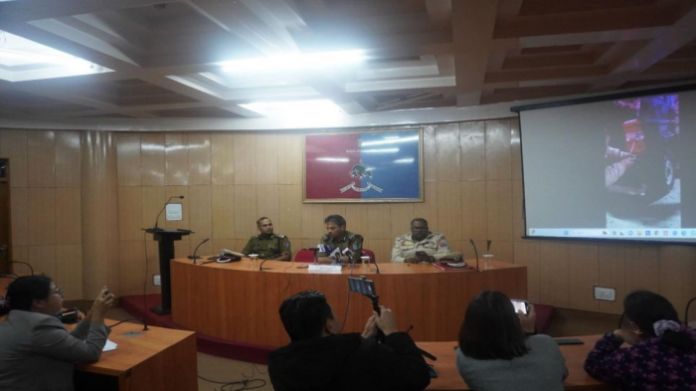
Nagaland Police have busted one of the biggest drug networks operating in Nagaland and other parts of Northeastern states, said the state police chief Rupin Sharma on Wednesday. Over one year, this network trafficked 60kgs of heroin valued at around 400 crores rupees, he added.
Sharma was addressing the media at the Police Headquarters here relating to the ‘war on drugs’.
Informing that a case was registered in Zubza Police Station under Kohima DEF on November 13, where two persons from Manipur were caught trafficking drugs, he said that within one month the police had successfully nabbed twelve persons in similar cases who were involved in illicit trafficking of narcotic drugs in the state.
The DGP also informed that the arrested persons belong to Nagaland, Manipur and Assam, and the case is still under investigation and that there is the involvement of many other people in the network, which will be unearthed soon.
“It’s not a small case, 60kgs of drug(heroin) being trafficked over one year by just one network is a huge case”, the DGP said, adding that almost 400 crores rupees of drugs trafficked by just one network is huge.
Sharma also said that through continuous efforts and direction, Nagaland Police has ensured that from the first of January 2023 till date, a total of 318 cases have been registered and 456 persons have been arrested in connection with NDPS (Narcotic Drugs and Psychotropic Substances)-related activities.
Mentioning that the total worth of the seizures made is around one hundred and ninety-nine crore rupees at market value, however, the damage to the networks is greater because the focus is on systematically going after them and dismantling them.
Sharma said the focus has now shifted to breaking the whole nexus operating in the supply chain of NDPS and in this direction, efforts are being made to develop the forward and backward linkages in NDPS cases and apprehend all the persons operating in the network.
Nagaland Police is committed to ensuring a drug-free Nagaland in line with the efforts of the Government of India towards ensuring a Drug-Free India by 2047.
Nagaland Police has initiated a lot of steps on various fronts: public engagement, awareness campaigns, inter-department coordination, better investigation and prosecution and technology upgradation, besides a Canine Squad. The Nagaland DGP further requested that the public extend a helping hand and be cautious as it is easy for the traffickers to fool people into carrying drugs or allowing other measures for facilitating traffickers.
(This news report is published from a syndicated feed. Except for the headline, the content has not been written or edited by OpIndia staff)