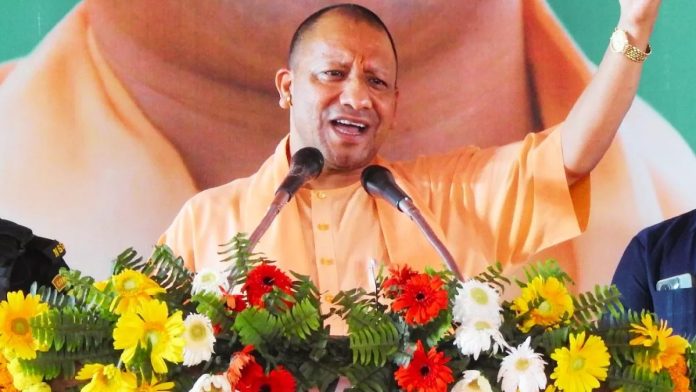
Drawing a stark comparison between the previous governments and the present government, Chief Minister Yogi Adityanath emphasized on Saturday that Uttar Pradesh witnessed curfews and riots before 2017.
However, he declared, “Aaj no curfew-no danga, UP mein sab changa” (Today there is no curfew, no riot here, because everything is fine in UP).
Addressing a public meeting at Mahatma Gandhi Stadium (Physical Ground) in Rampur, the CM said, “All festivals are being celebrated peacefully. Whether it’s Guru Purab, Holi, Eid, Diwali, or Christmas, all are celebrated joyously. Everyone has the freedom to celebrate festivals in their own way. There is security and prosperity here. Today, no one can endanger the security of daughters and businessmen. If anyone tries, he will face consequences.”
He further emphasized that the government is committed to providing security and facilities.
“The government is fulfilling its responsibilities. With such governance, the country is witnessing unprecedented development,” he asserted.
The Chief Minister also inaugurated and laid the foundation stone for 84 development projects worth Rs 610 crore in Rampur. A short film showcasing the development works in Rampur was screened during the event. The CM also honoured the beneficiaries of various schemes.
The Chief Minister highlighted that previously, farmers lacked access to electricity. However, this year, Rs 2600 crore has been allocated in the budget for free tube well irrigation, ensuring better agricultural practices.
“The government is diligently working towards ensuring timely payment of sugarcane prices to our ‘Annadata’ farmers and providing them with higher prices for their produce. Additionally, efforts are underway to create employment opportunities for the youth,” the Chief Minister said.
“On February 19, with the blessings of the Prime Minister, investment proposals of Rs. 10.5 lakh crore have been implemented in the state, which will provide employment to 35 lakh youth. The youth, who previously sought jobs in other parts of the country and abroad, are now finding employment opportunities within the state,” he added.
The Chief Minister highlighted the positive outcomes of the collective efforts of public representatives, stating that Rampur is now forging a new identity of development. He reassured the public, saying, “Don’t worry, we are committed to both development and preserving our heritage. Please continue to bless us. Every effort will be made to foster development here.”
He mentioned that with the advent of prosperity, occurrences of activities such as pickpocketing and thefts will decrease.
“We will ensure employment opportunities for everyone. The melodious strains of violins will once again fill the air in Rampur. The Rampur Gharana will regain its prominence as a distinguished musical institution,” he said.
CM said that we have constructed the Circuit House, which will be named after Saint Shiromani Ravidas Ji. Furthermore, the CM affirmed that in today’s India, whether it’s education, healthcare, employment opportunities, or the safety of daughters and businessmen, all are ensured.
“PM Modi has tirelessly worked for 10 years with the vision of a ‘Viksit Bharat.’ To achieve a developed India, we need a developed Uttar Pradesh, and for a developed UP, we need a developed Rampur. Projects such as the construction of a ring road, an airport, the rehabilitation of a sugar mill, the development of roads, polytechnics, IITs, and malls are all underway to contribute to the development of Rampur,” he said.
The CM said that the foundation stone of a new university has been laid today for Mirzapur and this division.
He criticized the previous government for hindering university construction, stating, “Earlier, universities were not allowed to be built. People attempted to grab land and claim it as their own. Today, no one can unlawfully take land from the poor. If we need land, we negotiate and provide four times the compensation; we do not grab land by force.”
He urged the public to vote in support of Ghanshyam Singh Lodhi.
(This news report is published from a syndicated feed. Except for the headline, the content has not been written or edited by OpIndia staff)