

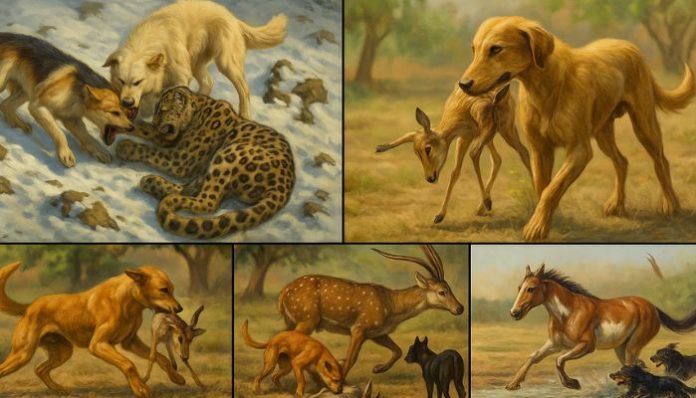
In April this year, morning walkers stumbled upon a harrowing scene in the pre-dawn quiet of Chandigarh’s Sukhna Wildlife Sanctuary. A pack of around 20 feral dogs had attacked two sambar deer near the lakeside. A young one was killed while the other barely escaped with injuries. Despite the efforts of onlookers to intervene, the sambar succumbed to its wounds. This was not the first incident of a stray dog attacking wildlife and it will not be the last either. From the foothills of the Himalayas to the salt flats of Rajasthan, similar scenes are playing out with unsettling regularity.
India’s free-ranging and feral dogs have become a major crisis as they have turned into invasive species in natural ecosystems. Rajasthan’s Sambhar Lake, a Ramsar wetland once famed for its flamingos, has become a hunting ground for 30 to 40 packs of feral dogs hunting migratory birds with impunity. Packs of dogs have learned to encircle flocks resting on the exposed lakebed. Not all birds can take flight at once, and the coordinated attack of dogs kills many of them without much effort.
Every day, locals report two to three wild birds being killed by dogs at Sambhar. The wetland’s conservation plan exists only on paper. Illegal dumping of meat waste draws scavenging dogs, and authorities fail to act in time despite the clear and present danger to wildlife.
The story is same across India. Dogs, who have been defined as “community animals” in ABC Rules, 2023, have expanded their territories from cities and villages to forests and grasslands, creating ecological havoc. These dogs pose extreme threats to biodiversity. Policy response to these multifaceted threats have so far been inadequate.
The Scale of the Problem – Dogs on Nature’s Doorstep
There are over 60 million dogs in India, which is only an estimated number, and some experts believe the number can be far beyond 120 million. Of these, more than half are stray or free-ranging. They live on the streets and in the wild with no human supervision whatsoever. The situation has made dogs the country’s most abundant terrestrial carnivore, outnumbering any wild predator.
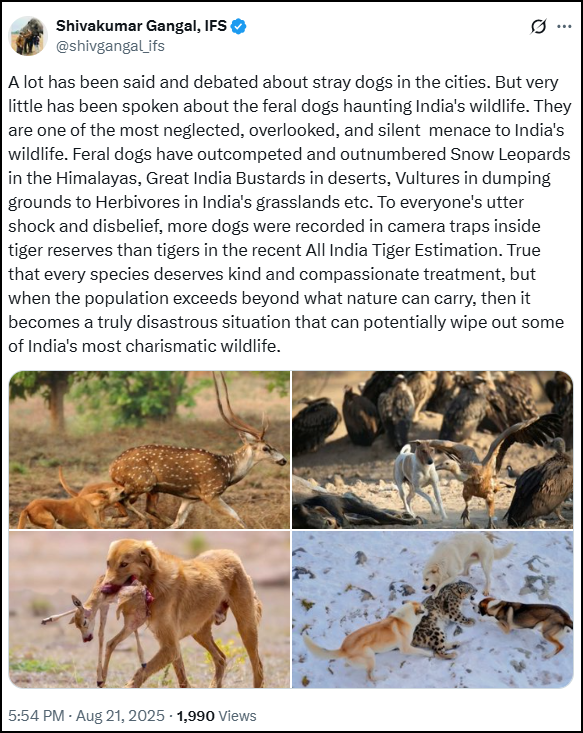
A nationwide survey reported that these dogs attack 80 different species of India’s wildlife, 31 of which are classified as threatened on the IUCN Red List. Some of these are critically endangered species. The incidents of dog–wildlife conflict are not confined to remote jungles. Nearly half of them are reported in or around Protected Areas like wildlife sanctuaries and national parks.
Alarmingly, camera-trap studies have detected feral dogs in most of India’s 50 tiger reserves, which illustrates how dangerous the incursion has become. From the dense forests of Central India to the high-altitude cold deserts, dogs are appearing in habitats where they were never part of the native fauna. A government tiger survey confirmed dogs as a threat to both ungulates (which they hunt) and carnivores (as disease carriers) in these reserves.
Speaking to OpIndia, Indian Forest Service (IFS) officer Shivakumar Gangal, noted, “Dogs are showing up on camera-traps beyond what nature can carry and at a dangerous level”.
According to scientific assessments, there are alarming numbers of feral dogs in Ladakh’s Changthang Wildlife Sanctuary, where researchers documented an average of 310 dogs per 100 square kilometres in one sector (Hanle) and 61 per 100 square kilometres in another (Tso Moriri). Even in the sparsely populated Trans-Himalayan plateau, packs of dogs thrive around villages and nomadic settlements, ready to range into surrounding wildlife.
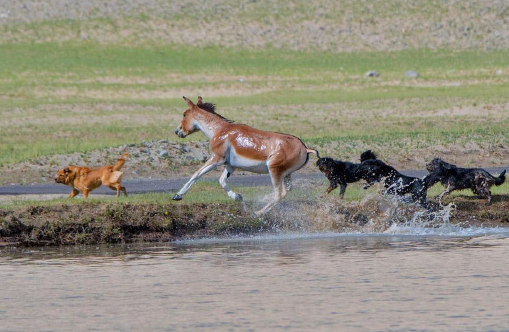
The point is clear. Free-ranging dogs exist at significant densities across diverse Indian ecosystems, often living subsidised by human waste and habitation. Their reach extends well into areas meant to be safe havens for wildlife.
These examples are a clear indication that the dogs are coming into direct conflict with native animals across the country. Be it cities, farming villages adjoining forests, or deep inside wildlife reserves, the presence of dogs and their threat to wild animals are being seen in large numbers.
For example, packs of dogs from villages routinely enter open fields in Hisar and Badopal districts of Haryana. Notably, black antelope often graze in these areas. Over a four-year period between 2016 and 2020, the Forest Department recorded that dogs killed 361 blackbucks, 1,641 nilgai, 25 peafowl, 29 chinkara gazelles, and 35 monkeys in just one division of Hisar district.
Research has shown that the threat is not anecdotal but well documented. A Bionotes paper pointed out that domestic dogs have already contributed to 11 vertebrate extinctions globally and threaten nearly 200 vertebrate species through predation, disturbance, competition, hybridisation, and disease transmission. In India, a national survey documented attacks on 80 species, 31 of them threatened on the IUCN Red List, with nearly half of such incidents occurring inside or near Protected Areas.
These are not small numbers. They show that dogs have become a leading cause of deaths for local wildlife. They have effectively become an apex predator in an area long devoid of native big cats. Across India, in the human-dominated areas, wolves, leopards or tigers exist only in small numbers. Dogs have taken advantage of the situation and become de facto apex predators with virtually no checks on their population or behaviour.
Stray dogs are subsidised scavengers, thriving on human waste, handouts, and indifference. They live on the streets but remain tied to human settlements. Feral dogs are different, they have reverted to the wild, forming packs, hunting wildlife, and behaving like invasive predators in ecosystems that never evolved with them. In India, the line between the two has blurred, as strays pushed out of towns and villages spill into forests, gradually turning feral and unleashing havoc on native species.
Direct Ecological Impacts – Predation and Competition with Wildlife
The most direct impact of stray and free-ranging dogs on ecology is through predation, that is, hunting, killing, or mauling wild animals. Unlike truly wild carnivores, dogs are not constrained by territory or prey availability alone. Their populations are heavily subsidised by human-provided food, including garbage, handouts, and livestock carcasses. This allows them to exist in unnaturally high densities.
These numbers, combined with dogs’ instinct to hunt in packs, spell disaster for many native species. Large prey that might fend off a single wild predator can be overwhelmed by a mob of 10–20 dogs. In one extraordinary case, a pack of dogs was observed chasing away an entire pack of wolves from a kill in Ladakh. In another instance from Assam, dogs were photographed dragging down a hog deer fawn on the outskirts of Kaziranga National Park. These examples drive home the point that dogs, aided by human proximity, can deal out death to wildlife ranging from small birds and reptiles up to medium-sized ungulates, and even compete with India’s native carnivores at the top of the food chain.
The list of wild species attacked or killed by dogs reads like a who’s who of Indian biodiversity. The birds who build their nests on the ground, for example, vultures, or threatened species like bustards, marine turtles like the Olive Ridley coming ashore to nest, high-altitude mammals like the Himalayan goral and Tibetan wild ass, rare primates like the golden langur of Assam, and iconic mammals such as red pandas, desert foxes, leopards, and even snow leopards have been attacked. Their nests have been destroyed and offspring killed by the dogs in large numbers.

The Great Indian Bustard is one of the most endangered birds in the world. There are hardly 150 individuals left in the wild. Most of them are in Rajasthan. Reports have suggested that packs of dogs roam on the fringes of Desert National Park and hunt bustard chicks. They disturb the nesting sites and have derailed breeding in the only remaining population of this species, making it hard for the species to survive anymore in the wild.
The Great Indian Bustard has been flagged in scientific papers as facing an “imminent threat” from feral dogs. With fewer than 150 individuals left, dogs predate eggs, chicks, and even nesting females, worsening the chances of survival for one of the world’s most endangered birds.
Killing wildlife is not the only problem. Dogs also inflict grave injuries and stress on wildlife. Every chase does not end in a kill. Some wild animals escape, wounded and exhausted, only to die later from infection or lose fitness due to chronic harassment. Persistent dog activity can effectively render habitat unusable for sensitive species.
For example, field scientists in Ladakh report that smaller wild cats like the Eurasian lynx and Pallas’s cat are “intimidated” by the presence of these dogs. There have been instances where packs of dogs have been seen driving snow leopards away from their kills. Dogs have been seen confronting brown bears, which indicates a high level of boldness among the canines. Dogs, which are supposed to be a domesticated species, are now behaving like an invasive super-predator in ecosystems that did not evolve with them.
The disease risk is equally severe. A study cited in Bionotes noted that camera traps captured more dogs than tigers in 17 tiger reserves, underlining how widespread the intrusion is. At Panna Tiger Reserve, serological and genomic evidence confirmed that both dogs and wild carnivores carried canine distemper virus and parvovirus, showing direct spillover potential.
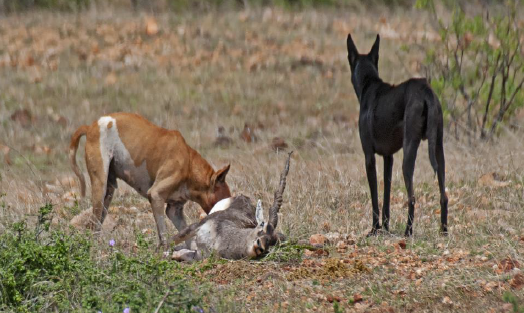
Experts suggest that dogs add a dangerous additional layer of challenge to already declining wildlife citing vultures as an example where dogs amplify existing pressures on the wild animals.
Gangal said, “Dogs are highly adaptive and resilient. They can literally eat anything, sleep anywhere, and survive in any condition. Wildlife, on the other hand, have very specific habitat and dietary needs. That is why dogs thrive, but wild species struggle.”
Furthermore, there is a serious issue of hybridisation of dogs. There have been examples in the wild where feral dogs were seen mating with wild canids including wolves and jackals. Though it is not as visibly violent as predation, such hybridisation can dilute the gene pool of endangered species. For example, if free-ranging dogs mate with Indian wolves or the Himalayan wolf in certain areas, there is a chance that it could threaten the genetic distinctiveness of these wild populations.
Such ecological impacts, predation, competition, disturbance, and hybridisation are a major cause of worry among wildlife experts. Together, these problems make free-ranging dogs one of the most pervasive and underestimated threats to India’s wildlife today.
Disease transmission – A looming biological time-bomb
Beyond the immediate carnage of teeth and claws, feral dogs pose a more invisible, but equally dire, threat to wildlife, that is, disease transmission. Domestic dogs are known vectors for a host of pathogens that can jump to wild animals. Some of these diseases have proven catastrophic to wildlife populations globally.
Rabies and canine distemper virus, or CDV, are among the most dangerous pathogens spread by dogs in the wild. Other pathogens, including parvovirus, have also created havoc in Indian wildlife. These diseases run rampant in stray dogs, which typically are not vaccinated and roam freely across the country, unlike in controlled pet populations. If these infected dogs come into contact with wildlife, the results become devastating in no time.
Gangal warned, “We often say that wildlife is the source of many zoonotic diseases. But the effect of those pathogens that humans and dogs are immune to, on wildlife, is rarely talked about. Pathogens from dogs and monkeys can jump silently to wildlife, which has no immunity to them.”
Global precedents underscore the danger. In Africa’s Serengeti-Mara ecosystem, a CDV outbreak originating from unvaccinated dogs caused a massive die-off of lions in 1994. Around 1,000 lions died because of the disease. In the late 2000s, Ethiopia’s highly endangered wolves suffered repeated CDV epidemics traced to dogs, which pushed that species closer to extinction. More recently, scientists have identified CDV as an emerging extinction threat for the Amur tiger in the Russian Far East.
India is not immune to these scenarios. There have been several instances where Indian wildlife had a close brush with disaster. For instance, in Gir Forest, Gujarat, which is known as the last refuge of the Asiatic lion, there was an outbreak of CDV in 2018. Dozens of lions were killed within weeks. The Indian Council of Medical Research confirmed the presence of CDV in the carcasses. The experts noted that the virus is widespread in the local dog population and poses a constant spillover threat to lions and other wildlife.
Ryan Lobo, founder of HPFA, said, “Gujarat has already lost a huge number of Asiatic lions to canine distemper virus. It’s an ongoing issue, but often state forest officials are too embarrassed or scared to admit it.”
Just two years after the Gir Forest disaster, 85 Asiatic lions died in Gir and surrounding areas between January and May 2020 from various diseases, including rabies. Just think about it. Decades of conservation went down the drain because we failed to keep stray dogs carrying rabies and other deadly diseases away from wildlife.
Other carnivorous animals, including tigers, leopards, foxes, and jackals, are similarly at risk. In recent years, diseases have jumped from canines to wild tigers and red pandas. Serological surveys suggest many wild carnivores carry antibodies, which is a sign of exposure to dog-borne viruses. Even herbivores are not entirely safe. Stray dogs can transmit parasites like sarcoptic mange, which is a skin disease in wild species. It is caused by mites.
In the Desert National Park of Rajasthan, there was a case of a severe outbreak of sarcoptic mange among foxes, which is believed to have been spread by dogs. Experts worry this could further endanger the fox and the park’s other inhabitants.
“Since dogs live in close contact with humans, they carry pathogens that we tolerate but wildlife cannot. Even a small bacteria alien to the wild can decimate populations that have no immunity,” Gangal remarked.
In summary, every free-ranging dog wandering near a tiger reserve or village woodlot is a potential disease vector on four legs. The continued prevalence of rabies in India’s dog population (which also causes human deaths every year) means species like the endangered striped hyena, wolf, or sloth bear could contract the virus from a bite and succumb unseen.
Meanwhile, the next CDV outbreak could imperil a whole subpopulation of lions or tigers before we even realise what is happening. This brewing epidemiological crisis adds urgency to controlling stray dog numbers and health status in and around wildlife areas. It is not just about bites and kills, but pathogens and pandemics, a “biological time-bomb” ticking away in India’s wilderness.
Policy and legal analysis – The so-called ‘good intentions’ that are killing the wildlife
If the ecological problem is clear, one might ask, why have India’s laws and policies not tackled the menace of stray dogs in the wild? The answer lies in a complex web of so-called well-intended, but totally misguided, regulations, chief among them being the Animal Birth Control Rules, 2023. Furthermore, the National Tiger Conservation Authority (NTCA)’s 2021 Standard Operating Procedure (SOP) on feral dogs must also be examined.
The ABC Rules 2023 – Prioritising dog rights over wildlife and people
India’s primary framework for stray dog management, the ABC Rules, was first notified in 2001 and revised in 2023. The core philosophy of the rules is to capture, sterilise, vaccinate, and release dogs back to the same location. The 2023 Rules even rename strays as “community animals”, affirming their right to occupy public spaces. Crucially, they forbid relocation or removal of any healthy stray, even if aggressive, harassing wildlife, or posing a public nuisance. At most, such dogs can be briefly held for sterilisation or observation before being returned.
The Rules also add bureaucracy. Only Animal Welfare Board of India-recognised entities can sterilise dogs, and monitoring committees, including welfare groups, must oversee the process. This centralisation has slowed sterilisation drives; municipalities now require approvals and NGO involvement, often causing inaction. Feeding is allowed only in designated areas, but enforcement is weak, and feeders frequently invoke the Rules to defend the practice.
“When you sterilise 50 dogs and put them back, you are essentially making a predator healthier to kill wildlife,” Lobo explained. “Across India, this is happening under the guise of ABC.”
The result is a legal environment where stray dogs enjoy strong protection, while threatened wildlife has no equivalent safeguard. Conceived as a humane solution to overpopulation and rabies, the Rules have coincided with rising dog bites and expanding stray populations, while obstructing effective management in ecologically sensitive zones.
Legal frameworks make the contradiction even starker. Under the Wildlife Protection Act, 1972, the state is duty-bound to protect all wild animals listed in Schedules I–IV, wherever they occur. Domestic dogs are not defined as wildlife, yet ABC Rules grant them unprecedented legal protection. This has created a paradox where a non-wild species is prioritised at the expense of protected wildlife, in direct contravention of WLPA obligations.
The NTCA’s Feral Dog SOP – A toothless attempt
In January 2021, the National Tiger Conservation Authority issued a Standard Operating Procedure (SOP) on “Stray/Feral Dogs in Tiger Reserves”, acknowledging the need to address the threat dogs pose to tigers, prey, and other wildlife. It called for identifying ingress points, capturing and sterilising dogs, vaccinating them, and crucially, never releasing them back inside reserves. Captured dogs were to be rehabilitated elsewhere, marking a departure from the ABC “neuter and release” approach.
The SOP has filled the policy void, but only on papers. Experts believe that it is inadequate as its scope is limited to tiger reserves and exclude habitats like grasslands, bird sanctuaries, and rural corridors where dog-wildlife conflict mostly occurs. It fails to tackle source populations in nearby villages and lacks a framework for disease surveillance, population monitoring, or robust community engagement. The definition of “feral” versus “stray” is also blurred, given that most free-ranging dogs are partly dependent on human-derived food.
Implementation has been patchy. Some reserves have initiated removals, but legal ambiguity under the ABC Rules and fear of backlash hamper action. The SOP is a fine example of a clash between welfare-centric and conservation-centric approaches. It is definitely a step forward, however, it remains ineffective without broader reforms, cross-sectoral coordination, and legal clarity to ensure wildlife is protected.
Ryan Lobo, founder of HPFA, pointed out, “The Wildlife Institute of India has released more than 800 stray dogs into Great Indian Bustard territory via ABC rules. Those dogs kill chicks, eat hatchlings, and destroy eggs. A sterilised dog can still kill wildlife.”
It is essential to understand why India has such a massive stray dog population that has expanded its presence into natural areas. The causes are overwhelmingly human-induced. Cultural practices, urbanisation patterns, and governance failures and dog-welfare centric rules played crucial role in population explosions of the stray dogs.
Wildlife experts argue that making a field director responsible for managing dogs is like making the victim responsible for handling his own problem. stressing that the root causes lie outside forests, in cities and towns where dog populations are fuelled by feeding and waste.
It is worth reflecting on why India has such a massive stray dog population spilling into natural areas. The causes are overwhelmingly human-induced, rooted in cultural practices, urbanisation patterns, and governance failures. The most significant driver is the abundance of food waste. In both cities and villages, inadequate waste management, from overflowing dumpsters to illegal dumping sites, provides a constant buffet for scavenging dogs. At the edge of forests, dogs gather around village dumps, slaughterhouse discards, fish offal, and tourist litter. At Sambhar Lake, meat waste from butchers attracted dozens of dogs, which then turned to hunting migratory birds. In hill stations and pilgrimage sites near wilderness, roadside trash sustains packs that regularly wander into adjacent woods.
Religious and cultural feeding practices further fuel the problem. In Hindu traditions, dogs are linked to deities like Bhairava and feeding them is considered meritorious. While well-intentioned, such practices allow populations to thrive beyond natural food limits. Well-fed dogs breed, roam further, and often end up in wildlife habitats, with feeders resisting their removal by invoking ABC Rules.
Peri-urban expansion and habitat encroachment have also brought human settlements, and their dogs, into closer proximity with wildlife. Infrastructure projects, new colonies, and agriculture in corridors seed these areas with dogs, sometimes through abandonment of pets.
Gangal said, “Dogs in the centre of cities push those on the periphery outwards, and eventually, they spill into forest areas. The problem begins in cities, but the innocent wildlife ends up paying the price.”
Finally, lax enforcement and lack of accountability mean illegal dumping, pet abandonment, and relocation of strays go largely unpunished. With culling no longer permitted and no robust alternative in place, bureaucratic inertia allows the crisis to worsen, a human-made problem demanding human-led solutions.
Experts say that forest departments alone cannot manage this crisis. The root causes lie in waste, feeding, and urban policies, yet other government departments rarely see stray dogs as a conservation challenge.
Solutions and strategies Putting wildlife first
Addressing the threat of stray and feral dogs to India’s biodiversity demands shifting from a scattered, dog-centric approach to a targeted, wildlife-first plan. Intensive spay-neuter-vaccinate campaigns should be concentrated in villages bordering wildlife habitats, creating buffers free from breeding dogs. Extending the NTCA SOP’s ban on reintroducing dogs into reserves to buffer zones would help, with captured animals relocated to shelters or pounds far from sensitive ecosystems. Amending the ABC Rules to allow exceptions in ecologically critical areas may be essential to give authorities the legal space to act decisively.
Preventing disease spillover requires a One Health approach, with vaccination drives in a 10-km radius around reserves and systematic wildlife disease surveillance. Training forest staff to test samples, deploying rapid response veterinary units, and funding programmes under wildlife health schemes can provide early warnings and curb outbreaks before they devastate vulnerable populations.
A joint, inter-agency framework between forest, municipal, veterinary, and district bodies is critical to break bureaucratic silos. Legal reforms should reconcile wildlife protection with dog control, granting powers for removal or humane euthanasia in notified habitats. Educating courts and policymakers on the conservation stakes is equally important.
Globally, the IUCN recognises feral dogs as alien invasive species. Its guidelines recommend eradication, containment, or control, not protection, inside biodiversity areas. Allowing feral dogs to proliferate within Indian ecosystems is inconsistent with the World Conservation Strategy 1980 and subsequent conservation frameworks that India has endorsed. Aligning domestic policy with international conservation standards is therefore essential.
Community engagement, responsible dog ownership, and incentives for control can reduce the influx of new strays. Securing garbage and enforcing waste rules in fringe areas will remove key attractants, while habitat protection and planned development can limit dog ingress. But it has to be done without intervention from the so-called “dog lovers” who believe dogs are above all species, including humans.
Ongoing research into control methods, deterrents, and movement patterns, combined with adaptive management, will ensure interventions remain effective and evidence-driven.
Conclusion – Conservation over dogma
Time is running out. For the child chased by a rabid stray in a town and for the fawn cornered by feral dogs in a sanctuary. India’s stray dog crisis is no longer just a civic or public health issue; it is a conservation emergency. Yet complacency, legal dogma, and misplaced priorities continue to shield free-ranging dogs at the cost of collapsing ecosystems. If this persists, we will have silent forests and worsening human–dog conflicts.
“In the Desert National Park alone, over 800 dogs share habitat with fewer than 50 Great Indian Bustards,” Lobo warned, “At this stage, unless hard measures like euthanasia are on the table, extinction is the only alternative.”
Bureaucratic inertia, poor inter-departmental coordination, half-hearted execution, and reluctance to amend failing laws like the ABC Rules have brought us here. After more than two decades, these rules have neither eradicated rabies nor curbed dog attacks, instead, they have undermined both public and wildlife safety.
Conservation over dogma means accepting that tough, humane measures are necessary. Laws must empower forest staff to remove or neutralise stray dogs in sensitive zones, and funding must match our claims of valuing species like tigers, bustards, and blackbucks.
As Gangal very well described, “Wild animals may look sturdy and unconquerable, but they are delicate and sensitive to even minute environmental changes. Unlike ancient times when “Nature took its own course,” the present times warrant the active intervention and management of wildlife populations which is exactly what the forest department is doing.”
Presence of feral dogs in the wild is a man-made problem, and the cost of inaction is measured in lost lives, human and wild. The choice is stark – act decisively now, or watch our natural heritage succumb to the unchecked dominion of feral dogs.


