

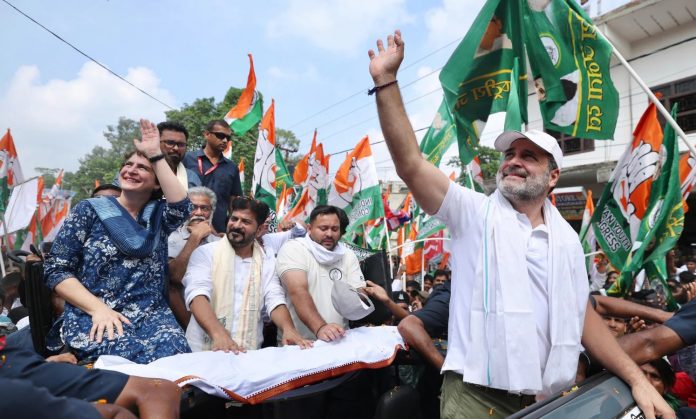
The Indian National Congress (INC) has faced a crushing defeat in the Bihar Assembly Elections, and the party is almost deciminated in the state with wins in single digits. As per latest results, the party is set to win only 6 seats, out of the 61 seats the party contested. The Mahagathbandhan alliance struggled trailed far behind the NDA and even ceded ground to parties like AIMIM in key regions. In a landslide victory, NDA has crossed 200 seats, and Chirag Paswan’s Lok Janshakti Party is set to win 19 seats, more than three times the seats led by Congress.
In the wake of this setback, several senior Congress leaders have emerged, publicly questioning the party’s leadership, organizational lapses, and decision-making processes for the Bihar elections. After the rebel by the group of 23 party leaders a couple of years ago, this is the first time such a large number senior party leaders have spoken against the party’s leadership.
Veteran Congress leader Kripananth Pathak, speaking from Patna, directly blamed state leaders for the disaster. He alleged that responsible leaders failed to relay accurate ground realities to the central leadership, leading to “huge errors” in strategy and candidate choices. Pathak said that ongoing complaints from party workers that were not escalated, warning that inaction could precipitate a “serious crisis” within the organization.
Congress MP Shashi Tharoor, who has emerged as a rebel leader with the party frequently criticising him and distancing itself from his comments, described the results as “seriously disappointing,” and urged “very serious introspection” beyond mere reflection. He pointed to potential “tactical, messaging, or organizational mistakes” during the election campaign.
However, Shashi Tharoor said that he cannot give any first-hand information, because he didn’t campaign in Bihar as he was not invited to campaign in Bihar. He noted that although he didn’t campaign in the state, he realised the issues based on his conversations with people. “Our party leaders must do some very serious analysis of where things went wrong,” he added.
#WATCH | Thiruvananthapuram, Kerala: On #BiharElections, Congress MP Shashi Tharoor says, "… it's very clear that the lead is overwhelmingly with the NDA. It's obviously seriously disappointing, and if that turns out to be the final result, then I think there will have to be… pic.twitter.com/10rnFhMEs1
— ANI (@ANI) November 14, 2025
Senior leader Mani Shankar Aiyar lamented that the Congress did not consider him worthy for a role in the elections, as he was not asked to campaign in the polls. He said that although once he was a ‘very senior leader,’ now he has been sidelined in the party. Appearing on News 18, he claimed he was participating in the debate on his personal capacity, not on behalf of the party.
Former Bihar Governor and Congress leader Nikhil Kumar attributed the defeat squarely to “the weakness of our organization,” stressing that electoral success depends on robust grassroots machinery. He criticised the lack of “strategic and intelligent” deployment across constituencies and admitted flaws in candidate selection, which may have contributed to the poor results. Kumar added that principles alone cannot compensate for operational failures.
Patna, Bihar: On state Assembly elections, Congress leader and former Governor Nikhil Kumar says, "This reflects the weakness of our organization. In any election, a political party relies on its organizational strength. If the organization is weak and cannot function… pic.twitter.com/s0FMnjTytd
— IANS (@ians_india) November 14, 2025
He said, “There were some differences in our selection of candidates, and perhaps we did not select the best candidates… But yes, it is a possibility. The likelihood was that some of the candidates who were selected may not have been of the best quality. And perhaps that caused the result.”
Nikhil Kumar added, “This reflects the weakness of our organization. In any election, a political party relies on its organizational strength. If the organization is weak and cannot function effectively, the overall outcome suffers. Our candidates are all very capable, but even better candidates could have been chosen. The organization should have worked strategically, intelligently and maintained a strong presence across all constituencies.”
Congress MP Akhilesh Prasad Singh pointed out the “friendly fights” between Congress and RJD in several constituencies as a result of the poor results. He said that such contests should not have taken place. He also pledged introspection into where the party lagged in its election strategy.
In a candid X post, Gujarat-based Congress leader Mumtaz Patel said that there should be no “excuses” and “blame games” over the results, and urged the party to “accept reality.” Her comments are significant as the Congress party in Rahul Gandhi’s leadership had already started to blame the Election Commission.
No excuses ,No blame game No introspection , it’s time to look within and accept reality. Till when will countless loyal ground workers who have stayed with the party through thick and thin …wait to see success … instead it’s failure after failure due to power concentrated in…
— Mumtaz Patel (@mumtazpatels) November 14, 2025
Mumtaz Patel lambasted the concentration of power in a “few” high-command figures “totally disconnected” from the ground, who have presided over “failure after failure” despite the loyalty of countless workers. Patel warned that these same individuals would likely be “rewarded again,” perpetuating the cycle of decline. She wrote without naming anyone, “And mark my words these same people will be rewarded again and again because they have made themselves indispensable with their control and power.”
Former Bihar Minister Shakeel Ahmad, who left the party after the conclusion of voting in Bihar, talked about allegations of “financial irregularities” in ticket distribution. He noted that several senior Congress leaders held press conference and raised the issues of irregularities in ticket distribution, financial irregularities and other issues.
He said, “We hope that an investigation will be conducted, and if the allegations are true and tickets were given for other reasons, then obviously action should be taken against them.”
Congress MP from Sasaram, Manoj Kumar, targeted the Bihar Pradesh Congress Committee (PCC) President Rajesh Kumar over the poor performance of the party. He demanded Kumar’s immediate resignation, arguing that the state chief “didn’t connect with Dalits” and mishandled candidate selection, which “cost Congress dearly.”
Manoj Kumar said that people in his area wanted the PCC president to visit the villages in the district, and he also requested Manoj Kumar to visit, but he didn’t visit even once. He stressed that these are not allegations, but the truth.
#BiharElectionResult #Nov14WithTimesNow
— TIMES NOW (@TimesNow) November 14, 2025
Bihar Cong MP Manoj Kumar slams PCC President, demands resignation of Rajesh Kumar
'PCC President didn't connect with Dalits. Candidates' selection mistake cost Congress. Social media can't win polls…': Congress MP @_Manojkumar_ram… pic.twitter.com/oav6hoGAH8
Kumar also dismissed over-reliance on social media as a campaign tool, stating, “Social media can’t win polls,” and emphasized the need for ground-level engagement.
These statements by several senior Congress leaders represents a rare convergence of voices against both state and central leadership in the party. This shows there are some leaders in the party who are not ready to peddle the lies of ‘EVM tampering’ and ‘vote chori’ to hide the party’s electoral failures, and that there are leaders ready to demand answers and actions from the party.
Despite the possibility that they will be sidelined in the party after their public outburst, the Congress leaders have pointed out organizational deficiencies, flawed candidate selection, inadequate communication between state and central levels, and lack of involvement of top leaders in campaigning.


