

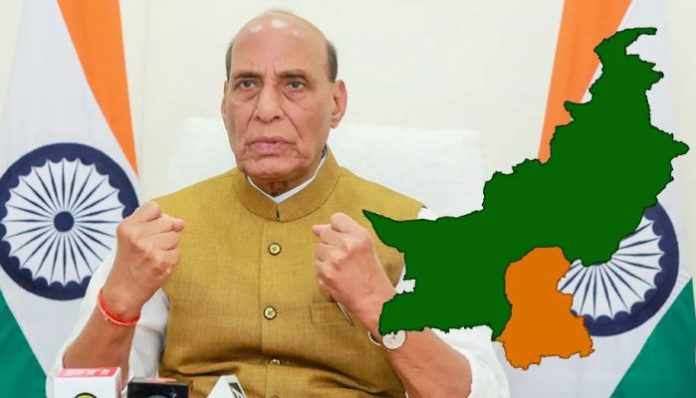
India’s Defence Minister Rajnath Singh sparked a political debate on Sunday (23rd November) with his remarks about Sindh, the region that today lies inside Pakistan. Speaking at an event organised by the Sindhi community, he said that while Sindh may not be a part of India at the moment, “civilisationally, Sindh will always be a part of India,” adding that borders are not permanent and “may change in the future.” His comments immediately drew sharp criticism from Pakistan, which condemned the statement as “delusional” and “dangerously revisionist.”
During his speech, Singh referred to a quote by veteran BJP leader Lal Krishna Advani, who had written about how Sindhi Hindus of his generation still felt the pain of losing Sindh during the Partition. Singh said that the Sindhi people have always shared a deep emotional and cultural connection with the Indus River, explaining that for Hindus, the river has been sacred for thousands of years. He added that even many Muslims in Sindh once considered the waters of the Indus to be as holy for them as Aab-e-Zamzam in Mecca.
#WATCH | Delhi: Defence Minister Rajnath Singh says, "…Today, the land of Sindh may not be a part of India, but civilisationally, Sindh will always be a part of India. And as far as land is concerned, borders can change. Who knows, tomorrow Sindh may return to India again…"… pic.twitter.com/9Wp1zorTMt
— ANI (@ANI) November 23, 2025
He repeated the same thought twice during his address, saying, “Today, the land of Sindh may not be a part of India, but civilisationally it will always remain Indian. And as far as land is concerned, borders can change. Who knows, someday Sindh may return to India again.” He also emphasised that people who revere the Sindhu River are “our own,” and will always remain connected to India, no matter where they live.
Pakistan rattled at Rajnath Singh’s remarks
Pakistan reacted immediately on Monday (24th November), issuing a strong condemnation through its Foreign Ministry. Islamabad, rattled by Singh’s remarks, described them as “delusional” and accused India of promoting an “expansionist Hindutva mindset” that threatens regional peace. The Pakistan government grumbled that his words violated international law, crossed diplomatic boundaries, and challenged the sovereignty of recognised borders.
In its official statement, Pakistan warned New Delhi against making provocative remarks. It said Indian leaders must refrain from issuing comments that could increase tensions in an already sensitive region. The statement further insisted that instead of making such claims, India should focus on addressing internal issues and ensuring the safety of its minority communities.
?PR No.3️⃣4️⃣8️⃣/2️⃣0️⃣2️⃣5️⃣
— Ministry of Foreign Affairs – Pakistan (@ForeignOfficePk) November 23, 2025
Pakistan Strongly Condemns Indian Defense Minister Rajnath Singh's Remarks About Pakistan’s Sindh Province https://t.co/wdeTkEg3xY
?⬇️ pic.twitter.com/qeXY0JmXgj
Pakistan’s Foreign Ministry also used the opportunity to rake up other political issues. It held forth that India must hold accountable those involved in violence against minorities and should work towards correcting what it called “faith-based prejudice” and “historical distortions”, even though Pakistan’s own record of protecting minorities has been awful. The press release went on to mention the grievances of India’s northeastern states and claimed that several communities there face “systematic marginalisation and identity-based persecution.”
Islamabad also linked the issue to Kashmir, urging India to take “credible steps” to resolve the dispute in accordance with UN resolutions. The press release concluded by stating that Pakistan would continue to protect its security, sovereignty, and national independence, and is committed to resolving all disputes peacefully, but only based on justice and international law.
Sindh’s deep civilisational link with India
Sindh is not just a geographical region; it is a major part of India’s ancient civilisational roots. The Indus River, or the Sindhu, flows through this land and has shaped the culture, agriculture, and early settlements of the entire region.
For thousands of years, communities living along the Sindhu developed some of the world’s earliest urban cultures. Many of India’s oldest stories, spiritual traditions, and cultural practices originated in the region that we today call Sindh. From the Indus Valley Civilisation to the epics, the land has remained closely tied to India’s consciousness.
India’s connection with Sindh is geographical, linguistic, cultural, mythological, and historical. The region was once a key part of ancient Bharatvarsha, and its name appears in several old Indian texts. Even our national anthem continues to include “Sindh,” showing the deep roots that the region holds in India’s identity.
The name ‘Sindh’ and its link to the Sindhu (Indus) river
The word “Sindh” comes from the ancient Sanskrit term “Sindhu,” meaning the river that flows powerfully across the plains. The Sindhu is one of the most important rivers in Asian history and gave birth to multiple cultures around it. It is the source from which the region got its name, and through the region, even India got its name.
The river formed the basis of the Indus Valley Civilisation, one of the oldest and most advanced civilisations in the world. Cities like Harappa and Mohenjo-daro, with their planned layouts, drainage systems, and trade networks, flourished along its banks. The people living in these settlements had connections with other civilisations in Afghanistan, Iran, and Central Asia, making Sindh a major centre of ancient trade.
Thus, the name “Sindh” is not just a label for a province; it is directly tied to the river that shaped Indian civilisation from the very beginning.
How India got its name from the Indus (Sindhu) River
The story of India’s name also begins from the same river. The ancient Sanskrit word “Sindhu” became “Hindu” in Persian, as old Persian language did not pronounce the ‘s’ sound at the beginning of words. When the Persians came into contact with the people living east of the river, they started calling the land “Hindu,” and its people “Hindus.”
Later, when the Greeks interacted with the Persians and the regions around the Indus, the word changed again. Greek dialects often dropped the ‘h’ sound, so “Hindu” became “Indos,” which eventually turned into the word “India.” This is how the name of a river slowly became the name of an entire country.
The name “Bharat” existed from much earlier times, but “India”, the name recognised across the world, came from the Indus Valley and the Sindhu River. The ancient Greek explorer Scylax of Caryanda, who travelled down the Indus River between 550 BCE and 450 BCE, played a major role in spreading knowledge about this land to the Western world. As trade routes expanded and geographical knowledge increased, “Indos” and “India” became fixed terms for this entire region.
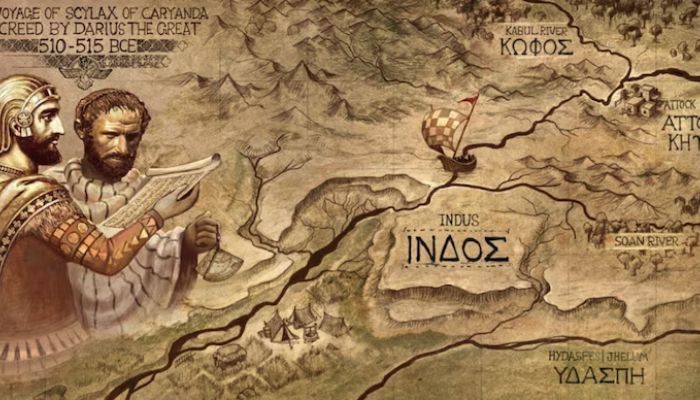
Over time, even the word “Hindustan” developed from the same root. “Sindhu” became “Hindu” in Persian, and Persian rulers called the land beyond the river “Hindustan”, the land of the Hindus. This name became popular across several centuries and formed an important part of India’s cultural identity.
The Indus (Sindhu) River
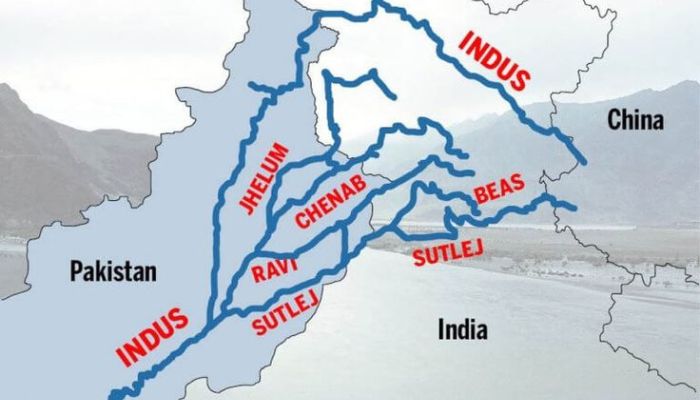
The Indus River, or Sindhu, is amongst the longest river systems of the world, extending over a course of approximately 3,180 kilometres. It originates near Mansarovar Lake in Tibet at a site called the “Lion’s Mouth” or Sênggê Kanbab, flows through Ladakh in India into Gilgit-Baltistan, and finally across Pakistan to the Arabian Sea near Karachi.
The Indus has six major tributaries, namely, the Jhelum, Chenab, Ravi, Beas, Sutlej, and the Indus itself. Post-Partition, water sharing between India and Pakistan was finalised under the Indus Waters Treaty of 1960, whereby Pakistan received control of the Indus, Jhelum, and Chenab, and India was given control of Ravi, Beas, and Sutlej.
It is around this river that the Indus Valley Civilisation grew. The people of this civilisation built some of the earliest known urban settlements and advanced sanitation systems. They traded not only within the region but also with faraway places. It goes to show how important a role the Sindhu River played in shaping the early history of the Indian subcontinent.
The river continues to be of immense cultural and religious significance. Ancient texts refer to the river as a “protector” and a holy waterbody that is central to rituals, stories, and traditions.
The Indus River System stretches over thousands of kilometres and sustains millions of people. The Jhelum originates from the Verinag spring in Jammu & Kashmir. The Chenab is the largest tributary, which is formed by the successive confluence of the Chandra and Bhaga rivers in Himachal Pradesh. The Sutlej has its source from Lake Rakshastal near Mansarovar. Together, these rivers have sculpted agriculture, trade, and civilisation in the northern part of the subcontinent.
It is at the Indus River that the Indus Valley Civilisation began, and was completely dependent upon, over 5,000 years ago. This civilisation produced planned cities, its extensive drainage networks, and a sophisticated trade culture. This is why the Indus or Sindhu continues to be an abiding feature of Indian history.
Sindh in the Ramayana and the Mahabharata
The connection between Sindh and India is also reflected in our two greatest epics, the Ramayana and the Mahabharata. These stories, known across generations, speak of Sindh as an important part of the landscape of ancient India.
Sindh in the Ramayana
In the Ramayana, Sindh was part of King Dasharatha’s vast empire. When Kaikeyi demanded her two boons from Dasharatha, he told her that his kingdom stretched from Sindh and Sauvira to Anga, Vanga, Magadha, Kashi, and beyond. This shows that Sindh was considered an important region even during those times.
When Sita was kidnapped by Ravana, Rama sent search parties in all directions. One of the groups of vanaras (monkeys) went towards Sindh, which was known for its unique “swimming horses.” Later, after the victory over Ravana, Rama gave the region of Sindhu-Sauvira to his brother Bharata. Bharata’s sons further expanded their rule into Gandhara, where they built major ancient cities like Peshawar (Pushkalavati) and Taxila (Takshasila).
Sindh in the Mahabharata
In the Mahabharata, Sindh appears again in several important sections. The region was ruled by King Jayadratha, who was married to Dushshala, the sister of Kaurava prince Duryodhana. Jayadratha supported the Kauravas in the war and was known for his conflict with the Pandavas.
In one incident, Jayadratha tried to misbehave with Draupadi during the Pandavas’ exile, leading to a fierce confrontation with Arjuna and Bhima. Later, during the war, he played a key role on the day Abhimanyu was killed, which led Arjuna to take a vow that he would kill Jayadratha before sunset.
The Mahabharata also describes the Sindhu River as a powerful force and a great protector. In the Anushasan Parva, it says that bathing in the Sindhu leads the soul towards heaven. These references show that the river and the region were deeply respected in ancient Indian traditions.
Sindh in India’s National Anthem
Even today, the Indian national anthem Jana Gana Mana includes Sindh as part of the regions that constitute the Indian subcontinent. Written in 1911 by Rabindranath Tagore, the anthem reflects the geography of undivided India, long before Partition. At the time, Sindh played a major role in trade, culture, education, and politics.
Despite the Partition in 1947, the word “Sindh” has remained in the anthem. According to most historians, it is there as a signifier of India’s civilisational identity and a recognition of the subcontinent’s shared heritage: Sindhi culture, literature, music, and spiritual traditions have contributed immensely to India, and the word in the anthem serves as a reminder of that contribution.
Borders may change, but history does not
The Partition of 1947 divided India and Pakistan on political and religious grounds. Lines were drawn on the maps, and millions of people became displaced overnight. But political decisions cannot wipe out thousands of years of civilisation, culture, and shared history.
Sindh has always been linked with India through geography, culture, spirituality, and ancient tradition. The Indus River, the epics, the civilisation, and even our national anthem point to the same truth that Sindh has been an essential part of India’s identity.


