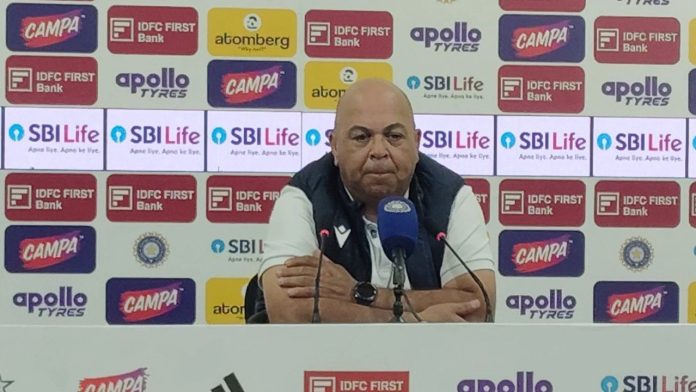
Cricket is a game obsessed with numbers: runs, wickets, overs, and sessions. But every once in a while, a single word carries more weight than an entire scorecard. Shukri Conrad’s remark after Day 4 of the second India-South Africa Test in Guwahati that South Africa wanted India to “grovel” was one such word.
And in no time, social media was up in arms. Conrad’s comment triggered massive outrage online and prompted newsroom discussions on the choice of words used by the coach of a team that has dominated the ongoing test series against India. Some of the fans were simply livid with the Indian cricket team’s head coach, Gautam Gambhir, the support staff, and the players for putting us in a position where we had to swallow insulting remarks from a visiting team.
When asked in the press conference about South Africa’s strategy to bat longer and not put India into bat earlier, Conrad said, “We obviously looked at how best we were going to use the new ball, because in the morning we still wanted a newish, hardish ball.”
He further added, “What we felt is that when the shadows come across the wicket in the evening, there’s something in it for the quick bowlers, so we didn’t want to declare too early and not be able to use that.”
We wanted them (India) to really grovel: Shukri Conrad, South Africa coach pic.twitter.com/PTkQH7zrGG
— RevSportz Global (@RevSportzGlobal) November 25, 2025
“And then, obviously, we wanted the Indians to spend as much time on their feet out in the field, we wanted them to really grovel, to steal a phrase, bat them completely out the game, and then say to them ‘come and survive on the last day and an hour this evening’,” added Conrad, explaining the rationale behind South Africa batting longer than required.
In modern cricket slang, “grovel” is sometimes loosely used to imply subjugation through skill, making a team chase leather, bow for long spells, or survive under duress. Conrad likely meant it in this sporting sense: make India toil, physically and mentally, until resistance bends. Yet cricket is not played in a vacuum. Words in this game don’t float free of history. They carry their own bruises.
But his comments instantly triggered outrage on social media. On X, several users, including journalists, expressed shock and condemned the choice of words used by Conrad, pointing out that “grovel” is not a neutral cricketing term but one with deep racial and historical baggage.
South Africa, the land of Nelson Mandela and also Mahatma Gandhi, suffered so much due to apartheid. A South African should be the last one to say: “We wanted them (India) to grovel.”
— Vikrant Gupta (@vikrantgupta73) November 25, 2025
Maybe Mr Conrad didn’t mean the racial undertone. Hope so
South African head coach Shukri Conrad saying “We wanted India to grovel” in the press conference is a huge misstep. Grovel carries a long history of deeply offensive, racial undertones. Maybe a slip of the tongue, but a costly one.
— Gargi Raut (@gargiraut15) November 25, 2025
In the Cricketing parlance, "Grovel" is considered as a highly offensive term. The world remembers what happened to the guy who said this the last time. Yet Conrad said it anyway. He knows there won't be a fight back. It's a dead horse. https://t.co/hW9ZJplaQN
— Guru Gulab (@madaddie24) November 25, 2025
But how did the seemingly benign word ‘grovel’ get its racial undertones in cricketing parlance? What was the incident that permanently etched ‘grovel’ as a racial slur never to be used again, until Conrad did for Team India?
When England captain Tony Greig used ‘grovel’ for West Indies
The word “grovel” is inseparable from 1976, from Tony Greig and the West Indies. When Greig, a white South African-born England captain, openly declared that England would make the West Indies “grovel,” it was not received as mere sledging. It was heard as racial and colonial condescension. Clive Lloyd, Viv Richards, and an entire Caribbean side understood it as an attempt to reduce proud, newly assertive Black cricketers to something beneath dignity. What followed wasn’t just a cricketing response, but a cultural and political statement: the rise of the most feared dynasty in cricket history.
That is why Conrad’s words cut deeper than he may have intended. South Africa, of all nations, cannot escape the shadow of apartheid when it comes to racial language. Even though Conrad himself comes from a marginalised community within South Africa’s racial hierarchy, the nation’s institutional memory still makes such words volatile. For Indian fans, already sensitive to historical patterns of condescension toward Asian and African teams, it sounded like an old colonial echo resurfacing in modern garb.
There is also an irony here that history loves. Tony Greig’s “grovel” comment didn’t weaken the West Indies; it forged them into something terrifying. England didn’t make the Windies grovel; the Windies made the world tremble. Cricket’s past teaches us that humiliation, when weaponised through words, often boomerangs.
But will Conrad’s remark spark a revolution of that scale in Indian cricket, which is currently in shambles? The Indian cricket team is already 0-1 down against the touring South Africa. In the ongoing match, they have a mountain of 522 runs to climb and emerge victorious. With just a single day left in the match, victory is no longer a realistic ambition. Survival itself now appears aspirational. It would take nothing short of a minor miracle for India to bat through the day and salvage pride from the wreckage of this collapse.
But the entire episode does serve as a reminder: Cricket is more than two teams battling out to emerge victorious. It is more than wins and losses. It is struggle. A coach explaining a declaration strategy probably did not intend to reopen old wounds, but in a sport whose history is soaked in colonialism, and racism, some words are never free of their past.