

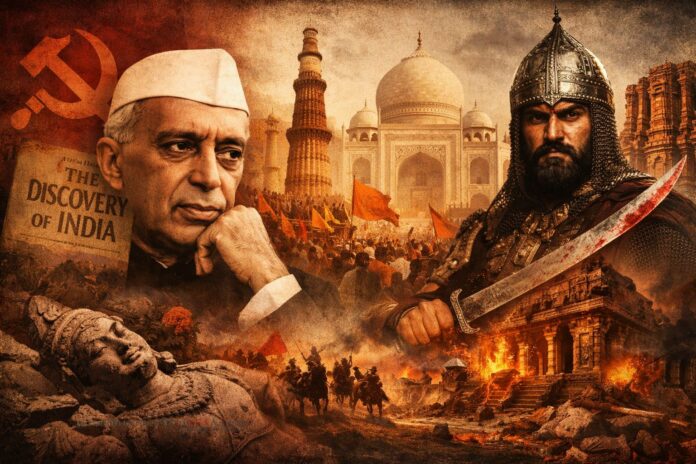
No other book serves as the theoretical foundation of Marxist historiography as much as Jawaharlal Nehru’s The Discovery of India (1945). The oft-quoted Nehruvian doctrines—such as the idea of India, the substance of composite culture, the role of Islam as a social revolution, and the amalgamation of all, secularism—have formed fundamental beliefs in contemporary India and are drawn from this work.
Nehru held a vision based on Marxist universalism that required religious scepticism as a prerequisite. In contrast, he found no intellectual solace in the Hindu cultural values that Gandhian ideals claim to promote, and were part of Congress’s political programme. Nehru dismissed these values as obscurantist and revivalist. When his turn came, Nehru obstinately omitted the Hindu ethos from shaping India’s state, effectively secularising India’s national life.
There are many instances in the book highlighting his cynical approach to India’s past. For Nehru, spirituality was nothing but squalor. ‘We’ve had enough of Ram and Krishn,’ he had said, and Indians had nothing to gain from them. Although spiritualism fascinated him, it had no practical use. It was like a stagnant pond. He warned Indians not to ‘lose themselves in a sea of speculation unconnected with the day-to-day problems of life’ and that they ‘must hold to their anchor of precise objective knowledge tested by reason, and even more so by experiment and practice.’
Nehru did not know what religion the people of the Indus Valley civilisation followed, but still he proclaimed it as a ‘predominantly secular civilisation.’ He was against Hindi because it shared the script, devanagari, with Sanskrit; ‘so it has become difficult to use in its larger and more natural significance.’ Again, Nehru confessed that he knew nothing about art or sculpture and reacted to it as a layman would. Yet, the Buddha statue at Anuradhapura (Sri Lanka) moved him greatly, and Nehru claimed he carried a picture of it for many years. But the architecture of some famous temples in South India, ‘heavy with carving and detail’, disturbed and filled him with unease. Elsewhere in the book, Nehru explained why the temples made him uneasy.
South India was a stronghold of Hindu orthodoxy, Nehru surmised. The repeated invasions of northern India led to many people migrating to the south, including craftsmen and artisans. As a result, South India became a centre for preserving old artistic traditions; hence, the elaborate carvings found on its temples. While the invaders introduced new ideas and architectural styles—evident in ‘the noble and beautiful buildings of Delhi and Agra’—South India ended up becoming a bastion of Hindu orthodoxy.
For Nehru, Islam’s appearance is always an‘advent’; it comes ‘i enters, and it arrives’ in India and goes in the same fashion elsewhere. So, when Islam ‘came’ to Iran, thousands of the followers of the Zoroastrian faith ‘migrated’ to India. The why and how of the collapse of the Sassanid Empire and what happened in its wake did get a word.
There is a whispering, reluctant reference to the devastating impact of Islamic bigotry and iconoclasm. Islam came to India as a new religious faith, and its frequent intercourse with indigenous faiths inevitably led Indians to become acquainted with the new religion. No objection was raised by either the state or the people, nor were there any religious conflicts. But when it came as a political force, it created many new problems. Nehru did not specify what these problems were, except that ‘there were many such raids, and they were bloody and ruthless.’ Yet those who led these ‘bloody and ruthless raids’ were unequivocally glorified in his account.
This is how Nehru has described the invasion of Mahmud of Ghazni. He was ‘far more a warrior than a man of faith, a brilliant captain,’ and India for him was ‘just a place from which he could carry off treasure and material to his homeland’ to build great edifices because ‘buildings interested him.’ He was interested in ‘encouraging cultural activities’ and anxious to ‘make his own city of Ghazni rival the great cities’ of central and western Asia.
So, he carried off ‘from India’s large numbers of artisans and master builders.’ Mehmud was enamoured with the great edifice of Mathura, exclaiming that it would have taken at least 200 years to build it. What Nehru did not tell us was that Mehmud was relating the magnificence of the Vasudev temple, and the fanatic ordered his troops to use naphtha and fire to burn the temple down after smelting silver and golden statues of Hindu gods b, but not before decapitating thousands of Hindus.
Though, as Nehru avers, Mahmud took away with him a vast quantity of treasure, ‘he touched and despoiled only a part of north India’, and the whole of central, eastern, and south India escaped him completely. His raids were considered ‘a big event in Indian history,’ but politically, India as a whole was not greatly affected by these bloody raids, and ‘the heart of India remained untouched.’
In Nehru’s estimation, Babur was an adventurer, a gallant knight, and a delightful, cultured man, typical of a Renaissance prince, a better one than the European kind that was common in those days. Babur was no fanatic like his ancestors, and there was no sectarianism, no bigotry, and he destroyed no temples. When once grave danger threatened him—thus Nehru described Babur’s pledge before the battle of Khanwa (1527)—Babur refused to retreat, as he was ‘made of sterner stuff’, and offered to give up drinking. Nehru paints the picture as if the Rajput army were predatory.
And whom did Nehru blame for the destruction? Not the rapacious ideology, not the gory-loving faith, but the people who were victims. The migration of Zoroastrians took place due to ‘the decay of the states in western and central Asia’, and the subjugation of Hindus occurred because of ‘the weakness and decay of north India’, because the Indian culture had become ‘old and tired and had lost its vitality’, while the invaders were ‘far more cultured and advanced in ways of living.’
However, ‘this new approach’ of Islam, the ‘advanced ways’ of the invaders, ‘produced powerful psychological reactions among the people and filled them with bitterness.’ Nehru quickly dwelt on how this new approach was salubrious, to say the least, because ‘it pointed out and showed up the abuses that had crept into Hindu society and the idea of Islamic brotherhood and made a powerful appeal, especially ‘to those in the Hindu fold who were denied any semblance of equal treatment.’ Nehru was repeating the argument of Mohammad Habib, who had described Islam’s ‘arrival’ in India as the beginning of social revolution in his monograph on Sultan Mahmud of Ghazni (1927).
Such a person, carrying cynicism and disdain for Hindu culture and repulsively oozing endearment for Muslim culture and icons, happened to preside over India’s destiny at its most crucial period. His ideas, variously referred to as Nehruvian ideals, Nehruvian secularism, or Nehruvian consensus, or Nehruvian whatnots, formed the raison d’être of the Indian state. That these ideas found resonance in the Marxian approach was not incidental.
Although India comprises diverse parts, it has remained united through its innate cultural bonds. Despite lacking a single unifying political authority to enforce homogeneity throughout its history, India and its people managed to stay together thanks to the inherent cultural consistency of Hinduism.
However, in official narratives, India became a land of many ideas, and its primaeval Hindu ethos, that inseparable glue, was dismissed as redundant and regarded with contempt. Talking about the past injuries and setting the house in order became a communal approach.
The accent of Nehru coincided with the emergence of Marxist historians in India. Therefore, it was not very difficult to integrate these Marxist interpretations of history into the Indian State’s philosophy. In a remarkably short span, Marxist historians, riding the wave of Nehruvian benediction, changed the story of India.
[The quotes are from The Discovery of India and Glimpses of World History, while Marxist historiography is explored in the author’s latest book, India’s Rogue Historians (2026).]


