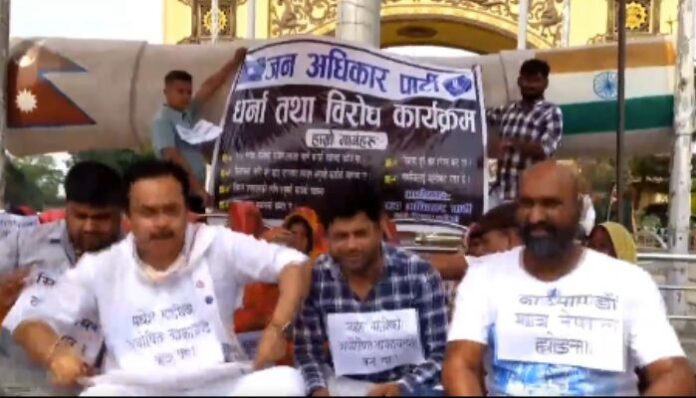
The ousted KP Sharma Oli-led communist government in Nepal used to attack India intermittently through rhetoric. The present Balen Shah-led government, however, has apparently leapt to rolling out policies antagonising India. This time, at the cost of making the Nepali populace suffer. Protests have erupted in many parts of Nepal after the government issued directives enforcing a tax on all items above Nepali Rupee 100 imported from India.
Nepal imposes Rs 100 customs duty on Indian goods
As per the new rules, a mandatory customs duty or Bhansar will be imposed on goods costing more than Rs 100, to curb the loss of national revenue for Nepal. The order to levy customs duty on Indian exports was originally issued by the Oli government around two years ago; however, it could not be implemented at that time.
The move came reportedly after complaints emerged that Nepalese citizens residing in the India-Nepal border areas frequently visited Indian markets for the purchase of household, food, clothing and other items.
There has been an increase in the presence and activities of Nepal’s Armed Police Force (APF) in border areas to enforce the draconian tax levy on Indian goods.
Confirming the imposition of NRS 100 custom duty on Indian exports, an official from Nepal’s Department of Customs told ANI, “It has always been the government’s policy to adopt a zero-tolerance approach to prevent illegal imports in customs areas. The Customs Act already had a provision requiring duties on goods worth more than 100 rupees. ‘We have become more proactive now.”
High-level team has been formed to monitor the imposition of customs duty on Indian exports
To ensure a strict implementation of the customs duty imposition, a joint monitoring team consisting of the Department of Customs, the Department of Revenue Investigation, District Administration Offices, Nepal Police, and the Armed Police Force have been formed. Inspections are being conducted by the APF on Nepali people coming back home from the weekly market in Kakarbhitta, Bhadrapur, Pherniya, and Rupandehi. Nepali citizens have to stand in long queues to have their packages checked by the authorities for Indian goods.
From Jhapa in the east to Kanchanpur in the west, all main and secondary customs points are witnessing intensified crackdowns under the pretext of curbing tax evasion. Besides inspections, the Nepali authorities are also running ‘awareness’ programs to apprise citizens about the new customs duty on Indian goods priced above NRS 100. The move comes across as the Balen Shah government’s diktat to deter Nepali citizens from visiting India and purchasing Indian goods altogether.
In addition to levying customs duty on Indian exports, Nepal, under Prime Minister Balen Shah, has also banned the entry of private vehicles with Indian license plates without prior authorisation.
Earlier, motorbikes with Indian number plates entered Nepal without any harsh restrictions, with many people even using them within the country.
However, the Balen Shah government’s unilateral, stringent policy, in addition to the prohibition on Indian-registered vehicles, has caused massive distress in Nepal’s border districts of Madhesh. The lives of ordinary people have been significantly affected by the Balen Shah government’s unwarranted targeting of India under the pretext of preventing revenue leakage.
Nepali residents in border areas rise in protest
Local Nepalis who boast of having roti-beti relations with India have expressed immense discontent and slammed the Balen Shah government for its ignorance of the ground realities in the Madhesh region. Many political parties and activists have also extended support to protesting Nepali citizens.
Umesh Yadav, a member of the Central Coordination Committee of the Janata Samajbadi Party (JSP), said the open border between Nepal and India cannot be controlled by those sitting in air-conditioned rooms, be it in Kathmandu or Delhi. “’The open border is a literal and practical truth here. It is completely wrong to impose policies arbitrarily without understanding the concerns of residents from Biratnagar to Nepalgunj,” Yadav said.
Crazy visuals from Indo-Nepal border as Nepali forces SNATCH even small packets from citizens & TAX them 🤯
— The Analyzer (News Updates🗞️) (@Indian_Analyzer) April 20, 2026
Balen Shah Govt has imposed a custom duty on every item, even as small as ₹100.
– Thousands of Indian traders in Bihar & Uttarakhand are also hit. Bad signs! pic.twitter.com/7DgZNHcXSw
Similarly, Rastriya Swatantra Party and chairman of the Open Border Dialogue Group, Dr Rajiv Jha, said that India and Nepal not only share a geographical border but also maintain social, cultural, religious, and familial ties.
“Setting a limit of 100 rupees in today’s era of inflation is extremely low and impractical; the government must review this immediately,’ Dr Jha said. ‘There should be a clear distinction between simple gifts brought by a daughter visiting from her maternal home and goods for commercial purposes. Food items should be exempt from customs,” Jha said.
Binay Yadav, Chairman of the Rastriya Ekta Dal, went a step ahead and dubbed the Balen Shah government’s move to levy customs duty on Indian goods, “undeclared blockade”.
“This step is against the provisions of the 1950 Peace and Friendship Treaty. The government should immediately remove the customs limit for household items and instruct security personnel to behave in a citizen-friendly manner,” he said, adding that if the directive is not rolled back, a massive protest will erupt in the Indo-Nepal border region.
The Nepali government’s divorced-from-reality move is not only causing immense inconvenience to Nepali citizens but also stoking troubles for Indian traders in the border areas.
In the Banbasa area of Uttarakhand’s Champawat district, Nepali citizens rely on the local Indian market for their daily essentials. Imposing a duty on Indian goods priced above NRS 100 would not only affect trade here but also result in price hikes in Nepal. This will force Nepali traders to procure affordable goods from non-Indian sources.
India-Nepal Border : Protests erupt over tax on imports from India exceeding ₹100. pic.twitter.com/o4UAs8dCcV
— News Arena India (@NewsArenaIndia) April 19, 2026
During a protest, a Nepali citizen told ANI, “Whatever the rituals are performed here (Nepal) from birth to death, we bring all the essentials from there (India), even the fertilisers which the Government of Nepal at times is not able to provide on time, we bring them from there. Now the situation has turned different; it is an unannounced blockade. The Jana Adhikar Party demand it to be withdrawn. Failure to control the plunder by the Government of Nepal is its incapacity.”
Another one said, “They’re not allowed to bring in items that cost above NRS 100 without paying tax; we want this provision to end. It has brought us to the protest. They should also respect the relation that exists- the relation of Roti-Beti between India and Nepal. We are demanding that the government give an exemption to the items that cost above NRS 100, which is for domestic use.”