

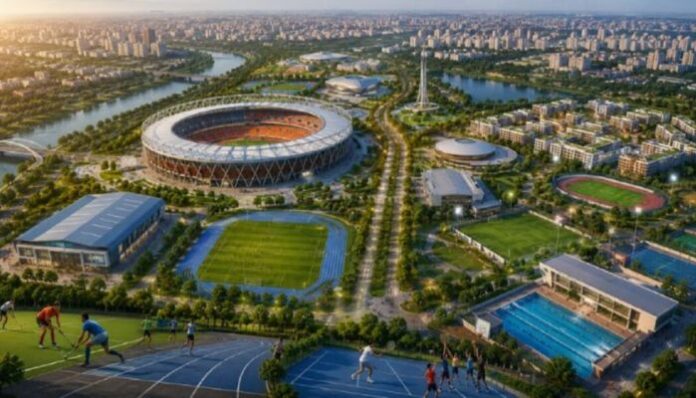
On 28th May, Union Home Minister Amit Shah reviewed preparations related to the 2030 Commonwealth Games, the 2036 Olympics, and other major international sporting events planned for Ahmedabad. During the meeting, he once again said that work is moving quickly to develop Ahmedabad as India’s sports capital.
Usually, such statements are seen as political promises that may or may not become reality. But Ahmedabad’s case appears different. Over the last few years, the city has witnessed the construction of world-class sports infrastructure, large-scale investments in sporting facilities, and several projects designed specifically to support future international competitions.
From the Narendra Modi Stadium in Motera to the Veer Savarkar Sports Complex in Naranpura, from new sports facilities across different neighbourhoods to major events such as the Khel Mahakumbh and National Games, Ahmedabad’s sports journey is no longer limited to a few isolated projects. Instead, an entire sports ecosystem is taking shape.
Today, sports are becoming a major part of Ahmedabad’s identity, just as industry and business once were.
A city that has reinvented itself before
Ahmedabad has a long history of changing and expanding its identity. Decades ago, it was known across India as the “Manchester of India” because of its textile mills. The textile industry played a huge role in the city’s growth and economy.
As time passed, Ahmedabad evolved into one of India’s major centres for trade, manufacturing, finance, and modern urban development. It became the economic powerhouse of Gujarat and developed a strong reputation for business and entrepreneurship.
Now, the city is entering another phase of transformation. This new chapter is not centred on factories or trade. Instead, it focuses on sports, youth participation, international competitions, tourism, and world-class infrastructure. Looking at the developments that have taken place during the last five to six years, it is becoming increasingly clear that Ahmedabad is trying to build a unique identity around sports.
How the sports city vision started
The year 2022 became a turning point in Ahmedabad’s sports journey. That year, Gujarat hosted the National Games, bringing athletes, coaches, officials, and sports enthusiasts from across the country. The event generated fresh excitement about sports throughout the state.
During the National Games, Amit Shah stated that Ahmedabad would become the world’s largest sports city in the future. At that time, many people considered the statement ambitious. However, the speed at which sports-related projects have moved forward since then has made that vision look far more realistic.
The National Games also highlighted an important reality. Hosting large sporting events requires much more than stadiums. A city needs training facilities, athlete accommodation, transport systems, medical support, recovery centres, practice venues, and modern urban infrastructure.
Several projects that were already underway in Ahmedabad received fresh momentum after the National Games. From that point onward, the idea of turning Ahmedabad into a sports capital became more visible and more structured.
Narendra Modi Stadium: The symbol of Ahmedabad’s sports ambition
If one structure represents Ahmedabad’s sports transformation, it is undoubtedly the Narendra Modi Stadium in Motera.
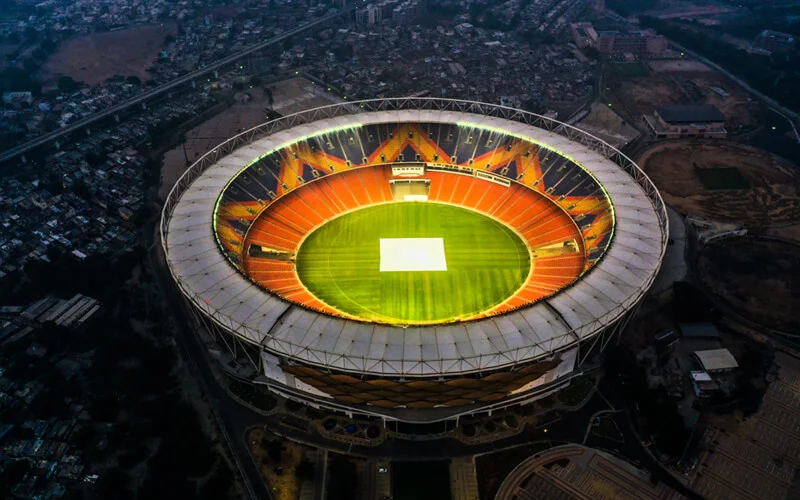
With a seating capacity of more than 100,000 spectators, it is the largest cricket stadium in the world. But its importance goes beyond numbers and records.
The stadium has helped place Ahmedabad on the global sports map. It has hosted major international cricket matches, ICC tournaments, World Cup games, and other large sporting events that attracted visitors from across India and abroad.
The stadium has shown how sports can contribute to a city’s image, economy, tourism sector, and international recognition. It has been demonstrated that sports are not only about competition and entertainment. They can also become a tool for branding a city and attracting investment.
For Ahmedabad, the Narendra Modi Stadium was not the final goal. It was the starting point of a much larger vision.
SVP sports enclave: the heart of the sports city project
While the Narendra Modi Stadium opened the door, the Sardar Vallabhbhai Patel (SVP) Sports Enclave is being viewed as the centrepiece of Ahmedabad’s long-term sports strategy.
Spread across more than 236 acres in Motera, the project is much more than a sports complex. It is being developed as a complete sports city designed to support future international events, including the Commonwealth Games and the Olympics.
From stadiums to dreams, Gujarat is building the future of Indian sports. 🇮🇳🏟️
— Dr. Mayur Sejpal 🇮🇳 (@mayursejpal) May 25, 2026
₹500 crore approved for the SVP Sports Enclave in Ahmedabad…
another giant step towards making India Olympic-ready under the visionary leadership of PM @narendramodi ji and CM @Bhupendrapbjp ji. pic.twitter.com/C5rUgfz0GA
The Sports Enclave will include an aquatics centre, indoor arenas, tennis facilities, athlete accommodation, training centres, and several other modern sports amenities. The idea is to create a complete ecosystem where athletes can train, compete, stay, recover, and improve performance without needing to move between different locations.
Many successful Olympic cities around the world have adopted this model. Ahmedabad is trying to build something similar by integrating multiple sports facilities within a single large campus.
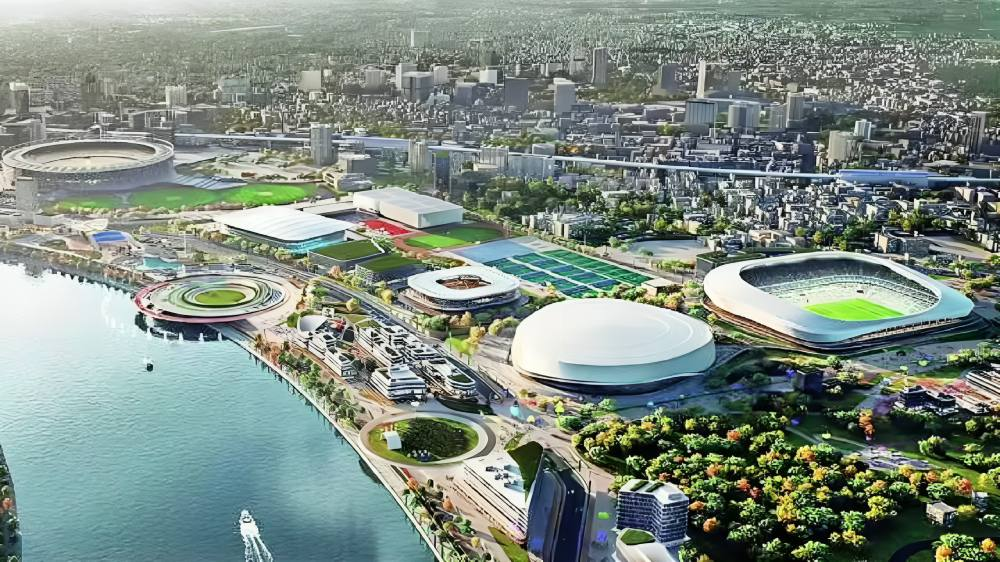
One of the most important aspects of the Sports Enclave is that it combines sports development with urban planning. Instead of constructing isolated stadiums, the city is building an interconnected sports ecosystem. This approach makes the project one of the most important pillars of Ahmedabad’s sports vision.
Veer Savarkar Sports Complex turns vision into reality
Large plans and announcements often take years to become visible on the ground. The Veer Savarkar Sports Complex is one project that has helped turn Ahmedabad’s sports vision into reality.
Built at an estimated cost of around ₹825 crore, the complex is considered one of the largest and most modern sports facilities in India. It includes swimming facilities, indoor sports infrastructure, training areas, and several other amenities designed for athletes.
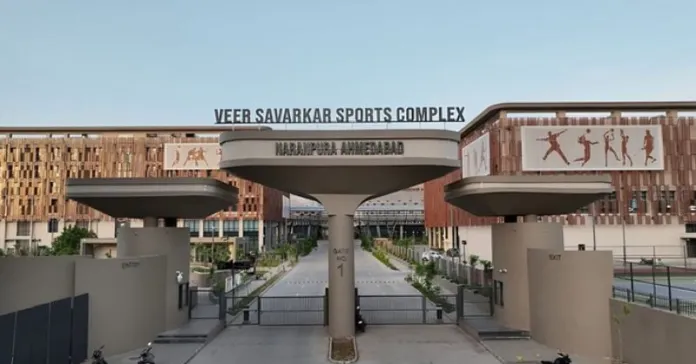
When the complex was inaugurated in September 2025, Amit Shah said that Ahmedabad was moving steadily toward becoming a sports capital. The statement carried weight because the infrastructure was already standing before people’s eyes.
Unlike projects that exist only on paper, the Veer Savarkar Sports Complex demonstrates how large-scale investment in sports infrastructure is becoming a reality in Ahmedabad.
Sports infrastructure is expanding across the entire city
Building a single stadium or one large sports complex is not enough to become a sports capital. For sports to become part of a city’s identity, facilities must be available across neighbourhoods so that children and young athletes can easily access them.
This is where the Ahmedabad Municipal Corporation (AMC) has played an important role. Over the last few years, the civic body has focused on expanding sports infrastructure throughout the city.
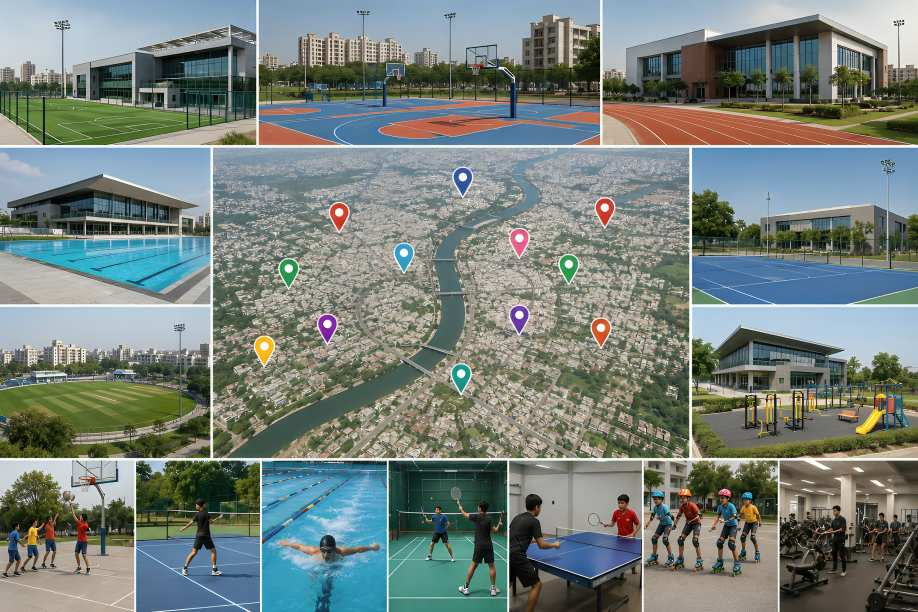
Plans are underway to develop 10 new sports complexes and 27 new playgrounds. These facilities are being spread across areas such as New Wadaj, Ranip, Nikol, Naroda, Vatva, Sarkhej, and several other localities.
The goal is to ensure that sports opportunities are not limited to premium or central areas. Instead, sports infrastructure should be available to residents in different parts of Ahmedabad.
According to AMC data, the city already has numerous gymnasiums, tennis courts, skating rinks, sports centres, and recreational facilities. The new projects are expected to strengthen this network even further.
This broader expansion is important because a sports capital is not defined only by international tournaments. It is also defined by how easily ordinary citizens can participate in sports.
Khel Mahakumbh: Creating athletes along with infrastructure
Sports infrastructure alone cannot create a sports culture. Stadiums and complexes need athletes, and athletes need opportunities to compete and develop their skills. This is where Gujarat’s Khel Mahakumbh has played a major role.
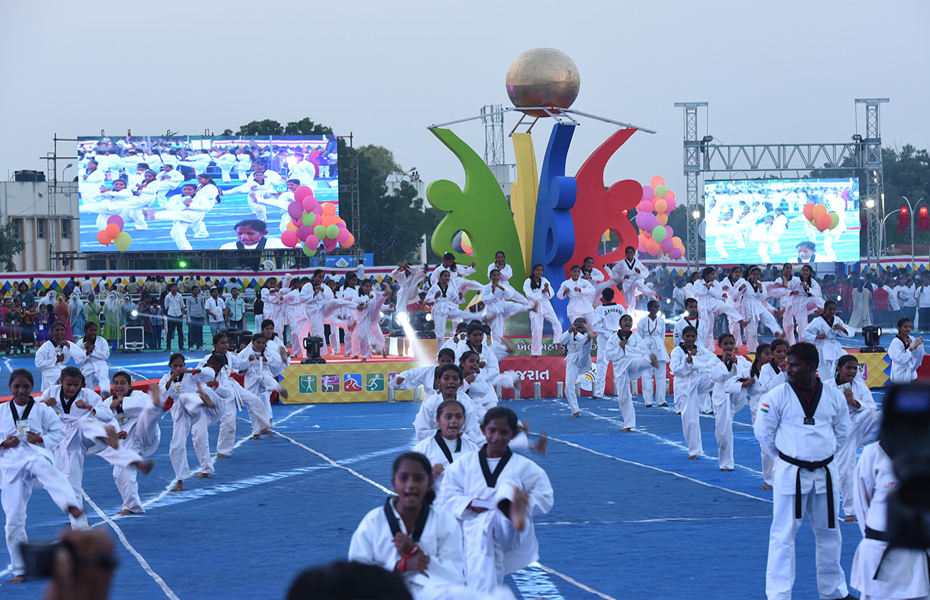
For years, the event has provided a competitive platform for millions of students and young participants across the state. It has encouraged grassroots participation and helped identify sporting talent from different regions.
The importance of Khel Mahakumbh lies in the fact that it complements infrastructure development. While Ahmedabad is building world-class facilities, programs like Khel Mahakumbh are helping create the next generation of athletes who will use those facilities.
The combination of infrastructure and grassroots participation is what makes a sports ecosystem sustainable in the long run.
Sports Zone and the Changing City
Ahmedabad’s sports strategy is not limited to stadiums and training centres. Urban planning is also being shaped around sports. One important example is the Sports Precinct Corridor project.
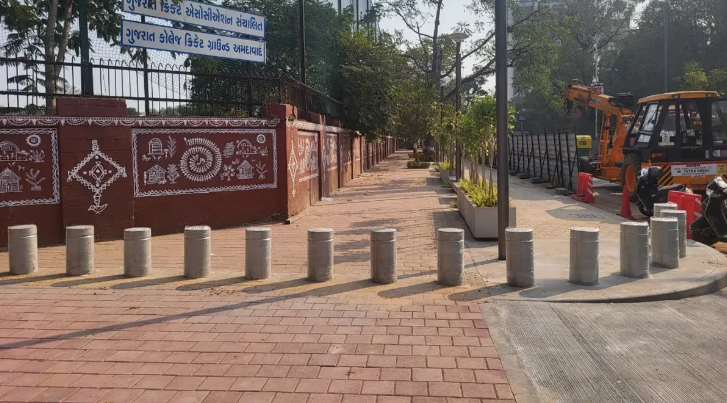
This planned 7-kilometre corridor connecting different parts of the city with the SVP Sports Enclave is not simply a transportation project. It is designed to make sports a visible and permanent part of Ahmedabad’s urban identity.
Many leading sports cities around the world have dedicated sports districts where sporting activities influence public spaces, city design, tourism, and community life. Ahmedabad is trying to adopt a similar model.
By integrating sports into urban planning, the city hopes to create an environment where sports become a regular part of everyday life rather than something limited to major events.
International events are strengthening Ahmedabad’s position
Hosting international competitions is another important requirement for any city that wants to become a sports capital.
In recent years, Ahmedabad has made significant progress on this front as well. The city has hosted events such as the Asian Aquatics Championships and demonstrated its ability to manage large international sporting competitions. Looking ahead, Ahmedabad is also preparing to host the World Police and Fire Games in 2029.
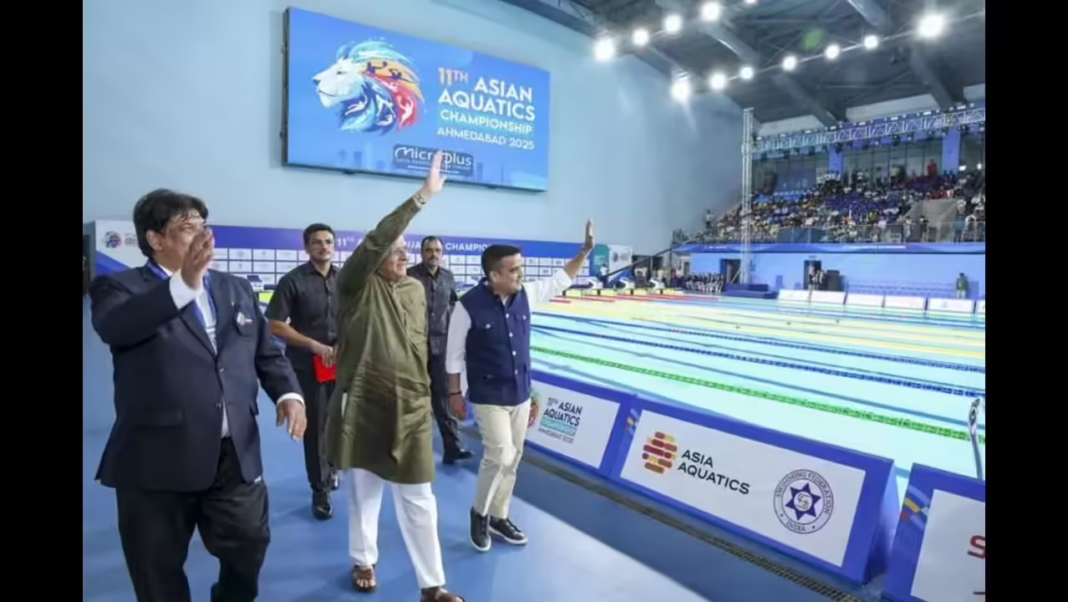
Such events bring multiple benefits. They improve infrastructure, strengthen event-management capabilities, expose local athletes and officials to international standards, and increase global visibility.
Every successful event helps Ahmedabad move one step closer to its long-term goal of becoming a globally recognised sports destination.
Preparing for the Commonwealth Games and Olympics
Perhaps the most ambitious part of Ahmedabad’s sports journey lies in its plans for future mega-events.
Preparations related to the 2030 Commonwealth Games and the 2036 Olympics are already influencing infrastructure development in the city. These preparations involve much more than sports venues. They include transportation networks, athlete housing, public spaces, urban development, logistics systems, and various support facilities needed to host international competitions.
When viewed together, projects such as the SVP Sports Enclave, athletes’ village, aquatics infrastructure, sports precinct developments, and citywide sports facilities clearly show that Ahmedabad is planning not just for the next few years but for the coming decades.
A City building a new identity
When all the developments are viewed together, a clear picture emerges.
The world’s largest cricket stadium, the massive SVP Sports Enclave, the ₹825 crore Veer Savarkar Sports Complex, citywide sports infrastructure projects, plans for 10 new sports complexes and 27 playgrounds, grassroots initiatives like Khel Mahakumbh, international sporting events, and preparations for future Commonwealth Games and Olympic ambitions are all connected pieces of a much larger vision.
This is no longer a story about a few standalone sports projects. It is the story of a city trying to build an entire sports ecosystem.
Ahmedabad’s journey is still underway. Several projects remain under construction, and many goals are yet to be achieved. But the direction is now clear. Over the last few years, the city has moved beyond being known only for cricket or commerce.
Today, Ahmedabad is steadily building a reputation as a city where sports, youth development, international events, and modern infrastructure come together. That is why the idea of Ahmedabad as India’s sports capital is no longer just a slogan. It is becoming a reality that is taking shape year after year.


