

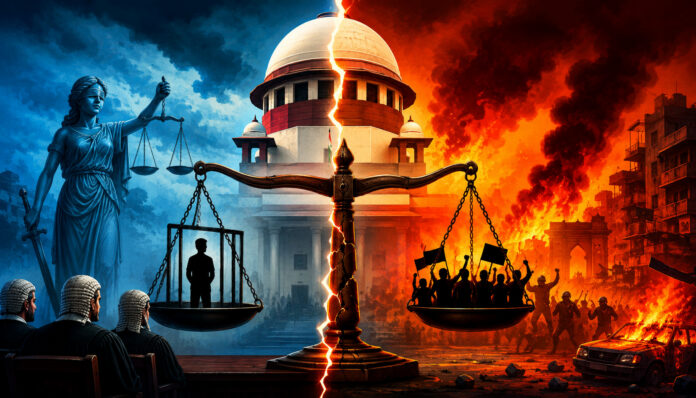
A Supreme Court bench consisting of Justices B.V. Nagarathna and Ujjal Bhuyan grabbed attention on May 18, 2026, when they declared that ‘bail is the rule, jail is the exception,’ even under the Unlawful Activities (Prevention) Act. The court expressed ‘serious reservations‘ over a January 2026 judgement by another Supreme Court bench that refused Umar Khalid and Sharjeel Imam bail in the bigger conspiracy case involving the Delhi riots. The comments were largely interpreted as a criticism of the previous decision, and they were readily welcomed by the so-called “young cockroaches.”
However, deserved and welcome are two different things. The way in which those observations were made is called into doubt by a deeper examination of what Justice Nagarathna’s bench actually did, and what it carefully did not do. Overruling and expressing reservations are two different things. Furthermore, there is legal cacophony rather than legal clarity when a bench criticises a binding order without following the proper procedures to formally challenge it.
What the January order actually said and why it was defensible
To respond to yesterday’s comments, one must first understand what Justice Aravind Kumar’s bench concluded in January 2026 and why it was not an error.
Umar Khalid and Sharjeel Imam were denied bail on January 5 by the two-judge bench, but five other defendants in the same case, Gulfisha Fatima, Meeran Haider, Shifa Ur Rehman, Mohd Saleem Khan, and Shadab Ahmed, were granted it. The January order was not a general rejection, which is an important distinction that is sometimes overlooked in the narrative. Each accused person’s claimed role was assessed separately in this measured ruling.
The court concluded that the five individuals granted bail had performed facilitative functions, such as participating in rallies and coordinating locally. In contrast, Khalid and Imam were named as the suspected architects of the conspiracy, those who, according to the prosecution, planned, managed, and coordinated the bigger plan that resulted in the violence that killed 53 people in February 2020.
Section 43D(5) of the UAPA, which states that a court cannot grant bail if it is satisfied that the accusations against the person are prima facie true, that is, credible on the face of the record, prior to trial, is the legal framework that the bench used. The bar is set high on purpose. Parliament raised the bar. The clause is in place because UAPA deals with crimes related to national security and terrorism, where releasing an accused person in the middle of an inquiry might have serious and permanent repercussions.
The idea that an accused person should be entitled to bail simply because they had been detained for a lengthy time was also discussed by Justice Kumar’s bench. It rejected that argument, ruling that a trial delay is not a trump card for automatic bail under the UAPA, especially in significant conspiracy cases where the investigation and proceedings are genuinely complex. The Supreme Court is required to implement a serious statutory framework that was passed by Parliament.
The problem with what Justice Nagarathna’s bench did yesterday
This does not imply that the January order is immune to criticism. Reasonable legal minds can argue on how Section 43D(5) interacts with the constitutional liberties , as well as whether a five year or longer imprisonment without a trial verdict, regardless of the legal language. However, there are proper and improper ways to register that disagreement inside the legal system, and what transpired on May 18 presents procedural issues that have been completely overlooked by the euphoric press coverage.
Andrabi’s case is not Khalid’s case:
The May 18 order resulted from Syed Iftikhar Andrabi’s bail application in a narco-terrorism case in Jammu and Kashmir, a factually and legally separate matter from the Delhi riots conspiracy. There may be differences in the charges, the evidence, the accused’s involvement, and the relevant precedents. When a bench decides one case and makes broad observations about another case with different accused and facts, the observations have no legal impact on the second case. In legal parlance, they are not the ratio, the legally binding rationale, of the ruling, but rather obiter dicta, or statements made in passing, and is not legally binding.
Procedural remedy was there:
The law offers a clear procedure where a two-judge Supreme Court bench feels that a previous decision made by a bench of the same strength is incorrect, the bench must submit the issue to the Chief Justice of India, who may then form a bigger bench to resolve the issue. The highest court in India resolves legal disputes in this manner. A smaller or equal bench can be decisively overruled by a bigger bench, three judges or more.
The bench of Justice Nagarathna did not mention it, instead, it merely expressed reservations, granted bail in another case, and proceeded. Khalid and Imam’s January bail denial is still in effect and not overruled. The more moral course of action would have been to initiate the formal referral process instead of leaving a competing set of observations floating in the legal void, offering comfort to no one and a solution to nothing, if the May bench truly thought the January order was unconstitutional, wrong enough to say so publicly.
Invocation of K.A.Najeeb is more complicated than it appeared
The Supreme Court’s three-judge decision in Union of India v. K.A. Najeeb, which maintained that extended incarceration could allow bail even under UAPA, was pointed out by the bench. That is an actual precedent that merits consideration. However, the January bench was aware of it, the question was whether or not their cases fell under the Najeeb principle, given the particulars of the Delhi riots plot and the particular roles credited with Khalid and Imam as alleged masterminds rather than minor players. The January order, when correctly read, does not sustain the claim that Justice Kumar’s court simply ignored Najeeb.
Where this leaves the Delhi riots trial
The actual situation remains unchanged for Sharjeel Imam and Umar Khalid. The order issued in January 2026 remains in effect, as does the one year ban on new bail applications. Even though they were read with sympathy, yesterday’s observations do not grant a bail request, do not represent a review or reconsideration of the January ruling, and do not bind the trial court or any later bench considering their cases.
In future bail applications, defence counsel will refer to Justice Nagarathna’s statements. They will suggest that the statute needs to be reviewed because even the Supreme Court has questioned the validity of the January order. It remains to be seen if a future court would agree with that argument or note that obiter reservations stated in a different case are not equivalent to a legally binding decision. A referral to a larger bench will be necessary if the legal order is passed. The trial continues in accordance with the framework set forth in the January order until that time.
Conclusion
The Supreme Court’s observations from yesterday have been interpreted by many as a justification of liberty principles in UAPA cases, and the constitutional problem they represent is real. However, the way they were expressed, openly pointing out a coordinate bench in a different case, raises concerns about judicial conduct that are just as important as the message itself.
It’s simple to point up a mistake made by a fellow bench member. The more difficult, time-consuming, and institutionally responsible course of action is to formally refer the issue for a binding judgement by a bigger bench. The January order is still in effect, and the discussion it sparked is still unfolding.
In other news, Umar Khalid’s application for interim bail was rejected by the Karkardooma court in Delhi on May 19.


