

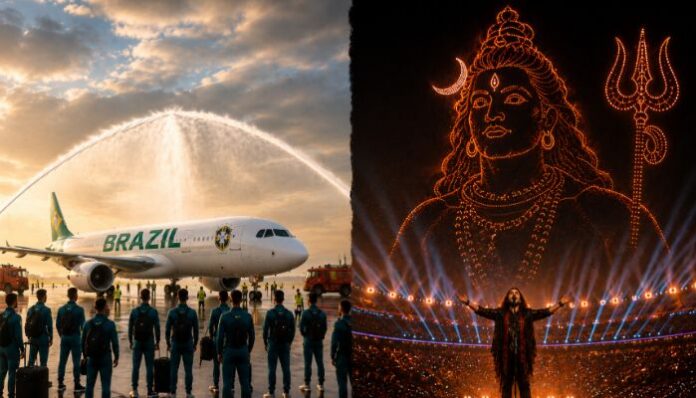
As Brazil’s national football team departed for the FIFA World Cup 2026 in the United States of America, a video is circulating online. The aircraft carrying the players received a ceremonial water salute. In simple words, the aircraft was baptised, invoking a Christian tradition to symbolically bless the quest for a sixth world title. Far from criticism, the ceremony was celebrated as an expression of Brazil’s culture, history and national identity. The images stood in stark contrast to the discussion that erupted in India just days prior.
During the IPL closing ceremony, Singer Kailash Kher performed a tribute to Lord Shiva, accompanied by pretty visuals and drone formations. While millions of Indians saw it as a celebration of India’s civilisational heritage, some leftist voices objected to what they viewed as the mixing of sports and religion.
The contrasting reactions raise a simple question. When Christian, Islamic, or other religious traditions appear alongside sporting events, they are often viewed as expressions of culture and identity, but why do similar debates emerge when the tradition being showcased is Hindu? Are all the religious symbols being judged by the same standard, or are Hindu expressions subjected to a different scrutiny?
From football stadiums to World Cups, faith is hardly absent from sport
The idea that sports exist completely separate from religion does not match reality. Athletes, teams and sports organisations often express their faith and cultural traditions during major events worldwide.
Footballers regularly make the sign of the cross before a match. Athletes are often seen praying after victories. During Ramadan, some matches have been briefly paused to allow Muslim players to break their fast. National teams also hold prayer services before important tournaments, and many athletes openly thank God after winning competitions. Let’s take the example of the Brazilian football team. The country’s football culture has long been linked to Christian traditions.
Players praying before matches and religious ceremonies connected to the major events. The recent “Baptism” of the Brazilian aircraft, before and after its arrival in the USA, is seen as a cultural tradition, not a mixing of sports with religion. According to the news website, it was mentioned as “ For millions of Brazilians, however, it meant something far deeper: a blessing for the dream of becoming world champions once again. This also shows that a tradition is taken in Brazil.
This does not mean sporting events should be used to promote religion. However, it shows that across the world, sports and cultural or religious identity often coexist. The real question is not whether religion appears in sport. The question is why some religious or cultural expressions are accepted as tradition, while others become controversial.
Why did a tribute to Lord Shiva at the IPL closing ceremony trigger controversy?
It became even sadder that we have to discuss these as a Hindu in a Hindu-majority country. The debate in India began after popular singer Kailash Kher performed a tribute to Lord Shiva during the IPL 2026 closing ceremony. It was accompanied by elaborate drone formations and visuals inspired by Hindu symbolism; the performance was widely appreciated by the spectators and viewers who saw it as a celebration of India’s cultural heritage.
However, not everyone viewed the performance in the same manner. The leftist gang argued that religion should be kept separate from sporting events and questioned the inclusion of overtly religious themes during a cricket tournament. Among them was journalist Lavanya Narayanan, who remarked, “Keep religion out of sport,” reigniting a familiar debate about the place of faith and culture in public events.
The controversy soon moved beyond the performance itself. The hypocrisy of Narayanan pointed out how the religious symbolism associated with Islamic faiths in sporting contexts often does not attract the same level of scrutiny. The discussion therefore shifted from Kailash Kher’s performance to a broader question: Is the principle of keeping religion out of sport applied uniformly, or only to Hinduism?
The reaction to the IPL ceremony once again exposed a divide among Indians over the relationship between culture, religion and public life. While one side regarded the Shiva tribute as a natural expression of India’s civilisational identity, the other saw it as an example of religion entering a space that should remain secular.
The Hindu exception: Why do Hindu symbols attract a different reaction?
The controversy is not limited to the IPL ceremony, but it tells a lot about the treatment of Hindu symbols and culture. Over the years, similar incidents have occurred whenever Hindu symbols, festivals, or religious expressions have gained visibility in public spaces. Whether it’s chanting “Jai Shree Ram”, the celebration of Hindu festivals in educational institutions, temple imagery at public events, or cultural performances rooted in Hindu traditions, objections are often raised in the name of secularism.
At the same time, when similar expressions are associated with other religious faiths, such as Islam and Christianity, they are viewed through a different lens. Islamic practices during Ramadan are often described as displays of faith and identity. Christian traditions in many Western countries are treated as part of the cultural heritage. Religious observances by athletes are generally celebrated as personal expressions of belief. This difference raises many questions about India’s secularism. If the objective is to keep all religious symbolism away from sporting events and public platforms, then the principle must apply equally to every faith.
However, if cultural and religious traditions are accepted as legitimate expressions of identity, then Hindu traditions cannot be treated as an exception. India’s civilisation, history and cultural landscape have been shaped predominantly by Hindu traditions. This does not mean that public institutions should favour one religion over another. However, it raises an important question: Should every public expression of Hindu culture be automatically viewed with suspicion, while similar expressions associated with other faiths be seen as harmless traditions?
The debate triggered by the IPL ceremony ultimately goes beyond a single song or performance. It reflects a larger disagreement over how secularism is understood in India. Is secularism meant to ensure equal treatment of all faiths, or has it increasingly come to mean greater scrutiny whenever Hindu symbols enter the public sphere?
Conclusion
The debate is not really about a Brazilian aircraft receiving a ceremonial “baptism” or a singer performing a tribute to Lord Shiva during the IPL closing ceremony. Both incidents point towards a larger question about how modern societies view the relationship between culture, faith and public life.
In Brazil, a tradition rooted in Christian symbolism was celebrated as an expression of national identity and footballing culture. Few questioned whether it amounted to mixing religion with sport. In India, however, a performance inspired by Hindu traditions quickly became the subject of a wider secularism debate.
Nobody is arguing that sporting events should become platforms for religious preaching. However, it is equally difficult to ignore the perception that Hindu cultural expressions often face greater scrutiny than similar expressions associated with other faiths.
As India continues to debate the meaning of secularism, perhaps the more important question is not whether religion and culture appear in public life- they do, across the world. The real question is whether the same standards are applied consistently to everyone.
If Christian symbolism can be viewed as culture in Brazil and Islamic observances can be viewed as identity in sporting events across the world, then it is worth asking why Hindu symbols so often become subjects of controversy in their own civilisational homeland.


