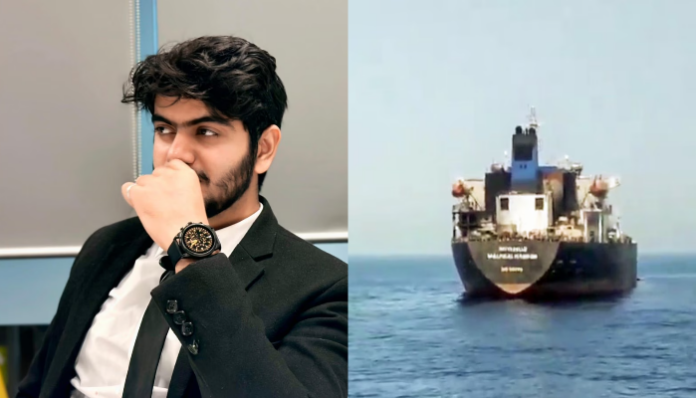
On 10th June (Wednesday), the three Indian sailors were killed in a US-raid on the Palau-flagged oil tanker MT (Motor Tanker) Settebello operated by IOS (Indian Ocean Ship) Marine based in the United Arab Emirates. They had been identified as deck cadet Aditya Sharma, engine fitter Shivanand Chaurasiya and chief engineer Patnala Suresh.
Rajesh Sharma who is the father of Aditya Sharma took to social media after the latter was initially reported missing and requested for help. He even shared a communication from the company informing him about the grim situation. However, it was later discovered that the trio had perished in the attack. Notably, he revealed that Aditya told them about how he was exploited by a senior crew member and wanted to quit the ship in April.
Furthermore, a complaint was also lodged, but the seniors pressured him to withdraw it, subsequently subjecting him to a harrowing environment and pushed him to work for 20 hours each day. “We have all conversations in records,” Rajesh Sharma mentioned. The family also raised concerns over the captain’s decision to navigate through a high-risk area despite receiving a warning and demanded accountability.
@MEAIndia
— Rajesh Sharma (@bobbylakhanpal) June 10, 2026
Vessel Settebello
IMO 9162916
I am father of one of the three crew missing. Aditya Sharma is my son.
Please help to locate and find him.
Below shipping company message to me.
My son has reported exploitation by senior at ship and want to quit this ship in April.
We…
IOS Marine refuted US accusations that prior messages, warnings or directives were ignored and asserted that no effective communication was set up with the vessel. Settebello was characterised as a civilian merchant ship involved in lawful economic activities, rejecting any suggestion that the ship had ties to Iran or was transporting Iranian oil.
The commercial ship was hit while passing through the Gulf of Oman. Minister of Ports, Shipping and Waterways Sarbananda Sonowal confirmed that the bodies were located and identified. He wrote, “This is a profound loss to our maritime family. The Modi government stands firmly with the bereaved during this difficult hour and is fully committed to supporting the next of kin.”
“I have directed officials to ensure immediate repatriation of the rescued crew members and swift return of the mortal remains of the deceased for their final rites,” he assured.
It is deeply unfortunate to learn of the tragic incident aboard the Palau-flagged MT Settebello. Sadly, three Indian seafarers initially reported missing are now confirmed dead after bodies have been located and identified.
— Sarbananda Sonowal (@sarbanandsonwal) June 11, 2026
This is a profound loss to our maritime family. The…
The ship reportedly had a crew of 28 individuals, comprising 24 Indians, 2 Pakistanis, a Russian and a Ukrainian. It was en route from Lianyungang port in China to Fujairah in the UAE and was purportedly struck for attempting to circumvent a US naval blockade of Iranian ports. The Omani armed forces managed to save the remaining Indian men.
India condemned the assault and released an official statement which read, “We reiterate our call for immediate de-escalation of tensions, and the conclusion of ongoing negotiations for a diplomatic solution so that peace and stability can return to the region. The targeting of commercial shipping and civilian infrastructure in the region must end, and free and unimpeded navigation and commerce through the international waterways in the region in keeping with international law must be restored at the earliest.”
Jason Meeks, American charge d’affaires in New Delhi, was summoned to Ministry of Foreign Affairs by additional secretary (Americas) Nagaraj Naidu to register “strong protest.” It was conveyed that attacks that endanger the lives of Indian seafarers are unacceptable.
A US State Department spokesperson asserted, “The department is in direct contact with the Government of India regarding this matter,” reported Hindustan Times.
3 attacks in 4 days
Tensions have increased as a result of three consecutive attacks by the United States on cargo vessels with Indian citizens close to the Strait of Hormuz over the last three days. However, they bear flags of other countries and are not under Indian ownership. Guinea-Bissau-flagged bitumen tanker MT Jalveer was hit in the latest occurrence on 11th June (Thursday).
Evacuation of crew from MT Jalveer to Shinas port is being coordinated with assistance from Royal Navy of Oman, and shall soon be completed.
— India in Oman (Embassy of India, Muscat) (@Indemb_Muscat) June 11, 2026
“Sir, please hear the coordinates. Shinas port control, this is a message from Jalveer that all crew are safe. We have a huge fire in the engine room,” a voice could be heard notifying the port authorities in an SOS call.
BREAKING | Alleged Attack on MT JALVEER Near Shinas OPL; Engine Room and Funnel on Fire!
— NewsTanksVoiceofSea (@NewsTanksind) June 11, 2026
Marine Tanks | Breaking News
An alleged attack on tanker MT JALVEER has been reported in the Shinas OPL area of Oman. According to initial reports, a fire has broken out in the vessel's… pic.twitter.com/xZT0EbBriN
“The ship was reportedly involved in a maritime security incident in the vicinity of Shinas port, Oman. It has 20 Indian seafarers on board, and all of them are reported to be safe. No casualties or injuries have been reported. As per the latest information, the evacuation of crew members to Shinas port has commenced. 6 more are to be evacuated,” highlighted Mukesh Mangal, Additional Secretary in Ministry of Ports, Shipping & Waterways.”
He added, “The Ministry is closely monitoring the situation and is in continuous coordination with the Ministry of External Affairs, Indian Missions abroad and the Indian Navy and other relevant stakeholders.”
#WATCH | On evacuation of crew from vessel MT Jalveer sailing off the coast of Oman, Additional Secretary, Ministry of Ports, Shipping & Waterways, Mukesh Mangal says, "The vessel has 20 Indian seafarers on board, and all of them are reported to be safe. No casualties or injuries… pic.twitter.com/8hpGecO5IQ
— ANI (@ANI) June 11, 2026
Earlier, on 8th June (Monday), MT Marivex, a sanctioned oil tanker was attacked by US forces. A “precision munition” was shot after the crew disregarded the orders, according to US Central Command (Centcom), which claimed that the ship had breached its blockade of Iranian ports. It was the 7th ship disabled by them over the same reason.
The crew started making distress calls after the ship’s engine failed and a fire erupted. The Omani military saved all 24 Indians onboard. Importantly, the US slapped sanctions on the vessel, formerly known as Arihant, for its ties to Iran. Arihant Shipping Inc., its proprietor has also been placed under sanctions by Washington which contended that the ship has been carrying “hundreds of thousands of barrels of Iranian fuel oil and bitumen within the Gulf since July 2025.”
According to ship-tracking data, MT Marivex last made a stop at the Iranian port of Bandar Abbas in early April, where it loaded cargo before sailing to Mangaluru and Karwar on the west coast of India. It was one of the few ships to depart the strait on 9th April amid ceasefire declaration. It remained in the “conflict zone” since then.
The MEA has responded to the assaults by outlining that India has forcefully condemned the attacks with the United States and underscored that the welfare and safety of its seafaring community is of “utmost importance.” The government reaffirmed that such instances have to stop.
“We further conveyed that dialogue and diplomacy are the way forward for the peaceful resolution of the conflict, and that there should be unimpeded access through the Strait of Hormuz in accordance with international law. Therefore, we made our position very clear on each of these points, while reiterating how important the lives, welfare, and safety of our people are,” stressed MEA spokesperson Randhir Jaiswal.
VIDEO | Delhi: Addressing a press conference, MEA spokesperson Randhir Jaiswal (@MEAIndia) said, “I had said that we attach high importance to the welfare and well-being of our seafaring community…When this particular attack on the ship MT Settebello occurred, we lodged a strong… pic.twitter.com/axDinSTmD4
— Press Trust of India (@PTI_News) June 11, 2026
“These attacks came from the US Navy stationed in the region, as reflected in various reports and as clarified through statements made from this podium. The three ships involved in these incidents were foreign-flagged vessels. Two of them were Palau-flagged, while the third ship, which came under attack today, was Guinea-flagged. They were not Indian-owned ships. All of them were foreign-flagged vessels,” the diplomat further pointed out.
US blockade and the reason behind the move
President Donald Trump aims to exert pressure on Iran by focusing on two economic factors: its oil earnings and the enormous charges it was asking ships to shell out to cross the strait which transports roughly 20% of the world’s oil and gas.
“Effective immediately, the United States Navy, the finest in the world, will begin the process of blockading any and all ships trying to enter, or leave, the Strait of Hormuz,” he announced in April, adding that other nations will also be involved and the Islamic Republic “will not be allowed to profit off this Illegal Act of extortion.”
“The blockade will be enforced impartially against vessels of all nations entering or departing Iranian ports and coastal areas, including all Iranian ports on the Arabian Gulf and Gulf of Oman. Centcom forces will not impede freedom of navigation for vessels transiting the Strait of Hormuz to and from non-Iranian ports,” pronounced US Central Command shortly afterwards.
— U.S. Central Command (@CENTCOM) April 12, 2026
Hence, Iran’s ports were blockaded which is defined as a “belligerent operation to prevent vessels and/or aircraft of all states, enemy and neutral, from entering or exiting specified ports, airfields, or coastal areas belonging to, occupied by, or under the control of an enemy state,” in US Navy Commander’s handbook on naval operations law from 2022, reported BBC.
Trump further warned that “we’re not going to let Iran make money on selling oil to people that they like and not people that they don’t like” and the intention was letting “all or nothing” move via the passage in a conversation with Fox News.
The proper locations of the deployed US Navy ships are unknown, and it is difficult to pinpoint the exact spots of these interceptions. Washington is unlikely to station its vessels close to Iran’s coast due to the threat of missile and drone offensives. Therefore, the blockade is likely to concentrate on the Gulf of Oman, which serves as a crucial transit route for a large portion of the world’s oil, including supplies from Iran.
Satellite and commercial data are likely being used by US forces to keep tabs on ships heading out of Iranian ports and wait for them to enter the open Indian Ocean before taking action. According to Centcom, there are over 100 fighter and observation planes involved, along with over 12 vessels.
The USS (United States Ship) Abraham Lincoln aircraft carrier is located about 200 kilometres (124 miles) south of the Iranian coast near the eastern edge of the Gulf of Oman, per satellite imagery from 11th April.
The decision went into effect in mid-April and 134 ships that complied with US instructions had been diverted thus far. 42 ships with humanitarian aid were permitted to pass through. However, the International Maritime Organisation, the maritime body of United Nations, has argued that no government has a legal right to halt vessels in international transit straits. Iran has termed the blockade as “piracy” and threatened to target ports of Gulf states in retaliation.
Indian lives in jeopardy
After China and the Philippines, India is the world’s third-largest source of skilled seafarers. Approximately 10% of all maritime workers worldwide are Indian seafarers. The number of onboard positions available for Indian sailors on both domestic and foreign ships has increased by 42.3% in the last five to seven years.
India fully complies with the STCW-95 Convention and Code, as evidenced by its inclusion on the International Maritime Organisation’s White List. Its inclusion on the list renders it more appealing to maritime companies. Experts predict that the proportion of Indian sailors in the global maritime industry will rise by 20% over the next ten years as a result of the existence of respectable maritime training facilities that produce competent employees, growing literacy rates, the ageing European seafarer population and the fluency in English.
The plentiful opportunities have, unfortunately, exposed them to attacks amid the ongoing hostile environment. The circumstances are equally challenging for Indians employed in the Middle East. After the Iranian attack on Kuwait International Airport, the total number of Indians killed in the region since the beginning of the dispute climbed to ten. A dhow near the Strait of Hormuz caught fire last month, killing one Indian sailor and injuring dozens of others.
The standoff claimed the lives of eight more Indian people and wounded multiple others in the region. Debris from a missile intercept in Abu Dhabi in March killed one Indian and hurt another. An Iranian attack on a power and water desalination plant in Kuwait took another Indian life in the same month. An Indian died in missile and drone assaults on Riyadh in March.
Early in the war, attacks on merchant vessels killed three sailors and two more Indians met the deadly fate due to a strike on an industrial facility in Oman on 13th March. Furthermore, one Indian national had been reported missing.
The government has repeatedly denounced the violence, emphasised the importance of ensuring safety of civilian lives, especially for Indians living in the impacted area and urged for a peaceful resolution of the confrontation. However, the situation is unstable and volatile with the threat persisting until a conclusive agreement is finalised by the warring nations.