
In an age where social media rewards outrage more than understanding, it takes only one individual looking for attention to manufacture a controversy out of thin air. Earlier this month, social media influencer Prasad Vedpathak did precisely that when he attempted to whip up outrage over a white pathway painted in a Mumbai housing society for the convenience of Jain monks.
What could have remained a simple conversation about a religious accommodation rooted in centuries-old traditions was transformed into a communal flashpoint after Vedpathak chose to describe the practice as “Jain Jihad”, a loaded and provocative phrase that immediately invited backlash from Jains and non-Jains alike.
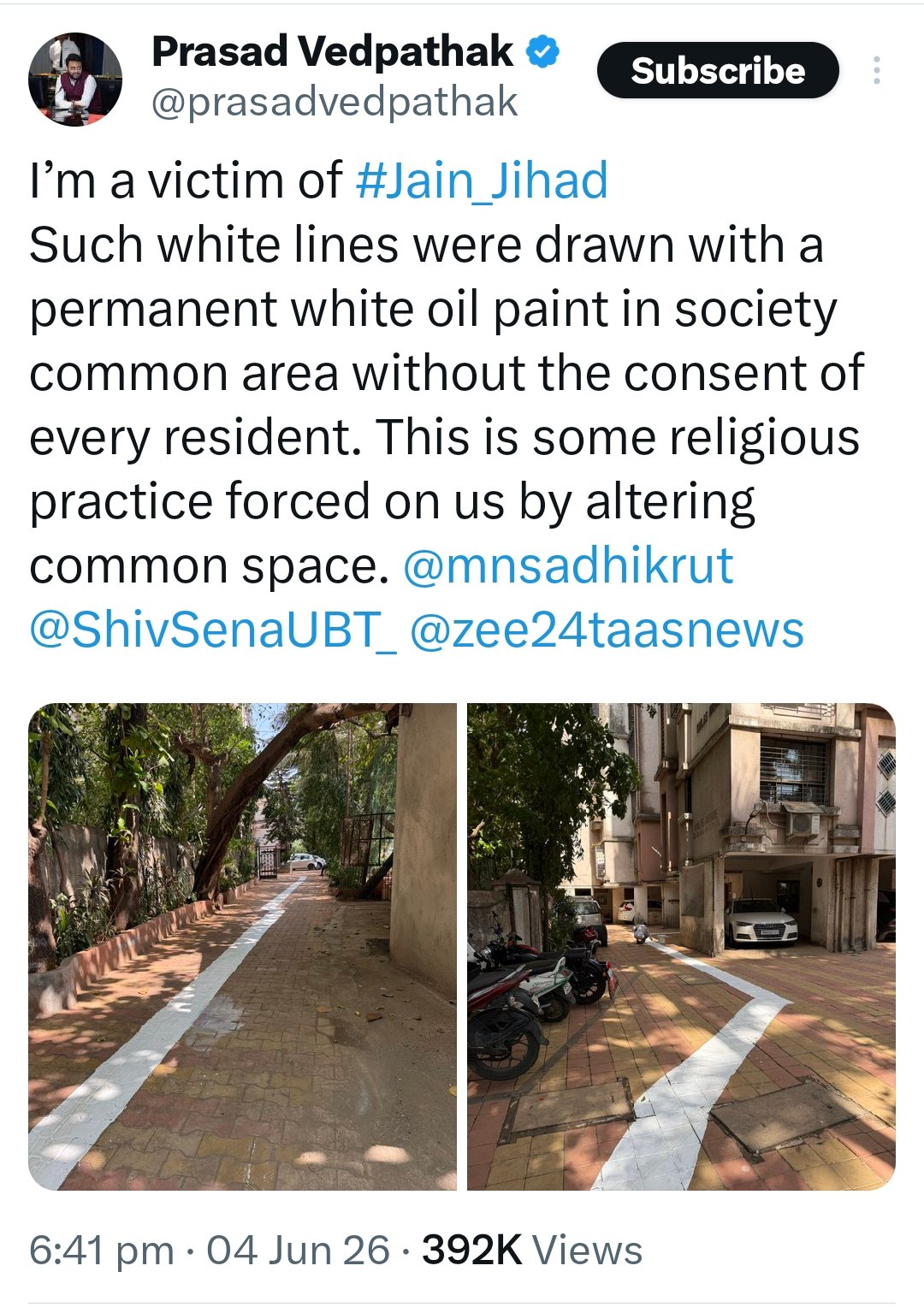
The controversy once again raised an important question: Who exactly is Prasad Vedpathak, and why is he attacking Jains over a practice that is rooted in compassion and humanity?
How a white pathway became “Jain Jihad”
The controversy began when Vedpathak posted videos from a housing society in Mumbai’s Ghatkopar area, objecting to white-coated pathways created to facilitate the movement of Jain monks.
For those unfamiliar with Jain traditions, Jain monks often travel barefoot and follow extremely strict principles of non-violence and asceticism. White coatings are sometimes applied temporarily on pathways during peak summer months to keep surfaces cooler and make walking easier for monks.
In the monsoon season, cement pathways often become covered with algae. According to Jain philosophy, algae are not inert growths but living entities that contain countless microscopic organisms. Since Jain monks dedicate their lives to the principle of ahimsa (non-violence) towards all living beings, they avoid walking on algae as doing so would inevitably harm or destroy the organisms residing within it.
This is also one of the reasons why sections of pathways are often coated with white paint or whitewash. Apart from helping keep the surface cooler for barefoot monks during summer, the coating also inhibits algae growth during the monsoon. The objective is not exclusivity, segregation, or territorial marking, as Vedpathak and others attempted to insinuate, but ensuring that Jain monks can travel safely and continue their religious practice of visiting households for gochari (seeking food) without unintentionally causing harm to living organisms.
In other words, what Vedpathak portrayed as some sinister assertion of religious dominance was, in reality, an expression of one of Jainism’s most fundamental principles: compassion towards even the smallest forms of life.
Rather than first attempting to understand the custom, Vedpathak labelled the practice “Jain Jihad”, an inflammatory term designed to provoke outrage and rally support against Jains from non-Muslims.
Responding to his claims, several social media users, including Jain community members, explained the purpose behind the practice. A social media user tried to explain the Jain tradition of having a white pathway in society. The video could be viewed below:
Yet, despite receiving explanations, Vedpathak persisted in portraying the issue as one involving “territorial assertion”, “religious politics”, and alleged encroachment by the Jain community.
He eventually got the pathway painted that appeared even more jarring. But by then, the objective appeared to have been achieved: claim a symbolic victory, portray himself as the aggrieved party, and keep the controversy alive for continued attention and engagement.
Playing victim after fanning the flames
As criticism mounted against his remarks, Vedpathak suddenly adopted a different tone.
In a lengthy social media post, he claimed that he had always admired Jainism for its compassion, humility and non-violence. He appealed to Jain followers to show empathy towards residents allegedly hurt by the white pathway.
However, the statement conspicuously avoided addressing the central issue: why did he choose to target Jains as ‘hegemons’ and label a harmless religious custom as “Jain Jihad” in the first place?
Even while claiming respect for Jainism, Vedpathak continued to insinuate that the pathway represented a form of religious assertion and repeatedly suggested that Jains were imposing themselves upon others.
The contradiction was hard to miss.
If the issue was merely about society’s consent, why invoke language specifically designed to provoke communal reactions?
Attempting to rally Hindus against Jains
Perhaps the most troubling aspect of the controversy was Vedpathak’s apparent effort to frame the issue as one involving “ordinary Maharashtrians” versus Jains.
Through videos, captions and repeated social media commentary, he attempted to portray Jains as a powerful community allegedly exercising disproportionate influence.
The messaging resonated with some habitual social media bigots who quickly amplified the narrative.
One such individual was controversial ‘activist’ Teesta Setalvad, who was arrested by the Gujarat ATS in 2022 in a case of forgery, influencing witnesses, and the investigation of the Gujarat riots in 2002 that occurred after 59 Hindus were burned to death in a train in Godhra.
Weighing on the white pathway row, Setalvad astonishingly suggested that Jains were becoming “new hegemons” and acting against Mumbaikars.
How #Jains ignore the majority, land owners, #Maharashtrians. Quite anti-Mumbaikar, anti-Harmony whatsay? The new hegemons? https://t.co/xz8srtBhoK
— Teesta Setalvad (@TeestaSetalvad) June 8, 2026
The irony was impossible to ignore.
Jains constitute barely 0.4 per cent of India’s population. Yet, according to the same ecosystem that routinely dismisses concerns about Islamism and Muslim supremacism as products of a majoritarian imagination, this tiny community has suddenly been cast as a threat to social harmony. When objections are raised to land encroachments, coercive conversion attempts, or cases involving religiously motivated targeting of Hindu women, activists such as Teesta Setalvad are often quick to portray Muslims as victims of majoritarian prejudice. But when it comes to Jains, the narrative is reversed: a small minority community is vilified for adhering to a centuries-old tradition rooted in ahimsa, compassion, and respect for all forms of life.
The entire episode, from Vedpathak’s unwarranted targeting of the white pathway to the subsequent attempts to portray Jains as oppressors, carried the unmistakable signs of a manufactured campaign aimed at driving a wedge between Jains and the broader Hindu society.
Vedpathak’s refusal to call out Islamic Jihad underpinning the Pahalgam terror attack
Vedpathak’s selective outrage becomes even more apparent when contrasted with his reaction to the April 2025 Pahalgam terror attack, in which Pakistani terrorists identified tourists by their religion before murdering them.
Rather than calling out the Islamist Jihadist ideology that underpins such acts of targeted violence, Vedpathak chose to sermonise about unity, cautioning people against discussing the Hindu identity of the victims and arguing that those doing so were merely advancing the terrorists’ agenda.
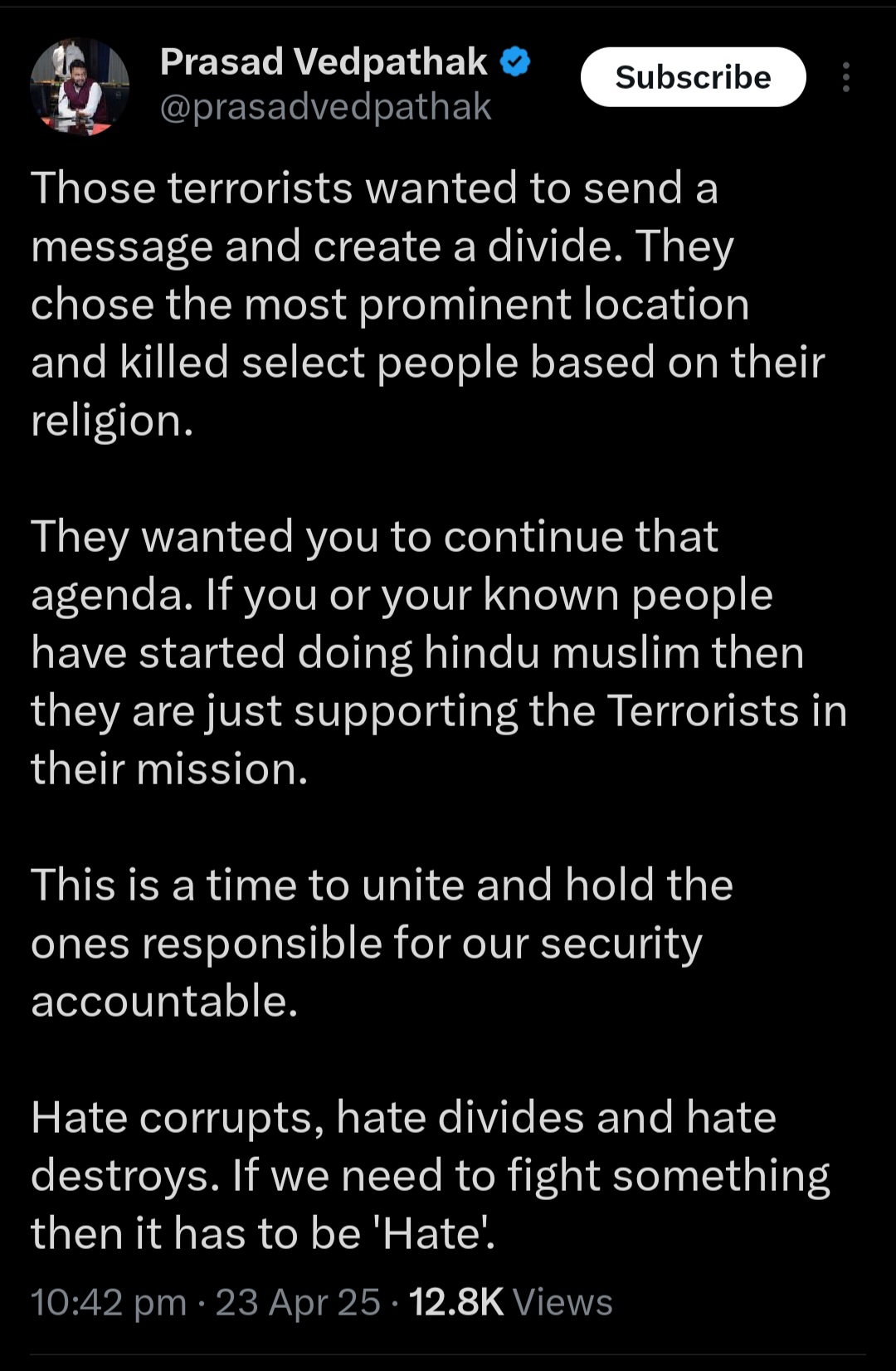
He urged citizens to “hold those responsible for our security accountable” and portrayed the attack primarily as a governance failure rather than an expression of religiously motivated hatred.
The contrast is striking. When terrorists singled out Indians for being Hindu, Vedpathak echoed familiar liberal platitudes about avoiding communal discourse and focusing on administrative accountability. But when confronted with a harmless Jain religious accommodation rooted in ahimsa, he had no hesitation in branding it “Jain Jihad” and portraying a tiny minority community as a social menace.
The inconsistency suggests that Vedpathak’s positions are guided less by principle than by whichever narrative is most likely to generate outrage and engagement at a given moment.
Not the first time Vedpathak has targeted Jain traditions
Interestingly, the white pathway controversy was not Vedpathak’s first confrontation with Jain customs.
In April 2025, he publicly complained after visiting the famous Ranakpur Jain Temple. Vedpathak expressed outrage that visitors were required to remove leather items such as belts and wallets before entering the temple.
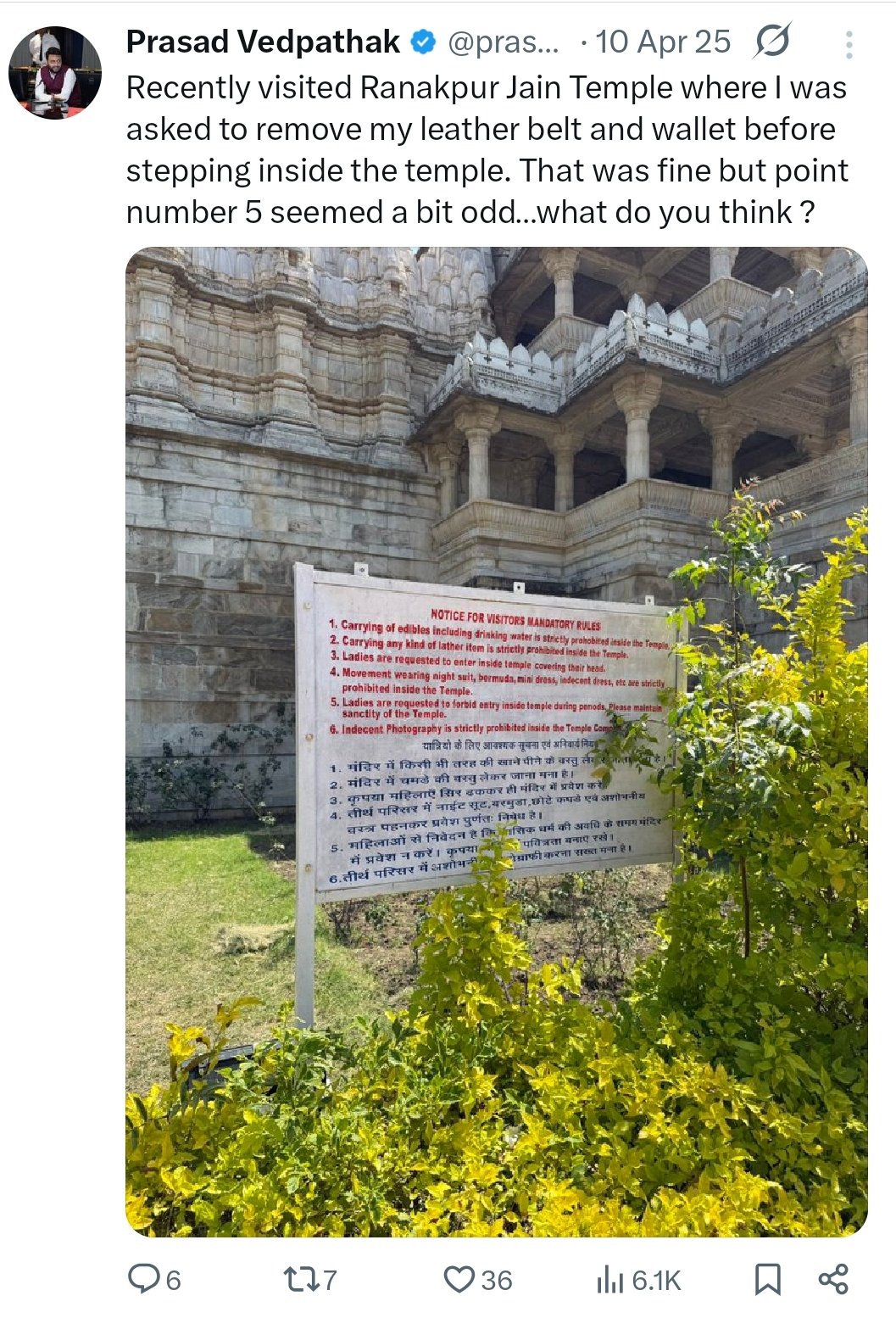
He was also unhappy with the temple’s rule regarding the entry of menstruating women. Yet neither of these practices is unusual within Jain religious traditions.
The prohibition on leather products stems directly from Jainism’s foundational principle of ahimsa, or non-violence towards living beings. Similar restrictions exist in numerous religious institutions across faiths.
Similarly, the Jain Agamas, the most authoritative scriptures in Jainism, prescribe that menstruating women should refrain from entering temple premises. This is not a practice unique to the Ranakpur temple; it is a long-standing religious norm observed across Jain temples worldwide. While the degree of enforcement may vary from place to place, the underlying principle is rooted in traditional Jain religious doctrine rather than any temple-specific rule.
Instead of understanding the theological basis behind these customs, Vedpathak once again chose public outrage.
One can reasonably infer that Vedpathak was attempting to manufacture a controversy by provoking self-described feminists into taking offence at the restriction. However, the effort failed to gain any meaningful traction at the time. In hindsight, though, the episode appears to fit into a broader pattern, suggesting that Vedpathak has been targeting Jain religious practices and traditions for quite some time.
The Hindu activist who dislikes idol worship
What makes Vedpathak’s self-branding particularly interesting is his frequent attempt to position himself as a defender of Hindu interests.
Yet his own social media history tells a rather different story.
In one widely circulated post, Vedpathak expressed anger after being gifted a Ganesh mural, declaring that he did not believe in idol worship.
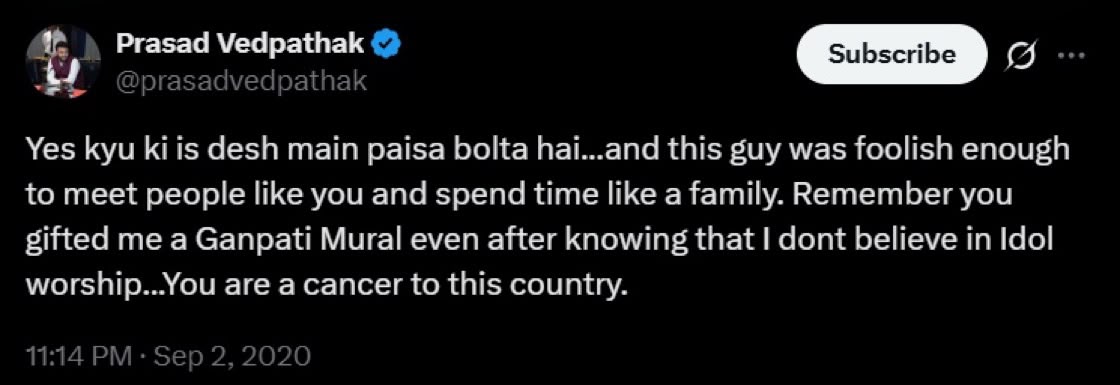
“Remember you gifted me a Ganpati mural even after knowing that I don’t believe in idol worship,” he wrote while attacking another user.
Idol worship is central to the religious practice of hundreds of millions of Hindus.
Yet the same individual who now claims that a white pathway hurt his family’s religious sentiments appears to have no hesitation in expressing disdain for practices cherished by large sections of Hindus.
Beef enthusiast a Hindu sentiment crusader?
Vedpathak’s social media history also contains posts in which he openly speaks about consuming beef, which is considered a taboo by an overwhelming section of the Hindu society.
In one post, he asked followers for suggestions regarding having a “Beef and Bacon Burger.”

While Vedpathak has attempted to present himself as a champion of Hindu sentiments, he has repeatedly displayed contempt for beliefs and practices regarded as sacred by many Hindus.
A Dhruv Rathee admirer
Vedpathak’s ideological influences are hardly a mystery. In April 2024, he shared an old interview with Germany-based pro-AAP propagandist Dhruv Rathee and described him as the future of Indian media.
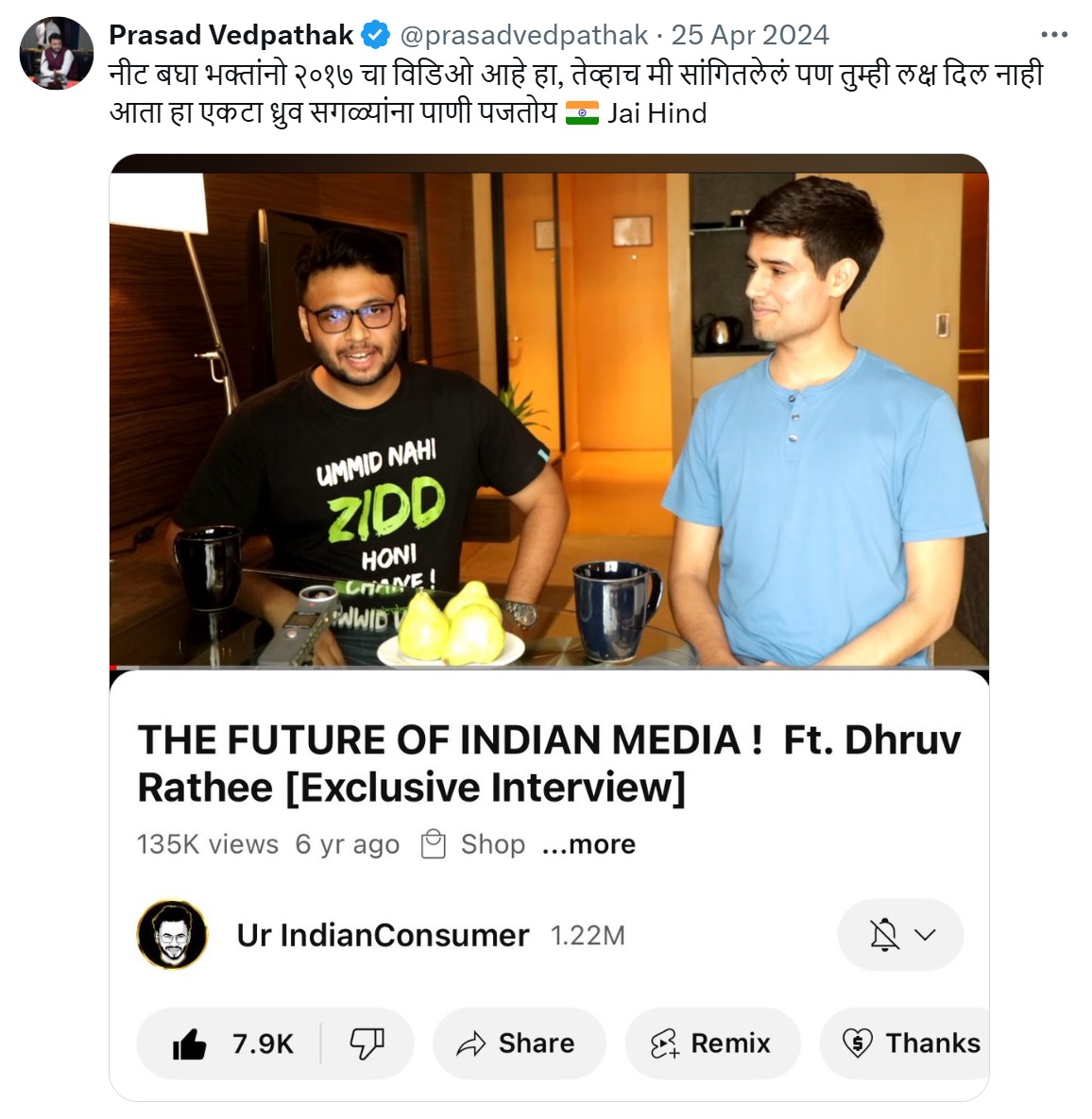
This is noteworthy because Rathee and the ecosystem surrounding him are notorious for promoting diabolical narratives that divide sections of Hindu society while presenting themselves as neutral commentators.
Vedpathak’s conduct during the Jain pathway controversy follows a remarkably similar pattern: identify a sensitive issue, frame it in the most provocative way possible, generate outrage, and then portray oneself as a victim once criticism mounts.
Outrage as a business model
Viewed in isolation, the white pathway controversy might appear trivial. Viewed alongside Vedpathak’s past conduct, a pattern emerges.
A harmless Jain tradition becomes “Jain Jihad”. Temple customs become evidence of discrimination. A gift featuring Lord Ganesha becomes a source of anger.
Religious sentiments become selectively invoked depending on what generates engagement.
The common thread is not principle. It is attention.
As outrage increasingly becomes a monetisable commodity on social media, influencers often find themselves incentivised to manufacture controversy where none exists. The more divisive the claim, the greater the engagement.
The Jain pathway episode appears to fit squarely within that template.
Rather than seeking understanding, Vedpathak chose provocation. Rather than learning about a centuries-old tradition rooted in compassion and non-violence, he attempted to portray it as a communal threat. And when the backlash arrived, he attempted to recast himself as the aggrieved party.
From attacking idol worship to flaunting beef consumption while simultaneously projecting himself as a defender of Hindu sentiment, Prasad Vedpathak’s public record suggests not a principled activist but a habitual rage-baiter willing to manufacture controversy for clicks, followers and relevance.
The white pathway may have disappeared from the society. The attempt to create suspicion and resentment against an entire community, however, revealed far more about Vedpathak than it ever did about the Jains.