

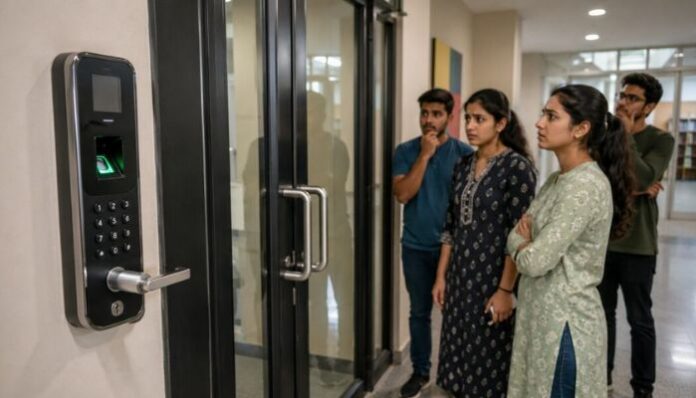
Several tragic incidents reported across the country in recent years have highlighted a major safety issue linked to biometric and smart locks. From the basement flooding in Old Rajinder Nagar, Delhi, to the hotel fire in Malviya Nagar and the library fire in Lucknow, these incidents had one common factor. During the emergencies, power failures caused biometric and smart-lock doors to stop working, trapping people inside. As a result, many people were unable to escape in time and lost their lives.
According to the experts, the problem is linked to the way some smart doors are designed. At present, biometric doors mainly work on two systems: “fail secure” and “fail safe.” Among these, the fail-safe system can become dangerous during emergencies. In this system, the door remains locked whether electricity is available or not.
Such doors need power to open. Under normal conditions, when a person scans their fingerprint or face, an electrical signal activates a mechanism inside the lock, which pulls back a spring and unlocks the door. However, if the power supply is cut, the system stops working, and the door remains locked.
Fail-safe locks work differently. In this system, a magnet keeps the door locked. When a fingerprint or other biometric key is used, the power to the magnet is switched off, and the door opens. Because of this design, fail-safe doors automatically unlock when there is a power outage, allowing people to exit safely during an emergency.
Experts believe that one reason fail-safe technology is not widely used in India is the fear of theft. Many people worry that if doors automatically unlock during a power cut, their homes or businesses could become vulnerable to break-ins. As a result, protecting property is often given more importance than emergency safety.
Safety guidelines clearly state that fail-secure doors should only be installed in places where highly valuable assets need protection and not in areas where large numbers of people regularly enter and exit. The rules also require every such door to have a mechanical override or manual unlocking system so that it can be opened during emergencies,s even if there is no electricity.
However, safety experts say these guidelines are often ignored. The incidents in Delhi and Lucknow have once again raised concerns about the use of smart locks without proper emergency systems. These tragedies have also sparked questions about whether enough attention is being given to human safety when installing such security systems.


