


Before moving on to the High Court’s observations on the point of law, let’s take a look at the brief facts of the case.
Brief background of the case
The case concerns a Muslim couple who married on December 20, 2024. At the time of the marriage, the wife was 16 years and 3 months old, and the husband was about 28 years of age. In May 2026, when the wife was about 8 months pregnant, she visited a government hospital. The hospital authorities noticed that she was a minor and informed the police.
The police verified the minor wife’s age from her school certificate and proceeded to register an FIR against her husband under Section 64(1) of the Bharatiya Nyaya Sanhita (BNS) and Section 6 of the Prevention of Children from Sexual Offences Act (POCSO). The wife said that the marriage was performed with her consent and was also consummated with her consent.
In her statement before the Special Judge, she maintained that she was under no compulsion to marry her husband or have sexual intercourse with him. The wife subsequently gave birth to a stillborn child on June 6, 2026. The child was buried but later exhumed with the permission of the Sub-Divisional Magistrate for DNA profiling and collection of evidence.
The present petition sought the quashing of the FIR filed against the husband, and action against police officers, concerning allegations of false implication and harassment. The petition has relied on Muslim personal law to claim immunity for the husband from penal action for having sexual intercourse with his minor wife.
What the Muslim husband told the High Court
Citing Muslim personal law, the Muslim husband argued that his wife had attained puberty before their Nikah, as required under the personal law. As per Muslim personal law, puberty is presumed if the wife has completed 15 years of age at the time of Nikah. The petitioner argued that it was a valid marriage under Muslim personal law and therefore, subsequent cohabitation or sexual intercourse is also valid and cannot attract criminal liability.
Legal question before the High Court
The task before the High Court was to decide on the point of convergence of Muslim personal law and the criminal law meant to protect minors against sexual abuse. The High Court divided the legal issues in the case into two parts: first, the legal character and consequences of a Nikah performed with a Muslim minor girl who has attained puberty; and second, whether a Nikah excludes sexual intercourse with a minor wife from the ambit of the BNS and the POCSO Act. The court refused to decide the question relating to the validity of the Nikah and limited the scope of its examination to the second issue.
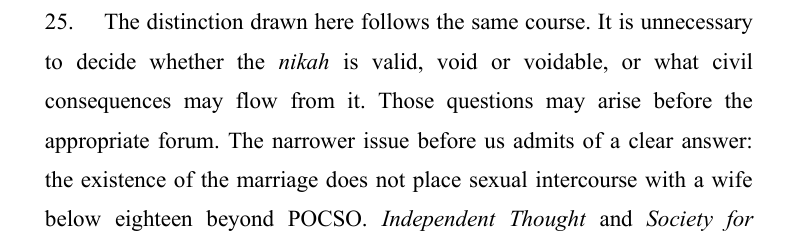
The question, precisely, before the High Court was “whether consent and the asserted validity of the marriage can displace that protective framework where the law itself fixes eighteen as the age below which consent to sexual activity has no legal efficacy”. In other words, the High Court examined whether a Nikah, even if valid, can grant a Muslim husband, who had sexual intercourse with his minor wife, immunity from the legal provisions that treat sexual intercourse with minors as an offence.
Observations of the High Court
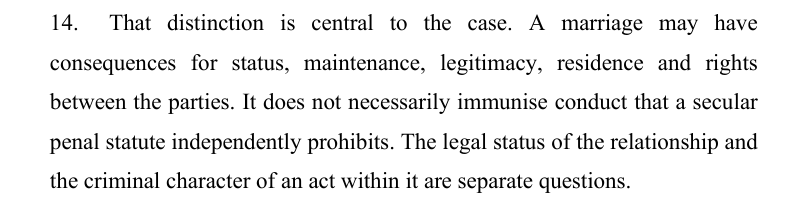
The High Court drew the distinction between the legal status of a relationship and the criminal character of an act committed within the relationship. The court said that a valid marriage cannot grant immunity from criminal liability.
A valid marriage does not immunise conduct criminalised under a secular statute
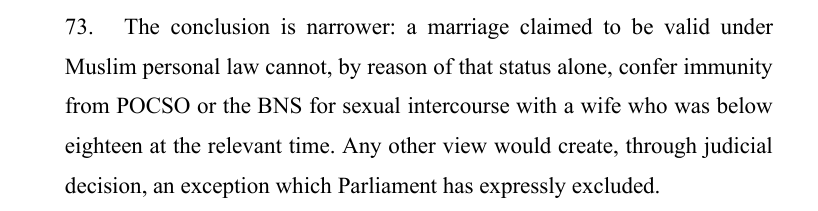
“…a marriage claimed to be valid under Muslim personal law cannot, by reason of that status alone, confer immunity from POCSO or the BNS for sexual intercourse with a wife who was below eighteen at the relevant time. Any other view would create, through judicial decision, an exception which Parliament has expressly excluded,” the High Court observed. The court said that a valid marriage “does not necessarily immunise conduct that a secular penal statute independently prohibits”.
“There is therefore no textual basis for treating a marriage recognised under personal law as reviving an immunity which the present penal law expressly withholds,” the court stated.

Personal law is not an exception to criminal laws
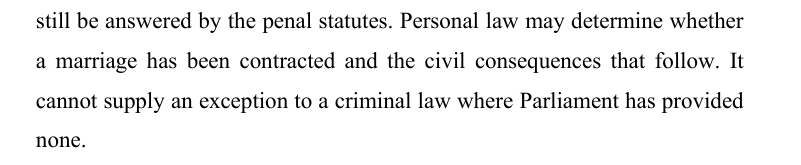
On the role of personal law, the court said that it is relevant for determining the status and consequences of a marriage, but it cannot act as an exception to a criminal law. “Personal law may determine whether a marriage has been contracted and the civil consequences that follow. It cannot supply an exception to a criminal law where Parliament has provided none,” the court said.
Consent of a minor victim irrelevant under criminal law
The court examined the legal scheme under the BNS and the POCSO Act and noted that both laws penalised sexual intercourse with a woman under 18 years of age. The BNS penalises sexual intercourse with a woman under 18 years of age, and the POCSO Act makes sexual intercourse with a child, male or female, under 18 years of age punishable. None of the laws take the consent of the victim into account for deciding the commission of the offence. Additionally, Section 42-A of the POCSO Act gives it an overriding effect over any other law.
The High Court pointed out that both the BNS and the POCSO Act fix the age of 18 years as the threshold for sexual consent. Under the laws, consent is irrelevant if the victim is under 18 years of age. Besides, Section 63 of the BNS criminalises sexual intercourse by a husband with his wife, who is under 18 years.
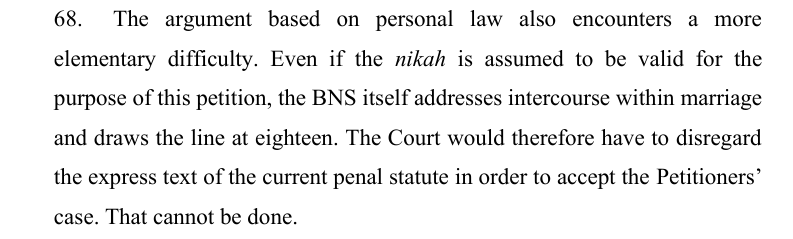
Applying the law to the present case, the High Court held that a minor wife’s consent for sexual intercourse does not grant any protection to the husband from penal liability. The court clearly stated that a marriage cannot advance a child’s age. “A person who is sixteen before the ceremony remains sixteen afterwards. For POCSO and Section 63 BNS, that fact is determinative of the legal capacity to consent to the sexual act,” the court said.
The High Court noted that the petitioners did not seek quashing, claiming absence of the ingredients of the offences alleged. It said that the grounds relied on by the petitioners, including personal laws and consent of the wife, do not take the sexual act committed by the Muslim husband out of the purview of the secular statutes.
The High Court observed that a consideration of factors like a valid marriage, existence of consent of minor or the nature of individual relationship would defeat the purpose of the legislation, which aims to protect minor irrespective of the circumstances surrounding an offence.
Based on a reading of the facts and the examination of relevant legal provisions, the High Court dismissed the petition and refused to quash the FIR filed against the husband. The court also declined the request of the petitioners to initiate disciplinary proceedings against the concerned policemen.


