

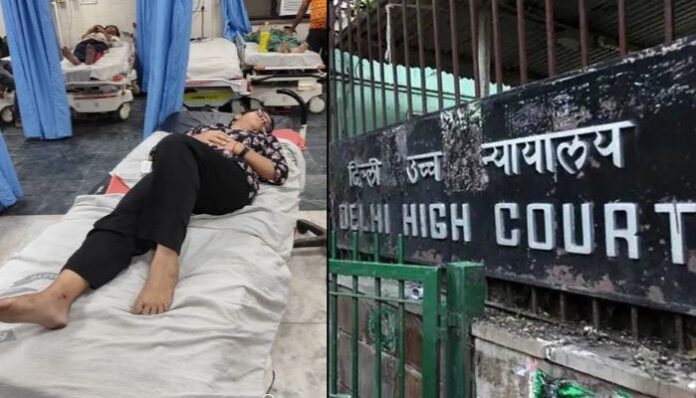
On Thursday (16th July), the Delhi High Court granted bail to one Abid Ali and Furkan, who were involved in attacking journalists during their coverage of an anti-encroachment drive in Seemapuri last year.
For the unversed, reporter Supriya Pathak and her cameraman, Shyam, were brutally attacked by a mob of Islamic extremists on 4th July 2025. The incident occurred when the duo were reporting on illegal encroachments and slum settlements built on government land near a mosque in Bengali Market, Delhi. The area fell under the jurisdiction of the Seemapuri police station.
According to the victims, a mob of burqa-clad women and underage boys not only beat them up mercilessly, but also looted their equipment, cash and personal belongings. While speaking to OpIndia, the victims said that they were assaulted separately. They were chased by a Muslim mob, which resorted to pelting stones and whipping belts.
दिल्ली सीमापुरी इलाके की बंगाली बस्ती में All India News की रिपोर्टर सुप्रीया पाठक कैमरामैन श्याम के साथ अवैध झुग्गी वाले मुद्दे पर कवरेज के लिए गईं थीं। सड़क के बीच बनी मस्जिद के पास कैमरा देखते ही जिहादियों की भीड़ ने दोनों पर हमला बोल दिया। भीड़ ने लिंचिग करने की कोशिश की।… pic.twitter.com/kDmqR5HWec
— Keshav Malan (@Keshavmalan93) July 5, 2025
The matter came up for hearing before a Single-Judge Bench of Justice Girish Kathpalia. During the hearing, the accused Abid Ali claimed that he never entered the bus, where the two journalists took refuge to escape the brutal assault by the marauding mob. In his defence, he alleged that his mother prevented him from boarding the bus.
Interestingly, the counsel of Abid Ali tried to de-legitimise the assault on the journalists by claiming that the victims were not from a ‘formal media house’ but ‘only freelancing for a YouTube channel.’ On the other hand, the accused Furkan has claimed that he was not present in the area at the time of the attack. His counsel had suggested that the victims suffered only ‘minor abrasions.’
The Delhi High Court noted that 4 other accused in the case have already been granted bail. Only Furkan and Abid Ali have been behind bars since 5th July 2025.
With the Investigating Officer/SI Virender Kumar absent from the court proceedings and certain ‘discrepancies’ existing in the chargesheet (colour of shirt worn by Furkan), Justice Girish Kathpalia granted bail to him and Abid Ali with a paltry bond of ₹10,000. The court ruled, “The accused/applicants cannot be kept in jail endlessly.“
During the court proceedings, the Assistant Public Prosecutor (APP) had submitted that Abid Ali and Furkan do not deserve bail as they had assaulted press reporters when they were trying to flee from the mob.
Justice Girish Kathpalia decided to double down on determining who qualifies to be a ‘journalist’ in a case about assault on 2 reporters by a violent mob.
“Despite sensitivity of the issue, the complainant apparently opted not to take the local police into confidence before starting their venture, though that cannot at all justify attack on them by the agitated locals. But the larger issue, as raised by prosecution side, being that the assault on the complainant was assault on freedom of press, I have deliberated upon this aspect,” he noted.
The Delhi High Court Judge then proceeded to dedicate 3 pages of his judgment to mouth platitudes on the state of Indian media. Justice Girish Kathpalia stated,
“…A significant section of the media has become largely unregulated and unorganized. Today, virtually anyone armed with a mobile phone and a microphone can proclaim themselves to be a “reporter”…”
He then went on to question ‘self-styled reporters’ who supposedly thrust microphones at citizens and, in the absence of an answer, declare that the ‘individual is evading questions’. Justice Girish Kathpalia claimed that it leads to the creation of ‘misleading public narrative’ and ‘unwarranted public pressure’.
The Delhi High Court further stated, “Equally disturbing is the tendency of some media actors to target or malign a particular social group through selective reporting, sensationalism or unverified allegations.” He claimed that such reporting could deepen social divisions, trigger communal disharmony and public disorder.
It is important to remember that the case under discussion concerns illegal encroachment in Seemapur, which was reported by Supriya Pathak and her cameraman, Shyam. Besides being assaulted for engaging in citizen journalism, these victims are now being virtue-signalled about ‘journalistic ethics’ by the same court that granted bail to the accused involved in violence against them.
The patronising, preachy attitude could have been reserved for another judgment. This reeks of borderline victim-blaming. To make matters worse, the court chose this case to suggest the creation of a regulatory framework for journalists.
“The time has come for the legislature to consider an appropriate regulatory framework that preserves freedom of press, while ensuring professional accountability, ethical standards, and respect for the rule of law, the rights of citizens and the larger public interest,” Justice Girish Kathpalia stated.
All accused in the case are now out on bail, the victims got assaulted, and now, a year later, their journalistic credentials are being downgraded as mere ‘freelancers working for a YouTube channel.’
A leaf from the Nupur Sharma case
This is not the first time that the Judiciary has resorted to targeting the victim instead of putting the onus of violence on the actual perpetrators.
In July 2022, the Supreme Court (SC) came down hard on former BJP spokesperson Nupur Sharma, saying that she was responsible for the brutal Udaipur killings with her comments on Prophet Muhammad and said she should “apologise to the whole country”.
A bench headed by Justices Surya Kant and J.B Pardiwala observed, “The way she has ignited emotions across the country. This lady is single-handedly responsible for what is happening in the country.”
By blaming Nupur Sharma, the apex court of the country had conveniently ignored the hatred and violence unleashed by Islamists and has instead targeted the woman who had stated merely what is written in Islamic hadiths, and affirmed by Islamic scholars all over the world.
At that time, the Supreme Court of the so-called secular, democratic country, which is supposed to be the conscience of the nation, had shockingly chosen to behave like a Church figure in a medieval witch trial. The recent Delhi High Court judgment is no different from this matter.


